Tag Archives: b-movies

Slipstream (1989)

Slipstream (1989)

slipstream894

Next up are a handful of reviews that I’ve been putting off for some time now. For those who have frequented the blog for a while (and also have sharp memories), you might recall that 3 different movies, all called “Slipstream,” have popped up frequently in my bargain bin movie hunting. Now I am finally going to watch all three of them, and see how they actually stack up. First up is 1989’s “Slipstream,” starring Mark Hamill and Bill Paxton.

“Slipstream” was directed by one Steven Lisberger, who is best known for writing and directing the original “TRON” in 1982.  He doesn’t have a whole lot of credits to his name, but apparently he worked anonymously on screenplays throughout the 1990s and 2000s, primarily because the failure of “Slipstream” tanked his potential career as a director.

The “Slipstream” screenplay was written by Tony Kayden, a television writer who did a few made-for-TV movies as well as a handful of episodes of shows like “The Waltons” and “Little House on the Prairie.” If that doesn’t sound like the ideal fit for a science fiction epic, you are probably right to think that.

The cinematography for “Slipstream” was provided by Frank Tidy, whose credits have included such masterpieces as Sylvester Stallone’s “Stop! Or My Mom Will Shoot!” and Steven Seagal’s “Under Seige.” However, he also worked as the director of photography on Ridley Scott’s first feature, 1977’s “The Duellists.”

The score for “Slipstream” (which is fantastic) was composed and conducted by Elmer Bernstein, and recorded by the London Symphonic Orchestra. Bernstein was a film composer and conductor who racked up hundreds of movie credits beginning in the 1950s, all the way up until his death in 2004. His credits include fantastic films (“Bringing Out The Dead,” “My Left Foot,” “Ghostbusters”), cult classics (“Heavy Metal”), and some of the worst regarded movies in cinema history (“Leonard Part 6,” “Robot Monster”).

slipstream891The special effects team for “Slipstream” involved a significant team of workers who were carried over by producer Gary Kurtz from an earlier collaboration on “The Empire Strikes Back,” including Andrew Kelly (“28 Days Later,” “Sunshine,” “Dune”), Phil Knowles (“Alien,” “Space Truckers”), Roger Nichols (“Batman Begins,” “Who Framed Roger Rabbit”), John Packenham (“Krull”), Alan Poole (“Empire of the Sun,” “The NeverEnding Story”), Peter Skehan (“Gladiator,” “Indiana Jones and The Last Crusade”), Ron Hone (“World War Z,” “Prometheus,” “League of Extraordinary Gentlemen”), and Neil Swan (“Alien,” “The Princess Bride”). Joining them were a couple of other special effects guys who have likewise gone on to significant careers: Steve Cullane (“Captain America: The First Avenger,” “Skyfall,” “Gravity,” “Hudson Hawk”) and Andrew Eio (“Mission: Impossible,” “Behind Enemy Lines,” “Event Horizon,” “Hackers”).

One of the most impressive aspects of “Slipstream” is the surprisingly deep cast, headlined by Mark Hamill and Bill Paxton, who both turn in memorable performances. The list also includes Ben Kingsley, Robbie Coltrane, F. Murray Abraham, and Bob Peck (in what might be his best role), who mostly mostly serve to fill out small roles throughout the film.

slipstream892One of the co-leads, Kitty Aldridge, has not had any acting credits since 1998, but has published a handful of novels throughout the 2000s since her acting career has ceased.

With such an impressively assembled, successful effects team and cast, you might be curious as to how “Slipstream” flew so far under the radar. Of course, there’s a reason for that. “Slipstream” only released in the UK and Australia (briefly), and the poor reception meant that it never got theatrical distribution in North America. It did wind up with a VHS release, and has since popped up on a ton of DVD compilations since falling into the public domain (which is how I came across it, of course).

The massive failure of “Slipstream” blew back particularly hard on Gary Kurtz, one of the film’s producers and arguably the driving force behind the film. Despite his earlier successes on influential and well-regarded films like “The Dark Crystal,” “American Graffiti,” and the first two “Star Wars” features, this failure basically sunk his career. He has only recently picked up producing again on a regular basis in the 2000s, and is still active at the age of 74.

The story of “Slipstream” follows a mysterious android (Bob Peck) as he is and pursued by both law enforcement (Mark Hamill) and a bounty hunter (Bill Paxton) in a weather-ravaged, post-apocalyptic world. The only means of travel in this world is by air on small, low-altitude planes, due to the catastrophic weather effects that ravage the landscape.

“Slipstream” was filmed throughout Europe, particularly in Turkey and Ireland, giving it a thoroughly impressive backdrop. Particularly, the extensive aerial shots over Ireland are absolutely gorgeous.

Reportedly, the original script for “Slipstream” was far more violent, but was cut significantly before filming. These cuts have been blamed partially for the movie’s general incoherence, though I personally feel that additional length is the last thing that this movie needed.

slipstream897As mentioned previously, “Slipstream” was very poorly regarded in the brief release it received at the time, primarily due to the meandering plot. Rotten Tomatoes currently has it at a 20% rating from both audiences and critics, though it comes from a fairly small sample size. IMDb has the movie at a somewhat higher 4.9, though that is still a long way from positive.

Most of the criticisms I have seen of “Slipstream” cite that it has very slow pacing, and that the plot meanders a bit too much. Some have complained about the effects being low quality, but that’s to be expected from a generally low-budget movie, regardless of the team behind it. Interestingly, it seems that the movie has been better received in retrospect, with people being somewhat fascinated by the casting and surprisingly good performances all around. I certainly agree that the movie is both longer and slower than it should be, but it does have a fair number of redeeming values.

First off, the performances in “Slipstream” are generally pretty good. Hamill manages to portray a chilling, strictly lawful antagonist, which provides a great foil for Bill Paxton’s laid-back, comic outlaw lead. Bob Peck mostly steals the show, however, with a great performance that captures the complexities of an advanced artificial being. His character slowly becomes more relate-able and human as the story goes on, which is pretty intriguing to watch Peck convey.

Unfortunately, the movie suffers from the extended absence of Mark Hamill’s character, who vanishes for an excruciating stretch of the middle of the film. I’m curious as to why this was done, because it doesn’t seem like a script improvisation, but rather an intentional design of the story. It does allow for some development, but his absence also makes the film far less interesting to watch for a decent stretch of time.

Of all of the problems with the film, none are quite as glaring as the pacing. This is at least partially to blame on the previously mentioned script cuts before filming, but a certain degree of blame has to rest with the director and editor for not recognizing the issue and finding a way to mend it. This seems like the perfect sort of film to have a director’s cut, but, because the major cuts were made before filming, there isn’t any spare footage to make such a re-cut possible.

Though it is hard to regard this as a true flaw, there are a whole lot of borrowed elements throughout “Slipstream,” that stand out significantly. There are some obvious similarities to “Star Wars” given the number of common contributors, but some of the more obvious parallels are to “3:10 to Yuma” (the plot) and “North by Northwest,” specifically in the opening sequence which depicts a plane/foot chase. Personally, I think the mixture of them all creates something kind of unique and interesting to watch, though I don’t think some of the homages should have been so blatantly done.

slipstream895The finale of the movie features a bizarre fight inside the cockpit of a plane, which is honestly the most exciting part of the film. Unfortunately, it passes a bit too quickly, particularly in comparison to the bloated, slow sequences that clog up most of the film.

M8DSLIP EC004I’m a big fan of the world that is constructed in “Slipstream,” particularly the background details. At one point, there is a cult portrayed that worships the weather, and another portion that presents a secluded, opulent colony trying to maintain their lifestyle and culture despite the apocalyptic surroundings. It mostly happens in the background, but it is fascinating to see how people have come to deal with the world after society has crumbled.

Overall, I liked this film far better than I expected to. It isn’t a high-quality film, and there are plenty of issues with it, but it was still generally enjoyable to watch, especially if you go in not expecting anything. The acting and music is particularly impressive, and if you can bear through the slower parts, it is worth a watch in my opinion.
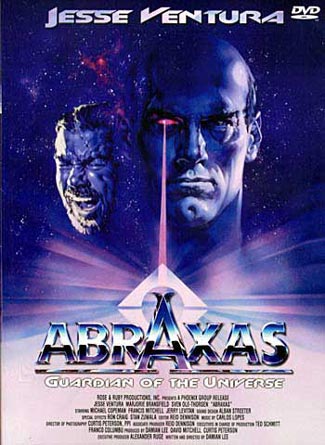
Abraxas, Guardian of the Universe

Abraxas, Guardian of the Universe

abraxas6

Today on the Misan[trope]y Movie Blog, we’re going to take a look at the 1990 Jesse Ventura sci-fi movie, “Abraxas, Guardian of the Universe.”

The writer and director of “Abraxas” is one Damian Lee, a B-movie writer, director, and producer who is still working today. His most recent flicks include a handful of smaller films: “A Fighting Man” (2014), “Hit it” (2013), and “A Dark Truth” (2012).

The cinematography on “Abraxas” is credited to three different people, which brings up some questions about the production. The first listed is Curtis Petersen, a veteran camera operator and b-movie cinematographer, who has well over 100 credits to his name (including “Rocky III,” “Rocky IV,” and “Look Who’s Talking”). Also credited are Mark Willis, a now-prolific camera operator working on television series such as “Hannibal,” “Copper,” and “Reign,” and Keith Thomson, another camera operator for whom “Abraxas” was one of his first ever credits. Given that there isn’t much information available about the film’s behind the scenes operations, it is anyone’s guess as to why all three men are credited, but I suspect that there was probably a dismissal at some point.

abraxas3

“Abraxas” features a handful of cheesy and cheap special effects, but they tend to work pretty well for the purposes of the movie. The special effects team doesn’t have a whole lot of credits between them, but I did notice that they all worked on the 1995 Roddy Piper movie “Jungleground,” which apparently features a lot of the same accessory crew as “Abraxas.” I’ve had that movie sitting in my collection for a good while now, so stay tuned for some coverage of that flick in the near future.

The music on “Abraxas” is really odd, featuring a significant number of strangely placed saxophone solos. The composer of the score was Carlos Lopes, who worked on the 1980s revival of “The Twilight Zone,” as well as a handful of smaller features over the years.

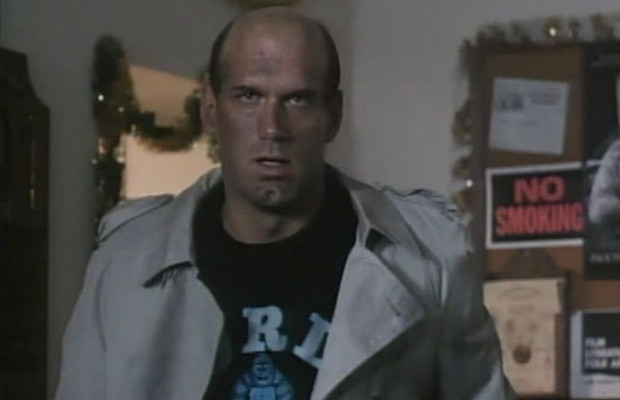
Apart from Jesse “The Body” Ventura, the wrestler turned actor turned politician, the cast of “Abraxas” notably features Sven Ole-Thorsen as his rival. Thorsen is fantastic ‘heavy’ character actor who has appeared in films like “The Running Man” (also with Ventura), “Twins,” “Gladiator,” and “Red Heat,” among many, many others. Both men are famously good friends with Arnold Schwarzenegger, whose film “Terminator” was a clear inspiration for “Abraxas.”

The rest of the cast on “Abraxas” is primarily filled out with unknowns, with the exception of the then-married couple of James Belushi and Marjorie Bransfield. “Abraxas” proved to be Bransfield’s only significant film acting role, as she hasn’t any credits since the mid-1990s. Belushi, bizarrely, is credited as “Principal Latimer,” the same name of his character in the 1987 movie “The Principal.” Whether his bit role was meant to be the same character is up for debate, but it certainly makes for an interesting little fun fact.

The story of “Abraxas” follows the title character (Ventura), a space cop, as he tracks down his former partner, the ruthless Secundus (Thorsen), who is fostering plans for domination of the universe. The pursuit lands both men on Earth, where Secundus impregnates a woman with a “comater,” which will apparently hold the key to the “anti-life equation” once it reaches maturity. Abraxas is faced with the decision of whether to kill a child, or run the risk of having Secundus’s plans come to fruition.

abraxas4
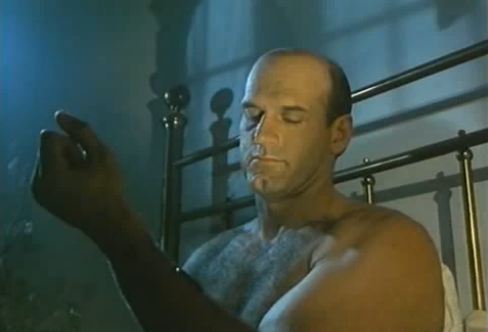
Apparently, this is space sex

As far as criticisms of “Abraxas” go, the attempts at comedy in the film merit a bit of shaming. All of the attempted jokes fall flat, and don’t fit in with the rest of the movie at all. I’m not sure what exactly inspired the attempted inclusion of comic relief in the movie, but I think it would have been better off either leaving it out entirely or committing more fully, and perhaps getting a comedy writer to do a pass on the script. When you just go half-way, you run the risk of having awkward, stilted moments in the middle of a serious movie.

Something that “Abraxas” engages in that is a minor pet peeve of mine is confusion over idioms. Almost any time a robot, alien, or person out of time is featured in a movie, it seems to be mandated for the script to attempt at least one joke about how the outsider doesn’t understand linguistic peculiarities. This isn’t inherently awful, but it has certainly been done to death. Also, particularly with aliens and humans displaced in time, there is no reason for them to not be familiar with the concept of idioms. For example, if I am speaking in another language with someone, and they mention a phrase that doesn’t seem to make much sense, one of the first things I will assume is that it is an idiom that I am not familiar with. People don’t naturally react to unfamiliar idioms by getting exasperated, it just doesn’t happen. And why not have the aliens use their own idioms, poorly translated into English? That’s at least a mildly better way to deal with the issue.

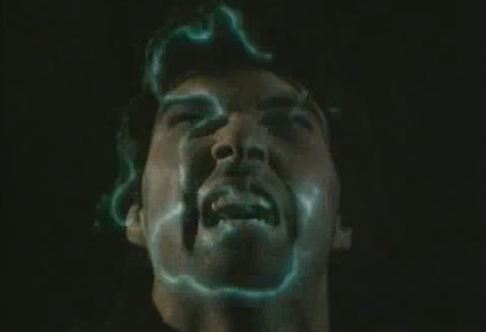
“Abraxas,” in true b-movie fashion, features a number of great, cheesy effects. In particular, there are a couple of solid head explosions scattered throughout the film, as Secundus’s favorite method of execution seems to be overloading people’s brains to the point of exploding. There are also some classic animated lightning / electricity effects that are sure to incite some nostalgia for b-movie fans.

abraxas5

Surprisingly, the central child actor  (the “comater”) is actually pretty solid in this film, which may have a direct correlation to the fact that he has almost no lines. Personally, I would be in favor of this being standard procedure for child actors. In all seriousness, the child is really effectively expressive without using his voice, and actually builds up a little bit of an air of menace by the conclusion of the film, as his powers become more honed.

Something that becomes evident very early on in “Arbraxas” is that the film features far too much internal voice-over, kind of like the awful cut of “Blade Runner” taken to a distant extreme. The monologues aren’t even limited to Jesse Ventura’s lead character: at times, both the villain (Secundus) and the love interest (Sonia) offer brief internal thoughts and narration, which is both lazy storytelling and a really confusing way to shift the audience’s POV.

abraxas2

Something that I have seen take a bit of criticism about “Abraxas” is the set and production design. While it is visibly cheap without any doubt, I actually thought that the work was pretty impressive, and made a little go a long way. It even sort of made sense in the story for the aliens to be comparatively only somewhat more technologically advanced, so they still use keyboards and simple computers. The intelligent armbands are a little bit of a leap, but how different could they possibly be from Siri?

If there is anything that I really dislike about “Abraxas,” it is the romantic subplot. Jesse Ventura just doesn’t seem up for the challenge of an emotional role, and he seems awkward and uncomfortable whenever that is what is required of his character. I thought that the story would actually have been more interesting if his mercy had come from a developing compassion for life in general rather than because of a specific attraction for one woman. It seems that would have made him a better foil for Secundus, and kept things from getting too bogged down emotionally.

abraxas1

Overall, “Abraxas” is definitely a fun good-bad movie worth giving a shot. It quite in an elite class of good-bad, but the film is entertaining enough to hold your attention, while also being plenty awful on a number of levels.

Hercules in New York

Hercules in New York

hercules6

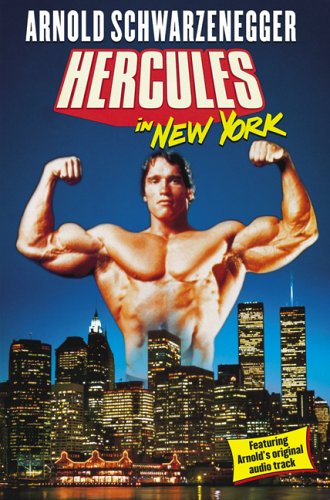
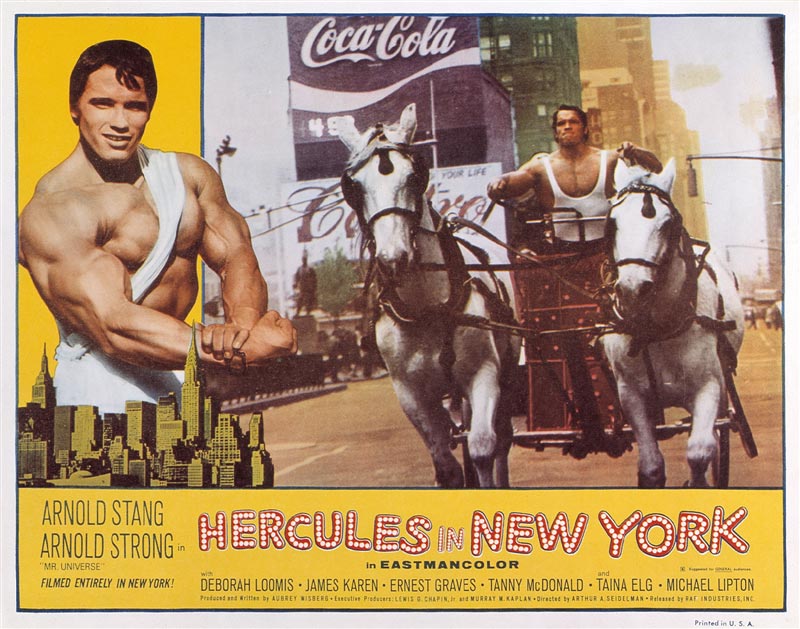
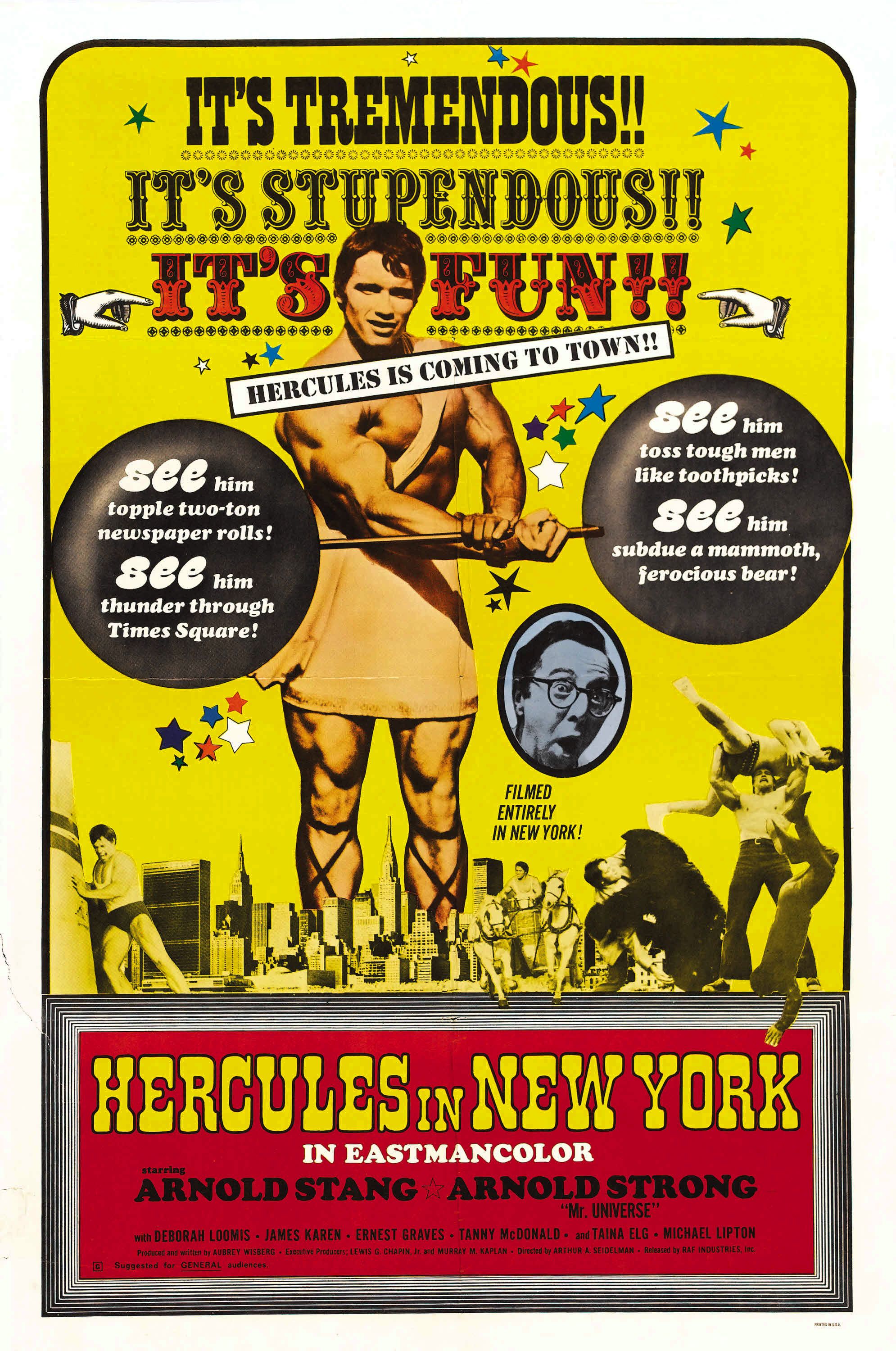
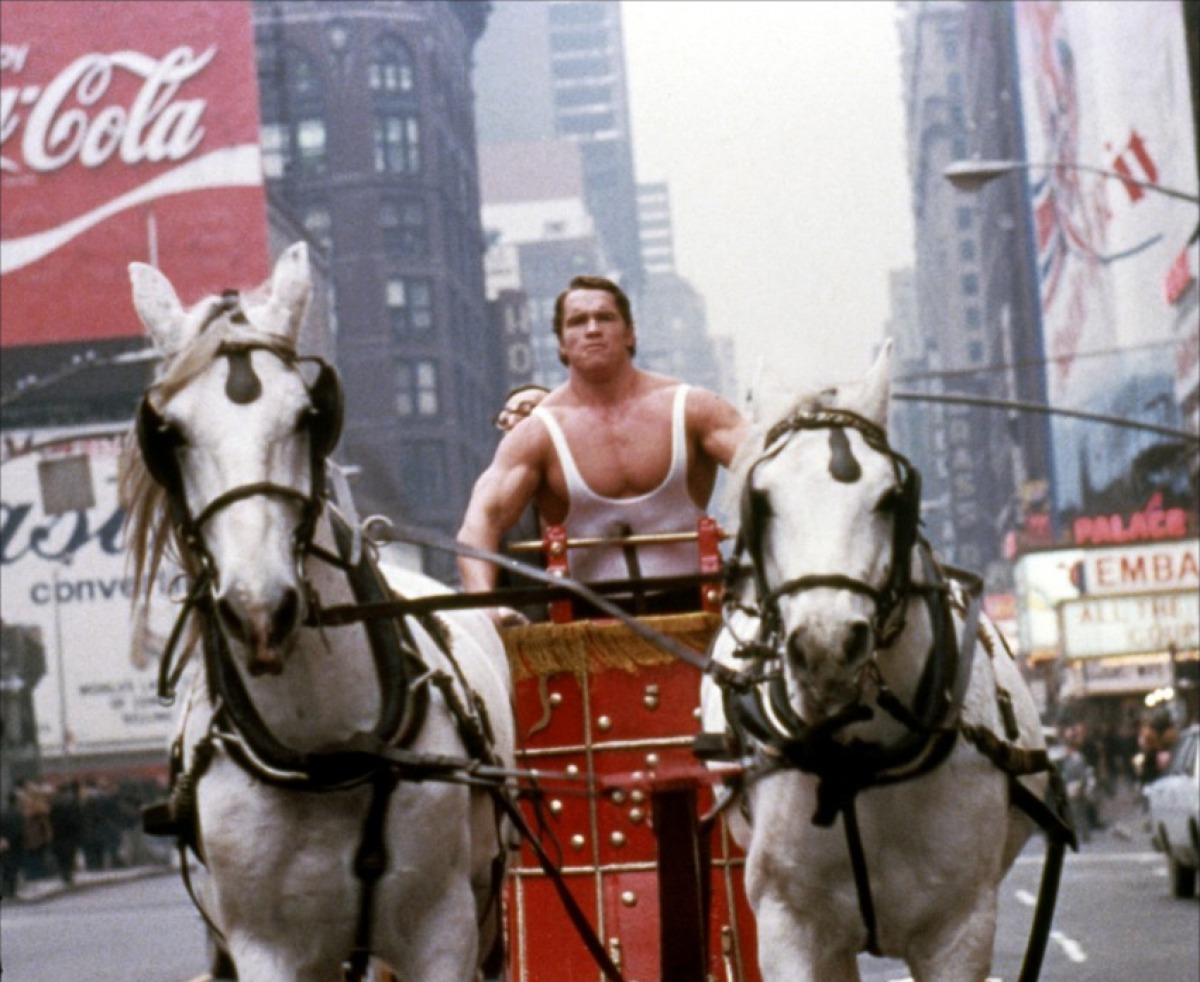
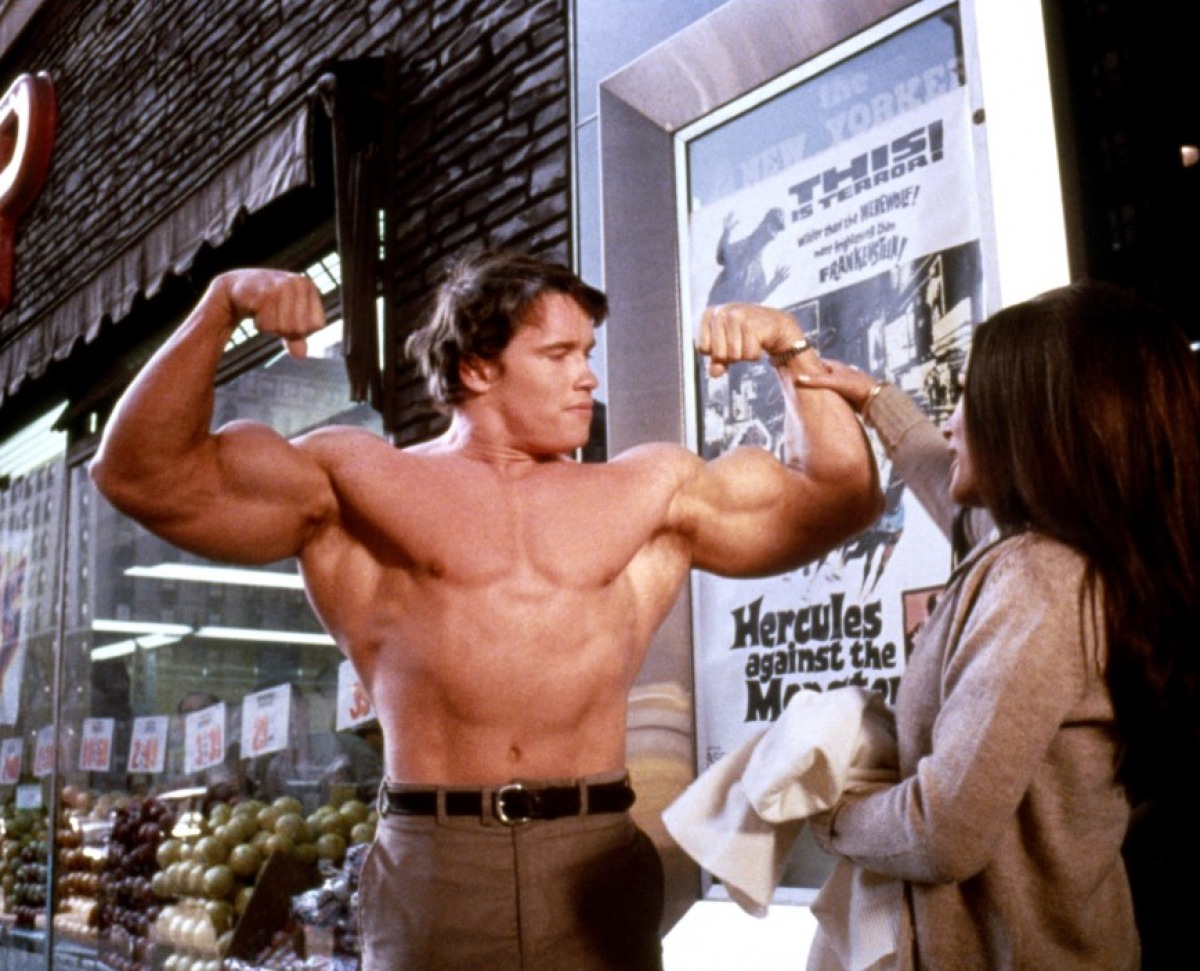
Today’s feature is a low-budget 1969 comedy by the name of “Hercules in New York”: a film most famous for featuring the first on-screen role for Arnold Schwarzenegger.

“Hercules in New York” was the last film written by Aubrey Wisberg, whose career featured included 1950s and 1960s science fiction films, as well as a handful or propaganda productions during World War II. Unsurprisingly, this film definitely seems misplaced in time. Even for 1969, the story and comedic style feels significantly dated. For contrast, “Hercules in New York” also saw the first directing job for Arthur Allan Seidelman, who has now had a significant career directing television movies and series. The mix of a wet-behind-the-ears director and an outdated, behind-the-times writer proved to be a bit of a perfect storm of awfulness for “Hercules in New York.”

hercules3Adding to the mix of inexperience and incompetence on the “Hercules in New York” crew was a cinematographer with no previous credits, and a musical composer with no listed credits before or since the movie. It honestly feels like the entire crew was pulled out of a hat, which I’m sure was done in an effort to keep the costs far below the radar.

The story of “Hercules in New York” follows the angsty demigod as he decides to explore the modern world, to the intense displeasure of his father, Zeus. He quickly becomes unwittingly involved in mafioso-run sports gambling in New York City, and manages to make headlines for his feats of strength. Enraged with his meddling, Zeus decides to punish Hercules, which leads to further shenanigans in the mortal world.

Worried about Arnold Schwarzenegger’s unwieldy last name, the producers on “Hercules in New York” decided to credit him as “Arnold Strong, ‘Mr. Universe.'” The name “Arnold Strong” was chosen as a sort of gag, playing off of his co-star’s name “Arnold Stang.” Mr. Universe was used, of course, because that was the title that Arnold was most known for at the time, as he won the famous bodybuilding competition at the age of 20 (just 2 years prior to “Hercules in New York”). His next film role wouldn’t be for another 4 years, when he essentially played an extra in the fantastic Robert Altman movie, “The Long Goodbye.”

hercules4One of the most infamous and memorable aspects of “Hercules in New York is the dubbing that was done early versions of the feature. Because of Arnold’s thick accent, it was decided that his lines should be dubbed over, which makes for entertaining watching in retrospect. Even in the versions with Arnold’s audio track re-inserted, you can hear the dubbed voice during a closing sequence where Hercules speaks through a radio to Arnold Stang’s character. It is honestly a toss-up as to which audio track is more entertaining: Arnold’s natural voice with the worst acting performance of his career, or the bizarre voice-over that doesn’t fit Arnold’s body in the slightest.

Some years ago, the rights for “Hercules in New York” were auctioned off on e-bay, accruing bids for just over half a million dollars by the auction’s end. Given poor reception and general infamy of the flick, it is possible that the winner significantly overpaid for the product. The movie currently holds a well-deserved 17% critic score on Rotten Tomatoes, along with a 29% audience score.

The character of Hercules has a long cinematic tradition: he has featured in big budget flicks, animated movies, cheap Italian films, and epic television series. Apart from Arnold Schwarzenegger, the character has been portrayed over the years by notables such as Dwayne “The Rock” Johnson, Lou Ferrigno, Kevin Sorbo, Ryan Gosling, Sergio Ciani, and Kirk Morris, among many, many others.

I haven’t been able to find budget information for “Hercules in New York,” but you have to assume that this was an incredibly cheap production just judging from the film quality. It is hard to say if it made any money, just because there isn’t exactly a wealth of information out there about it. The rights to the film have changed hands a few times over the years, and it is currently distributed by Trimark. However, I doubt that it makes any significant money on home video sales.

hercules2Strangely, I actually think that there is some promise in the concept for “Hercules in New York.” The Greek gods are constantly meddling in the mortal world in mythology, so why not have a fish out of water tale where a god comes down to do it again in the modern world? Of course, this film does just about everything wrong, but I think that this could have been a serviceable enough film in more capable hands at every level. Essentially, this is not a film that was damned from conception.

The biggest issue for “Hercules in New York” is its use of outdated (even for 1969) humor. The jokes are all incredibly weak and infantile, and a lot of the humor seems like it is supposed to come from Arnold Stang’s character, whose comic relief style was suited better for the comedy world prior to the JFK assassination. All of the comic portrayals in the film are overly-expressive, frenetic, and basically cartoonish: a style that can go wrong all too easily, and certainly does so here.

One other serious problem with “Hercules in New York” is that the hero, Hercules, is an absolute asshat throughout the movie. A few characters acknowledge this fact, but inexplicably forgive him and begin to like him for reasons that are never made clear on screen (which is a whole different issue with the writing in the film). The audience is clearly supposed to sympathize with the demigod, but I couldn’t help but identify with the put-out and exasperated Zeus, who has clearly had it with Hercules’s constant shit.

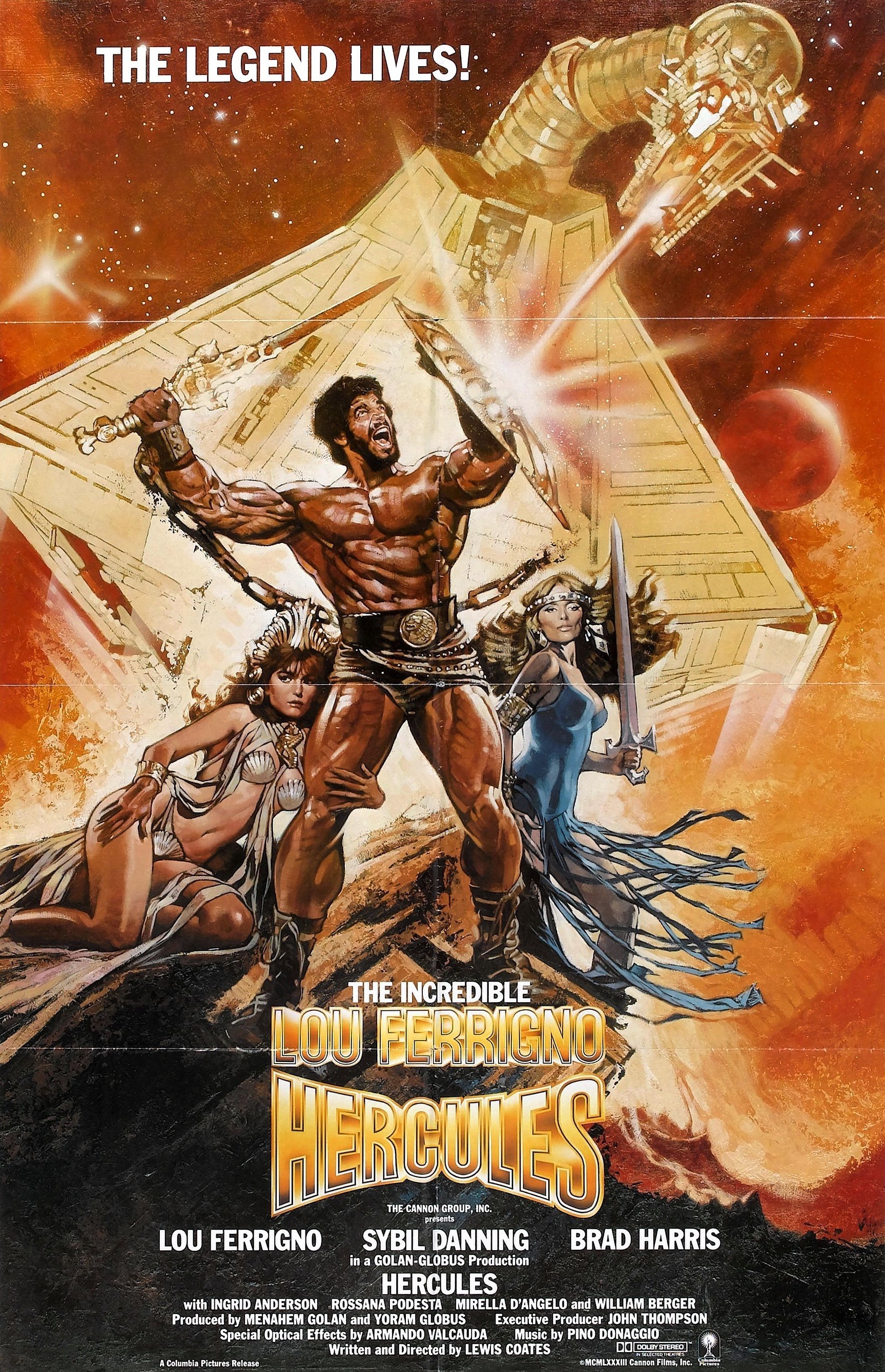
I would be remiss to not mention the amazingly awful Central Park bear fight in this film. The sequence almost rivals the bear fight from the Lou Ferrigno’s “Hercules” film, though I shockingly think that that one (a scene where a bear is thrown into space, mind you) is more believable that Arnold’s bear wrestling in this flick. Take a look for yourself:

At one point in the film, Mercury decides to intervene in the plot to help Hercules out of a bind. He does this by bafflingly summoning Samson and Atlas out of absolutely nowhere, exactly where they need to be to help Hercules. This might have been an interesting side plot (Mercury defying Zeus to help Hercules) if it had been developed earlier, but as it exists in the film, it feels like an improvised element used to patch a plot hole. It comes completely unprecedented and out of left field, and winds up being just another example of the mass ineptitude behind this movie.

All of the acting is this movie is honestly beyond awful. From the leads to the accessory players to the extras: not one person turns in a decent performance. At that point, you have to assume that the problem is not with the actors, but with the direction and the script: because honestly, what are the odds that you cast an entire production’s worth of duds? This isn’t “The Producers” as far as I know.

“Hercules in New York” is clearly trying to be a fish out of water comedy, but a good deal of it doesn’t make sense. Hercules should be treated as a man out of his own time, not like a creature from another planet. Is the audience supposed to believe that the Greek gods do not understand tact or basic social graces? Sure they live remotely, but they do have a sort of society on Olympus. There is the potential for this movie to be entertaining, but the writing never quite takes it in the right direction (at least not for long).

hercules1Overall, I think “Hercules in New York” sits right on the boundary between being an entertainingly awful movie and a dull, nearly-unwatchable one. If you ask me, it does land on the right side of that line, but only barely.  I can recommend this for bad movie lovers for the sake of a few select highlights, and because of just how awful Arnold is in this early role. However, it is a pretty weak recommendation: there are definitely more worthwhile bad movies to spend your time on.

YouTube Round-Up

Howdy there, loyal readers! This weekend wound up being a real doozy, so I don’t have a new review ready for today. Never fear though, because there is some good stuff coming up later this week, particularly as I start delving into my accumulated archive of bargain bin acquisitions.

In the meantime, I decided to round up a lovely bunch of full movies that are currently available, totally free, on the wide world of the internet. Enjoy!

—-

Willard

willard

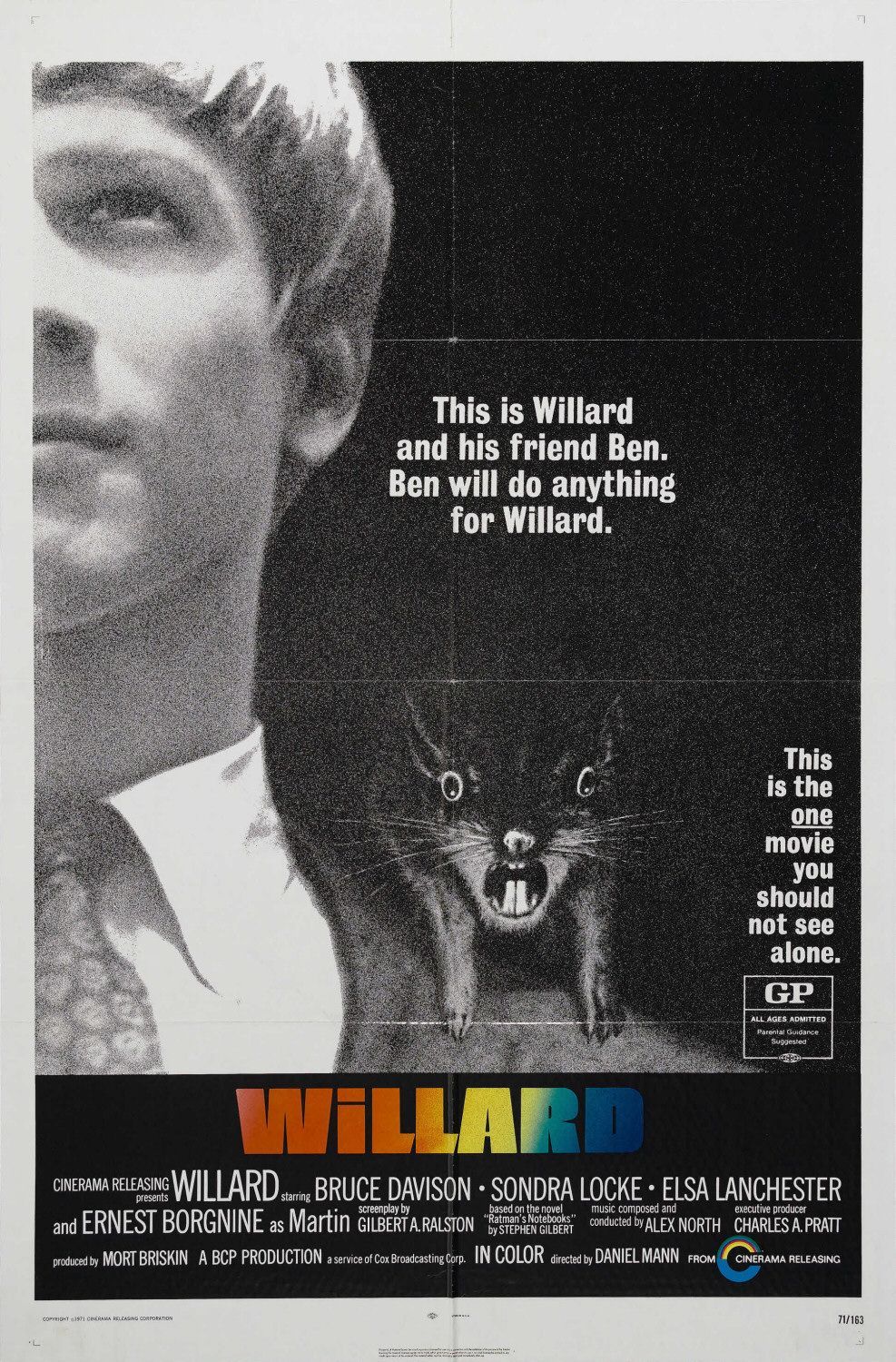
I have had the damnedest time finding a physical copy of this 1971 classic, but luckily it has been hanging around on YouTube unimpeded for a while (though it is obviously a VHS rip). I particularly like “Willard” because of the way it blends a revenge story with a monster movie. The hybridization worked splendidly, and has been mimicked many times since. You also can’t help but identify with Willard, even as he starts going over the edge with his rat-fueled rampage. It is definitely worth a watch, particularly as it seems to be fading from the public consciousness. Here’s hoping it gets a blu-ray treatment at some point.

—-

Martin
martin

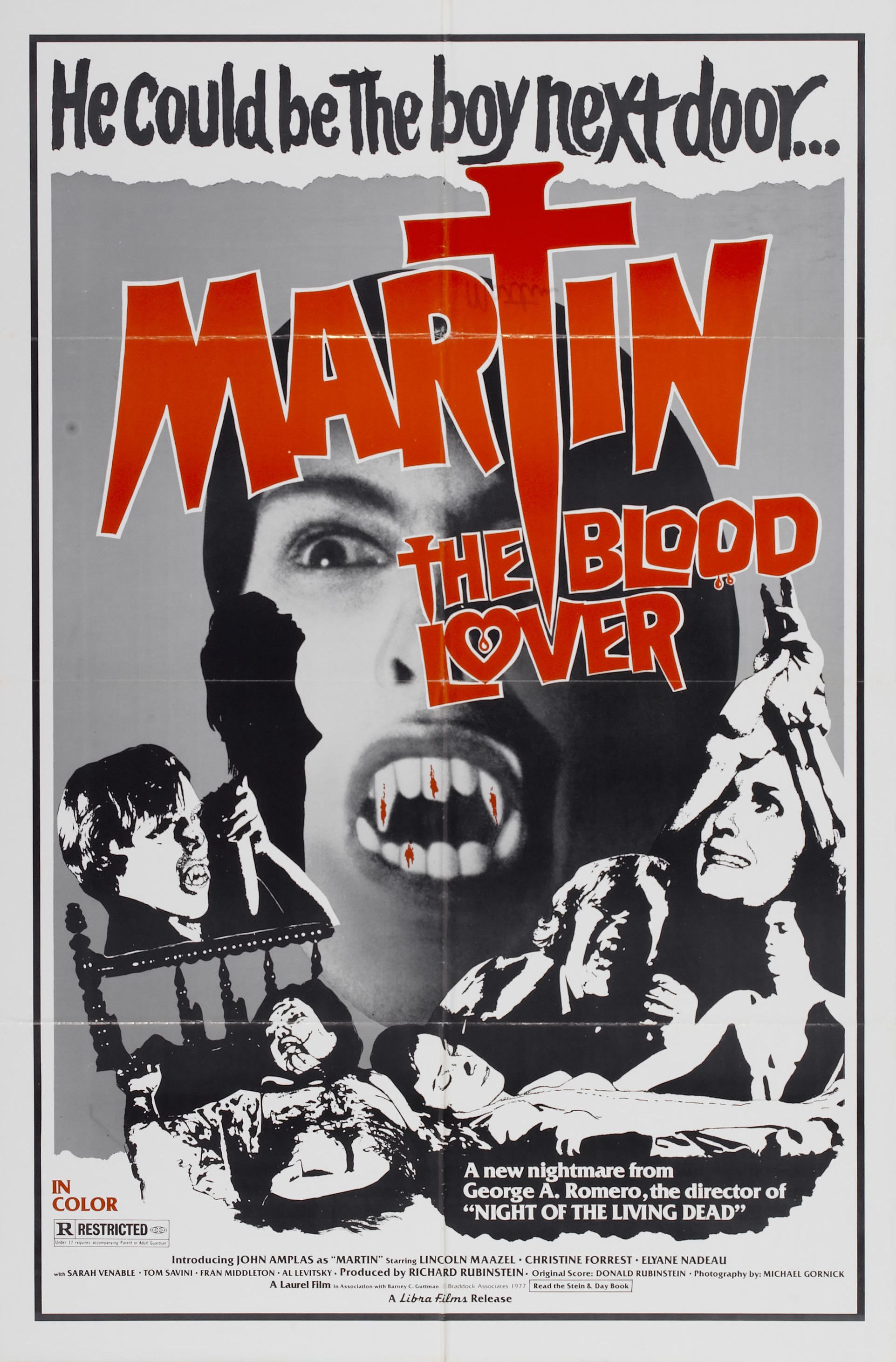
“Martin” is a clever 1977 George Romero vampire movie that has managed to slip through the cracks of history, and is one that the writer/director highly regards as one of his finest films to this day. On debut, it wound up being overshadowed by “Assault on Precinct 13” at Cannes, and never managed to get much off the ground. I recently read about the film in Shock Value by Jason Zinoman, and the described counter-supernatural style really stuck out to me. The question of whether Martin is actually a vampire follows throughout the movie, and Romero uses this to poke at the over-tired tropes of vampire movies. It sounds like the sort of film that would work well today, so it may just have been long ahead of its time. What luck that this forgotten gem is hanging around in the annals of YouTube!

—-

A Bucket of Blood
bucketofblood

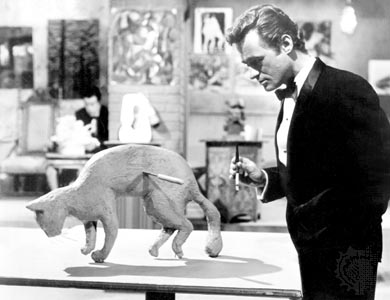
I absolutely love “A Bucket of Blood,” and think that it might just be Roger Corman’s true masterpiece. This film has been popping into my head quite a bit recently, particularly while re-watching Martin Scorcese’s “After Hours” and the modern cult classic “Murder Party.” Both of these films feature over-the-top, tongue-in-cheek assaults on the contemporary art world, something that has never been done better than in “A Bucket of Blood.” The story follows an awkward and incompetent aspiring artist who is shunned by his local arts community. Through a bizarre series of accidents, he winds up becoming a hit artist after plastering a mold over his neighbor’s cat, which he accidentally killed out of frustration. Loving the attention, he decides to replicate the success by going on killing spree, an immortalizing his victims by coating them with plaster. The movie horrifying, hilarious, and has one of the most relate-able and sympathetic serial killers that I have ever seen in a film. If you haven’t seen this, it gets an enthusiastic recommendation from me.

—-

Walking Tall
walkingtall

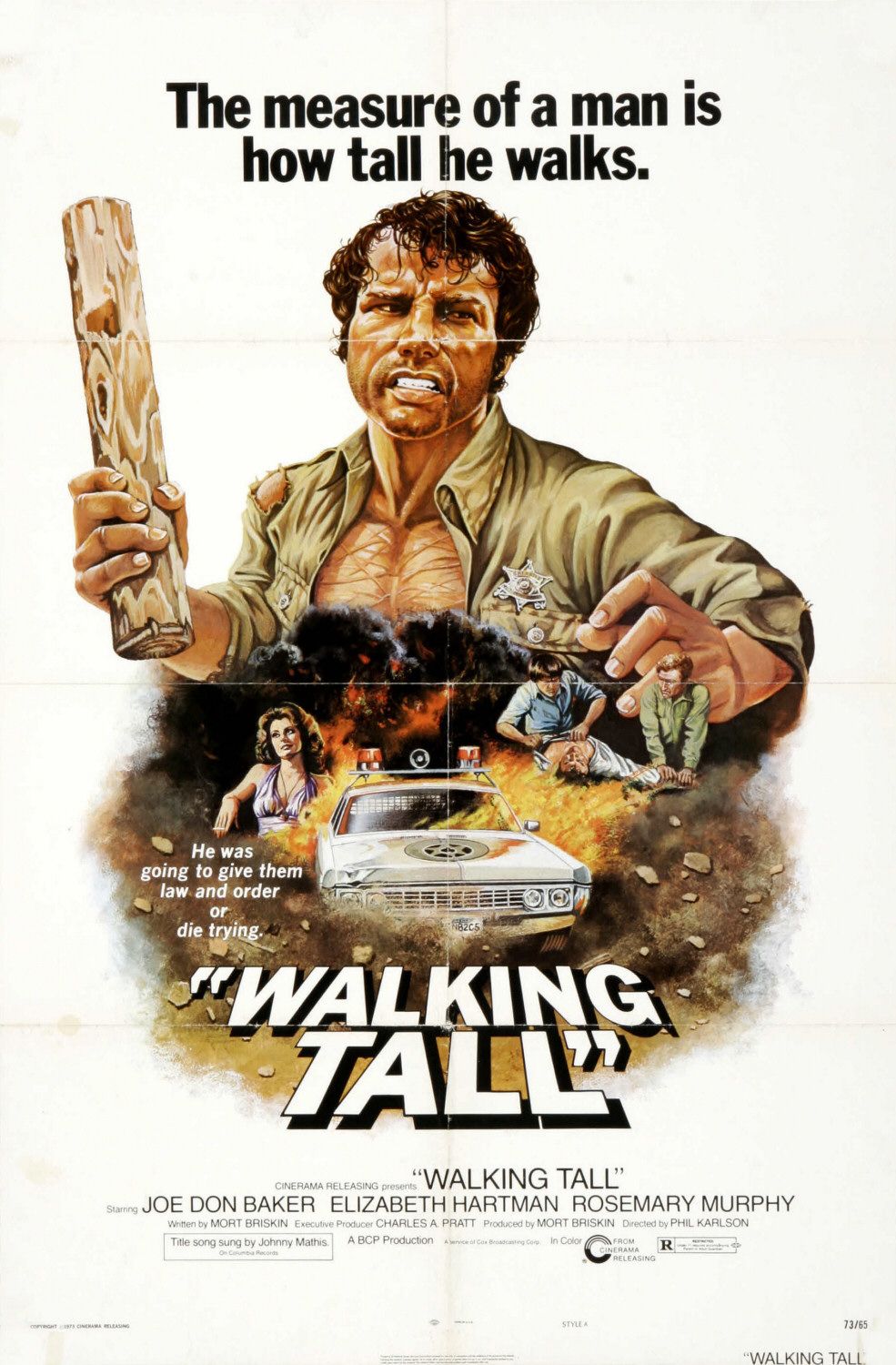
Nothing gives me quite as much joy as seeing Joe Don Baker show up in movies where I am not expecting to see him. I covered a few of his movies back in the IMDb Bottom 100, but I still hold that he is the best part about all of those awful movies. And, honestly, I kind of like “Mitchell.” I’m planning to cover Joe Don Baker in at least one upcoming review, but I think “Walking Tall” deserves a special little mention. Not only is this the Joe Don Baker-iest of all the Joe Don Baker movies, but like “Willard,” it has really fallen out of the public consciousness. I have likewise had no luck finding a physical copy of this movie, apart from the recent remake starring Dwayne Johnson. However, that flick definitely lacks the odd charm and grittiness of the original flick. I hope this gets a re-release of some sort in the near future, but for now, you can catch Joe Don Baker whacking people with a slab of wood to your heart’s content on YouTube.

—-

Hercules

hercules

There are an awful lot of Hercules movies out there. In fact, I’m going to be spotlighting one of the lesser ones later this week. However, I don’t think any of them are as entertainingly bizarre as this 1983 Italian film by Luigi Cozzi. And, of course, it stars the Incredible Hulk himself, Lou Ferrigno.  If you thought that either of the 2014 Hercules flicks were disappointing, then this one is sure to never let your hopes get up again. The bear fight / tossing sequence has become particularly infamous, but there are a whole lot more things to enjoy in this film than just that brief clip. This one is almost certainly worth your time, if you are up for wasting an hour and change on YouTube. It is an experience. And, if you are up for more, there’s even a sequel out there!

Stuart Gordon Spotlight: “The Pit and The Pendulum”

The Pit and The Pendulum

pit2

Welcome back! We are at the tail end of the Stuart Gordon Spotlight here at Misan[trope]y Movie Blog, taking a look at 1991’s Edgar Allan Poe inspired “The Pit and The Pendulum.”

“The Pit and The Pendulum” marks yet another collaboration between Dennis Paoli and Stuart Gordon, a combination that proved successful over the years. Just as with “Dagon,” Gordon specifically takes on the directorial role, leaving all of the writing work to Paoli (at least in the credits).

This adaptation of Poe’s acclaimed short story is by all accounts a heavily altered version of “Pit and the Pendulum,” and even includes a highly modified version of another Edgar Allan Poe story, “The Cask of Amontillado,” thrown into the middle. Outside of the setting and the eponymous device, this version of the tale is virtually unrecognizable from the original incarnation. In that way, it is somewhat similar to “The Black Cat,” another Poe adaptation Gordon would take on years later. Both concern themselves very little with the source material, which isn’t inherently a bad thing in my opinion. However, I think both films attempt to add in too much extra content, which is something I will get into later.

“The Pit and The Pendulum” had a famous film adaptation done in 1961 starring none other than Vincent Price, and was notably directed by B-movie legend Roger Corman. In the years since Gordon’s 1991 take on the story, another adaptation was created in 2009 by yet another B-movie notable: David DeCoteau. However, his version was significantly less well-received, holding an astounding 2.9 rating on IMDb at the time of this writing.

The cinematography on the movie was contributed by Adolfo Bartoli, who did a significant amount of work for Full Moon Features throughout the 1990s. His credits include a handful of “Puppet Master” sequels, as well as “Demonic Toys” and “Prehysteria.”

The music on “The Pit and The Pendulum” was unsurprisingly provided by Richard Band, brother of Full Moon Features head Charles Band, who produced the film. Richard Band has contributed music to two Stuart Gordon features since “The Pit and The Pendulum”: “Castle Freak” and “Dreams in the Witch House.”

The set and production design of “The Pit and The Pendulum” was provided by Giovanni Natalucci, who worked on a number of previous Stuart Gordon features like “Robot Jox,” “Dolls,” and “From Beyond.” Personally, given the low budget, I think a splendid job was done creating a believable enough set and appearance for the Spanish Inquisition.

The cast features a score of recognizable faces for Stuart Gordon fans and general film buffs alike, including Lance Henriksen (“Aliens”), Jeffrey Combs (“Re-Animator,” “From Beyond,” nearly everything by Stuart Gordon), Oliver Reed (“Gladiator,” “Tommy”), Jonathan Fuller (“Castle Freak”), Stephen Lee (“Dolls”), and Mark Margolis (“Breaking Bad”).

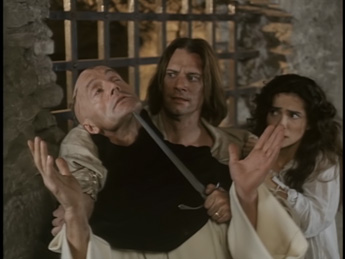
pit5 pit6The story of “The Pit and The Pendulum” follows a young couple in Toledo, Spain during the heat of the Spanish Inquisition. They wind up on the wrong side of Torquemada after an incident in which they attempt to save a young boy from being flogged. From that point, the two try to survive a variety of tortures while Torquemada faces challenges to his reign of terror, both from internal and external sources.

This version of “The Pit and The Pendulum” was apparently the result of the second attempt by Stuart Gordon to adapt the work onto the screen. Apparently, years earlier, Gordon intended to make a movie from the story, but with Billy Dee Williams and Peter O’Toole in key roles. This reminded me a little bit of how “Dagon,” which was initially set to star Jeffrey Combs, got put on the back-burner in favor of “From Beyond,” and wound up staying there for over a decade (meriting a recasting).

This adaptation certainly takes a number of liberties with the story of “The Pit and The Pendulum,” but one of the most interesting inclusions was a modified version of the sword of Damocles, an ancient Italian anecdote about the heavy responsibility of leadership, told via the image of a great sword held by a hair above a throne. I thought this worked well here, particularly given the similarities of the images of the hanging sword and the pendulum blade. However, I wish the sword had been used more cleverly and effectively in the story, though it does play in as a plot device.

“The Pit and The Pendulum” was released straight to video by Full Moon Features, meaning it never had the opportunity to make money back in theaters. The budget was estimated at a low $2 million, so it probably did well enough to meet production expectations. Given the method of distribution, the film didn’t get a lot of attention. Nevertheless, it currently holds an IMDb rating of 6.2, and Rotten Tomatoes scores of 56% (critic) and 41% (audience). However, I found that those low numbers were a bit deceiving given: of the 9 critic reviews counted, at least one of the ‘rotten’ reviews admitted that the movie wasn’t bad, but was just underwhelming for Stuart Gordon. I agree that this isn’t great for Stuart Gordon, but on its own, it isn’t an awful horror movie. I’d say it justifies the middling score it has accrued on IMDb, but not the significantly lower metrics from Rotten Tomatoes.

When it comes to positives about “The Pit and The Pendulum,” I have to start with pointing out the performances. Lance Henriksen always plays a great B-movie bag guy, and his Torquemada is no exception. Jonathan Fuller is also pretty solid as the lead in the story, particularly in a few moments where he laughs off torture attempts to throw off his adversaries. Jeffrey Combs, as always, is fantastic in his minimal background role, and just about steals the show in a couple of moments. That said, in spite of the good performances, I definitely had some issues with this movie.

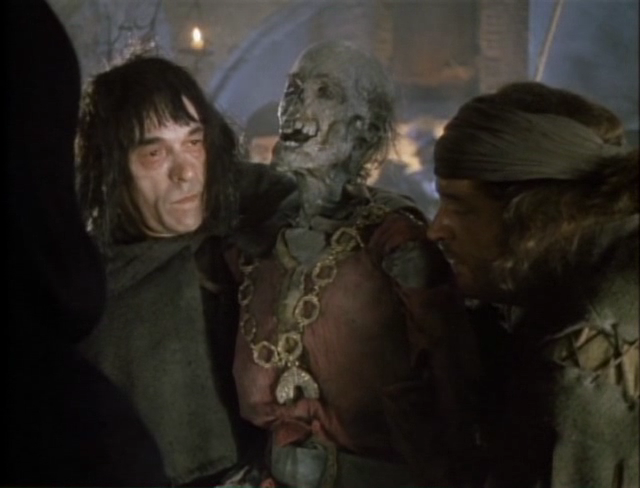
pit3Something about the opening of the film confused me out of the gate: the movie starts with Torquemada ordering the flogging of a long-deceased corpse. It almost plays as physical comedy, watching a dried corpse a la “The Crypt Keeper” being flogged into pieces. I have to assume this was intentional on the part of Paoli, but I don’t understand how this bit of absurdity plays in with the rest of the film tonally.

pit4I don’t think anything about this film took me aback as much as the inexplicable inclusion of actual witches, who are shown to be capable of telepathy. I assumed that the inquisitors were wrongfully accusing people of witchcraft, not persecuting an actual subset of witches within the Spanish population. I’m sure there were some Pagans and such in the area in real life, but even real Pagans aren’t actually magic, as the witches are portrayed in this film. I just can’t wrap my head around the logic of their inclusion, outside of providing a handful of minor plot devices to move the story along. It just seemed so astoundingly unnecessary to me: like the old saying goes, “when you hear hoofbeats, think of horses not zebras.” Why on Earth are the people accused of witchcraft in this movie actually witches? It makes more sense for the story that Torquemada is just randomly persecuting people on the slightest whim. Does the fact that these accused witches are actually magic mean that the inane selection process used by Torquemada’s men actually works? I mean, come on. That’s not only outlandish, but it is counter to the entire story.

Something else that bothered me about the story (in relation to the inclusion of actual witches in it)is what the ultimate message of it was. It obviously takes a strong stance against Torquemada’s religious violence in the Inquisition, but it is unclear why that is. Maria could be representative of the purer, better form of Christianity, which initially seemed to be the case, but then she developed witchcraft-based telepathy. What are we supposed to make of that? Is witchcraft/paganism the right way to go, as they were wrongfully persecuted by the Christians? Are the Catholics on the right track, as the Vatican attempts to shut Torquemada down? The only thing that is clear at the conclusion is that Torquemada is bad, and everything else is left muddied.

Worse yet, one of the great and defining strengths of “The Pit and The Pendulum” was its reality-based sense of terror and dread. This adaptation, with its inclusion of magic, telepathy, witches, etc., managed to turn what should be something realistically suspenseful into a tale that borders on being fantasy-based and generic.

Personally, I think that this story would have worked better in a shorter form, similar to the hour-long format of “Masters of Horror.” Paoli clearly struggled to flesh the story out enough for a feature: he wound up making additions that weakened the film, and ultimately inflated the movie just enough to throw the pacing off and void the suspense. To be fair, though, Paoli was tasked with making a lot out of very little, as the short story source material isn’t exactly rife with plot details. For what he had to work with, he did manage to build a narrative around a very narrow tale.

pit1Overall, “The Pit and The Pendulum” is entertaining despite its lack of focus and general bizarreness. The performances are all pretty great, and I liked the production design for sure. I feel like the script tried to do a little too much, and the third act just didn’t play as strongly as it should have. The sleep spell (and all of the witchcraft) was beyond out of place here, and Torquemada’s hallucinatory (?) confession scene just didn’t feel satisfying enough. This would have been a more interesting and compelling story without the supernatural elements in it, given that it is never well developed and is just completely unnecessary (or worse, antithetical) to the story.

I don’t recommend going out of your way for it, but it is a good enough watch for horror fans. If you happen to stumble across it, there is plenty here to make it worth your time in entertainment. Otherwise, this isn’t a must-find essential entry in Stuart Gordon’s filmography.

Stuart Gordon Spotlight: “Stuck”

Stuck

stuck4

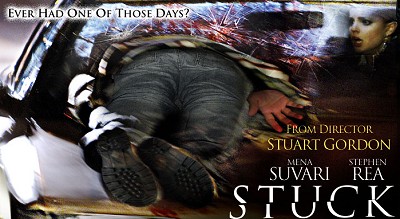
Welcome back to the two-week spotlight on director Stuart Gordon! Next up is 2007’s “Stuck,” a strange thriller pulled straight from tabloid headlines.

“Stuck” was co-written by Stuart Gordon and a fellow named John Strysik, who previously worked on 2002’s “Deathbed,” which Gordon produced. The story is loosely based on a incident that occurred in 2001, in which a woman hit a homeless man with her car, and then hit him in her garage, assuming he was dead. The screenplay changes a number of details significantly, but the general premise is based on the outlandish tale, which received a good deal of press coverage at the time.

The cinematography on “Stuck” was provided by Denis Maloney, who rejoined Stuart Gordon after working together on “Edmond” a couple of years beforehand. The music for “Stuck” is also provided by a returning crew member from “Edmond:” Bobby Johnston, who also worked on Stuart Gordon’s “King of the Ants” some years earlier.

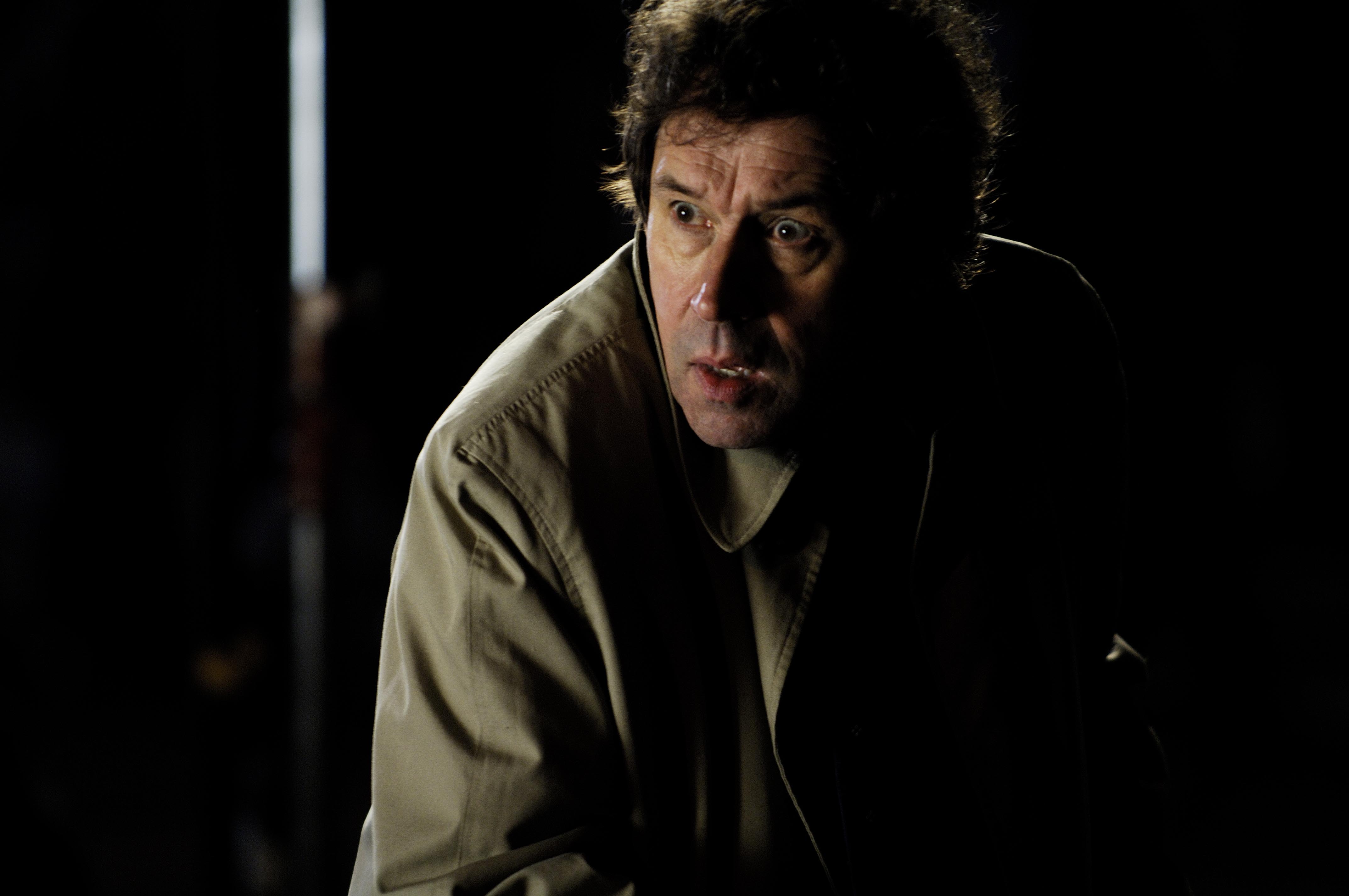
The cast of “Stuck” includes some notable faces from Academy Award Best Picture winners, notably Mena Suvari of “American Beauty” and Stephen Rea of “The Crying Game.” The accessory cast includes Lionel Mark Smith (who also appears in Gordon’s “Edmond” and “King of the Ants”), Russell Hornsby of “Grimm,” and Stuart Gordon’s wife Carolyn Purdy-Gordon, who once again plays a curt medical professional (as she did in “Re-Animator” and “From Beyond”).

stuck5 stuck1The reception of “Stuck” was pretty mediocre: it has a 72% critic score and a 55% audience score on Rotten Tomatoes, along with a 6.5 rating on IMDb. However, the box office totals on the film were particularly awful: it grossed less than 100,000 dollars in a brief theatrical run on a estimated budget of $5 million, making it a financial failure.

stuck2Personally, I feel like “Stuck” is a pretty solid low-budget thriller, and builds suspense well throughout the film. I didn’t think there were any glaring flaws, but there also isn’t much about the film that makes it stand out from a crowd.

“Stuck” does feature some really good performances, particularly from Rea and Suvari. However, just like the rest of the film, they don’t really leave a lasting impression. I also found that the characters didn’t seems very realistic, which is odd given the source material is (theoretically) reality. I will say that you can’t help but empathize with Rea’s character, and that Suvari’s character becomes increasingly despicable as the story goes on, to the point that she is damn near demonic by the end of the film.

stuck6“Stuck” still has a little bit of Stuart Gordon’s trademark style despite the shift in genre, with some cringing gore moments (notably a sequence where a dog chews on someone’s exposed bone) and a little bit of dark comedy interspersed throughout. Oddly, though, judging by the trailer it was marketed as a straight comedy, which is not even close to accurate, and almost certainly blindsided any audiences going in based on that summary and hook. The trailer almost feels like a parody cut of out-of-context moments from the film, and is surreal to see after watching the actual movie. Here is another look at that:

Overall, I appreciate that “Stuck” is yet another attempt by Stuart Gordon to step outside of his usual genre boundaries. I found it to be a little bit better than “Edmond,” which takes a similar tone and atmosphere, and it is certainly leagues better than the train-wreck that is “The Wonderful Ice Cream Suit.” It certainly doesn’t belong in the top tier of Gordon’s works as far as entertainment value goes, but it is also more of a clear-cut thriller than most of his other works. I enjoyed it, particularly for its small budget, and think that the criticisms of it are a bit harsher than is merited. It isn’t a masterpiece, but it is a pretty solid watch with some good performances.


Stuart Gordon Spotlight: “King of the Ants”

King of the Ants

kingants2

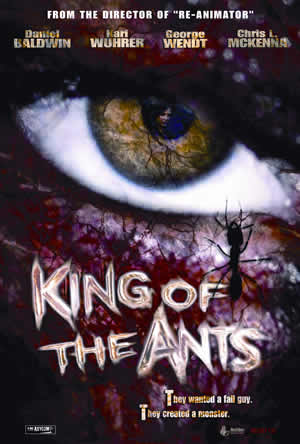
Welcome back to Misan[trope]y Movie Blog, and the continuing two week spotlight on writer/director Stuart Gordon. Next up is “King of the Ants,” Gordon’s take on the crime thriller genre.

“King of the Ants” is based on a novel by Charlie Higson, who also adapted it into the screenplay used for this film.  The novel has a 3.87/5 star rating on GoodReads.com, which is generally pretty solid score. It was his first novel, of which he has currently written over 15, and is rapidly pushing 20.

The cinematography on “King of the Ants” was provided by Mac Ahlberg, one of Stuart Gordon’s most steadfast collaborators, and a man who Gordon affectionately referred to as “The Professor” since their first project together on “Re-Animator.” “King of the Ants” would be their last work together, as Ahlberg would pass away in 2012 at the age of 81.

“King of the Ants” was produced and released by The Asylum, a production company that is now best known for the “Sharknado” films and a long series of “mockbusters,” made to imitate larger-budget contemporary blockbusters to leech off of their secondary market sales. However, back in 2003 The Asylum was a pretty typical b-movie studio, years before they made their name with CGI monster movies and legally dubious imitation flicks.

The music in “King of the Ants” is provided by Bobby Johnston, who also worked on “Edmond” and “Stuck” for Stuart Gordon, making him one of the most consistent elements in Gordon’s more recent film efforts.

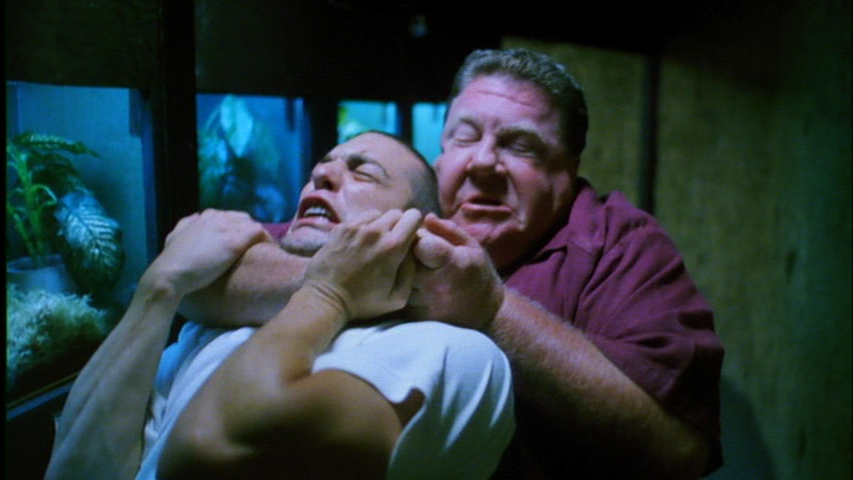
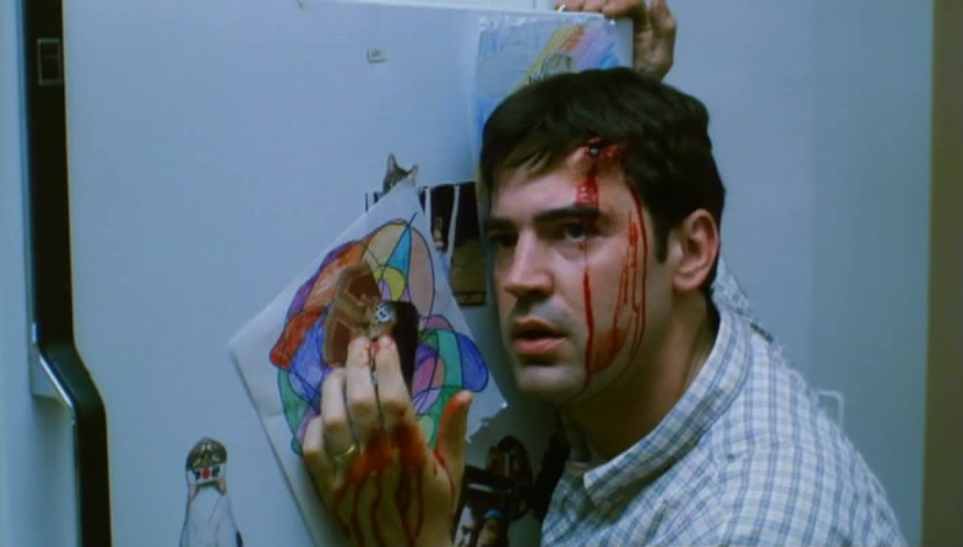
The cast of “King of the Ants” includes a handful of recognizable faces, including George Wendt, Daniel Baldwin, and Ron Livingston. The lead was given to a relative unknown in Chris McKenna, who has since popped up in a good number of television roles. The accessory cast includes Lionel Mark Smith (“Edmond,” “Stuck”) and Vernon Wells, who provide some some of the comic relief as enforcers beneath Daniel Baldwin. In the background, you might spot Ian Patrick Williams (“Dolls”) in a small role, similar to his ‘blink-and-you-miss-it’ part in “Re-Animator.”

kingants6 kingants4The story of “King of the Ants” follows a house painter who becomes a low level criminal after a happenstance encounter leads him to consider new professional options. He ultimately kills a federal investigator over a mistaken assassination order, which lands him in hot water with his criminal employers. From there, things get more than a little out of hand, ultimately leading to a climactic, revenge-fueled rampage.

kingants5As with most films backed by The Asylum, “King of the Ants” was released straight to video, meaning it didn’t get a theatrical run. It subsequently didn’t get much attention, but what it got was generally positive. It currently holds a 100% critic score and a 57% audience score on Rotten Tomatoes, as well as a 6.3 rating on IMDb. The critics’ score is a little misleading, given only 9 critic reviews were counted, but that is still undoubtedly solid.

kingants3“King of the Ants” is outside of Stuart Gordon’s usual style, but this film works astoundingly better than either “Edmond” or “The Wonderful Ice Cream Suit” as far as experimentations outside of his comfort zone go. This film is also a little more down to earth and relateable than “Stuck,” but the atmosphere feels very similar. Given what Stuart Gordon’s films have looked like in the 2000s, I can’t help but wonder if he has been trying to have a Cronenberg-esque late career change of style. The two film-makers have always had some similarities, though Cronenberg has certainly accrued more critical acclaim over his career. Whether intentional or not, it is probably a good thing that Gordon has tried some different kinds of movies, though I think his skill set at this point is very well catered to the horror genre over any others at this point. That said, I wouldn’t mind seeing him take on a couple of more thrillers like “Stuck” or “King of the Ants” in the future.

I particularly enjoyed the accessory cast in “King of the Ants”: shockingly, even Daniel Baldwin isn’t too bad here. Ron Livingston is always nice to see, even though he doesn’t get a whole lot of time on screen. However, the person who steals the show the most is probably George Wendt, who leads a sort of motley crew of odd enforcers under Daniel Baldwin.

kingants1As far as negatives go, there was one sequence that really didn’t fly with me. During a sequence where the lead character is being repeatedly hit in the head, a weird nightmare scene pops up periodically. It didn’t really work for me, and it seemed thrown in for the sake of a gross out gag (a grotesque humanoid monster eats its own poop at one point). It just wasn’t necessary in any way for the film, particularly given how realistic and harsh the rest of the violence was in the movie. Also, given how low-budget this film was, I can’t help but wonder if the money spent on those effects could have been used better elsewhere.

There is arguably an issue with the main character not behaving like the average Joe he is supposed to be. Personally, I think he just declines rapidly in regards to his morality, and is not a character that you are supposed to be behind or supporting by the end of the film. I do think that a couple of staged of his moral degradation were missed, but the audience also isn’t exactly privy to his moral standards when the story starts: we just assume he is an average Joe, because that is what he appears to be.

Probably the biggest issue with “King of the Ants” is the low production quality, which makes it look particularly cheap. Oddly, even when working on a shoestring budget, this is an issue Stuart Gordon hasn’t ever had before. However, if “King of the Ants” had the production quality of either “Stuck” or “Edmond,” it would be one of his best films without a doubt. It might be a petty criticism, but appearance matters in a visual medium, and I have to dock it some points for its lackluster presentation.

kingants7Overall, I thought that “King of the Ants” was a pretty solid flick, particularly for a movie coming out of The Asylum. I wouldn’t hesitate to recommend it to people despite its handful of flaws, because it mostly makes up for the problems that arise. I definitely wish that the production quality was higher, but it is still entertaining and impressive in spite of that issue.

Stuart Gordon Spotlight: “Re-Animator”

Re-Animator

reanimator9

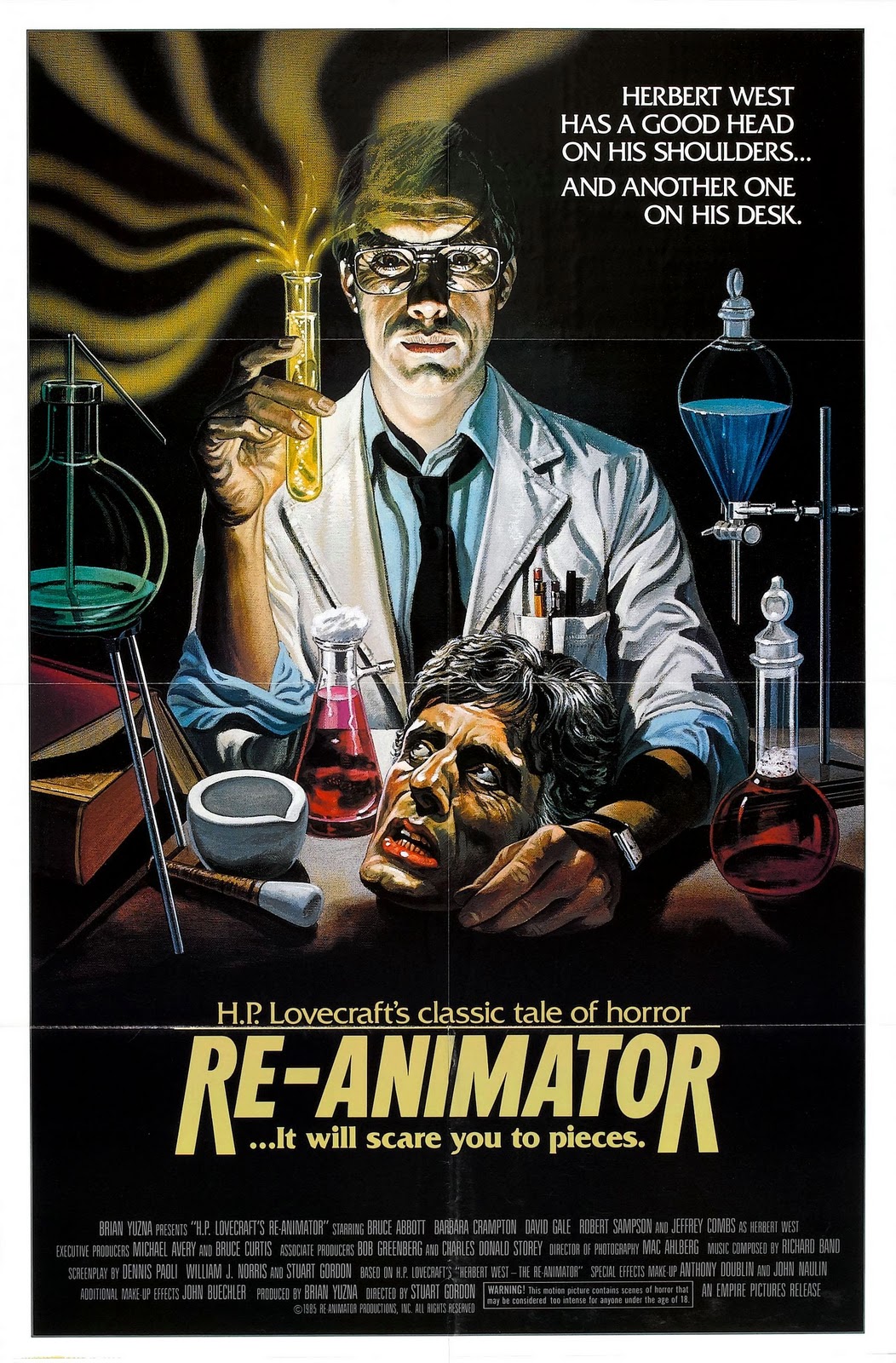
Welcome back to Misan[trope]y Movie Blog’s two week spotlight on the works and career of Stuart Gordon! Today, I’m taking a look at the most acclaimed and beloved of Stuart Gordon’s movies, 1985’s cult classic “Re-Animator.”

“Re-Animator” marked the first film directing work for Stuart Gordon, and was additionally the first writing collaboration for Gordon and Dennis Paoli, which would prove to be a long-running partnership. A third writing partner was present in William Norris, who never worked on any other films.

Before “Re-Animator,” Stuart Gordon was working for the Organic Theater Company in Chicago. He noticed that many of his actors were doing movies, and decided he wanted to try his hand at one as well. He decided to go with the horror genre because of the low budget required, and the generally high profitability of genre movies.

The source material, “Herbert West: Re-Animator” by H. P. Lovecraft, was published in parts over multiple issues of “Weird Tales” magazine. It was long out of print when Stuart Gordon got the idea of doing a movie, meaning that in order to read it, he had to request access to an original copy in the Chicago Public Library. The movie essentially “re-animated” the story from obscurity, and renewed popular interest in Lovecraft’s works.

reanimator1The screenplay of the “Re-Animator” film differs greatly from the content of “Herbert West: Re-Animator.” Ultimately, the original story only provided the characters and some details for the screenplay, which significantly altered the plot to make it more cinematic.

Brian Yuzna and Bob Greenberg both acted as producers on the picture, and would go on to collaborate extensively with Stuart Gordon on future projects. Yuzna even helmed two sequels to “Re-Animator”: “Bride of Re-Animator” in 1989, and “Beyond Re-Animator” in 2003.

The cinematography on “Re-Animator” was provided by Mac Ahlberg, who would go on to frequently collaborate with Stuart Gordon on films like “Dolls,” “Robot Jox,” and “The Wonderful Ice Cream Suit.” A handful of shots were completed by Robert Ebinger, who was dismissed after only a week of shooting on the behest of Charles Band, whose Empire Pictures was backing the movie.

The music on “Re-Animator,” which drew significant influence from the score of “Psycho,” was composed by Richard Band, brother of Charles Band and ultimately a frequent member of Stuart Gordon’s movie team.

The effects on “Re-Animator” were all done as simply as possible to keep the budget low, meaning that no optical special effects were used. There are a number of shots that appear to be done with special effects, but were actually executed with the creative use of lighting, camera angles, and practical effects. It has been estimated that the production used 30 gallons of take blood in total, which was used creatively in tandem with raw meat to do most of the gore in the film. Stuart Gordon has a fantastic quote about the use of cheap effects, taken from the “Re-Animator” DVD commentary:

“The audience will accept very simple special effects if they like the story and are involved.”

reanimator5

The cast of “Re-Animator” features a handful of actors who would return to work with Stuart Gordon again in the future. Of course, Jeffrey Combs leads the way as Herbert West, who would become one of the most consistent figures in Stuart Gordon’s later films. Barbara Crampton later popped up in “From Beyond” and “Castle Freak,” and Robert Sampson appeared in 1989’s “Robot Jox.” Bruce Abbott returned for the first sequel to the film, but never reunited with Stuart Gordon on any of his later movies. David Gale would unfortunately die only a few years after “Re-Animator,” though he also appeared in Yuzna’s sequel, “Bride of Re-Animator.”

A number of notable actors appear in the background of “Re-Animator,” such as Stuart Gordon’s wife, Carolyn Purdy-Gordon, as an ER doctor. The first reanimated corpse is played by Peter Kent, who is best known as a frequent stunt double and stand in for Arnold Schwarzenegger in films like “The Terminator,” “Total Recall,” “The Running Man,” “Predator,” “Last Action Hero,” and “Jingle All The Way.” Also in the background is Ian Patrick Williams, a member of the Organic Theater in Chicago with Gordon at the time, who would later appear in the Stuart Gordon films “Dolls” and “Robot Jox.”

“Re-Animator” follows the story of a medical student who becomes embroiled in experimentation on the re-animation of corpses after a mysterious new student transfers into the school and leases a room in his home. This relationship winds up causing significant problems for the pair as they are forced to butt heads with the school administration and simultaneously have to deal with the violent, erratic behavior of their creations.

reanimator4Notably, the creative team behind “Re-Animator” decided to release the movie unrated after getting an NC-17 from Motion Picture Association of America (MPAA) rating board. Amazingly, the movie still managed to get advertised widely and booked in theaters, a major accomplishment for a film without a stamp of approval from the MPAA, and something that is unlikely to happen nowadays.

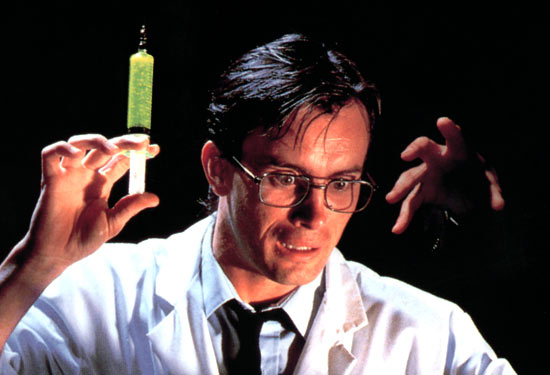
The infamously radiant reanimation fluid used in the film was made up of a chemical mixture used for certain kinds of road flairs, and was apparently highly toxic. Given the short life span of its luminosity, it had to be frequently replaced in order to maintain a consistent glow from shot to shot.

reanimator2All of the dead bodies were meticulously made up based on professional input from forensic pathologists in the Chicago area. Specifically, the coloration of the makeup was done using direct comparisons to actual autopsy photos of corpses. The vivid coloration on the bodies is meant to imitate the actual coloration effects that occur after death.

The humor in “Re-Animator” was something that wasn’t initially planned, but has wound up being a defining aspect of the film. Stuart Gordon has said that it was added in party due to his experiences working with forensic pathologists while doing research for the film, noting that they had some of the darkest senses of humor of any people he had ever met. In many ways, this integration of humor into horror influenced what would eventually define Stuart Gordon’s style. Here is another relevant quote from the director about what he learned about humor and horror from making “Re-Animator”:

“Laughter is the antidote for fear…you can build tension and then relieve it with laughter…but if you do both at the same time they cancel each other out.”

“Re-Animator” interestingly used many of the same locations and crew as “The Terminator.” The movie was eventually screened for Arnold Schwarzenegger himself, on the recommendation of his body double, who plays the first revived corpse in “Re-Animator.” Arnold apparently loved it, enough so that he later recommended Stuart Gordon for the directing job on “Fortress.”

The inclusion of the “laser drill” in the movie was a bit of science fiction when “Re-Animator” was made, but today laser surgery is standard practice in medicine in general, and specifically in autopsies (as is depicted in the film).

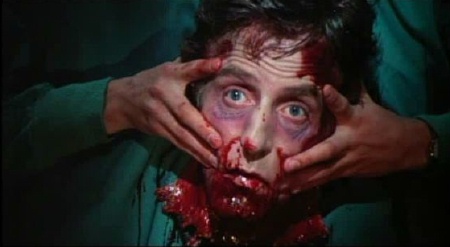
The most infamous scene in the movie is undoubtedly the decapitated head attempted rape sequence, and is perhaps the most uncomfortable thing Stuart Gordon has ever filmed. The original actress cast for Barbara Crampton’s role apparently dropped out due to the inclusion of the scene, and it caused David Gale’s wife to walk out of an early screening of the movie in shock.

reanimator6

“Re-Animator” was highly regarded by critics at the time, and still holds an impressive 94% Rotten Tomatoes critical aggregate rating. Audiences have been a little less receptive to the film, giving is a 7.3 on IMDb and a 82% on Rotten Tomatoes, but it is regarded as both a horror classic and a cult classic regardless.

Personally, I think that one of the most fantastic aspects of “Re-Animator” is the ending, in which Bruce Abbot’s character revives Barbara Crampton over a black screen, with only the reanimating agent in a syringe visible. It then closes on an iconic scream from Crampton. I have mentioned this ending before, way back when I covered Uwe Boll’s “House of the Dead,” which manages to botch a very similar concept for the ending.

“Re-Animator” is now regarded as a classic of the horror genre, and has influenced many other films since its release. On top of the eventual sequels, “Re-Animator” also inspired a musical adaptation, which was apparently pretty highly acclaimed.

Overall, “The Re-Animator” is more than deserving of the reputation that it has garnered. The effects are fantastic, the performances are great, and it has set the tone for the careers of both Stuart Gordon and star Jeffrey Combs. It is a must watch for horror movie fans, b-movie aficionados, and arguably film buffs in general. For fans of the genre, this is a thoroughly enjoyable movie.

However, I think it is hit-or-miss for people not already ingratiated into the genre: particularly, the infamous “head” sequence is likely to turn a subset of people off who might otherwise enjoy the movie. As effective as the scene is at disturbing the audience and drawing a reaction, that has to be weighed against the potential for the effect to turn people away: you want an audience to cringe and turn their head, but you don’t want to go so far as to push them out the door.

So, as far as a recommendation goes, it is an emphatic ‘yes’ for horror fans, and an indecisive ‘maybe’ for general audiences, with a clear caveat of the content that pops up in the film. If you think you can handle it, give the film a shot.

Stuart Gordon Spotlight: “Dagon”

Dagon

dagon8

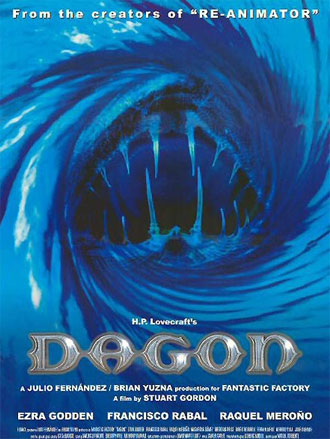
Welcome back to Misan[trope]y Movie Blog’s two week spotlight on writer/director Stuart Gordon! Next up is 2001’s “Dagon,” which sees Gordon dive back in to the Cthulhu mythos of H. P. Lovecraft.

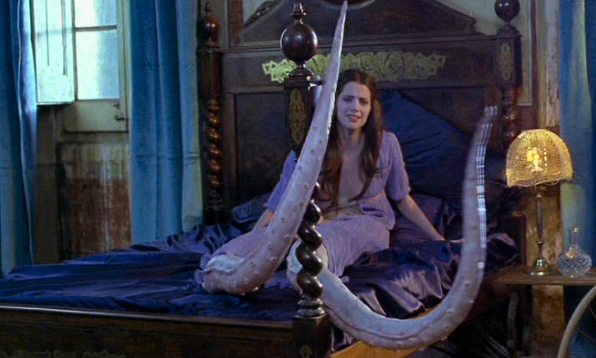
“Dagon” is a loose adaptation of H. P. Lovecraft’s “The Shadow Over Innsmouth,” the only one of his works to be published as an independent book (as opposed to a section of a magazine) in his lifetime, with a whopping printing of 200 units. The film adaptation changes some major details from the story, most notably the location (from New England to Spain), and the nature of the creatures (from frog-like to octopus-like).

“Dagon” once again reunited Dennis Paoli and Stuart Gordon on what would be one of their longest-running projects (taking over 15 years to ultimately see to the screen). Paoli took sole writing credit on “Dagon,” which was unusual given how often the two have acted as writing partners. “Dagon” was initially written to be made as a follow-up to “Re-Animator” in the 1980s, and was intended to have Jeffrey Combs in the lead. However, for a handful of reasons, “From Beyond” ultimately got precedence, putting “Dagon” on the back-burner for what wound up being well over a decade.

The cinematography on “Dagon” was provided by Carlos Suarez, an acclaimed Spanish cinematographer who has been working since the 1960s, but has never really branched outside of his home country.

The music on “Dagon,” which is only used sparingly in the film, was composed by Carles Cases, another Spanish member of the crew who has never particularly branched outside the world of Spanish-language cinema.

The special effects on “Dagon” were provided by DDT, an acclaimed Spanish special effects outfit that has worked on films such as “Hellboy” and “Pan’s Labyrinth,” where their skill in creating creatures has been excellently showcased.

A number of members of the production design and art team from “Dagon” would later work with producer Brian Yuzna on “Beyond Re-Animator,” the second of two dubious sequels to Stuart Gordon’s initial 1985 adaptation.

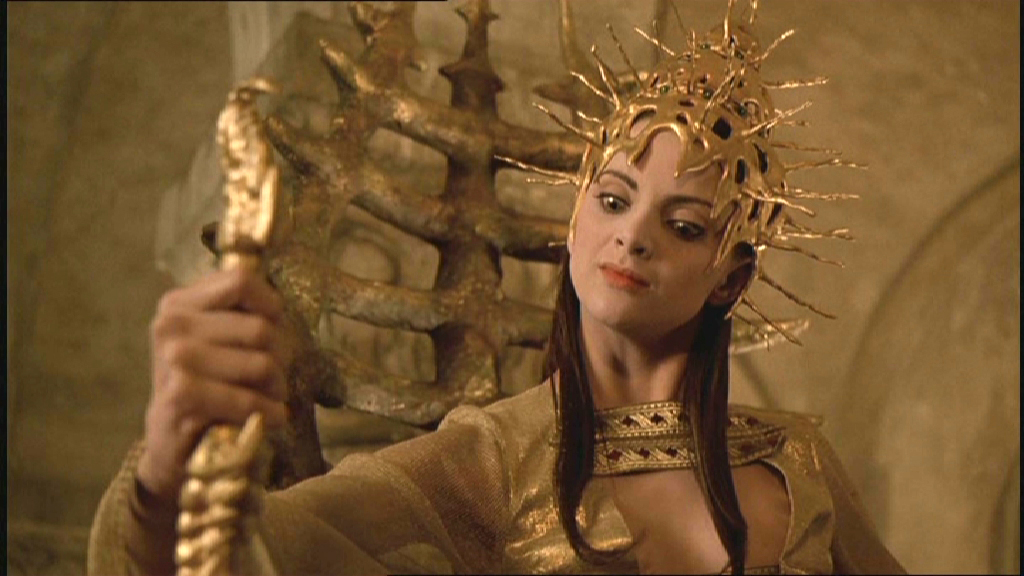
The cast of “Dagon” is led by Ezra Godden, who would later reunite with Stuart Gordon years later for “Dreams in the Witch House.” The British actor modeled his character of Paul on a combination of Woody Allen and Harold Lloyd, creating a sort of oddly comic and out of place protagonist. The cast also features the acclaimed Spanish actor Francisco (Paco) Rabal in one of his last on-screen performances before his death, as well as the first film role for actress Macarena Gomez.

dagon3 dagon7The story of “Dagon” follows four Americans  on a boating vacation, where they suddenly and mysteriously become shipwrecked just off of the Atlantic coast of Spain. In their search for medical help on shore, it quickly becomes clear that they have stumbled upon a peculiar and hostile village with a number of hidden secrets.

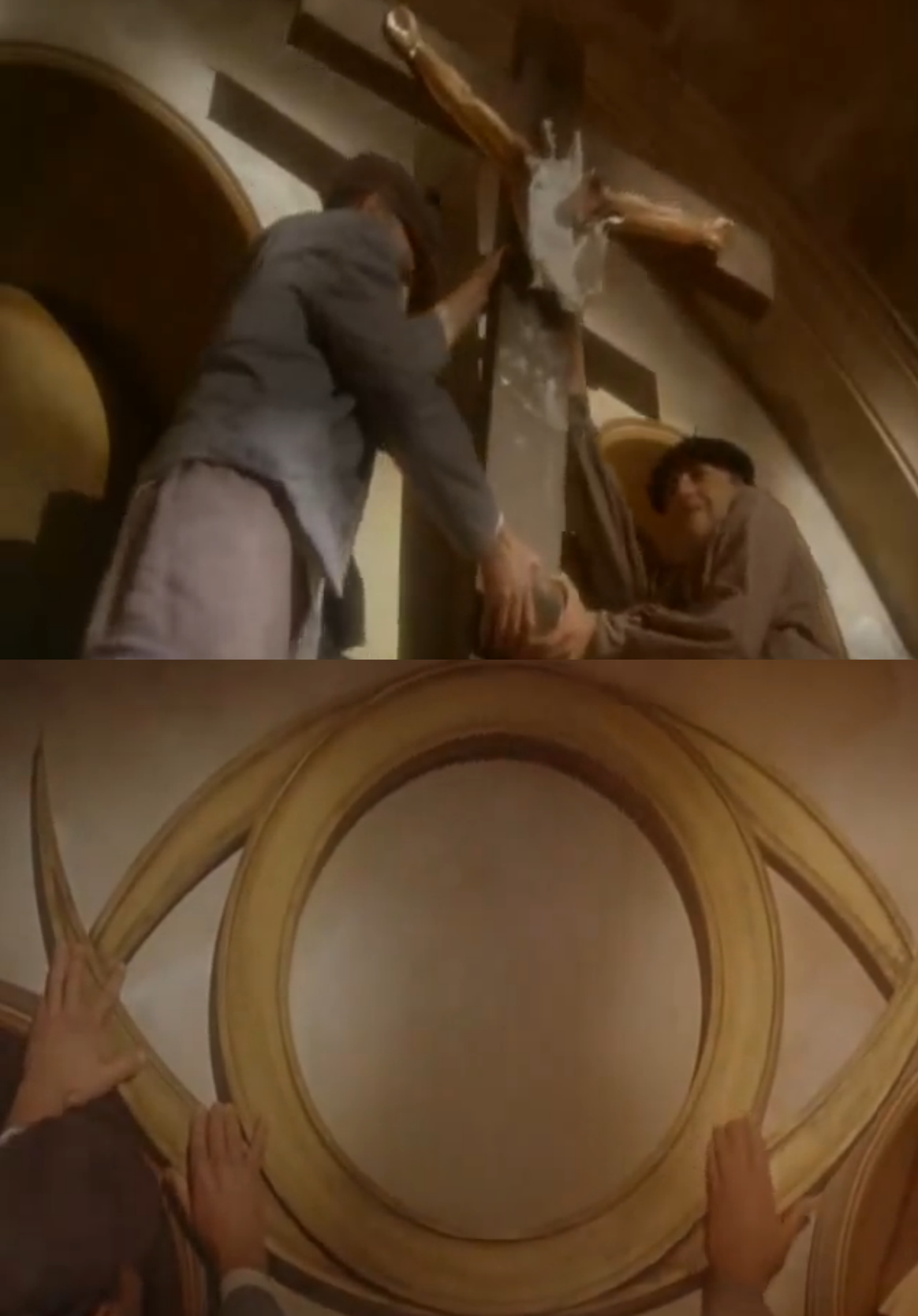
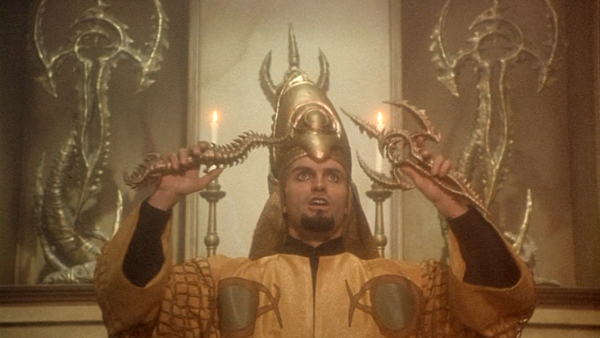
In the DVD commentary for “Dagon,” both Dennis Paoli and Stuart Gordon mention the concept of the story being a “battle of the gods.” Dagon was not just an invention of Lovecraft, it was based on a fish-god of the same name mentioned in the Old Testament as being the deity over the Philistines. Appropriately, there are a number of sequences showing conflict between Christianity and the Dagon-worshippers: notably, an extensive flashback sequence that depicts the revolution of the town from being Catholic to following the sea-god Dagon.

Apparently, Stuart Gordon was worried that there would be issues with finding Spanish extras willing to desecrate Christian symbols for this sequence. Hilariously, the cast and crew were more than happy to oblige, and reportedly destroyed all of the spares  off-screen as well, claiming it was therapeutic.

dagon9
The intersecting crescents “eye” symbol for Dagon was developed specifically for this film

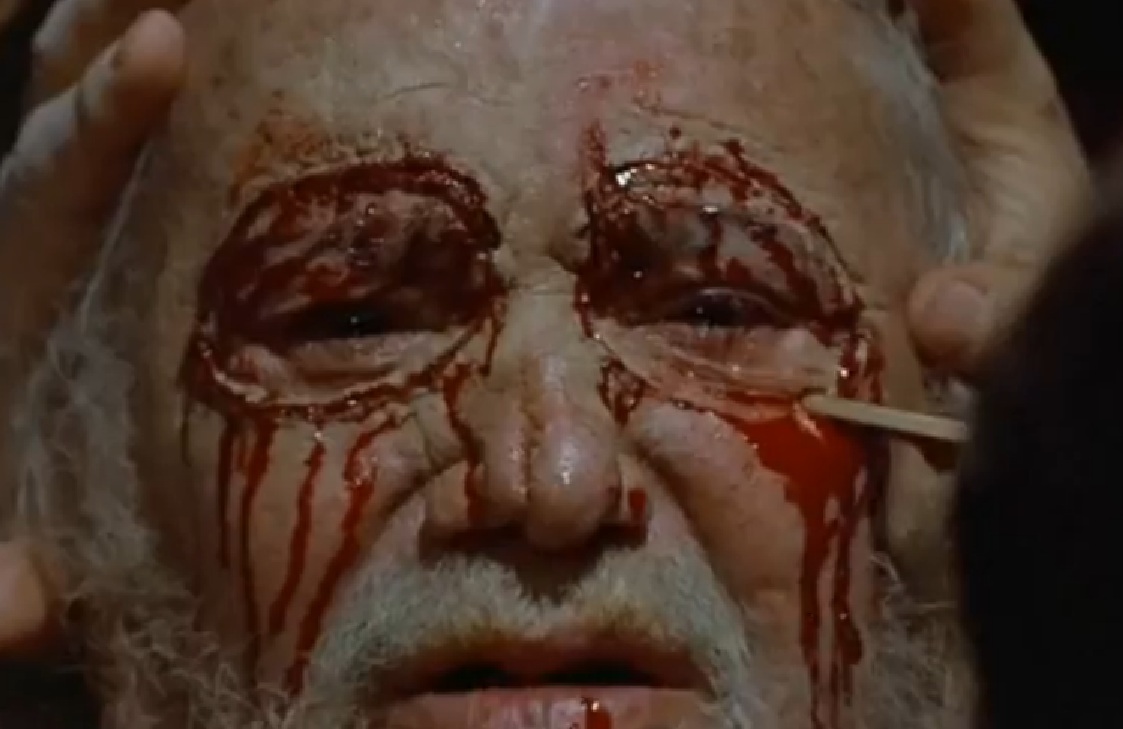
Stuart Gordon and Dennis Paoli include a number of small details throughout “Dagon” that become more noticeable upon re-watching the film. For instance, none of the native islanders are ever shown blinking, a detail pulled from the source material that is meant to point to their “fishy-ness.” There are also a number of repeated phrases and actions on the part of Paul: he frequently mentions “two possibilities,” and is often faced with dichotomies throughout the film. Paul is also shown experiencing stomach pain, which becomes more intense and pronounced as the film goes on. Ultimately, the source of the pain is revealed to be a set of gills that have developed around his ribs. Personally, I would think that the sensation of growing gills would differ a little bit from a stomach cramp, but I have also never experienced a transformation into a fish-person.

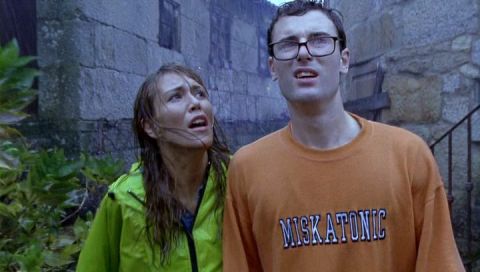
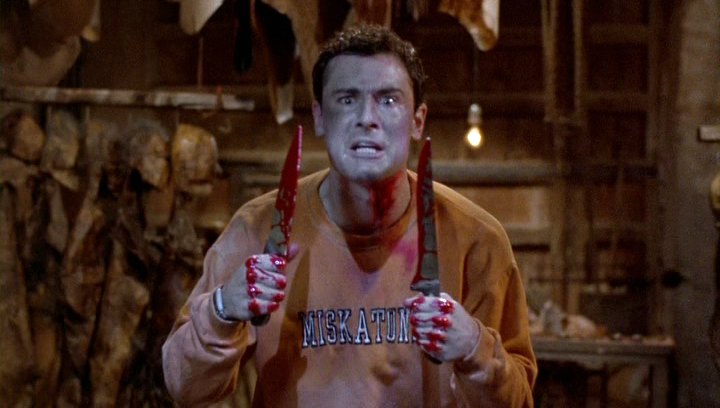
Those with a keen eye will notice that the Godden’s character of Paul wears a sweatshirt throughout the film bearing the name “Miskatonic University.” That fictitious school features prominently throughout Lovecraft’s works, and is directly featured in Stuart Gordon’s previous Lovecraft film adaptation, “Re-Animator.”

“Dagon” reportedly had a total budget of 4.2 million euros, a total that it didn’t even come close to meeting in a limited Spanish theatrical run. The movie currently holds a 6.3 rating on IMDb, and has Rotten Tomatoes scores of 56% from both audiences and critics, a rare case of consensus. No matter how you cut it, “Dagon” was not a successful feature.

Criticisms that I have seen of the movie have claimed that it was too specifically catered to fans of Lovecraft, while others have claimed that despite its attempts, it proves that Lovecraft’s style simply can’t be adapted to film in a way that is simultaneously successful and faithful.

Personally, I have a few issues with the film, but none of them specifically relate to the adaptation. I think that the changes made by Paoli were sensible, and that there is nothing inherently prohibitive about this story that would prevent it from making a good movie. Hell, I think Stuart Gordon came pretty close here to having one of his best films.

Unfortunately, there are definitely issues with “Dagon.” First off, Ezra Godden’s Woody Allen act is just distracting, and completely fails to extract any laughs. Worse yet, his development into a hero seems to happen inexplicably, and his final twist even moreso. I could see exactly how Jeffrey Combs might have managed this character, and if things had turned out different, I think he could have nailed it. Godden struggles to convey intensity, and never seems genuinely terrified. Combs has an ability to portray those things, while also pulling off a side of humor. Godden tried to do that, but he doesn’t have the same kind of balancing capabilities or the comedic chops to do so. While none of the performances were outstanding (Gomez was also distractingly awful at times), no one had the same amount of screentime or responsibility as Godden, and he just couldn’t keep it all together.

dagon1dagon4Apparently, there was some internal debate on the production over whether or not Dagon should be shown in the conclusion. There were a handful of poor decisions here that wound up just about sinking the movie for me. First, Gordon relented, and allowed Dagon to be shown on screen at all. Second, Dagon was depicted solely with low-budget, 2001 CGI. Third, CGI was used inexplicably and interchangeably with (really good) practical effects throughout the film. Computer generated special effects, with rare exception, age horribly, and that is absolutely the case with “Dagon.” Worse yet, there was no reason to have a full shot of a giant monster at all in this movie: Lovecraftian horror is atmospheric, and relies a lot on what you don’t see, and I believe Stuart Gordon knows that. This movie could have been pulled off with only a glancing shot of Dagon (“Cabin in the Woods”,  “Cloverfield”) or just by showing the results of his actions. However, I think I understand why that decision was ultimately made.

dagon2
dagon6 Seriously, the practical effects look ok

“Dagon” was a low-budget production, and in 2001, I imagine the computer effects featured were expensive. For whatever reason, it was decided at some point in the production that certain aspects of the film needed CGI. My guess is that the effects shop pushed it, and showed off the capabilities of their CGI department, and maybe even cut the production a good deal. At that point, I imagine the “in for a penny, in for a pound” logic took over, and decisions were made to get everything possible out of the money that was sunk into the effects. Thus, we get a number of CGI shots that look awful now, but were probably impressive then, including Dagon himself. Regardless of what the logic was, it still looks awful, and cheapens the look of the movie as a whole. Those kind of missteps are like a pin in a balloon for me, and can sink my opinion of a pretty good movie pretty quickly.

Overall, “Dagon” is not one of my favorites in Stuart Gordon’s filmography by a long-shot. There are a lot of things I like about it: the location, the monster designs, and the practical effects, for instance. However, the moments of poor CG just about spoil the whole thing for me, and most of the acting is really disappointing (or at worst, grating). There is a general lack of genuine intensity, and the whole movie feels hollow for it. If this movie had happened in the late 1980s with Jeffrey Combs (and probably Barbara Crampton, I would assume), I’m sure that the result would have been stronger on all fronts. Not only would the cast have been more capable, but the option and temptation of adding the extensive computer generated effects wouldn’t have been there due to technological and financial constraints. Worst case scenario, they would have attempted a practical solution to include Dagon at the end of the movie anyway, and I would be willing to bet that it would still look better (and certainly age better) than what made it onto the screen in 2001.

dagon5
I’m saying they sacrificed the film’s quality

All of that said, “Dagon” is still a pretty fun horror movie, and doesn’t deserve the generally scathing reviews that it garnered. The upsides are very strong, and there is certainly some entertainment value to the movie. “Dagon” is worth giving a shot, but I wouldn’t put it on the top of my Stuart Gordon list by any means.

Stuart Gordon Spotlight: “Fortress”

Fortress

fortress1

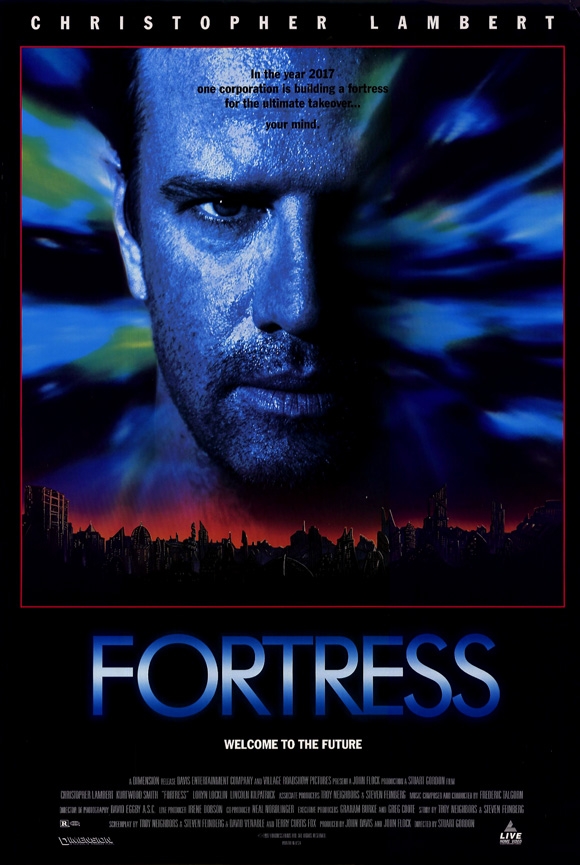
Welcome back to Misan[trope]y Movie Blog! Next up in the two week Stuart Gordon spotlight is “Fortress,” a 1992 Australian sci-fi flick starring the Highlander himself, Christopher Lambert.

“Fortress” marks one of the rare occasions where Stuart Gordon didn’t have any writing credit: he strictly directed “Fortress.” That is probably a good thing, because judging from the listed credits, there were already plenty of writers involved with the screenplay.

The initial story of “Fortress” is credited to both Troy Neighbors and Steven Feinberg, who share an initial screenplay credit with a third collaborator, David Venable. Following that, there were apparently re-writes done by Terry Curtis Fox, a scarce television writer who shares an additional (but separate) writing credit on the film. Judging by how the gymnastics sometimes go regarding writing credits on films, I wouldn’t be shocked to learn that plenty more hands were involved as well, but were left off of the final listing. I would be even less surprised to learn of some phantom writer on the project given the combined inexperienced of all of the listed writers involved.

The cinematography on “Fortress” was provided by David Eggby, a particularly well-regarded director of photography in Australia, who has extensive work on sci-fi features such as “Mad Max” and “Pitch Black” to his name.

Frédéric Talgorn returned to do the music on “Fortress” after contributing the excellent score to a previous Stuart Gordon movie, “Robot Jox.” Despite not being quite as memorable as the one he did for “Robot Jox,” the score to “Fortress” is certainly good, though perhaps unremarkable.

“Fortress” was distributed by Miramax’s Dimension Films in the United States, which was Bob Weinstein’s sub-division of the highly successful company. Dimension has historically focused on high profit-potential horror and sci-fi films, and “Fortress” was no exception. Interestingly, the Weinstein brothers retained the Dimension label when they ultimately jettisoned Miramax, and incorporated it into the current powerhouse that is the Weinstein Company today.

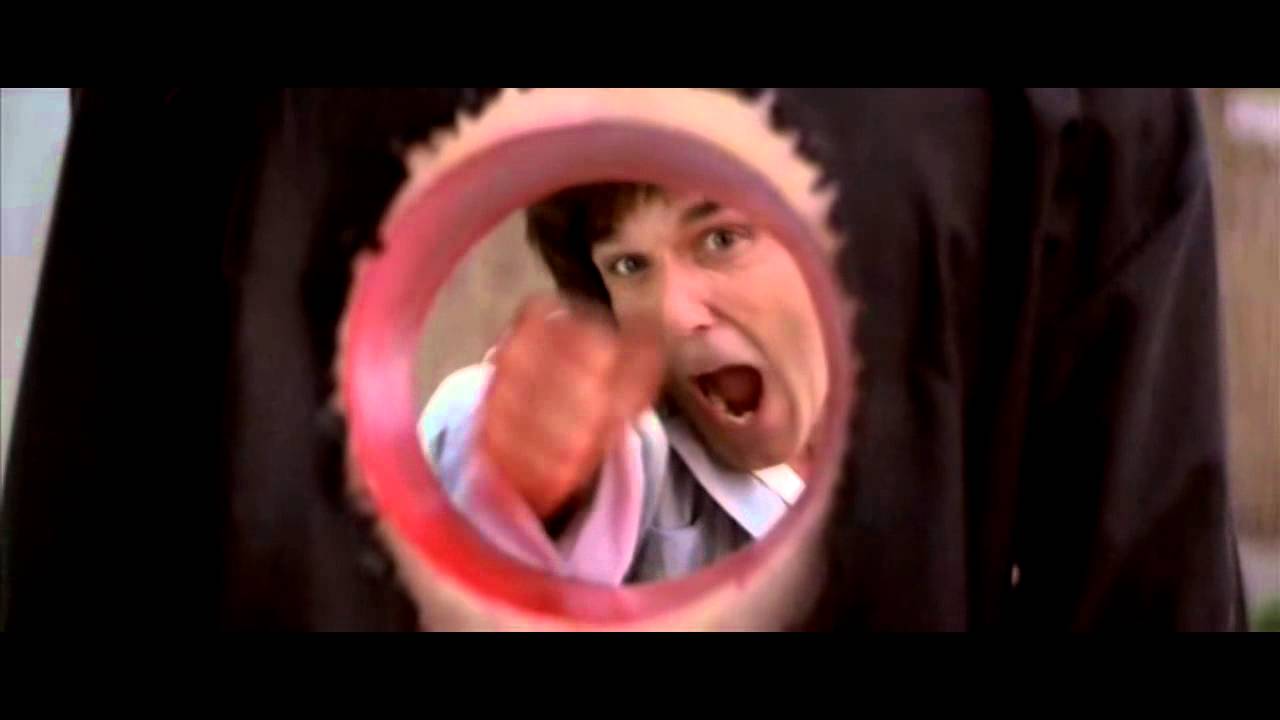
There is a lot to say about the effects in “Fortress.” There is certainly lots of gore and squibs to go around, which pushes the cheese limit on the flick. In particular, there’s a sequence where a guy has his entire stomach blown out, to the point where there is a complete and perfect hole that he can put his hand through. I’m pretty sure that was a gag in “Kung Pow: Enter the Fist,” which puts “Fortress” at the Rubicon of turning into self-parody. In spite of that, it never quite crosses that river in such a way as to lose the audience entirely, at least not in my opinion.
fortress7Something absolutely worth noting about “Fortress” is that the cyborgs and gadgets all look pretty damn cool, and fit in fantastically with the general set design (which is also top notch). That might seem like a basic thing, but I’m sure there are plenty of ways where this could have gone wrong. Practical effects are all over the place, which is a good practice for this kind of film. All of the sci-fi devices are believable and tangible, and nothing is completely ridiculous. Even the internal detonators placed in the prisoners are pretty simple explosives from the look of them. Speaking of explosives, there are also a couple of fantastic, classic explosions throughout the movie that action movie fans are sure to get a kick out of.

The effects people on “Fortress” included Robert Clark, who has worked effects and makeup on such films as “Starship Troopers,” “Mimic,” and “Cocoon,” and Robert Blalack, whose special effects credits include “Stars Wars – A New Hope,” “RoboCop,” “The Blues Brothers,” and the original “Cosmos” television series. “Fortress” also marked the first credit for the now-proficient visual effects producer Blondel Aidoo, who has worked such fantastic effects movies as “X-Men: Days of Future Past,” “Spider-Man,” and “Minority Report,” and such not-so-fantastic movies as “Marmaduke,” “Beverly Hills Chihuahua,” and “Kangaroo Jack.”

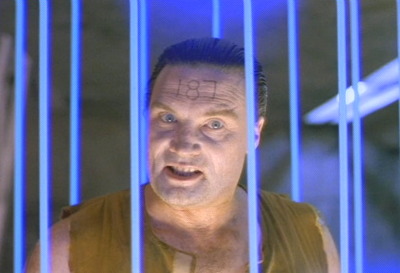
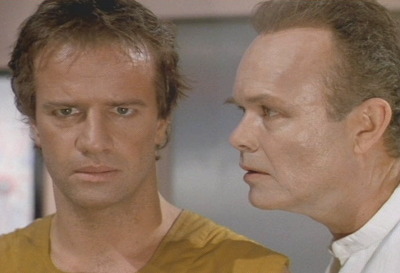
fortress3Outside of Christopher Lambert, the cast of “Fortress” includes a handful of recognizable faces, including Stuart Gordon favorite Jeffrey Combs and Kurtwood Smith of “RoboCop.” Character actor Clifton Collins, Jr. appears in an early role for him, before dropping his initial stage name of “Clifton Gonzalez Gonzalez,” which he bore in honor of his grandfather, the actor Pedro Gonzalez Gonzalez. The voice of the prison computer system is voiced by none other than Carolyn Purdy-Gordon, wife of Stuart Gordon and frequent antagonist-figure in his films. Other notables in the cast include Vernon Wells as a heavy inmate and Lincoln Kilpatrick as an aging prisoner facing parole.

fortress6The plot of “Fortress” follows a couple attempting to have a second child after an initial failed pregnancy. However, the dystopian future they live in (2017 United States, hilariously) operates on a strict one-child policy, meaning that they must attempt to cross a border out of the country without their pregnancy being detected by authorities. Unfortunately, they are caught at the Canadian border and sentenced to incarceration in an underground super-prison, where their child is to be confiscated upon birth. Lambert’s character tries to survive the hazardous world inside the prison, while also searching for a way to escape with his wife and unborn child before the out-of-control prison company can claim all of their lives.

“Fortress” made $46 million total on an estimated budget of $8 million, making it a significant financial success. However, it currently holds an IMDb rating of 5.8, a Rotten Tomatoes audience score of 48%, and a critic rating of 40%. Personally, I feel like these scores are a bit deceiving, as is the case with any film that falls within the good-bad aesthetic. Just at a cursory glance, some of those negative reviews acknowledge how fun the movie is, but give it a low score nonetheless.

Once again, as I have found with many critics’ reviews of Gordon’s movies in the past, I saw many that compared “Fortress” to Gordon’s earlier works, specifically “Re-Animator.” “Fortress” is very clearly a different kind of movie than “Re-Animator,” without any connection to the horror genre or Lovecraft, and Gordon wasn’t even involved in writing on “Fortress.” So, why on Earth would it be anything like “Re-Animator,” outside of a handful of stylistic and casting choices? It boggles my mind how some critics can’t separate the past and the present for directors and writers. I guarantee that someone out there is writing a review of “Maps To The Stars” right now complaining about how it isn’t “Videodrome” or “Eastern Promises.” You can’t ignore the body of work of a creator when writing about a new feature, but basing an entire review on it is beyond unfair.

As far as actual criticisms go, I saw a fair number of complaints about Lambert’s acting abilities. Personally, I don’t find him that distracting in general, though his accent is always pretty heavy. I usually enjoy his performances when he pops up in things, and “Fortress” is no exception. He isn’t a dynamic actor by any means, but he is pretty solid at the few character types he plays.

fortress4There are some good imaginative sci-fi elements to “Fortress” that are based on real social issues of the time: issues like the privatization of prisons, social anxieties on overpopulation, the institution of one-child laws, the use of technology in surveillance wiping away privacy, the replacement of humans by more efficient robotic workers, etc.

As far as performances go in “Fortress,” it is impossible not to mention Jeffrey Combs. He is once again solid in his supporting role, and is nearly unrecognizable with his long hair, massive lenses, and hippy-ish dialect. Also deserving of commendation is Kurtwood Smith, who is one of the best movie villains out there, period. I’m surprised he hasn’t gotten more opportunities to show it off over the years. He is incredibly memorable in “Fortress,” almost as much so as his most highly regarded role in “RoboCop.” It is just hard not to love a creepy, evil prison warden trying to get in touch with his humanity.

fortress5 fortress2There are a couple of well-executed twists and fake-out in “Fortress” that make it particularly memorable in my opinion. I really like the twist of what the government does with the “extra” children conceived outside of the one child limit. Cyborg experimentation sort of ties into aspirations of transhumanism, which is alluded to at points through dialogue as a way of dealing with overpopulation: the goal is to create a non-sexual, immortal cyborg population that will be able to sustain on the planet. It is also fun to see how the cyborg played by Smith condescends to his computer, looking down on the entity that represents a part of him that he comes to loathe. He clearly desires to be more human, and takes the frustration out on his computer. Speaking of which, the computer gets a glorious act of revenge with an outstanding death for Smith.

The ending sequence, which was apparently omitted from some versions of the movie, also features some bit I really enjoyed. There is a little bit of “Maximum Overdrive” thrown in at the last minute, which leads to a spectacular final explosion and one of the cruelest fake-out non-deaths you can imagine for the conclusion of a movie. Lambert’s reaction shot to the explosion is also hilarious, but I unfortunately haven’t been able to dig up a clip of it.

This is one of the few Stuart Gordon movies that I had not seen before this retrospective, and I was pleasantly surprised by it. Most of what I had heard was that it failed to live up to his other, more memorable works. However, I think this deserves consideration towards the top of the list for his career. I feel about “Fortress” what I expected to feel about “Castle Freak,” which is the opposite of what I was led to believe before watching them. “Fortress” is an absolute blast of a movie with some great sci-fi and action elements, hammy performances, cheesy / squibby effects, and a fun concept at the core. I think this movie generally deserves a second look, because I found an awful lot to like about it.

If you are looking for a fun flick for a bad movie showcase, I think “Fortress” will certainly fit the bill to your satisfaction. I mean, it is a sci-fi prison break movie featuring Herbert West, Connor MacLeod, and Clarence Boddicker. What about that isn’t to love?