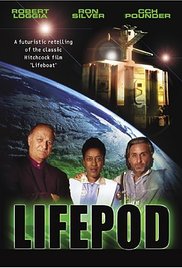
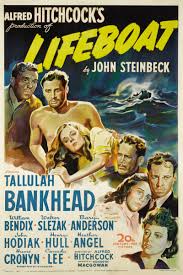
Today’s feature is an ambitious remake of Alfred Hitchcock’s Lifeboat, with a science fiction twist: 1993’s Lifepod.
Lifepod was directed by the well-regarded character actor Ron Silver, who is best known for movies like Timecop and The West Wing. However, it was his only directorial feature over his career.
The screenplay adaptation for Lifepod is credited to producers Jay Roach and Pen Densham, who each have a handful of television writing credits for shows like Space Rangers and Poltergeist: The Legacy.
The cast for Lifepod includes director Ron Silver, Robert Loggia (Over The Top, Scarface), and C.C.H. Pounder (Face/Off, RoboCop 3), among others.
The score composition for the movie was done by Mark Mancina, who was in a bit of a transitional period at the time. Before Lifepod, his credits included primary low-budget fare like Space Mutiny. Following Lifepod, however, he got the chance to dictate the music on some much larger productions, such as Speed, Speed 2: Cruise Control, Bad Boys, Twister, Con Air, Tarzan, and Training Day.
Alan Baumgartner served as the film’s primary editor, whose credits since include comedies like Zombieland, Meet The Fockers, and Dodgeball: A True Underdog Story, as well as more recently acclaimed movies like American Hustle, Trumbo, and Joy.
Lifepod was made specifically for television broadcast, and was first debuted on June 28, 1993 on Fox. It currently holds an IMDb user rating of 5.9/10, which, while far from stellar, could certainly be much worse.
The plot of Lifepod is summarized on IMDb as follows:
Lifepod chronicles the trip of eight passengers after the ship they were traveling on blew up on Christmas Eve. Immediately people start dying. The passengers begin to investigate why the ship blew up and how it relates to them.
Remaking a Hitchcock movie well is a difficult task to say the least: some could argue that even Hitchcock himself wasn’t very good at it (I personally prefer the first Man Who Knew Too Much). So, when I first heard about the oddity that is Lifepod, I knew I had to check it out. Shifting the setting and genre for a remake can yield interesting results, and distance the remake enough from the original that it isn’t judged as harshly as it could be. On top of that, these kinds of shifts can allow the writers and director a little more creativity with the material.
In the case of Lifepod, I think that this source material is uniquely suited to this particular re-imagining. The similarities of being lost at sea and being adrift in space are notable, and the interpersonal tensions intrinsic to the story are universal in such a way that the temporal setting doesn’t impact their potency: betrayal is just as shocking and painful in the 30th century as in the 20th.
Lifepod isn’t a masterpiece by any means. Not only are there some mediocre effects and performances, but the pacing isn’t great, and the music doesn’t do a very good job of building the necessary tension to make the story really punch. That said, there are enough compelling moments to make this movie worth watching, beyond its gimmicky value as a Hitchcock remake in space. Silver in particular gives a memorable performance, and the cast (for the most part) play pretty well off of each other. The set design is also pretty decent, though I wish the pod had more of a claustrophobic feel to it: it is hard to tell just how big it is throughout the movie. In general, however, this is definitely a stand-out as far as television movies go.
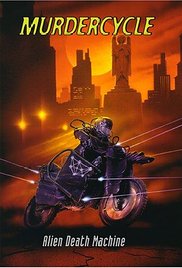
Today’s flick is a little-known 1999 feature from the infamous library of Full Moon Entertainment: the amazingly-titled Murdercycle.
Murdercycle was distributed by Full Moon Entertainment, an outfit run by Charles Band that is infamous for b-level horror movies like Castle Freak, Demonic Toys, and Dollman, and notoriously terrible franchises like Puppet Master, The Evil Bong, and The Gingerdead Man.
Apparently, Murdercycle was created from the remnants of an unrealized Charles Band project from back in the days of Empire Pictures, which would have involved motorcycles battling each other in something called Battle Bikes. However, it didn’t get made before Empire folded, and Band went back to the drawing board years later under his new Full Moon label.
Between the director and two credited screenwriters for the movie, only one of them has any other credits to his name: writer Neal Marshall Stevens, who used his frequent pseudonym “Benjamin Carr” for the project. His other credits include Retro Puppet Master, Hellraiser: Deader, and Thir13en Ghosts, along with a handful of other low budget horror films.
The plot of Murdercycle is summarized on IMDb as follows:
A meteor falls to earth near a secret CIA military hideout and merges with a motorcycle and it’s rider to create an alien soldier bent on recovering an alien artifact. Military soldiers with the help of a female doctor that can read minds try to figure out what is going on and how to stop it before it kills them. They are also hindered by the CIA agent in charge of the base who refuses to divulge the hideouts’ secrets which could help them.
At first glance, Murdercycle seems to have all of the required elements for a fun b-movie. Honestly, I was sold on the title alone. A killer motorcycle? How could that be boring?
I went into Murdercycle without any other background than that. Based on the title, I thought of a few directions the movie might go. It could be a story like Death Proof or The Hitcher, about an unhinged biker who builds a rig equipped with blades, explosives, and gadgets for terrorizing people on the road. Or, maybe the motorcycle is just operating itself for purposes of mischief and murder, like a Maximum Overdrive or Killdozer situation. Either way, I would have been more than content.
Instead, Murdercycle has very little to do with the titular vehicular manslaughterist (which, as it turns out, is an alien that absorbs technology). The movie is, weirdly enough, a bit of a character drama, and spends a lot of time focusing on betrayals, interpersonal tensions, and widespread deception. The murderous wheeler is an occasional interjection of lackluster pyrotechnics into what is otherwise a military drama. While that might sound kind of intriguing to some, the characters and dialogue are pretty severely lacking, and the acting ranges from “soap opera adequate” to “community theater unqualified.”
The motorcycle itself is disappointing as well. It isn’t even a motorcycle as much as it is a dirt bike with a bunch of vaguely menacing accoutrements glued onto it. To say the least, it didn’t match the image of a bladed, chrome, roaring Harley Davidson beast with a taste for blood that was initially conjured in my head from the title.
The MurdercycleGoogle Image result for “evil motorcycle”Google Image result for “killer motorcycle”
An unexpected amount of time in the move is dedicated to vaguely interesting philosophical issues, like the ethics of Artificial Intelligence and the potential boundary-violating practice of mind reading. Weirdly, though, the ability to read people’s thoughts is taken as a given,and is apparently public knowledge in the world of the movie: one of the central characters is a psychic, and no one is terribly surprised, alarmed, or even incredulous about that claim.
The real problem with the injecting of these philosophical ideas into the story isn’t that they are there (science fiction really should intersect with philosophy), but how they are written in. Every time one of these thought-provoking issues comes up, the movie grinds to a complete halt, and they are addressed with the subtlety of a hammer on a gong. Even worse, they are addressed really poorly, like you are sitting in on the first session of a Philosophy 101 course.
Likewise, the writers clearly wanted to slip in references to comic books in the screenplay, which is something that can be done well and effectively without distracting the audience. However, instead of making the references organic and natural, the characters are written to go out of their way to mention specifics about the Fantastic Four over and over again, beyond the point of saturation.
Honestly, this is one of the most disappointing movies I have seen in a long time. Not only is the title golden, but there were plenty of ways to make the movie better, even with the existing plot. I actually appreciate some of the ideas presented here, which indicate some ambition in the writing, but the execution was disappointingly sloppy. The end result of it all is a movie that is basically Predator, but with freshman philosophy discussions instead of over-the-top machismo, and an amateurishly-decorated dirtbike instead of a terrifying alien.
This past week, I had my first opportunity to experience Fateful Findings, a movie from the contemporary trash cinema master, Neil Breen.
Neil Breen, who performed just about every major role behind the scenes of the movie, is apparently a successful Las Vegas architect who self-funds his film productions with his profits. On top of his numerous behind the scenes duties, he also stars in all of his films, and Fateful Findings is no exception.
Fateful Findings was released in 2013, and is Breen’s third feature-length work. A fourth feature, Pass Thru, is due to release in 2016.
Fateful Findings is a movie that almost defies summary. There are so many sub-plots, dropped threads, and non-sequiturs that the story is barely coherent. On IMDb, the plot is broken down as follows:
A small boy discovers a mystical power as a child. He is then separated from his childhood girlfriend. He grows up to be a computer scientist who is hacking into the most secret national and international secrets, as well as being an acclaimed novel writer. His childhood ‘finding’ gives him amazing paranormal powers. He is reunited with the childhood girlfriend, mystically, on his hospital deathbed… as his relationship with his current drug addict girlfriend is deteriorating. The passions build between the threesome. Mystical, psychiatric and worldly forces rise to prevent him from revealing the hacked secrets. He attempts to reveal all in a Washington DC large press conference, with ‘fateful’ and dangerous consequences.
Fateful Findings is one of the most deeply incompetent films I have seen in a long time. Honestly, Coleman Francis, who could never quite figure out how sound worked on film, made more watchable movies than Neil Breen. Not only is Fateful Findings written in a confusing, convoluted, and rambling way, but both the sound and visuals are lacking on a near-parallel level.
Any given sequence might feature an airplane flying overhead, a loud air conditioner, inexplicably loud ambient tones, or silence for no apparent artistic purpose. Really, the sound throughout the movie is a crap shoot in every way imaginable. There is even one sequence where the sound of keyboard typing continues in the background after the character is no longer on the computer.
The visuals are primarily comprised of awkward close-ups, with occasional strangely set up two shots. A number of sequences feature two or more people at a table, which rapidly become confusing thanks to the way the shots are structured, and the fact that Breen can’t seem to fit more than two people in any given shot. Even worse, however, is the fact that the acting is all truly horrendous, which makes the pressure of the closeups unbearable. On top of that, the editing leaves in long stretches of silence between lines, that only serve to enhance the awkwardness of their deliveries.
Honestly, I could go on forever nitpicking specific issues with this movie. However, here is the key takeaway: with the right group of people, Fateful Findings is a blast. This is a weird movie that takes itself way too seriously, and is all the more comedic because of it. It is almost artistic in its lack of cogency, and in how it revels in its own terrible form and practice. Surreal might be the right word for it, but I would hesitate to give it that much credit: it is a nonsensical fever dream of a concept that somehow made it to film without getting translated into any language at all.
Today I’m going to take a quick look at a b-movie classic: The Thing With Two Heads.
The Thing With Two Heads was a 1972 low budget movie that was presented by the notorious Samuel Z. Arkoff, and distributed by American International Pictures. The film’s writer/director, Lee Frost, had a long career making exploitation features, including 1975’s The Black Gestapo.
The plot of The Thing With Two Heads is summarized on IMDb as follows:
A rich but racist man is dying and hatches an elaborate scheme for transplanting his head onto another man’s body. His health deteriorates rapidly, and doctors are forced to transplant his head onto the only available candidate: a black man from death row.
The movie primarily stars Academy Award winner Ray Milland and former NFL star Roosevelt Grier as the mismatched central pair.
Effects legend and winner of many Academy Awards Rick Baker appears briefly in the film in a gorilla suit, and apparently did work on the effects as well, though without credit.
The score for The Thing With Two Heads was provided by Richard O. Ragland, who also provided music for Q: The Winged Serpent, The Touch of Satan, and Grizzly, among many others low budget features.
Nowadays, The Thing With Two Heads is regarded as an off-color cheese-ball classic of trash cinema, that certainly has a bit of a cult following. Roger Ebert gave the movie a 1-star review, and IMDb currently has it at an unenviable 4.1/10 from its user base, but it certainly hasn’t disappeared into absolute obscurity by any means.
The Thing With Two Heads is certainly a movie made for its time period. This reminded me in some ways of Bone, and in other ways of the standard field of blaxploitation movies that came out in the 1970s. However, its goofiness kind of defies classification: it is hard to call this anything other than a b-movie, though there are definitely blaxploitation elements. It isn’t what anyone would call progressive in its portrayal of race, but given the time period, it certainly could have been worse.
The movie certainly isn’t good by any stretch of the imagination, but it has some odd value as a silly relic of its time period. For b-movie fans who can stomach lesser Roger Corman movies, The Thing With Two Heads shouldn’t be any trouble, and might be worth checking out. The effects and stunts are in particular pretty hilariously inept, which are almost worth the experience on their own.
Hello, loyal readers! I’ve been a bit swamped as of late, and haven’t had the chance to write a full review this week. I do, however, have a quick recommendation:
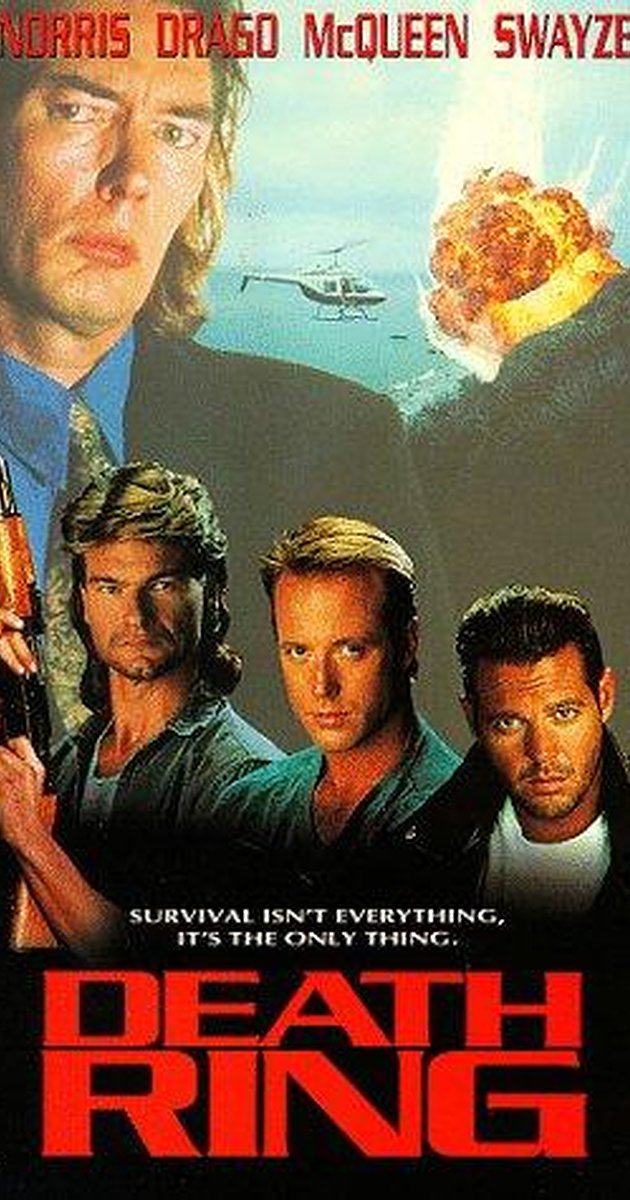
Don’t let that trailer throw you off: None of Patrick Swayze, Chuck Norris, or Steve McQueen are in this movie. Instead, this movie stars a bunch of people who have common last names with those people, which is about as hilariously deceptive as b-movie gimmickry gets.
This is a pretty clear cut Deadliest Game kind of human hunting movie, so the plot isn’t anything to write home about. However, the action scenes and the acting are delightfully cheesy. It may not be the unadulterated glory that is Deadly Prey, but Death Ring is a pretty good time for you b-movie fans out there. In particular, I enjoyed all of the creative cutting used to avoid moderately expensive gore effects. I assume they didn’t think anyone would notice.
The best part of the movie, however, is that fact that director R.J. Kizer has actually made it kind of big since the early 1990s. He is now an ADR editor with a whole lot of big studio credits under his belt. Deadpool, Inception, X-Men: First Class, Daredevil, Night at the Museum, The Dark Knight Rises, Jingle All The Way, Alien Resurrection, Street Fighter, and Showgirls are just a few among many movies he’s worked on since directing Death Ring in 1992.
Even better, he has had two other directorial credits in his career. One of them is a b-movie classic that you might be familiar with: Hell Comes To Frogtown.
Yesterday, I had the chance to catch a pre-release tour screening of the latest film by Kevin Smith: Yoga Hosers. This horror-comedy (or comedy-horror) is a quasi-sequel to Tusk, and focuses on a handful of characters from that movie on a new adventure involving a Canadian Nazi conspiracy. Because this movie hasn’t hit theaters yet, I’m going to preface this review with a SPOILER WARNING.
Yoga Hosers was written, directed, and edited by Kevin Smith, a once-revered Sundance darling and Miramax loyalist who is now known for his sprawling podcast network, oversized hockey jerseys, and nerdy ramblings. However, he has never stayed away from movies for long, in spite of often claiming to be done with the medium. Yoga Hosers is the second in his planned “True North” trilogy: a series of movies set in Canada that was kicked off by Tusk, and will conclude with Moose Jaws at an undisclosed future time.
Smith’s cinematographer for the movie was James Laxton, who previously worked for him on Tusk, and has worked on an assortment of other films like Bad Milo and Nightcrawler.
The music for Yoga Hosers was provided by Christopher Drake, who has primarily worked on DC animated movies and video games like Injustice: Gods Among Us, Batman: Under The Red Hood, Justice League: Doom, and Batman: Arkham Origins.
The special effects and creature work for Yoga Hosers were overseen by Robert Kurtzman, who has had a long career working on films like Tusk, It Follows, The Faculty, John Dies At The End, the From Dusk Til Dawn trilogy, Vampires, In The Mouth of Madness, The People Under The Stairs, 976-EVIL, DeepStar Six, Army of Darkness, Tremors, and From Beyond, among many others. He even directed a handful of movies, like Wishmaster.
Yoga Hosers stars Johnny Depp (Donnie Brasco, Black Mass, The Lone Ranger, Sweeney Todd, Charlie and the Chocolate Factory, A Nightmare On Elm Street), his daughter Lily-Rose Melody Depp, Kevin Smith’s daughter Harley Quinn Smith, Kevin Smith’s podcast co-host Ralph Garman (Red State, Ted), Haley Joel Osment (Entourage, The 6th Sense), Tony Hale (Veep, Arrested Development), Justin Long (Drag Me To Hell, Accepted), Kevin Smith’s wife, Jennifer Schwalbach Smith (Red State, Jersey Girl), and Kevin Smith himself.
Initial reviews for Yoga Hosers are pretty negative. As of June 13th, 2016, Yoga Hosers has an IMDb user score of 4.9/10 with 499 votes tallied, and a Rotten Tomatoes critic score of 25%, with 20 critic reviews in.
The idea for Yoga Hosers was born on the set of Tusk, when Harley Quinn Smith and Lily-Rose Melody Depp were thrown in as minor characters in a convenience store scene on a whim by Kevin Smith. The result, according to Smith and Johnny Depp, was a surprisingly natural performance from both girls, and an impressive chemistry. Upon completion of the film, Smith claims that Johnny Depp expressed interest in reprising his character in the future, all of which planted the seeds for Smith to write a screenplay around the three minor Tusk characters.
The design and tone of Yoga Hosers was intended to imitate the sorts of movies that would run on late night cable during Smith’s childhood. In particular, Kevin Smith has cited Re-Animator, From Beyond, and Puppetmaster as the sort of movies that inspired Yoga Hosers. However, instead of making a movie purely in that vein, he wanted to center the story on teenage girls, once he realized that that demographic wasn’t able to enjoy those same movies he could, due to a lack of representation.
Yoga Hosers, unfortunately, doesn’t quite succeed in its aims. While there is some humor that would probably resonate with young women (primarily centered on texting and contemporary technology), most of the humor in movie is referential. For instance, the biggest laughs I recall from my screening were from cameos by people like Stan Lee and Kevin Conroy, or from direct references to other Kevin Smith works (primarily podcast in-jokes and one blatant Clerks reference). Worse than that, however, is the sheer quantity of tired non-jokes in the screenplay: exaggerated Canadian accents and cultural jokes are milked endlessly, awkward banter with Johnny Depp doesn’t play, celebrity impersonations are almost as prominent as they were in Master of Disguise, and the villainous “Bratzi” minions are a collective high pitched, shouting annoyance.
While there is nothing necessarily wrong with any of this (it is all a matter of preference, I guess), I have trouble believing that any of these elements would really appeal to tween girls, as Kevin Smith apparently intended. All of these things seem far more geared to appeal to middle-aged (and stoned) Kevin Smith fans than anyone else.
The thing that seems almost beyond belief to me is the fact that Johnny Depp gives the worst performance in a movie with two non-actor leads. Honestly, the Depp and Smith offspring do have good chemistry, and are generally ok with the load they were given. Depp, on the other hand, is just as jarring and unfunny as he was in his first turn with the character in Tusk. Apparently, his fascination with the character stems from, predictably enough, an obsession with facial prosthesis. Much like Eddie Murphy, Depp seems to have fallen into a trap in which he needs to be behind some sort of mask to give a performance. Even in Black Mass, in which he is quite good, he is transformed with makeup into another person. The manhunter Guy Lapointe is, as Smith tells it, a way for Johnny Depp to wear a prosthetic dick on his face (that was, apparently, VERY intentional), and use a fake accent that has annoyed the people closest to him for years. Now, Depp has a platform to annoy the movie-going public with it as well, or at least whoever actually shows up for Yoga Hosers.
The effects work in Yoga Hosers honestly perplexed me. I’m not sure if the green screen work was intentionally bad as a sort of homage, or if it was just shoddy. To Kurtzman’s credit, the sausage monsters are unsettling, but the use of CGI gore (well, saurkraut) looks absolutely unforgivably awful. The thing that stood out most, though, was the centerpiece of the film: a Nazi-crafted Golem built out of human remains and bratwurst in the shape of a hockey goalie. Looking past the obvious insensitivity of including a Nazi-built Jewish folkloric figure, the monster looks implausibly fake. Again, this might have been homage, but I couldn’t get past how clearly rubbery the texture looked. Compared to his work on Tusk (or any number of other films), the “Goalie Golem” just looked bad.
What really annoys me most about Yoga Hosers is that the parts are so much better than the product. Johnny Depp is a capable actor, Robert Kurtzman is a wizard, Kevin Smith is a decent director (and far better writer), and the stated motivations behind this movie are fantastic. I am a huge fan of the same kinds of movies that drove Smith to make Hosers, and I am also in agreement that women and girls need more representation in popular fiction. Yoga Hosers, in theory, is a movie that needs to me. That is why I feel so disappointed that it isn’t actually that movie.
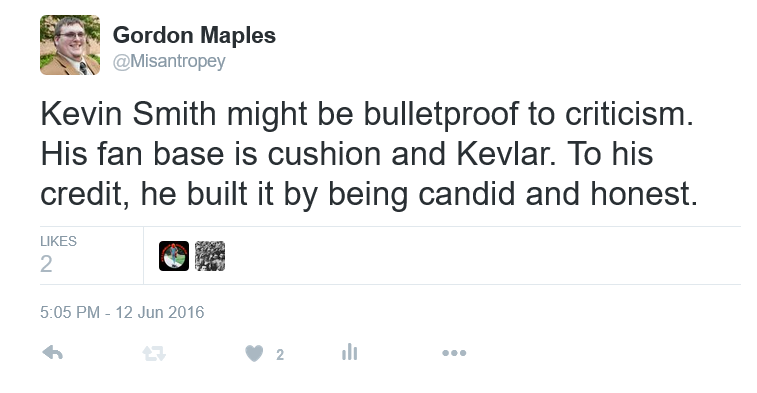
Lastly, there is a big problem underneath this movie that seeps out in some not-so-subtle ways. Kevin Smith has a long-standing chip on his shoulder with the very concept of film criticism. For as easy-going, likable, inspiring, and positive-natured as the man usually is, Smith has nothing but contempt for those how would dare to point out flaws with a Kevin Smith movie. From what I can tell, this dates back a long way, at least to Jersey Girl, but really went into meltdown after Cop Out. In Yoga Hosers, he goes so far as to give the villain a distinct motivation: a desire to execute all art critics, which sets up a number of tired critic jokes. This reminded me a lot of the 1998 Godzilla, in which Roland Emmerich included a character based on Roger Ebert in order to mock him. The result, as you might expect, is that Emmerich looked like a petty jackass. Now, Kevin Smith has sunk roughly to the same level, which is regrettable to say.
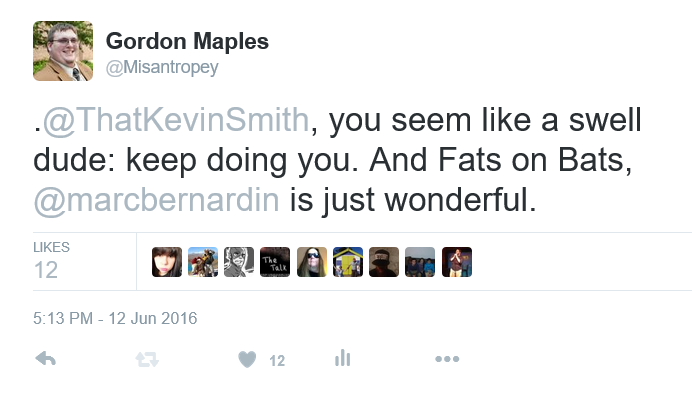
The thing is, I generally like Kevin Smith as a personality and nerd pundit. The screening of Yoga Hosers I went to took nearly 5 hours, but the movie itself was only a fraction of that time. Kevin Smith knows how to talk and endear himself to fans: he is honest and candid in a way that should doom him in the confidential land of Hollywood, but the admiration he has endeared has kept him afloat for years. Just the experience of listening to him talk has brought people out to theaters across the country, and his audience online likely dwarfs even that. As a public figure, Smith makes people laugh, and inspires lots of people to create. Honestly, that seems to be his true passion at this point. Unfortunately, his movies just aren’t as compelling as he is. There is a reason his tours are more Q+A than movies now: on a deeper level, people really want to hear him and experience him, not watch his movies.
All in all, I’ve been pulling for Smith to resurrect his film career. I really liked Red State, and thought that Tusk had some good highlights. Yoga Hosers, though, is a huge fall. It is everything negative that I feared it might be from the time it was announced. That said, I’m optimistic about Kevin Smith focusing on television: I think it might just suit him better at this point. As for Yoga Hosers, this is really only watchable for Kevin Smith fans, and even then, it is a toss-up. My advice is to skip this one.
![Misan[trope]y](https://misantropey.com/wp-content/uploads/2014/10/misantropeyhead1.png)








 Misan[trope]y