“A Fight For Faith” was originally released in December of 2004, and marked the final entry into “The Bibleman Adventure,” which was the second incarnation of the franchise after the short-lived “The Bibleman Show.” The franchise would continue with “Bibleman: PowerSource” in 2005, following the adventures of the new Bibleman introduced in “A Fight For Faith.”
“A Fight for Faith” was co-written by Brady Williams and Jef Scott, the actors who portray Cypher and Wacky Protester, respectively. The director for the episode, a role that had long been handled by the now-absent Willie Aames, is Jim Standridge, who had been a cinematographer on the show dating back to “Breaking the Bonds of Disobedience.”
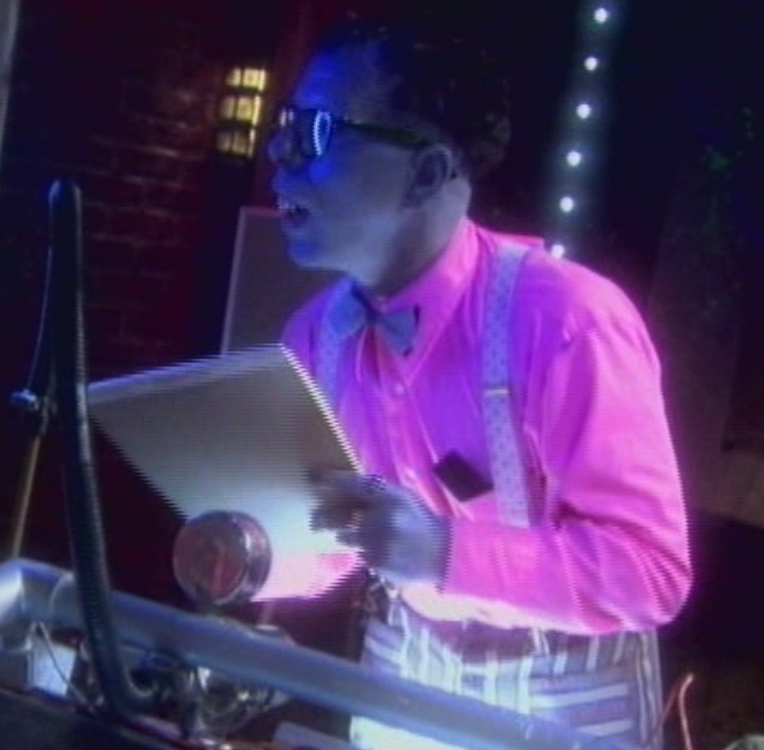
The villain of “A Fight For Faith” is played by Jef Scott, who appears yet again under the moniker of “The Wacky Protestor,” a character who was notably killed at the end of “Divided We Fall.” Apparently, death once again holds no meaning in the Bibleman universe, as he returns apparently unharmed. The evil computer, L.U.C.I., also makes an appearance as his quasi-henchman once again.
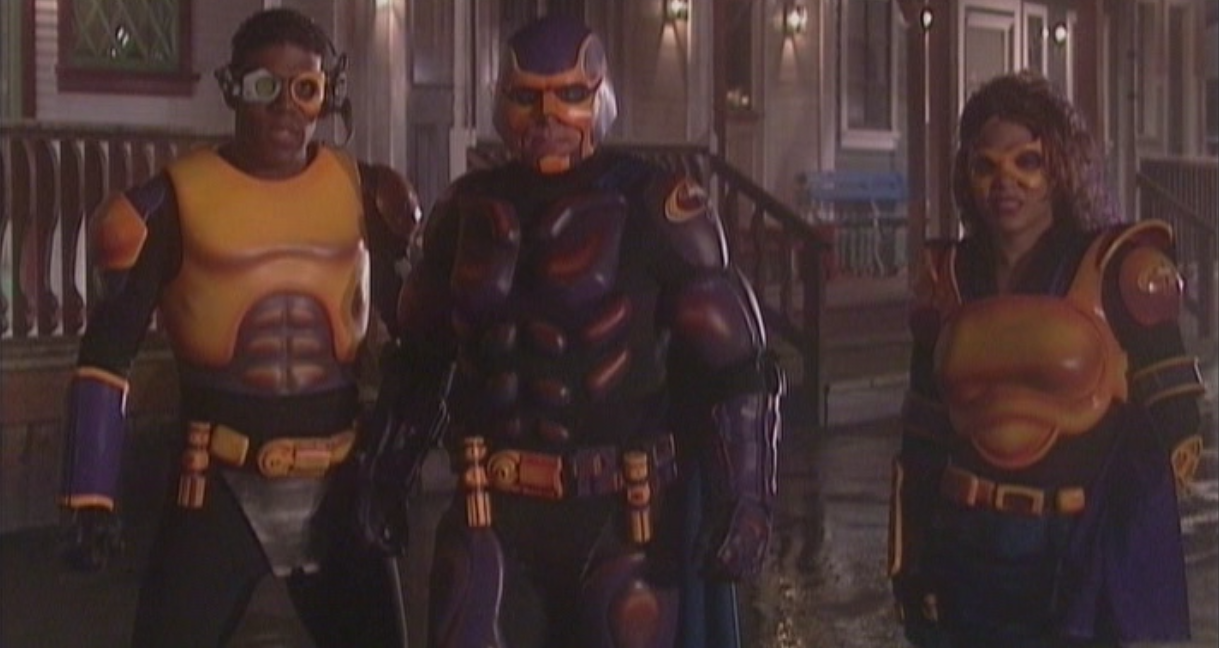
Bibleman is surrounded by his same typical group of allies: Cypher, Biblegirl, and U.N.I.C.E., though Bibleman himself is a new character: Josh Carpenter, who replaces Miles Peterson as the crusading hero.
The story of “A Fight for Faith” centers around a plan by Wacky Protester to literally convert the whole world to atheism through the help of a virtual reality video game that he calls “ART.” The new Bibleman, Josh Carpenter, has to work with the rest of the bible team to save the day.
L.U.C.I.: So, you want to convert the kiddies to atheism?
Protester: Yes! Yes! That’s correct! The belief that there is no god, no faith, no hope, or no future.
The face of the atheist revolution
“A Fight for Faith” starts with a cold open, where Cypher is attempting to stop a band of bible thieves. Literally, this gang is hauling around giant crates labeled “BIBLES.” Now, if there is anything I know about bibles, it is that they are numerous in quantity and can easily be acquired for free, thanks to the Gideons. So, what exactly is the point in stealing crates filled with bibles? I just don’t get it: they aren’t worth anything, people can access them anywhere, so what exactly is the purpose of the act outside of empty symbolism (which is also irrelevant, because they are doing this in secret). Apparently, their ultimate plan is to burn them. However, I don’t understand why they didn’t just collect the countless free bibles floating around out there to do that? The cost/benefit of going through the trouble and hazard of stealing them from a warehouse just doesn’t make sense to me, particularly for the purpose of what I assume is a political display.
Part of the plot that I didn’t cover in my summary is that the Wacky Protester at one point manages to sneak into a church, unquestioned, and essentially hypnotizes and kidnaps a number of kids from their vacation bible school. And it isn’t like he is sneaky or subtle: he wears the worst possible disguise, acts blatantly suspicious, and is hauling around a mysterious device that literally has “I ❤ Evil” painted on it. I’d be hesitant to trust any institution to keep children that fails to catch that in a security net.
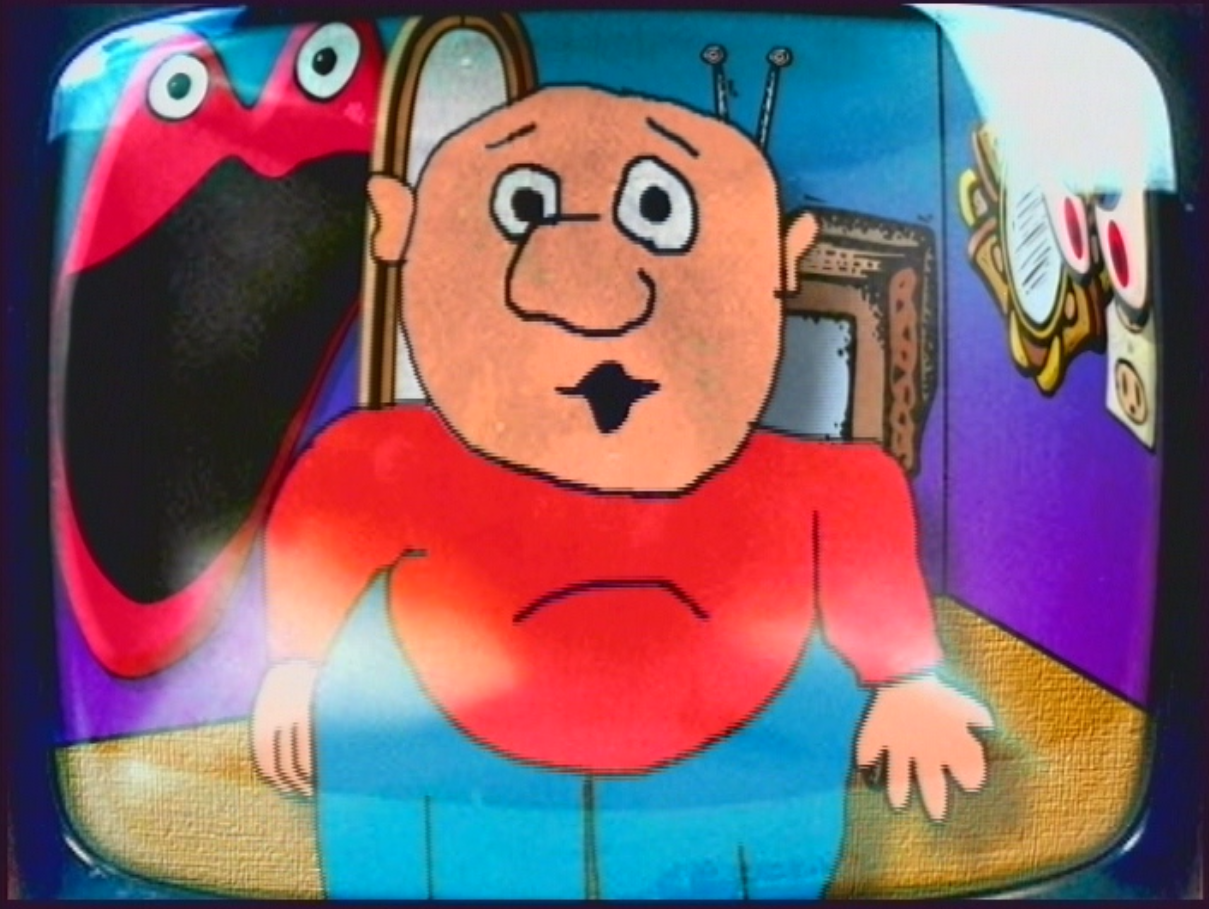
Speaking of which, the evil, atheist video game that Protester uses to trap children in is definitely one of the weirdest things to ever show up in the show. It isn’t a virtual reality game as much as it is a portal to an alternate dimension that is filled with bright colors, cartoons, 2-D images, and nightmares:
The final showdown of the episode features, among other things, a sing/dance-off between Wacky Protester and Cypher, who are notably also the two co-writers of the episode. Apparently, they were just dying to do a duet, so they wrote one for themselves. The episode concludes with Protester getting trapped in his trippy video game dimension, which I suppose spares him the almost guaranteed brutal death that he was going to face at the hands of Bibleman and company.
“A Fight For Faith” may be the most popular episode in the entire franchise, as it is the only one to inspire both a live stage adaptation and a video game. It might just be that the episode title was catchy, but this is definitely the one Bibleman story I have run into the most often, in one incarnation or another.
Something that I can’t help but wonder is how burned Brady Williams, the actor who plays Cypher, was about not getting to become Bibleman after Willie Aames left the show. It seemed like he was being groomed for it, and his presence with the program dated back a long way. However, I suppose it was decided that the conservative, evangelical consumer base wasn’t ready for a black Bibleman. After all, this was only 2005!
I don’t think I have to go into too much detail as to how this episode is offensive and generally shitty to secular people. I mean, the entire premise of the story is that not believing in god is bad and wrong, and that there is literally nothing imaginably worse than a world populated and run by nonbelievers. The entire notion of a moral code beyond the bible is an entirely alien concept from the point of view of the show’s creators. The goal here is clearly to stigmatize anyone who doesn’t believe in god, and to convey that message directly to an audience of young children. In a series packed with lazy stereotypes and bad advice, this is the most brazenly offensive of the bunch in my opinion.
Of course, all of that also means that this episode is, unintentionally, an absolute laugh riot. The lack of understanding and comprehension of technology, atheism, science, and generally everything in this episode is exponentially more over-the-top than anything that has been in the show up to this point. It is enough for me to wonder if Willie Aames was actually a moderating creative force for the program. In any case, this episode makes for a strong recommendation from me: there is plenty of nonsense to enjoy here.
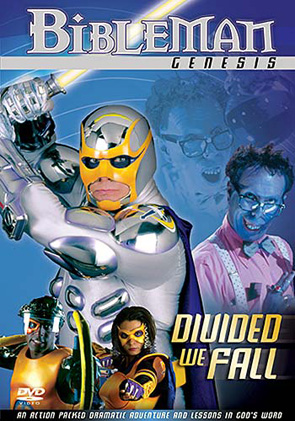
“Divided We Fall” was originally released in March of 2004, and was the eleventh entry into “The Bibleman Adventure,” which was the second incarnation of the franchise after the short-lived “The Bibleman Show.”
“Divided We Fall” was produced and directed by former sitcom star Willie Aames, who once again takes top billing as the central hero, Bibleman. This episode was written by Brady Williams, the actor who plays Bibleman’s sidekick, Cypher.
The villain of “Divided We Fall” is played by Jef Scott, who appears yet again under the moniker of “The Wacky Protestor,” a character who was previously defeated in “A Light In The Darkness.” The evil computer, L.U.C.I., also makes an appearance as his quasi-henchman.
Bibleman’s allies in “Divided We Fall” are his long-time sidekick, Cypher, his supercomputer, U.N.I.C.E., and Biblegirl, who is still played by Heather Hazelwood/McSmith from “Jesus Our Savior” and “A Light In The Darkness.”
The story of “Divided We Fall” picks up when the Wacky Protester tries to use the horrifying (and apparently popular) children’s show “Mr. Funky’s Wild Time” to corrupt children across the nation into becoming rebellious and disobedient. Likewise, he plans to sew discord within Bibleman’s team by using L.U.C.I to pose as U.N.I.C.E. for the purpose of spreading misinformation between them. Interestingly, that sounds really similar to “Silencing the Gossip Queen,” though that episode focuses on causing tensions between annoying children as opposed to annoying adults.
This is a hit children’s program in the Bibleman universe
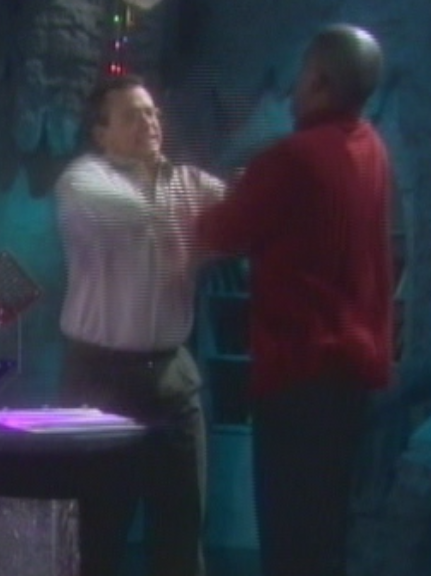
The Protester’s plan hinges on the assumption that Bibleman, Biblegirl, and Cypher won’t actually talk to each other like adults at any point, and prefer being passive aggressive and in-communicative indefinitely. Of course, it initially works because they are essentially giant babies (complete with a slap fight between Cypher and Bibleman), but they do eventually figure things out and foil his plan.
Of course, there is another big flaw in the Protester’s plan: the fact that he bothered to go after Bibleman at all. If he hadn’t hacked into U.N.I.C.E., the team would never have been tipped off as to his plan for “Mr. Funky’s Wild Time,” and he would have gotten away with it. I mean, how exactly was Bibleman going to predict his plan of attack on this television show anyway? If Protester had just hacked into the show and not been obsessively preoccupied with the bible team, he would have a legion of mindless children at his command…or something like that. Y’know, that part of the plan doesn’t make a whole lot of sense either. Aren’t children pretty unruly and rebellious anyway? Was his plan to send a bunch of children into puberty early?
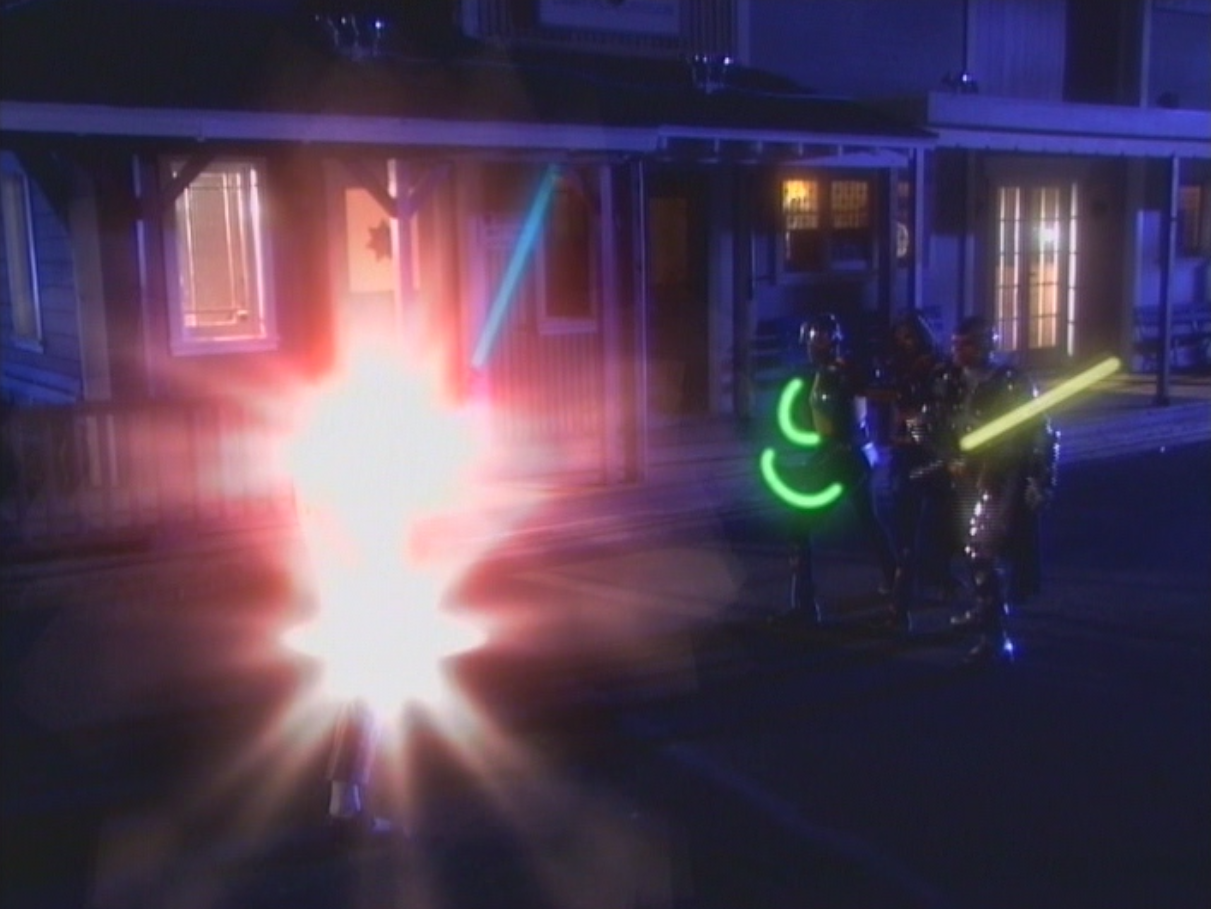
The Wacky Protester finally gets an explosive death in “Divided We Fall,” after taking a series of deflected laser blasts from the bible team. It is actually a bit underwhelming for a Bibleman villain death, but it is still pretty brutal for a humanoid to explode into pixels I suppose.
“Divided We Fall” marked Willie Aames’s last appearance as BibleMan, and there is even an awkward reference to Bibleman’s age and potential retirement in the episode. I’m not sure what the situation was in regards to his departure from the show, but I do know it at least had something to do with a change of publisher and the relaunch of the series as “Bibleman: PowerSource,” which occurs following the next episode (“A Fight for Faith”).
Overall, this episode is far from one of the worst in the series, and certainly benefits from the presence of the Wacky Protestor. However, there aren’t any goofy potions or spells, which is always one of the more goofy qualities of the show. There is plenty of impossible hacking magic, terrible acting, and incompetence from the bible team to go around, though. This is another one that isn’t towards the top of my list, but one could do much worse for an adventure with Bibleman.
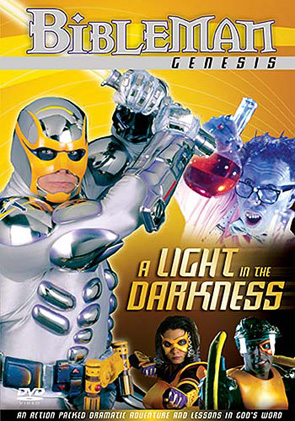
“A Light In The Darkness” was originally released in January of 2003, and was the tenth entry into “The Bibleman Adventure,” which was the second incarnation of the show after the short-lived “The Bibleman Show.”
“A Light in the Darkness” was written and directed by former sitcom star Willie Aames, who once again takes top billing as the central hero of Bibleman.
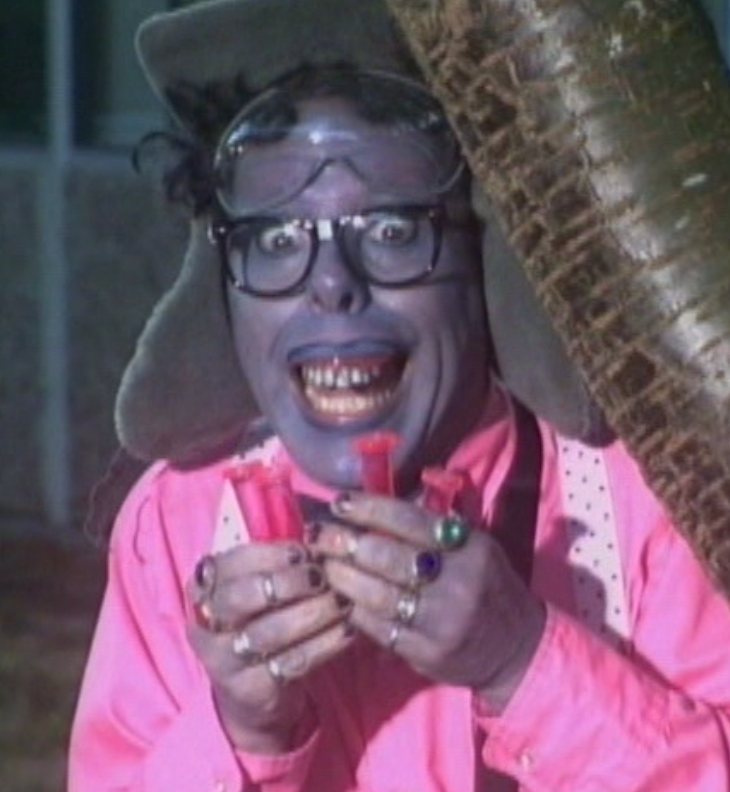
The central villain of “A Light in the Darkness” is again played by Jef Scott (who was previously Primordious Drool in “Jesus Our Savior”), but this time under the moniker of “The Wacky Protestor,” who can best be summed up as an evil Jewish scientist atheist clown. Oddly, he doesn’t really have any qualities of a protestor, not does he particularly do any protesting of anything. The evil computer, “L.U.C.I.,” also pops up once again as his support.
Bibleman’s allies in “A Light in the Darkness” are his trusty sidekick, Cypher, his supercomputer, U.N.I.C.E. (who receives an upgrade in this episode), and Biblegirl, who was actually a bit of mystery for me here. At first I thought that she had been re-cast again, because the credit on the episode is “Introducing Heather McSmith,” whereas she has previously been credited as Heather Hazelwood. ‘Hazelwood’ is also listed on the DVD credit, and after some research, it appears that the same actress has used both names. However, that doesn’t really explain why they continued using the ‘introducing’ credit after her first episode. Bibleman’s first sidekick, Coats, briefly appears at the beginning of the episode as a robot assassin sent into Bibleman’s headquarters.
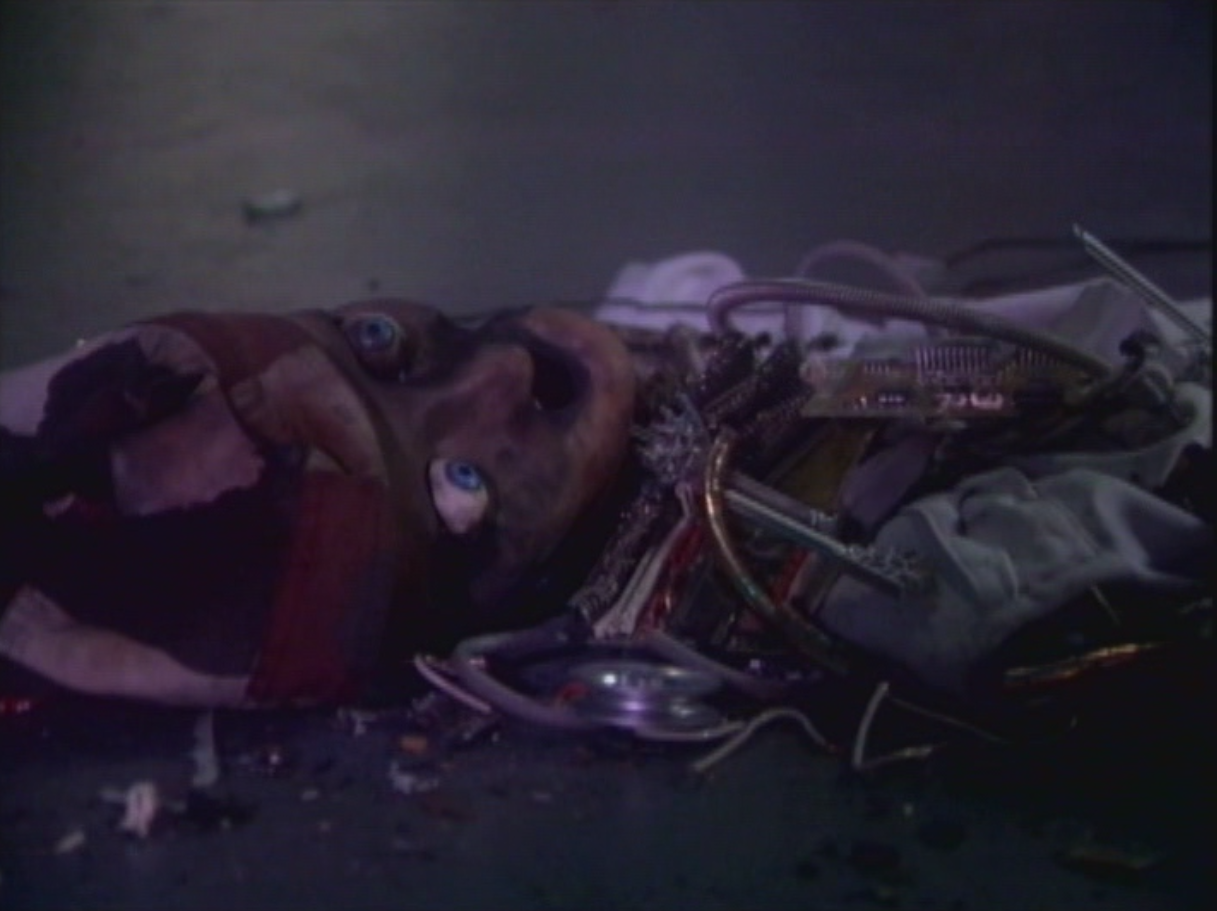
The Coates robot doesn’t last long
The story of “Light in the Darkness” kicks off with a robotic version of Coats, Bibleman’s former sidekick, attacking Bibleman in his home. The assault damages U.N.I.C.E., prompting a repair and dramatic upgrade. The bible team, rightly assuming that the robot attack was planned by The Wacky Protestor, prepare for a battle. Meanwhile, the Protestor develops some sort of atheism gas that makes people depressed, with the intention of using it to prevent people from going to church. He ultimately decides to use it on Biblegirl, which causes problems for Bibleman’s team.
Atheism: seen here in pink test tubes
“A Light in the Darkness” stoops to one of the lowest stereotypes about people who lose their faith or leave religion: that the only reason they do so is because they are depressed, and that mentally healthy people would never leave their church of their own will. That’s pretty shitty, to say the least. Even more shitty is insinuating that depression is the result of evil, vaguely Jewish, clown-like forces acting on people, rather than noting the fact that it is a treatable chemical imbalance that people of any religious tradition deal with every day. At no point does anyone say to the depressed folks, “Hey, you aren’t alone in dealing with this, you can see a doctor for help! Maybe they can identify this weird fog on your face?” Instead, they are just sort of pushed to be more involved with their fellowship, and told to pray more. After all, sadness is apparently the result of evil demon clowns with bad teeth, so prayer should clear that right up!
Depression often presents as a reddish fog in front of your face, which can mildly impair your vision.
“A Light in the Darkness” also features one of the worst child actors / characters who has been on the show since its initial incarnation. The character is essentially the protestor’s boos, and is likewise a perplexing mix of stereotypes: he speaks like a bad impersonation of an Italian mobster, dresses like a dork, and wears what looks like a biker hat. It doesn’t make even the slightest bit of sense, and the child who plays him is infuriatingly obnoxious.
“A Light in the Darkness” doesn’t feature any gratuitous deaths outside of Robot Coates, but to be fair, that one is pretty great. Overall, this is a pretty entertaining episode, but isn’t quite in the top tier of my list. As always, the comedy is bad, but the presence of Jef Scott doing his over-the-top schtick gives it a leg up on most of the other episodes. I think this episode also marks the first appearance of the unexplained guy in a white monkey suit, who lives in a cage in Wacky Protestor’s hideout. That certainly counts for something.
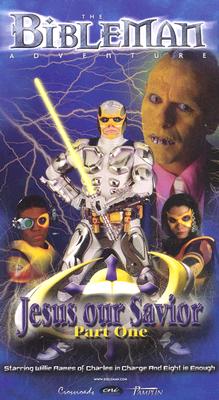
“Jesus Our Savior” was the first and only two-part Bibleman story, with the first part originally airing in October of 2002, and the second appearing in February of 2003. It comprises the eighth and ninth entries into “The Bibleman Adventure,” respectively. Both parts of “Jesus Our Savior” were written, produced, and directed by Bibleman himself, Willie Aames.
After a whopping 8 minute recap of the previous episode, the story of “Jesus Our Savior” finally continues with Bibleman on the brink of defeat at the hands of the new villain, Primordius Drool. However, instead of finishing him off, Drool captures Bibleman and brings him back to his lair, where Biblegirl and Cypher ultimately track him. Of course, they are able to temporarily defeat Drool by attacking his shiny tooth, and rescue Bibleman from his lair.
After the team is reunited, they manage to piece together Drool’s plan: to use the public’s dependence on Bibleman to draw them away from depending on God. So, they decided to pray, and clarify that they should never take credit for what they see as God’s work. Speaking of which, check out the BibleMan branded bible in stores near you!
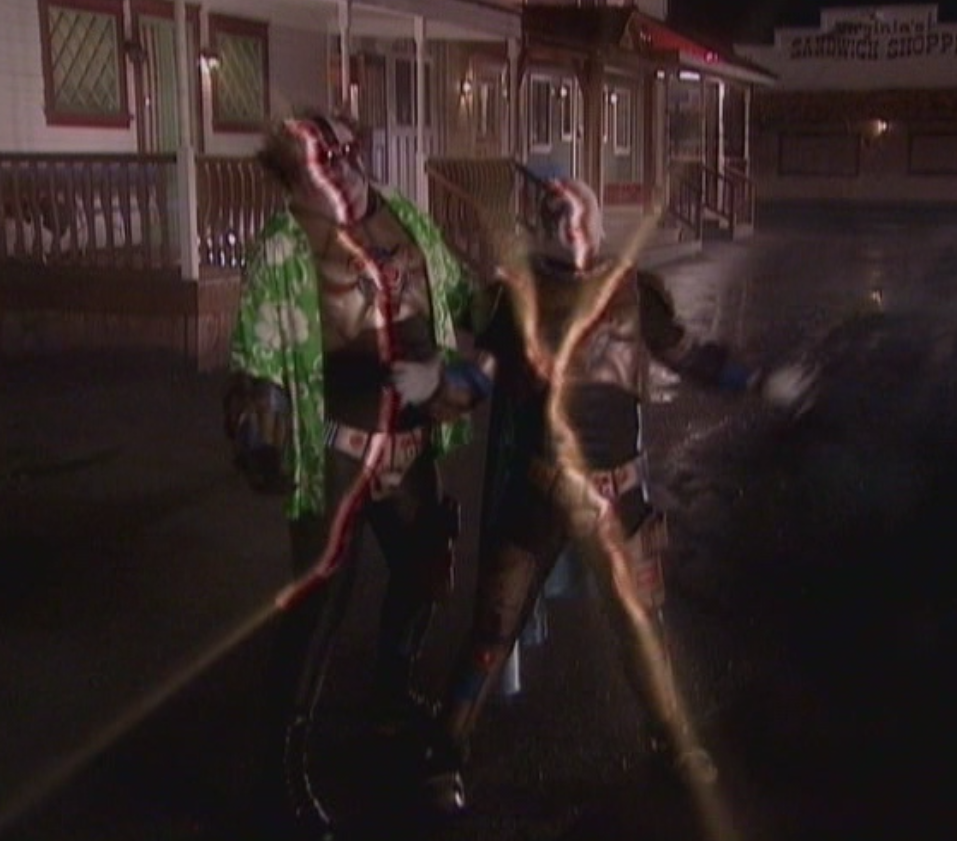
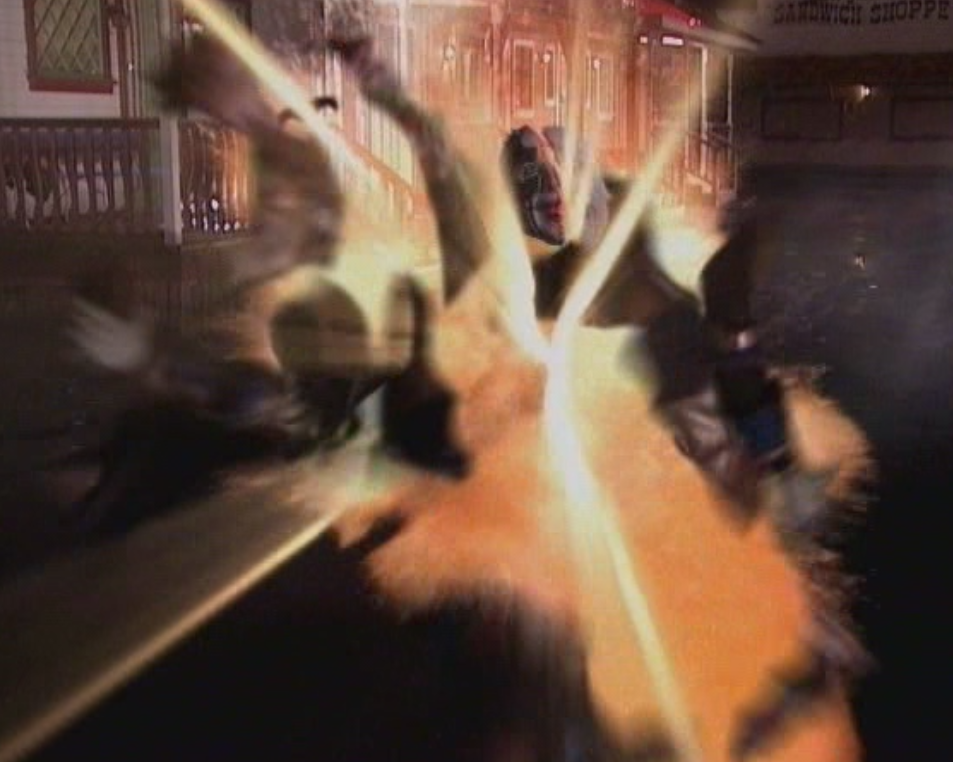
The episode’s plot ends quickly, with Drool ultimately being dispatched pretty easily through teamwork between Cypher and Bibleman, with the green clown-man exploding into lightning and pixels. However, the last seven minutes is essentially dedicated to a sermon from Bibleman about the importance of Jesus, who concludes by all but explicitly stating his retirement, and Cypher’s takeover of the Bibleman role.
However, another sequence appears after the apparent conclusion of the episode that creates yet another cliffhanger: Bibleman’s former sidekick, Coates, appears unexpectedly and attempts to assassinate the hero. This leads into the real last episode for Willie Aames: “A Light In The Darkness.”
There isn’t a whole lot of content to this episode, and I can’t help but feel like they should have consolidated the two parts of “Jesus Our Savior” into one, slightly longer story. Not only does it start with an 8 minute recap, but there is also more than one point where characters just watch clips of the previous episode on a computer monitor. All in all, probably a solid third of the episode in total is made of recycled footage from the previous entry.
If the two parts of “Jesus Our Savior” had been condensed into one, it might have made a pretty good sendoff for Willie Aames from the series. However, the team clearly wasn’t prepared to deal with a two part story, and the second half is a boring wreck. The fact that it ends with another cliffhanger cheapens the entire emotional conclusion as well, and nullifies the feeling that this episode marked the end of an era. I’m a little curious if the last segment was filmed later, after an agreement was made for Aames to stick around for one more episode. Honestly, if you cut that and “A Light in the Darkness” out of the series, the overall story doesn’t skip a beat. It is also pretty disappointing to see the allusion to Cypher taking over, given how the transition is actually handled in “A Fight For Faith.” Overall, this is a really boring episode, and doesn’t live up at all to the setup of the first part. For being roughly 45 minutes long, nothing much actually happens in this episode.
“Jesus Our Savior” was the first and only two-part Bibleman story, with the first part originally airing in October of 2002. It is the eighth entry into “The Bibleman Adventure,” which is the second incarnation of the franchise.
“Jesus Our Savior” was written, produced, and directed by Bibleman himself, Willie Aames. The biggest change for the episode is the absence of series regular Brian Lemmons, who had been on board since the beginning of “The Bibleman Adventure.”
The biggest revelation in “Jesus Our Savior” is that Luxor Spawndroth, the villain from the previous episodes “Breaking the Bonds of Disobedience” and “Lead Us Not Into Temptation,” is actually dead, after appearing (in one form or another) in seven consecutive episodes. The new villain goes by the name of Primordious Drool, played by Jef Scott, and becomes the central antagonist of “The Bibleman Adventure” going forward. The key things to know about drool are that he is vaguely Jewish, vaguely effeminate, very green, and immensely overacted. L.U.C.I., the evil computer that worked under Luxor, carries on with Drool, but it is assumed that Ludicrous was also actually killed in “Lead Us Not Into Temptation.”
The fact that death is suddenly a real and consequential thing in the Bibleman universe is actually kind of eerie, particularly with how violently and gruesomely Bibleman and company had dispatched of foes in the past. The point is glossed, but it definitely leaves a creepy sense of unease over the episode, much like the tensions left over after Coats disappeared with minimal explanation. I’m curious what the situation was that led to Brian Lemmons (Luxor) to leave the show, and if it was an amicable split. Something I have noticed from watching the series in sequence is that it feels like a number of bridges were burned behind the scenes.
Bibleman’s team once again includes his computer, U.N.I.C.E., his sidekick, Cypher, and a new incarnation of Bible Girl. Theoretically, it is the same character as before, though played by a new actress who looks nothing like the previous one.
The story of “Jesus Our Savior” primarily serves as a transition, marking the end of Luxor and the introduction of the more powerful, more ridiculous villain of Primordious Drool. Most of the episode is dedicated to Bibleman and the team learning about Drool’s style, but it eventually gets into Drool’s evil plot, which is actually kind of interesting. His plan is to benefit off of Bibleman’s celebrity, and confuse people into raising him as an icon above God, only to tear him down publicly and shatter the public’s faith. Of course, he does this by luring Bibleman onto a particularly anti-Semitic Jerry Springer analogue, which is a clip that is now particularly nefarious online.
“Jesus Our Savior” introduces yet another new armor for Bibleman. This time, it is a shiny, chrome monstrosity, that I personally think is a bit of a downgrade from the previous incarnation.
Jef Scott as Primordious Drool is, overall, a massive improvement for the show. The guy chews scenery like nobody’s business, and absolutely steals every scene he shows up in. In this episode, he at one point calls Bibleman “bib-LEE-man,” which never fails to crack me up. He also randomly breaks out into song without provocation, and contributes the sort of zany comedic presence that the show previously lacked. Some of his humor is low, stereotypical, and lazy, but he has an undeniable presence and charisma that adds something of distinct value to the show. His musical numbers are even almost bearable to listen to, which is a notable improvement.
Given that “Jesus Our Savior, Part One” is only the first part of a two-installment story, it of course ends on a cliffhanger. I’m not a big fan of cliffhangers in general, and this is no exception: I would have vastly preferred an extended episode / movie rather than a two part extravaganza, but I suppose they decided to break it up so that it could air in television slots more easily.
“Lead Us Not Into Temptation” was released in February of 2001, and is the seventh entry into “The Bibleman Adventure,” which is the second incarnation of the franchise.
Willie Aames once again plays the role of Bibleman in “Lead Us Not Into Temptation,” while also directing, producing, and co-writing the episode. His co-writer was Greg Perkins, who also collaborated with Aames on the screenplay for the earlier episode, “Conquering the Wrath of Rage.”
The villain in “Lead Us Not Into Temptation” is again Luxor Spawndroth, who previously appeared in “Breaking The Bonds of Disobedience,” in which he was notably exploded into many pieces. He is played by Brian Lemmons, who makes his seventh straight appearance as the villain in the show. However, the is the first time in that run that he has reprised the same role. The evil computer L.U.C.I. and his primary henchman Ludicrous also feature alongside him.
In “Lead Us Not Into Temptation,” Biblegirl makes her first appearance as an official member of the team after joining at the end of “Breaking the Bonds of Disobedience.” U.N.I.C.E., the supercomputer, and Cypher, Bibleman’s other sidekick, also appear, rounding out the bible team.
The plot starts off as BibleMan tries to save a young, newly-converted Christian child by helping her overcome the bullying she faces from her non-Christian friends. Because, in our Christian-dominated society, that is totally a thing that actually happens. In any case, she becomes tempted by the evil magic of computers and the internet via peer pressure. Satanic forces take over her mind via the internet (a website called “Hackemup.com”) and try to make her to leave her new religion and hang out with her non-Christian bullies. It is…amazing.
The amount of luddite, imaginary computer magic going on in this episode is hilarious, and the misunderstanding of how computers and the internet function is baffling. Go figure that the folks behind “BibleMan” wouldn’t totally grasp the latest technology, given their top-notch mastery of computer generated effects. There are a lot of computer-ish terms thrown around without context in this episode, like this line in reference to the demonic website / game / vaguely evil internet thing (HackEmUp.com):
“I went to the site. It was pretty cool. Well designed, lots of fail-safes and duplicate firewalls. Very high security for something like this…”
-Cypher, on HackEmUp.com
That sounds like they read the back of the box for Norton Antivirus, and figured that’s all they needed to know to write this episode about the evil internet. As you would expect with any BibleMan episode, the special effects are hilariously pathetic. None of the websites look like anything that is actually on the internet, and the sets are as colorfully cartoonish as ever. There are predictably a lot of lasers and vaguely technological effects going on, including a bizarre force-field effect used to indicate that someone’s mind is being controlled by satanic computer magic.
The offensive portrayals of non-Christians in this episode are really over the top: essentially, the lesson of the episode is to not associate with any non-Christians in any capacity, because they are corrupting influences. Also, apparently all non-Christians in Bibleman’s fantasy universe are massive dickheads, which is frankly the real reason someone wouldn’t want to associate with those people. The fact that this is a lesson taught to children who watch this show is just backwards and hazardous. Among other things, this lesson is designed to stunt children’s social growth, and deliberate encourages them to have a less diverse social network. The goal is to try to make children shut out any alternate viewpoints and perspectives about the world, which is just…bad. It is just plain bad.
This episode features one of my favorite scripture-related exchanges in the show that I have seen so far, which goes as follows:
Biblegirl: I’m worried about him (Cypher), and Riley
Bibleman: Me too.
Biblegirl: What can we do?
Bibleman: Well, the Bible says that we shouldn’t worry about anything, but pray and ask God for anything you need.
Biblegirl: I know this one! Phillipians 4:6!
Bibleman: That’s right! Then, we need to find out who is really behind this website!
Just to recap that dialogue, BibleMan says to pray about the issue and do nothing else. Then, he says to specifically do something about it. Was that scripture even sort of necessary or relevant there? Even better, the very next scene is BibleGirl spying on Cypher and reporting his activities to BibleMan, after which they confront him. Is that not the opposite of what he (and the bible) said to do in that situation?
Unsurprisingly, “Lead Us Not Into Temptation” features another brutal death for Luxor Spawndroth, who is this time evaporated by a deflected laser blast.
This is one of the few episodes that I had actually covered previously on the blog. I absolutely love this episode, and typically refer to it as “BibleMan vs. The Internet” due to the ridiculous plot. This is one of the first episodes of the show I ever saw, and it made a pretty significant impression on me, though not in the way that the creators intended. I definitely recommend giving it a watch if you can dig up a copy of it.
“Breaking the Bonds of Disobedience” was released in January of 2001, and is the sixth entry into “The Bibleman Adventure,” which is the second incarnation of the franchise.
“Breaking the Bonds of Disobedience” was directed, produced, and co-written by Bibleman himself, Willie Aames. His co-writer was once again Marion Wells, who also helped pen “Shattering the Prince of Pride” and “The Fiendish Works of Dr. Fear.”
The villain for this episode is Luxor Spawndroth, who is played by Brian Lemmons for his sixth straight lead villain role. L.U.C.I., the evil computer, and Ludicrous, his henchman, appear as well, but the latter is this time dramatically re-cast.
Bibleman’s allies for “Breaking the Bonds of Disobedience” include Cypher, the supercomputer U.N.I.C.E., and the introduction of the first Biblegirl as a secondary sidekick.
The story of “Breaking the Bonds of Disobedience” centers on a play based on Bibleman, which the team is frantically trying to plan and execute. However, this cuts into their praying time, and leaves them susceptible to a new engineered rebellion disease created by the villain Luxon Spawndroth. Bibleman and company have to resist the disease, find a cure, pull off the play, and finally defeat Luxor before he can spread the disease any further.
The episode kicks off with a dayglo laser nightmare, which is apparently a rehearsal for a Bibleman musical about temptation, that would ironically require a significant intake of drugs to sit through.
One of the key assumptions of the episode’s plot is that rebellion can be caused by an infection or disease, which strikes me as more than a little silly. I think it plays into the idea that children only rebel because of some outside influence, rather than being just a natural part of growing up, and the folks behind Bibleman are clearly terrified of the thought of children growing into rebellious teens. In any case, the plot pretty blatantly involves biological warfare, even if it is nonsense and fictitious. That’s not particularly anything new for a show that has featured mind control drugs and hypnotism, but biological warfare is still pretty dark for for a children’s show.
“Breaking the Bonds of Disobedience” features an updated introduction song and title sequence, which works with the increasing pseudo-technological aesthetic of the show. Personally, I find this particular version of the song incredibly grating, and almost makes me miss the old theme to “The Bibleman Show.”
The title of this episode, “Breaking the Bonds of Disobedience,” strikes me as a tad bit ridiculous. When I think of disobedience, the first thing I think of is not bonds. Speaking of which, why not use the word ‘rebellion’ in the title? That is what the story is really about when it comes down to it, and it just seems like a more apt and obvious word than ‘disobedience.’
This is the first episode where I have spotted a “BibleMan” branded bible on set, which is something that I have always found kind of hilarious. For a show that has an entire episode dedicated to the folly of pride and how God should have more glory than any individual, that’s a gutsy move.
One of my favorite parts of this episode occurs after Bibleman has been infected with the disease of rebelliousness. For some reason, the only effect it seems to have is to make him ornery and forgetful of his bible verses. A young girl walks up to him, and asks him if cheating on homework is bad, and he literally cannot answer because he can’t remember his scripture. That is a level of inept that is hard for me to even fathom: to have your moral code so tied to a book that without it, you can’t even perform basic though processes. If that is the case, why don’t the bad guys just mess with his memory? Theoretically, if he can’t remember passages from the bible, he’ll be off the rails snorting cocaine and murdering passers-by with his laser sword in no time.
In keeping with truest and most time-honored of Bibleman traditions, the villains of the episode once again die miserably. This time, U.N.I.C.E. causes L.U.C.I.’s remote drone to explode, which somehow causes a chain reaction that results in Luxor and Ludicrous shattering into of pieces in the midst of a fireball. Not too shabby as far as villain deaths go.
For some reason, I kind of love this episode. I think it is mostly because of the dayglo stage production and Bibleman’s utter helplessness and unhinged fury throughout the story, but I also kind of like the new version of Ludacris. There is also a segment where Luxor fools Bibleman with what I am pretty sure is a shitty Dr. Phil impression that slowly turns into Forrest Gump, which is just amazing to watch. This one is a solid and hardy recommendation from me: it is just the right amount of nonsense that makes for an enjoyable Bibleman experience.
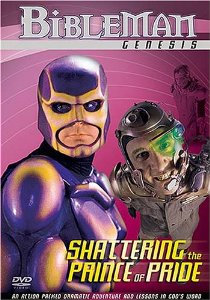
“Shattering the Prince of Pride” is the fifth entry into “The Bibleman Adventure,” which is the second incarnation of the franchise.
“Shattering the Prince of Pride” was co-written, directed, and produced by Willie Aames, who once again stars as Bibleman. The other credited writer was Marion Rose Wells, who also wrote the Bibleman episode “The Fiendish Works of Dr. Fear.”
The villain of “Shattering the Prince of Pride” is, of course, the eponymous Prince of Pride, who is played by Brian Lemmons, who appears as the primary villain in his fifth-straight Bibleman episode here. He is once again joined by his henchman, Ludicrous, and the evil computer, L.U.C.I..
Bibleman is once again joined by his trusty computer U.N.I.C.E., as well as his sidekick, Cypher. However, in this episode, they are at each other’s throats more than usual, which is explained over the course of the story.
The plot of “Shattering the Prince of Pride” follows BibleMan as he is making preparations for a new nationally published comic strip based on his image. Cypher and U.N.I.C.E. bicker over who should be featured as his sidekick, and Bibleman struggles to maintain his humility in the limelight. The new villain, the Prince of Pride, further complicates matters through the use of a ray gun that excessively boosts people’s egos.
The story actually pulls an interesting fake-out with Bibleman, in that the Prince of Pride claims that he starts becoming prideful about his own humility after being hit by his pride ray, which is an interesting and complicated notion to portray in a television show for kids. However, it is mostly played for a joke, and the ray ultimately just makes him garden-variety prideful.
The comedy in “Shattering the Prince of Pride” really gets to the point where it is trying to hard, focusing on being self-referential and generally comedic, which makes it lose some of the charm of being earnestly made. It is also pretty clear that humor is there to try to mask the incompetence that is still very much present, which never comes off well.
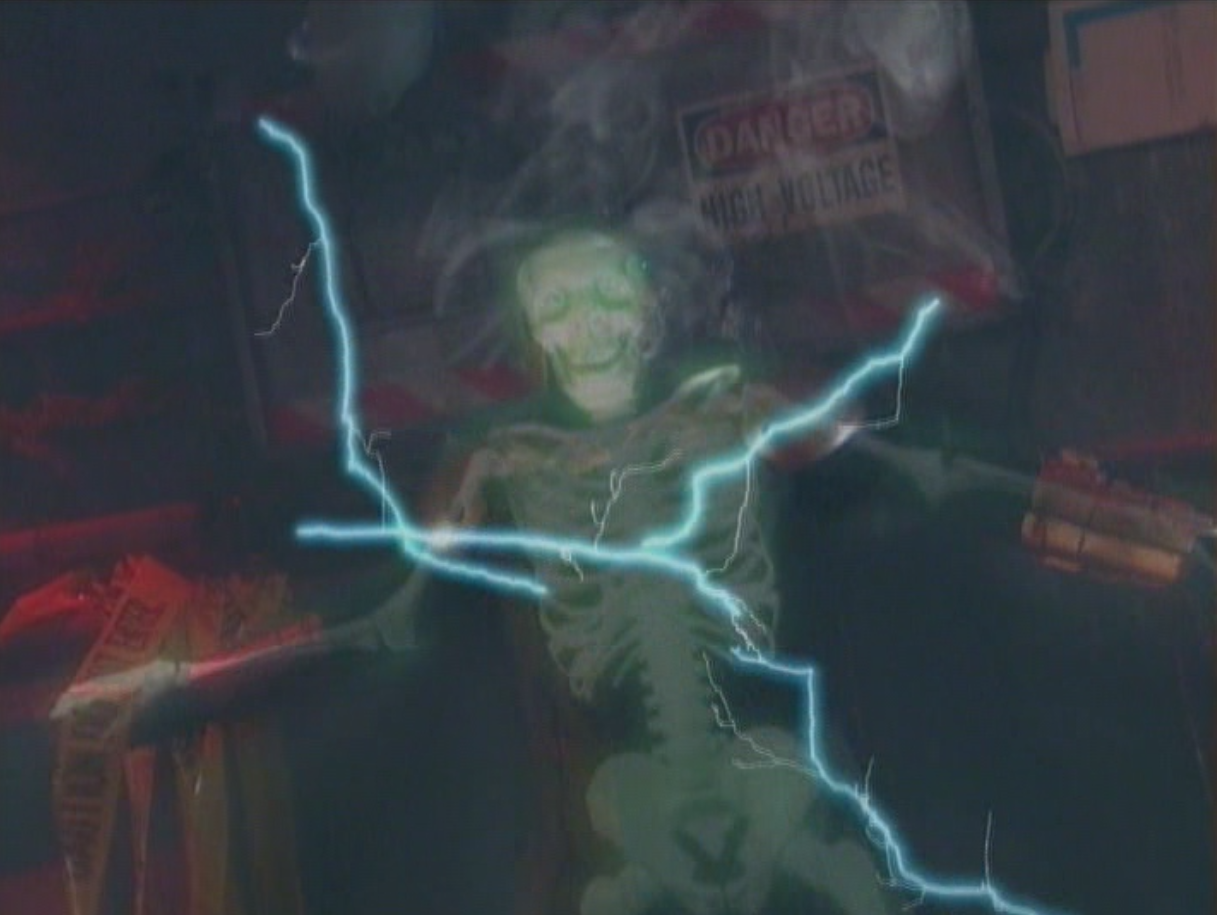
Once again, the villain dies an exceptionally terrible death, but the Prince of Pride gets the most graphic one so far. Bibleman manages to back him up into an electrical grid, which causes him to fry for a number of seconds before exploding into a mass of green fluid. It is actually pretty dark and gory, even for Bibleman’s Old Testament standards.
“Shattering the Prince of Pride” is uneven episode, but the highlights of it are pretty great. A lot of the humor totally misses, but some of it works, and the over-the-top villain death pushes it into the realm of being a recommendation from me. I mostly just wish that The Prince of Pride was a little more distinctive, and that he got more interesting screen time. The most boring part of the episode is his musical number, which seems to drag on indefinitely in an episode that is already almost 45 minutes long. This isn’t the episode I would introduce someone to the show with, but again, the highlights are pretty solid.
“Conquering the Wrath of Rage” marks the fourth entry into “The Bibleman Adventure,” which is the second incarnation of the franchise.
“Conquering the Wrath of Rage” was directed, produced, and co-written by Willie Aames, who once again stars as Bibleman. The other credited writer is one Greg Perkins, who I wasn’t able to dig up any information on.
The villain of “Conquering the Wrath of Rage” is El Furioso, who is yet another antagonist portrayed by Brian Lemmons, marking his fourth straight appearance on the show. He is once again accompanied by his self-aware, possibly stoned henchman, Ludicrous. The evil computer, L.U.C.I., also pops up again as a supporting villain.
Bibleman has a new partner for “Conquering the Wrath of Rage” in the rookie Cypher, who is introduced as a bit of a tech wizard, and is credited with designing the new Bibleman armor. He winds up hanging around for a long time in the series as I recall, becoming a bit of a staple. I’m not really sure what happens to Coats, the previous sidekick, as the point is glossed over pretty quickly. It is actually somewhat implied that the split wasn’t exactly pleasant, which might allude to some tensions behind the scenes.
The story of “Conquering the Wrath of Rage” focuses on a new villain named El Furioso, who comes up with a chemical that causes uncontrollable fits of rage. This is used both on local children and on Bibleman to disastrous effect. Bibleman must confront his own anger and learn to trust the people around him in order to win the day and defeat El Furioso.
The episode begins with Bibleman fighting a group of really racist caricature villains, whose lines are subtitled despite the fact that they are speaking clear English. If the exaggerated, generic Asian accents don’t get the point across, the reference to Jackie Chan certainly does. Bibleman also, in keeping with tradition, straight murders one of them in a fit of rage after they corner Cypher. However, this time his actions are actually addressed, as the theme of the episode deals with rage and violence.
“Violence never got anyone anywhere”
-Bibleman, noted vigilante murderer
“Conquering the Wrath of Rage” features another notable upgrade for the Bibleman outfit, and introduces what is probably the most recognizable version of the cowl. This version is far more musclebound than the previous versions, and sets the precedent for future changes to the outfit as the series goes on.
“A man in spandex is no laughing matter”
-Bibleman
“Conquering the Wrath of Rage” also introduces the use of lower third text gags, which continues throughout the rest of the series. These are usually a bit funnier than the comedy in the dialogue, because they don’t rely on the actors having any kind of comedic timing.
El Furioso is probably the most amusing performance from Brian Lemmons so far in the show. He feels like he must be offensive somehow, but I’m not really sure to who? His name would make you think of some sort of Mexican stereotype, but it doesn’t really play that way, apart from using the occasional Spanish phrase. He is somewhat effeminate, but also occasionally drifts into what sounds like a bad imitation of a Jewish person, making for a really perplexing mixture of stereotypes.
As is tradition for the series, El Furioso suffers an awful demise in the conclusion. Bibleman uses some sort of divine force field that forces Furioso’s beam weapon to backfire, which leaves him dissolved into a nasty, green, gooey mess. In keeping with the theme of the episode, Bibleman doesn’t directly strike him down, but he certainly gets very dead. Bibleman’s reaction to this horrific loss of life is, quote:
“Jeepers, what a mess.”
human remains
Overall, “Conquering the Wrath of Rage” is a solid recommendation from me as an entertainingly awful entry into the saga of Bibleman. It makes for a pretty good introduction into the series: the cheese factor is to the max, and the comedic writing is actually entertaining at times, and completely baffling and tone deaf at others.
“The Fiendish Works of Dr. Fear” marks the third entry into “The Bibleman Adventure,” which is the second incarnation of the franchise.
“The Fiendish Works of Dr. Fear” is once again directed by Eric J. Smith, who also took the reins on the previous episode, “The Incredible Force of Joy.” Willie Aames, who also plays Bibleman, co-directs, and the writing for the episode is credited to Marion Rose Wells.
The central villain of “The Fiendish Works of Dr. Fear” is, of course, Dr. Fear. However, the character is once again played by the same actor, Brian Lemmons, who portrayed the previous two villains: The Master of Misery and The Shadow of Doubt, a fact that is pointed out once again by his self-aware sidekick, Ludicrous. This time, Dr. Fear appears to be partially cybernetic, which gives him a little more interesting appearance. The evil computer program, “L.U.C.I.,” who appeared in the live version of “The Incredible Force of Joy,” also shows up as an accessory villain.
Both the intelligent computer, U.N.I.C.E., and a sidekick, Coats, appear alongside Bibleman in “The Fiendish Works of Dr. Fear,” just as they did in the previous two “Bibleman Adventure” installments.
The story of “The Fiendish Works of Dr. Fear” follows Bibleman as he leads the “Clean is Cool” campaign to keep kids off of drugs (or something like that). Meanwhile, a new villain named Dr. Fear plots to fill people with anxieties and destroy their self confidence, even taking aim at Bibleman himself. I assume that also has something to do with drugs, but I wasn’t entirely clear on that point. Bibleman, as per usual, has to figure out the villain’s plan and overcome his own fears to win the day.
“The Fiendish Works of Dr. Fear” shockingly kicks off with Bibleman dancing to a swing number with lyrics about saying ‘no’ to drugs. I can’t even make this kind of ridiculous thing up, that is actually how the episode starts.
This episode also features the first (but not the last) time that Bibleman appears on a televised talk show. Of course, Dr. Fear uses this opportunity to strike Bibleman with some sort of fear ray, which sets off his anxieties about appearing on camera, leading him to briefly botch the interview.
For once, Bibleman actually takes a fair amount of damage in the combat sequences, particularly thanks to Dr. Fear’s ranged attack. Speaking of which, why exactly doesn’t Bibleman have a way of fighting from a distance? You would think that with the amount of technology at his disposal, he would have some sort of plan for this kind of thing. He ultimately figures out a way around it, but it wouldn’t have been as much of an issue if he just had some sort of bible-themed projectile for combat.
The humor here is still cringe-inducingly awful, and bows to a number of lazy stereotypes for no discernible reason. The plot also isn’t as entertainingly cheesy as other episodes, which, combined with yet another lackluster villain, makes for a pretty dull watch on the whole. The most amusingly terrible thing in the episode is the swing dance in the opening sequence, which passes pretty quickly. “The Fiendish Works of Dr. Fear” definitely isn’t on the top of my list for Bibleman episodes, but it is also far from the worst. It also features a brutal villain death for Dr. Fear, but it generally pales in comparison to most of the other episodes.
Reviews/Trivia of B-Movies, Bad Movies, and Cult Movies.
![Misan[trope]y](https://misantropey.com/wp-content/uploads/2014/10/misantropeyhead1.png)




















 Misan[trope]y