Tag Archives: bad movies

BibleMan vs Evil Soft Drinks

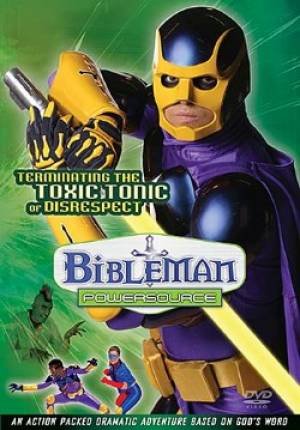
BibleMan: Terminating the Toxic Tonic of Disrespect
biblemantt1

It has been a while since I covered my favorite ol’ evangelical costumed crusader, so I figure it is about time to delve back into the cinematic cesspool that is my BibleMan DVD collection. Speaking of which, here it is:

biblemancollection

Today’s episode is entitled “Terminating the Toxic Tonic of Disrespect.” It doesn’t have the same ring as “A Light in the Darkness” or “The Six Lies of the Fibbler,” does it? In any case, this is the first BibleMan episode to feature Josh Carpenter after his initial, formal introduction as the new BibleMan in “A Fight for Faith.” This episode marks the beginning of the “PowerSource” run of the show, which is the most recent (and last?) incarnation of the character.

First off, the new BibleMan is definitely a bit of a downgrade. Robert Schlipp, who plays Josh Carpenter, is definitely just a preacher in a hero suit. To Willie Aames’s credit, his character of Miles Peterson definitely projected himself as a super-hero in the role, which is a pretty stark contrast next to Schlipp’s take on the role.

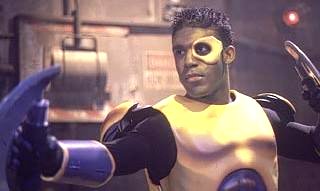
“Toxic Tonic” introduces a new sidekick in Melody, who is surely one of the worst actors in the entire universe. Bible Girl doesn’t entirely disappear, but is relegated to an off-screen support role for the episode. Cypher, BibleMan’s resident Black Friend(TM), also returns for the new series, and continues his role as the only half-bearable member of the team.
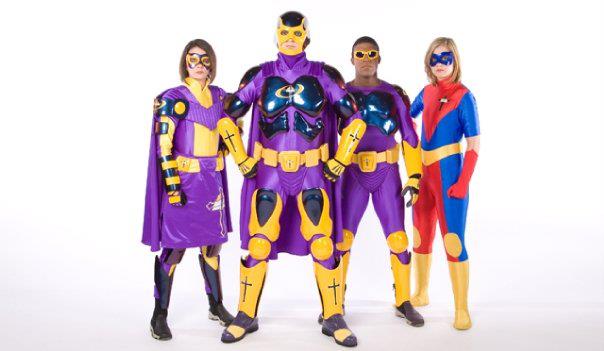
biblemantt5
The PowerSource Bible Team (Melody on the far right)

The introduction of Melody offers the only actually good lesson that I have seen in the entire series: BibleMan and Cypher at first assume that she is a delivery girl when she shows up at the base, and initially dismiss her as a moron despite her expertise with technology. Of course, in typical BibleMan form, they never acknowledge the obvious sexism of their assumptions, and only ultimately apologize for not respecting her as one in “God’s image.” So close, BibleMan. So close.

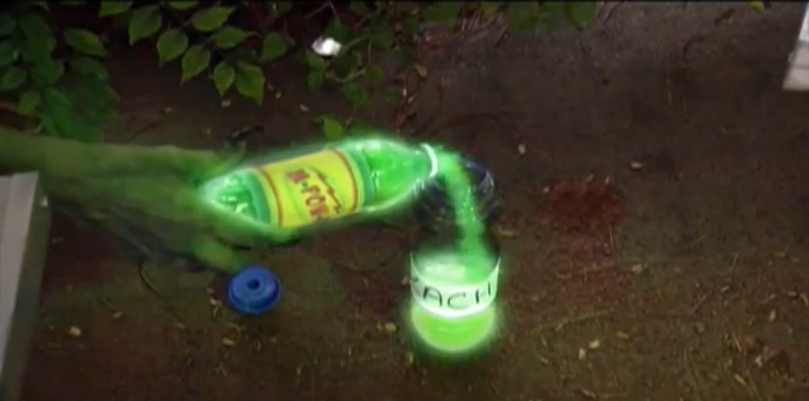
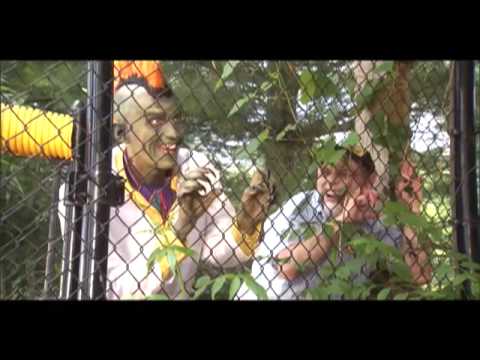
The villains, in a bit of a separation, aren’t the offensive stereotypes I typically expect of the series. Instead, the antagonistic duo is comprised of run-of-the-mill zany mad scientists: the neon-mohawked Dr. E. Meritus Snortinskoff (yeah, good job on that one) and his henchman named Stench. The two sinister scientists are executing a plan to make a bunch of kids indignant and rebellious by selling them “Empower” energy drinks made from sugar, water, and “pure evil.” The Bible team realize what is happening after noticing a bunch of burgeoning teenagers acting shitty to authority figures. You know what, BibleMan? Never change.
biblemantt3

The Bible Team ultimately wind up getting a sample of the “Empower” energy drink, and discover its contents (pure evil, bad attitudes, and probably a lot of high fructose corn syrup I assume?). This leads to a rambling, scripture-laced train of thought that could rival the revelation scene from “Black Dynamite.” Somehow, through rambling about trees for a while, the team figures out where to find the evil scientists.

Maybe my favorite aspect of this episode is that a good few minutes of run-time towards the beginning are eaten up through the use of what appears to be totally unnecessary recycled footage from the episode “Crushing the Conspiracy of the Cheater,” which, confusingly, wasn’t released until two years after “Toxic Tonic.” This brings up some serious questions of continuity in the series, but I am not going to dare delving into that.
biblemantt4Predictably, the Bible Team wins the day through grace, goodness, and the violent use of laser swords. The bad guys do get away this time (instead of dying horribly), but I don’t believe that either of them show back up later in the series.
biblemantt2This isn’t one of my favorite episodes, and certainly doesn’t compare to the “BibleMan vs The Internet” entry. However, it definitely has the same old heavy-handedness that all of the incarnations have. The episode of course ends with a prayer, and a plea for all of the viewers to convert to Christianity. As far as entertainment goes, I do kind of love how shitty the kids are who imbibe the “toxic tonic,” and how generally panicked the creators are about the idea of teenage rebellion. There is definitely something to enjoy here, but it isn’t one of the stronger good-bad entries in the show. That might have a little to do with the change of creative team with the dawn of the “Powersource” series, but I’ll need to watch more of them to see if there is a significant perceptible difference between the incarnations.
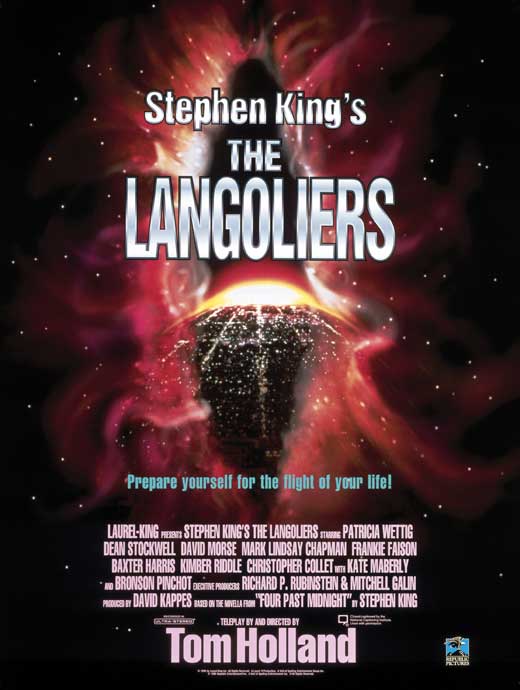

The Langoliers

The Langoliers
langoliers3

“The Langoliers” is a 1995 ABC miniseries adapted from a Stephen King novella of the same name (it came from the same collection that later produced the Johnny Depp movie “Secret Window”).  I think most people have forgotten about it (for good reason, I might add), but I definitely remember watching this on TV when I was a kid. Specifically, I remember the hilariously terrible eponymous ‘langoliers,’ that look something like evil mollusks crossed with a chainsaw.

langoliers1Apart from the langoliers themselves, the series is chock full of other crappy CG effects, and they have all aged about as well as an open bowl of shrimp. For instance, the plot involves a rift in space-time, which an airplane accidentally flies through. Here’s what that looks like:

langoliers2Not so great, huh? For even more CG fun, here is the climax of the film set to “Guile’s Theme” from “Street Fighter.” Just look at those giant Pac-Man raisins go!

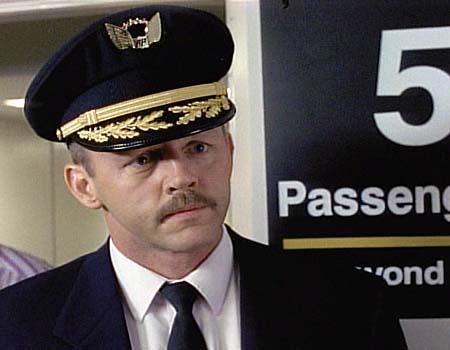
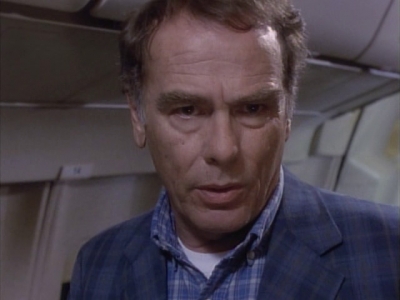
Aside from the awful CG throughout, the next most memorable aspect of the series are the performances. There are a handful of decent actors featured, such as Dean Stockwell and David Morse, but they all wind up looking pretty abysmal in this thing. Stockwell in particular winds up playing a heavy-handed Sherlock Holmes analogue, which is surprisingly one of the less distractingly awful performances in “The Langoliers.” Morse, who I guess is supposed to be the lead, plays one of the most generic characters I have ever seen on screen. Conveniently for the story though, he also happens to be a pilot! Of course, if he were anything else, everyone would have just died before the end of the first act, and the movie/series wouldn’t be 3 hours long.

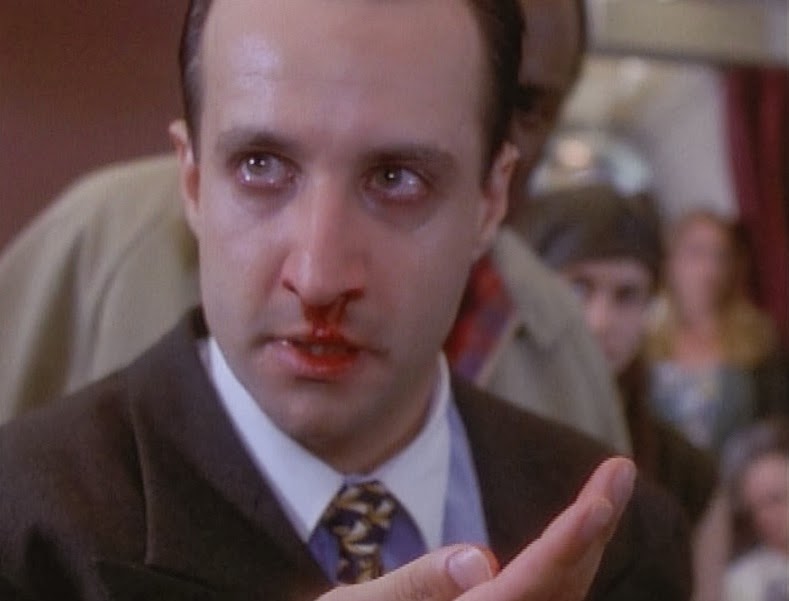
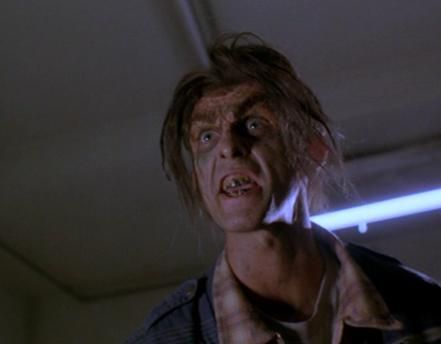
langoliers7langoliers6Chewing the scenery with arguably more gusto than the langoliers themselves is Bronson Pinchot, who plays the increasingly unhinged character of Craig Toomy: a stock broker of some sort who is in the midst of a breakdown as the story begins. His performance is, to say the least, memorable.  Here’s a clip of Toomey hallucinating an argument with his father. Honestly, it is on the level of “amazingly awful”:

On the other end of the acting spectrum is Kate Maberly, who plays a young blind girl with inexplicable psychic powers named Dinah. Her performance is, in a word, bad. You can check out a little bit of it in the trailer, though it hardly scratches the surface of how terrible her line reads are:

Rounding out the cast are a few more notables: Frankie Faison, who would later play Commissioner Ervin Burrell in “The Wire”, Patricia Wettig, who has does extensive acting work on television, and Mark Lindsay Chapman, who most would probably only recognize as the Chief Officer from “Titanic.” While Wettig gets her fair share of ridiculous lines in the third act (“Are we the new people?!?”), Chapman definitely steals the show for most of the movie. Essentially, Chapman plays a grittier version of James Bond: a rough around the edges assassin and hit man with some sort of connection to the British government. As with Stockwell’s Holmes-ian character and Morse’s pilot, it is ridiculously handy to the story that a super-agent with field training winds up in the crew of survivors, particularly once Toomey finally snaps.

langoliers5
I mean, he looks so harmless though?

The entire reason I went back to watch “The Langoliers” in the first place was because I noticed a handful of similarities while watching the recent Nicolas Cage “Left Behind” film. Particularly, both stories involve people inexplicably disappearing from aircraft, leaving personal possessions behind. Here is a clip from the earlier Kirk Cameron adaptation, which I think shows a lot of the similarities:

It turns out that the first “Left Behind” novel came out in 1995, 5 years after King published “The Langoliers,” and the same year that “The Langoliers” miniseries aired on ABC. It turns out that I’m not the only one to notice the similarity: you’ll find comments all over the internet pointing out the parallels. I’m sure it is only a coincidence, but it sure is a fun one: that makes 3 awful movies with almost the exact same premise!

The director and screen-writer of “The Langoliers” is Tom Holland, who is almost certainly best known for writing and directing “Fright Night” and “Child’s Play.” However, he has pretty much fallen off the map in recent years. I imagine this has a little bit to do with his abysmal follow-up to “The Langoliers”: another Stephen King adaptation called “Thinner.” I recently watched that as well, and it makes “The Langoliers” look like “Touch of Evil.”

Due to the mixed bag of underacting, overacting, and hilariously bad CG effects, I think there is a lot of entertainment value to be had from “The Langoliers.” I particularly enjoyed the handful of instances where the actors have to stare out of plane windows and react to the langoliers, which they obviously can’t see. That’s just the sort of thing that can set me a-giggling.

The series / movie (the DVD cut just sort of merges them) is definitely too long at 3 hours, but I didn’t think it was impossible to sit through. All the same, I think a super-cut of the highlights gets the entertainment across without wasting a significant portion of your day. The Nostalgia Critic pulls together a good number of clips for his review of the series, so I can recommend checking that out for anyone curious:


The Brothers Grimm

Clerk’s Pick

Clerk:
Hannah, Video Central (Columbus, OH)

videoc

Movie:
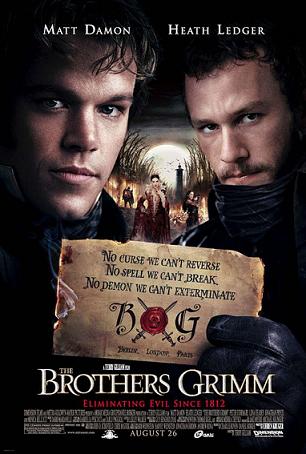
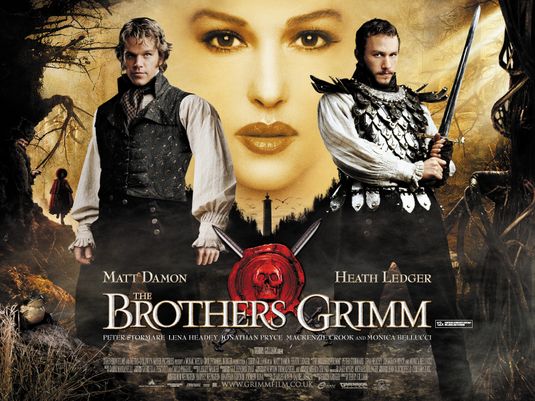
The Brothers Grimm
grimm2

Pitch:
“It almost has a USA series sort of concept. They are the brothers Grimm, but they are con artists. I love the little references to the Grimm tales, and it is just a generally fun movie. Also, it is beautiful, being a Terry Gilliam movie. Critics really didn’t care for it, but I think it is pretty fun, and I enjoyed it when I watched it again recently.”

Background:

“The Brothers Grimm” seems like a winning combination from the start: the Grimm tales are some of the most beloved, dark fairy tales of all time, and here they are put into the hands of one of the most visionary and imaginative directors out there in Terry Gilliam, who specifically specializes in the bleak and strange (“12 Monkeys,” “Brazil”).

grimm1The writer of “Brothers Grimm” is credited as Ehren Kruger, who is probably best known for his involvement in writing a number of the “Transformers” films. He has a number of other credits to his name that predate “Grimm,” such as the Ben Affleck flick “Reindeer Games” and the much-maligned third “Scream” movie. His only particularly well-liked work seems to be “The Ring,” for which he wrote the adapted English screenplay. Interestingly, the writing credit on “Grimm” was the subject of much controversy: Terry Gilliam and Tony Grisoni (“Fear and Loathing in Las Vegas”) apparently extensively re-wrote Kruger’s script, but were denied writing credits by the Writers Guild of America.

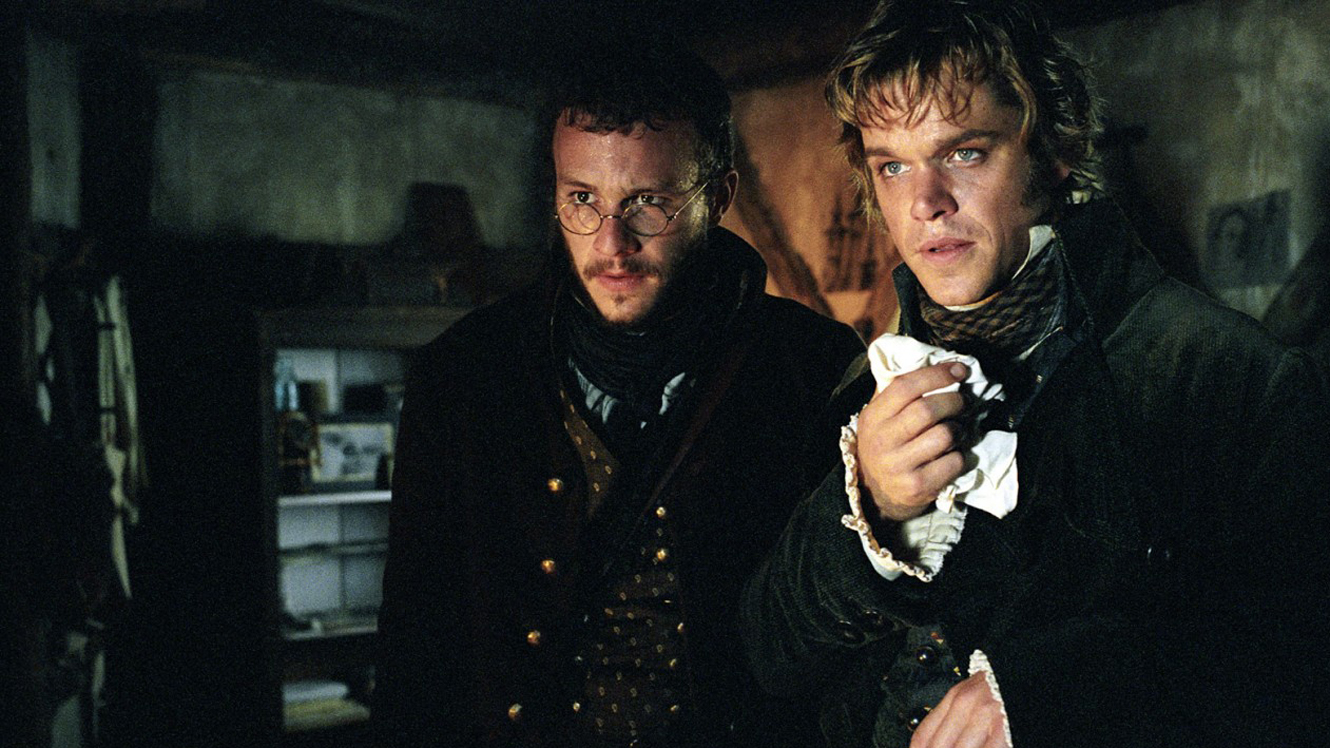
The cast of “Grimm” features the late Heath Ledger and Matt Damon as the eponymous Brothers. Outside of them, the cast features Gilliam favorite Jonathan Pryce (“Brazil”), the now-acclaimed Lena Headey (“Game of Thrones”), Peter Stormare (“Fargo”), Monica Bellucci (“Irreversible”), Mackenzie Crook (“Pirates of the Caribbean”), and character actor Roger Ashton-Griffiths. Interestingly enough, Headey, Pryce, Crook, and Ashton-Griffiths have all appeared in recent seasons of “Game of Thrones” in an assortment of roles.

grimm3Interestingly, it is reported that Gilliam wanted Johnny Depp for Damon’s role, but Bob Weinstein dissented, claiming that Depp was not commercial enough. Of course, Depp’s “Pirates of the Caribbean” released during the production (2003), changing his status overnight. Stormare’s role was apparently given to Robin Williams initially, but he dropped out before filming.

grimm6Among the producing credits on “The Brothers Grimm” are the notorious Weinstein brothers, Harvey and Bob. This movie released just as the brothers were fleeing Disney (and their original company of Mirimax) in 2005, for the greener pastures of their new incarnation, The Weinstein Company. Technically, “Grimm” released under Bob Weinstein’s Dimension Films label (in cooperation with MGM and Summit due to the budget), though it could be considered one of the first productions of The Weinstein Company.

Unsurprisingly, the Weinsteins clashed significantly with Gilliam over the course of the film’s production. In a 2009 interview, Gilliam had some choice words about the brothers and the ultimate product that is “The Brothers Grimm”:

“…they’re interesting producers, but they are people who are good at those jobs and not at directing movies. And yet they want to be filmmakers. They interfered more than I’ve ever been interfered with before.”

“it’s not the film they wanted and it’s not quite the film I wanted. It’s the film that is a result of two people, or two groups of people, who aren’t working well together.”

As Hannah mentioned, “The Brothers Grimm” was not well-received on release. It currently holds a critic score of 38% and an audience score of 39% on Rotten Tomatoes, a rare case of agreement between the two barometers. However, the IMDb user score is notably higher at a 5.9, which may indicate that the movie has been looked back on more fondly in recent years (though not dramatically). It did manage to make some money on a high budget of an estimated $88 million, but not much. It is really something when a movie can break $100 million total in ticket sales and not make an impressive gross.

Review:

The best aspect of “The Brothers Grimm” is almost unarguably the effects. They are a little dated a decade down the line (the werewolf transformations, particularly), but not excessively so. Visually, the film is really solid all around, with an interesting mix of CG and practical effects. There is also some masterful use of lighting (particularly in a couple of the Mirror Queen sequences), which is to be expected from Terry Gilliam.

You can tell that there are the makings of a good Gilliam movie here, but that it just couldn’t come to fruition. I’m sure Gilliam would blame the Weinsteins’ constrictions for that, but I think that Gilliam’s vision was just too big for the realistic budget: the film almost didn’t get released at all due to the skyrocketing budget of the flick. Of course, the writing wasn’t exactly stellar either, which didn’t give the movie much of a foundation to work with.

The script is pretty shoddy on the dialogue front, to the point that the actors can’t really salvage it. They are still pretty charming and do what they can with the material, but it just isn’t very good. The constant nods to the Grimm Fairy Tales are to be expected, but they come a little too often and a little too blatantly for my taste. It isn’t as bad as “League of Extraordinary Gentlemen” or “Van Helsing” by a longshot though, which some have (I think unfairly) drawn parallels to. Probably worst of all though is the fact that the plot just isn’t very interesting or engaging. I loved the initial concept, but the plot’s inane complexities really took me out of it by the third act. I just couldn’t stay invested in the labyrinthine details as the story progressed.

grimm5There is another pretty big problem with this film, and I think it is one that significantly impacted the behind the scenes tensions: this movie is just too long for what it is. I know that one of the fighting points between the Weinsteins and Gilliam was over  the director’s right to final cut (final say on the editing of the movie), and I’m willing to bet the Weinsteins wanted him to tighten it up against his wishes. And you know what? They were right in this case. One of Gilliam’s greatest weaknesses is pacing, and a number of his more recent movies have been criticized for this problem. I don’t think it is as bad here as it has been in some other films of his, but the 2 hours of run-time here feels as long as a Peter Jackson Tolkien adaptation, and it isn’t nearly entertaining enough to justify it.

Recommendation:

Unless you are a die hard fan of the Grimm Fairy Tales, or are a Terry Gilliam completest, I think “The Brothers Grimm” is pretty skippable. It has some good moments, and I don’t think it is as bad as the critics treated it on release, but I found it to be a mediocre film overall. Gilliam is capable of a whole lot better, and it is hard to divorce the ultimate product of this movie from the incredible potential it had.

Escape From Hell

Escape From Hell
hell3

It is about time I got back to (God)Awful Movies, the segment of the blog dedicated to the worst of religious cinema.

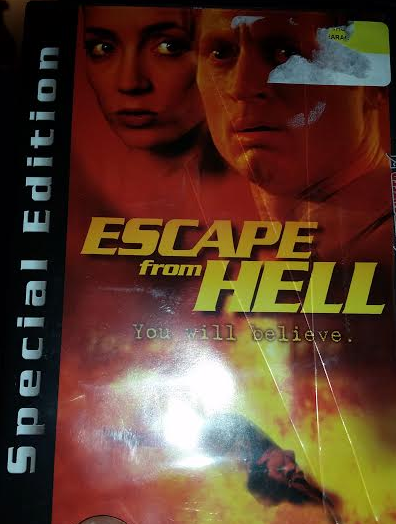
Today’s feature, “Escape From Hell,” is one that I have come across a couple of times in bargain bins in the deep south. I’m not sure how far it actually got distributed, but I’ve certainly never seen it outside of Alabama or Georgia. Here’s what my copy looks like:

hell1

I’m sure glad to know that I got the special edition! Hopefully that means there is some CGI Jabba the Hutt to enjoy.

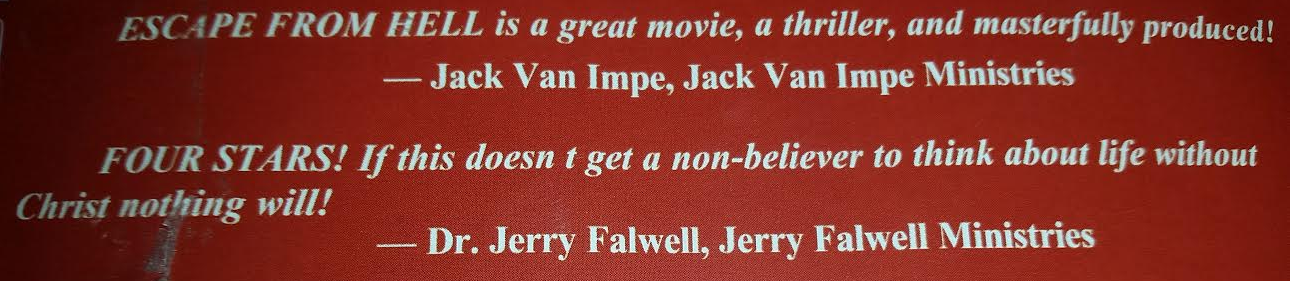
The reason that I initially picked this up, apart from the title and the cover art, is because of the amazing blurbs on the back of this box. Here are a couple of them, including two from noted film critics Jerry Falwell and televangelist Jack Van Impe:

hell2

Well, I’m sold. I can’t wait to see if this film makes me think about my “life without Christ.”

Out of curiosity, I decided to dig around to see if there is a trailer out there for this thing. I ultimately dug one up, but, to my joy, I found something even better as well: a clip collection, courtesy of the fantastic folks over at Everything is Terrible!

Now I am definitely psyched. Here is the trailer I dug up as well, in case you happen to be curious:

Director Danny Carrales and writer Michael Martin have apparently worked together on a number of Christian features outside of “Escape to Hell,” including films called “The Gathering” and “Second Glance.” Star Daniel Kruse pops up in “The Gathering,” as well as another movie that Carrales and Martin worked on called “Pilgrim’s Promise.” One of the other actors in “Escape to Hell,” Terry Jernigan, has managed to appear in an assortment of bit film roles over the years, but my favorite credit of his is on an upcoming movie called “Sasquatch vs. Yeti.” You can bet that I am looking that one up.

I think that the biggest red flag for me when sifting through the IMDb entry far “Escape to Hell” was finding someone credited as “2D/3D animation and effects / special effects supervisor.” That can’t spell out anything good for this movie. Also, the person with that credit has nothing else current listed to their name outside of another Carrales/Martin feature (“Pilgrim’s Progress”).

My next favorite credit on this movie is one of the producers, Randy Smith, who is apparently a professional boom operator who has worked on an assortment of actually good movies (“12 Monkeys,” “Fear & Loathing in Las Vegas,” “Phone Booth”) and occasionally not-so-good movies (“Thinner,” “The Langoliers”).

Now, let’s see how this thing is. Will it scare me into the arms of Jesus? Will I be forced to reassess all my sinful life choices? Will I be able to even stay awake through this whole thing? Let’s find out!

Review:

Wow, this is really awful. I’m not really sure where to start.

The cinematography is awful in nearly every way you can imagine. Some of the shots are nothing short of nauseating for no reason whatsoever (just people walking down a hallway, for instance). There are so many dutch angles that you will question if your head is even on straight. When the camera is being used half-sensibly, everything feels like an infomercial, or a soap opera at best. Unfortunately, even those moments are few and far between.

The acting is about what you would expect: most of them seem like they are reading directly off of the scripts. In the few cases where that isn’t the case, they either hilariously overact, or sound like they are giving half-rate sermons. Of course, a lot of that blame deserves to be leveled at the writing as well, which is more heavy-handed than a steel gauntlet.

It turns out that my nervousness about that “2D/3D animation and effects / special effects supervisor” was more than justified. There is way more reliance on special effects than there should be in this flick, and they look really bad. I’m pretty sure that they didn’t look good when they were done originally in 2000, and they certainly don’t look good 15 years down the line. I’d bet that they could have pulled off better practical effects with the money they spent on the CG here, and wound up with something way more convincing (the few moments that do involve practical effects in this movie do look passable). That at least would have looked like something realistic, whereas the CG here just looks downright laughable. Moments where characters are cast into hell are supposed to be intimidating and terrifying, but instead they are profoundly hilarious.

Overall, this isn’t a movie worth spending the time to sit through. For the most part, it is just boring dialogue between characters you just can’t give a damn about. I would recommend checking out the “Everything is Terrible” highlights (which has all of the best parts included), and just leaving it alone from there. This isn’t a film that is going to change your life, and it certainly isn’t going to send anyone running to Jesus who wasn’t on his team already.


Leprechaun 3

Leprechaun 3
leprechaun1

A few years ago, I spent a Halloween doing a full watch through Warwick Davis’s infamous “Leprechaun” franchise. Like most bad movie people, I was already very familiar with the first and fifth installments (“Leprechaun: In The Hood”), but I was curious about the rest of them.

For the most part, they are pretty forgettable. I can’t speak for the new WWE reboot of the franchise (“Leprechaun: Origins”), but “Leprechaun 6: Back 2 The Hood” and “Leprechaun 2” were nearly unwatchable and definitely the worst of the bunch that were out at the time.

“Leprechaun 4” is deserving of a rewatch/review post to itself: essentially, it is a generic sci-fi movie that has the Leprechaun cut in in lieu of an actual alien creature. It is a little bizarre, to say the least.

However, none of the Leprechaun movies (including the original and “In The Hood”) have stood out in my memory quite as much as “Leprechaun 3,” and I’m surprised it doesn’t get more attention.

As with a number of horror movie sequels, “Leprechaun 3” has a ridiculous, gimmicky setting to try and make the story new and interesting (see: “Jason Takes Manhattan”). In “Lep 3”, that setting is none other than Las Vegas, NV.

The more I have thought about it, the more I love the concept of this movie. Leprechauns are all about wishes, luck, and wealth: where better to throw one than Las Vegas? However, the setting is only the surface of what is notable about this flick.

In a baffling turn, the plot of “Leprechaun 3” actually primarily centers around a person who is bitten by Warwick Davis’s creature, who slowly (and inexplicably) starts to become what I can only describe as a “were-leprechaun.” Yeah, that’s the kind of movie we are dealing with.

leprechaun2

As I mentioned, it has been a few years since my “Leprechaun” marathon, so I was curious as to how much I might have forgotten about this film, and if I was perhaps remembering it more fondly as a good-bad movie than I should have. So, I just gave it a re-watch, and here are some of my thoughts on it after a second viewing.

—–

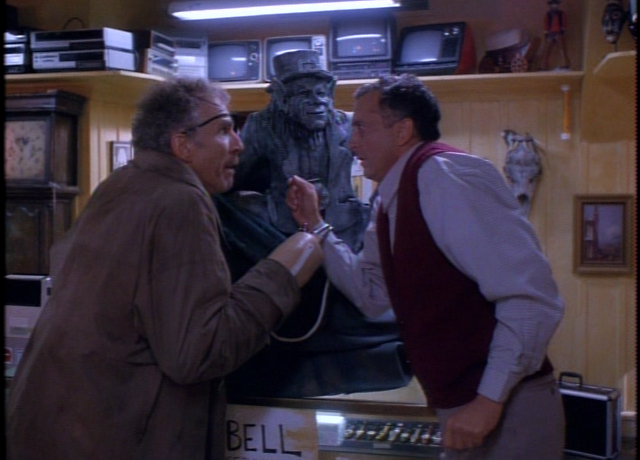
I totally forgot how this movie began, and what brought the Leprechaun to Vegas in the first place. A one-eyed man (who I don’t recall from the second movie) wanders into a pawn shop in Vegas with the Leprechaun, in it’s dormant stone form, dragging behind him in a raggedy sack. He then sells him to the pawn broker for 20 bucks and disappears. The broker then almost immediately awakens the Leprechaun by removing his cursed medallion, to the shock of no one. Then, the rhyming starts. I almost forgot just how horrible and distracting the lazy and cringe-worthy rhyming dialogue was in these movies.

leprechaun4

Perhaps the only thing worse than Warwick Davis’s lines in these movies are the ones given to everyone else. Here’s an interaction from the film, for instance, after a young boy discovers a woman whose car has broken down:

“Have you ever blown a rod before?”

“I beg your pardon?”

“The engine, I meant”

Oh come on now, that is a bit of a stretch (to say the least). And this is less than 5 minutes into the film, in one of the first lines of dialogue introducing central characters. It doesn’t exactly go up from there, either. Speaking of which, that “young boy” (who supposedly isn’t old enough to walk on a casino floor) looks like he is almost 30.

leprechaun5

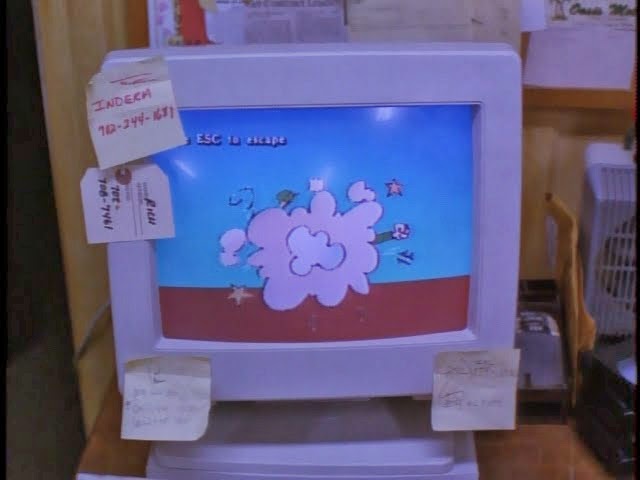
Here’s another thing I forgot: the internet hilariously plays a really important role in this 1995 movie. I am a total sucker for movies that include the internet before anyone knew much about it, and this one is no different. The internet in this movie is basically just a poorly animated storybook and guide to everything Leprechaun (and Were-Leprechaun) related.

leprechaun6

Another thing that somehow slipped my memory: one of the main characters is a skeevy magician, who is played as hammily as possible by an actor named John DeMita, who primarily does voice acting nowadays for video games and English dubs of anime series (“Final Fantasy XIII-2,” “Naruto”).

leprechaun3

The leads of the film are the aforementioned 30 year old supposed teenager, who becomes hooked on gambling / becomes a were-leprechaun, and his love interest: an ambitious magician’s assistant. Other notable characters in the unnecessarily and shockingly large cast of “Leprechaun 3” include an over-the-hill roulette dealer who lusts for the beauty of her youth, a casino worker who is in debt to the mob, and, strangely enough, the pawn broker from the opening. Somehow, the Leprechaun winds up stuck in that pawn shop for over half an hour of run time, making the broker a mildly important player in the film. His theft of one of the Leprechaun’s coins is the catalyst of the entire casino-centric story.

When the Leprechaun finally does make it to the casino, the movie somewhat sidetracks as he starts taking out most of the accessory cast while his last lost coin continues to change hands. The most notable of these deaths is of the roulette dealer, who wishes for youth and beauty. As with any sort of crafty and devious wish-granting creature, it quickly goes sideways on her when Leppy tracks her down. This is one of those things that is easier to show than to tell:

There are just no words to describe how ridiculous that is. I have to admit, though, that’s kind of what I assumed happened off screen in “Willie Wonka.”

The whole middle act of the film is basically Warwick Davis hamming it up in the casino, killing off characters, and continuing with all of the worst rhymes that the writers could think up. The best of all of these deaths is definitely the magician’s, who bites it towards the end of the movie in a unique take on the classic “sawing a person in half” trick.

Of course, I have to get into the whole “were-leprechaun” plot. It turns out that it was a little different than what I remembered: the main character is turned into a were-leprechaun because he both bitten and is exposed to Leppy’s blood, which is apparently toxic and burns like acid (very xenomorph-like). Other than that, it is about exactly what you would expect: he starts wearing bad prosthetic facial hair, freckles magically appear on his face, and he starts rhyming incessantly in a fake Irish accent. It is pretty annoying in the moment, but hilarious to look back on.

leprechaun7

There is a particular segment of the film that I forgot about in which the magician’s assistant and co-lead, Tammy, is possessed by the lost coin after the casino boss makes a wish to sleep with her. The coin is stolen again before anything happens, but the whole segment has massively uncomfortable undertones. The casino boss is almost immediately killed afterwards by Leppy, who summons a killer sex robot from his TV, which is one of the more bizarre cases of instant karma in film that you’ll ever come across.

leprechaun8

The finale, of course, features some extensive Leprechaun battles between Leppy and the were-creature, and features lines such as:

For pulling this trick,

I’ll chop off your dick!

and

Cut her nose,

and I’ll hack off your toes!

and

Power to power

You have much to learn

Taller or shorter

I’ll make you burn!

I can’t emphasize this enough: every single line between these two central characters in the last act is like this. Back and forth, back and forth: constant. Again, this is as annoying as anything in the universe to sit through, but I am laughing my ass off thinking about it now.

The Leprechaun is ultimately defeated with the creative use of a flamethrower, but only after he fails to lure Scott, the were-leprechaun, to join him on what he literally refers to as “the green side.” Scott is magically cured of his were-leprechaunism after the bout for reasons that aren’t exactly clear meaning that there’s a happy ending for Tammy and Scott. However, the last line has to be overdone, inappropriate, and cheesy, so the writers decided to rip off the last line to “Casablanca.” I can’t even begin to go into how much is wrong with that.

So, does “Leprechaun 3” hold up as a good bad movie? Honestly, it is way better than I remembered (on a good-bad level, of course). The characters are all hammed up to the max, the plot is the perfect sort of nonsense. I would recommend this one over the original or “In The Hood” in a heartbeat. In general, this is a movie that bad movie lovers should not miss by any means. The only big problem with it is the casino boss sequence’s sexual assault overtones, which could have been fixed really easily with a quick rewrite. It isn’t just unnecessary for the story and shitty to include, but it also messes with the whole tone of the movie. With that caveat, this is a solid good-bad movie recommendation from me.

Plotopsy Podcast #8 – Small Soldiers

Small Soldiers
small2

Recently, I read a book recounting the story of the early days of DreamWorks, called “The Men Who Would Be King” by Nicole LaPorte. The book features extensive insight into the many DreamWorks features produced during the Spielberg/Katzenberg/Geffen years of the company. One of the most interesting of these that I specifically recounted from my childhood was “Small Soldiers,” a movie that I really enjoyed at the time it was released. However, it was a critical and financial disappointment for the company, despite being technically successful. To understand why the film was so poorly received and regarded at the time, there is a fair amount of background information worth reading into.

“Small Soldiers” was conceived from an interesting mix of envy and greed. Pixar and Disney released the smash hit “Toy Story” in 1995 to massive acclaim and fortune not only on screen, but also from lucrative toy and merchandise tie-ins. In response, the team at DreamWorks struck up a deal with Hasbro to do tie-in toy merchandise for a series of films. DreamWorks notably had a historical axe to grind with Disney, due to Jeffrey Katzenberg’s rocky relationship with Michael Eisner, and the fact that many animators at DreamWorks were poached from the great mouse. Topping “Toy Story” would have been nothing short of a major triumph and vindication for the company. And so, “Small Soldiers” was the first of these Hasbro tie-in features released, and the expectation of it was to match or surpass the “Toy Story” acclaim and fortune earned for Disney and Pixar.

In a recent review of “Small Soldiers” by Doug Walker (The Nostalgia Critic), numerous similarities to “Toy Story” are specifically pointed out from the movie, and they are pretty undeniable. However, “Small Soldiers” is definitely a very different beast than the lofty and light-hearted “Toy Story”, and I wouldn’t be surprised if some of those sequences were the result of not-so-subtle arm-twisting by the DreamWorks brass.

Joe Dante, a B-movie and cult director who had seen success with movies like “Gremlins,” “Piranha,” and “The Burbs,” was attached to direct “Small Soldiers.” In retrospect, this was probably a misstep for a film that was intended to primarily to serve a youth audience. Even “Gremlins,” arguably his most family friendly movie at the time, is a good deal darker than your typical blockbuster family fare. It can certainly be said that the darkly comedic ultimate product of “Small Soldiers” is a creation born from Joe Dante’s influence.

A number of writers ultimately worked on the script for “Small Soldiers.” First, the team of Ted Elliott and Terry Rossio, who had struck big for Katzenberg on “Aladdin,” worked on the film. Those two continued to work for DreamWorks on a number of other films, including “The Road to El Dorado” and “Shrek,” before working extensively on the “Pirates of the Carribbean” franchise for Disney. The other writers who later worked on the screenplay included Adam Rifkin, who penned the hit “Mouse Hunt” for DreamWorks in the previous year, and Gavin Scott, who co-wrote “The Borrowers” in 1997 for Working Title.

On May 21, 1998, less than two months before the release of “Small Soldiers” in theaters, an expelled High School student named Kip Kinkel murdered his parents and committed a school shooting in Springfield, Oregon. This sparked a lot of public conversation about the marketing of violence to children, and some believe that this event caused the film to be more harshly criticized than it might have been otherwise.

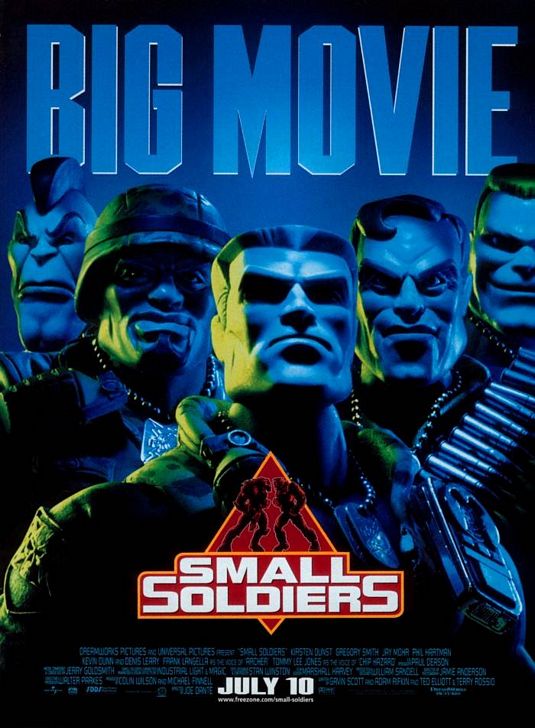
Not helping the matter, the final product of “Small Soldiers” was far more violent than expected: promotional materials even had to be altered (most notably the poster, in which a gun was reportedly digitally removed from Chip Hazard’s hand). The movie was ultimately slapped with a PG-13 (the only DreamWorks movie to get the rating), which caused a stir given it was being marketed with the Burger King equivalent of a Happy Meal. This also theoretically limited its financial potential by keeping young children out of the theaters, which certainly didn’t go over well with DreamWorks. This also understandably further opened up a lot of questions about violent products being catered to children, which almost certainly negatively affected many reviews of the movie.

small1

“Small Soldiers” has a deep cast of comedic character actors that provide a lot of the comic power of the film, including David Cross, Jay Mohr, and Dennis Leary. However, it is undoubtedly not a product suitable for young children, not only because of the violence, but because the humor is rather dark and laced with social satire that they couldn’t possibly get. The PG-13 rating is certainly justified, in any case. The movie’s cast also notably features a pre-fame Kirsten Dunst, and, sadly, the last screen performance of Phil Hartman.

small3Phil Hartman, beloved comedic actor of “Saturday Night Live,” “NewsRadio,” “The Simpsons,” and “The Groundlings” comedy troupe fame, has a bit role in “Small Soldiers” as the moronic father of Kirsten Dunst’s character. Tragically, Hartman was murdered by his wife just before the release of “Small Soldiers,” making it his last live action theatrical role.

small5A number of references to Joe Dante’s movie “Gremlins” are hidden throughout the movie (including a direct reference to the Gremlin ‘Gizmo’), as well as numerous nods to classic B-movies. Dante got his start in film cutting B-movie trailers for Roger Corman, and has maintained his connection to B cinema to this day. His website, Trailers From Hell, is essentially a love letter to the old school B classics, featuring trailer commentaries from lauded B-movie writers, directors, and special effects masters such as Stuart Gordon, Eli Roth, Rick Baker, Lloyd Kaufman, Larry Cohen, Roger Corman, and himself.

small8
The special effects and designs for the action figures in “Small Soldiers” were done by legendary creature creator Stan Winston, and includes a mixture of practical and computer generated effects. This same technique earned Winston massive acclaim on “Jurassic Park” only a handful of years before. The figures themselves are particularly impressive, as you can see on display below:

The voice acting cast of “Small Soldiers” is incredibly deep, and features a rogues gallery of notables. Outside of Tommy Lee Jones, there are a number of alums from “The Dirty Dozen” that make up the Gi Joe esque Commando Elite, including George Kennedy, Clint Walker, Ernest Borgnine, and Jim Brown. The Gorgonites feature voices from Frank Langella, Christopher Guest, Michael McKean, and Harry Shearer. Even the Barbie analogues impressed into service by the Commando Elite late in the film feature the voices of Christina Ricci and Sarah Michelle Gellar.

“Small Soldiers” was created during a time in which DreamWorks functioned as a massive multimedia company, with interest in film, video games, animation, and music. Appropriately, DreamWorks attempted to milk every last drop from films released during this time period, and “Small Soldiers” was no exception. The film got a soundtrack that featured rap remixes of classic rock songs, a DreamWorks video game, and a slew of tie-in toys from the DreamWorks arrangement with Hasbro. In theory, “Small Soldiers” was intended to be a family movie with massive crossover potential that would provide proof of the DreamWorks multi-media model. Of course, that isn’t what it wound up being, to the disappointment of many.

So, why was “Small Soldiers” such a disappointment? Honestly, I think that the hands-off style of DreamWorks, which operated its live action with a “power to the artists” mentality reminiscent of United Artists, really burned them with “Small Soldiers.” I don’t think that the marketing team and the brass in general quite grasped the dark creature that was being created with “Small Soldiers”, or maybe they were just incapable of reigning it in for whatever reason. If DreamWorks had it set in their mind that they wanted a “Toy Story”, they probably should have hit the panic button the minute that military-grade microchips and hostage situations popped into a draft of the script. Also, there probably should have been more thought put into giving the film to a guy known for creating dark genre movies in Joe Dante. Secondarily, part of the issue with the film was just timing: releasing on the heels of a school shooting was something outside of their control, and didn’t do them any favors in the press or with critics.

small7

Now, this is a case where I actually like “Small Soldiers.” I think it is a pretty enjoyable dark comedy in the vein of “The Burbs” if you can divorce it from its context. The “Toy Story” connection, the extensive and inappropriate marketing campaign, and the general social atmosphere around the film all really contributed to the generally negative reception movie if you ask me. I would recommend giving it another shot if someone hasn’t seen it in a number of years: I think it holds up pretty damn well, and is far more clever than it has any business being.

That is all for today’s (Plot)opsy Podcast! Check in next week when I’ll be covering another DreamWorks flick, Sam Mendes’s “Road to Perdition.” Make sure to like Misan[trope]y Movie Blog on Facebook and subscribe to the (Plot)opsy Podcast on iTunes to keep up with all of the latest updates.

Hackers

Clerk’s Pick

Clerk:
Brock, Video Central (Columbus, OH)
videoc

Movie:
Hackers
hackers6

Pitch:
“‘Hackers’ made me want to paint my keyboard different colors. This is the future we are going to be living in. I love this movie.”

Background:

“Hackers” is a 1995 movie that has achieved cult classic status, particularly in internet communities, for its hilarious depiction of a group of hackers and their unrealistic use of the internet. The movie provided break out early roles for Angelina Jolie, and to a lesser degree Matthew Lillard.

hackers2

“Hackers” director Iain Softley has done very little else of note, with the exception of the Kevin Spacey movie “K-PAX” in 2001 and the movie “The Skeleton Key” starring Kate Hudson in 2005. IMDb lists two movies directed by Softley that have yet to be released: “Curve” and “The Outcast.” Neither film currently has a release date scheduled, however.

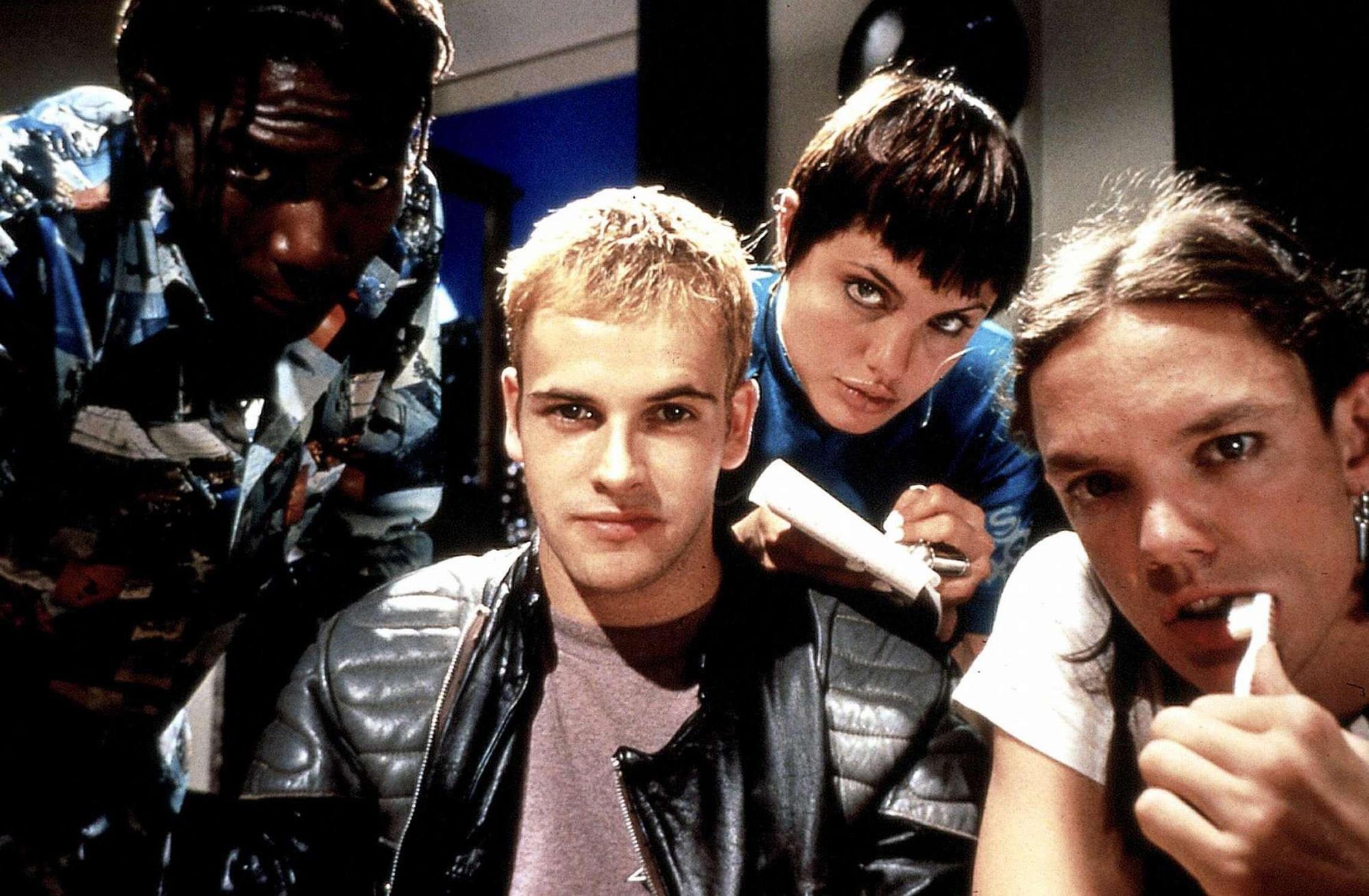
The cast is a veritable rogues gallery of notables. Angelina Jolie and Johnny Lee Miller lead the way, with Fisher Stevens, Wendell Pierce (“The Wire,” “Selma”), Lorraine Bracco (“The Sopranos”), Matthew Lillard (“Scream”, “The Descendants”, “SLC Punk”), and even magician Penn Jillette  and pop singer Marc Anthony filling out the lower rungs of the cast. Miller and Jolie wed soon after the completion of filming, which is a frequent footnote and fun fact attached to the film.

hackers1

Perhaps the most telling thing of all about this movie can be gleaned from looking at the writing credit. “Hackers” was penned by one Rafael Moreu, whose only other writing credit is for the much maligned “The Rage: Carrie 2.” Despite the reception of the script, apparently there was a lot of research put into the script by Moreu, some of which shows up on screen. A number of the character pseudonyms are nods to famous hackers and computer engineering icons (“Babbage,” “Emmanuel Goldstein”), and the central supercomputer in the story is named after William Gibson, an acclaimed and influential science fiction author who coined the term “cyberspace.” It is also reported that members of the cast and crew of “Hackers” spent time attending real hacker meetups and conferences while making the movie.

The marketing campaign for “Hackers” included, of course, a website. The design was made in such a way as to give the appearance that it had been hacked by outsiders. This included a number of snarky graffiti messages on top of the promotional materials. One in particular reportedly read “see ‘The Net’ instead,” a reference to the now equally notorious 1995 cyber-thriller starring Sandra Bullock.

Review:

I admittedly had somehow never seen this movie before, but its reputation precedes it. It is regarded nowadays as a classic bad movie, one of a subset of movies about the internet before anyone really understood how it worked (“The Net” gets the honor of being in this category as well).

Honestly, I’m not even sure where to start with this thing. The dialogue? The fashion? The music? Lorraine Bracco? There is a whole lot bad about this movie.

The first and probably biggest issue with “Hackers” is the script, which is a mixture of word salad techno-jargon and cheesy 1990s counterculture idioms. As mentioned in the background of the movie, the writer reportedly spent a fair amount of time around hackers while he was writing and preparing this movie. I can’t help but wonder if the hacker community was playing a lengthy practical joke on the production, intentionally feeding Moreu word salad and bad information. I mean, that certainly sounds like the kind of thing the internet community would do nowadays. In any case, the lines that make it into the movie are often cringe-worthy and nonsensical, something that is emphasized by the fact that most of the cast clearly has no idea what they are talking about.

Speaking of cluelessness in the cast, Lorraine Bracco deserves a specific call out for her performance. Even though her character is supposed to not understand computers in the story, it is clear that she is incredibly out of place in this movie. She doesn’t get a whole lot of screen time, but her deliveries when she is on screen are just abysmal. She just doesn’t fit in with the rest of the cast, and it stands out like caps lock.

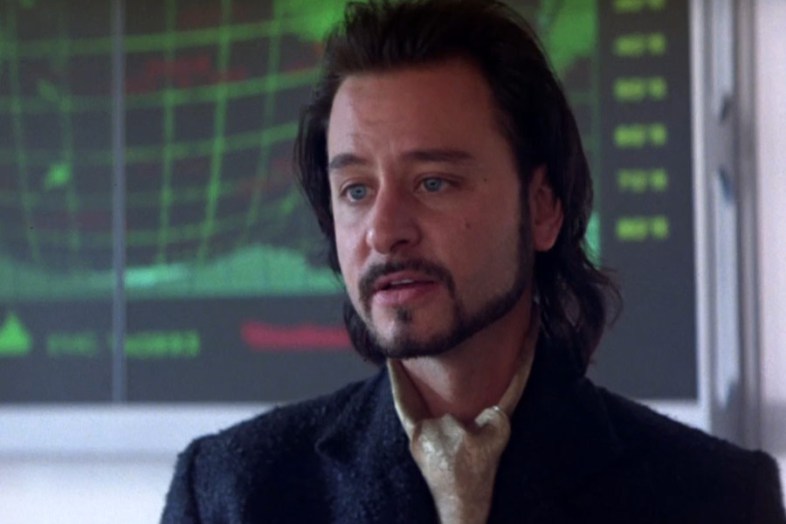
Fisher Stevens plays the antagonist in the story, and is probably the most entertaining element in the movie. He goes well over the top in his portrayal of a sold-out master hacker who holds no loyalties and looks down on the world (“The Plague”). His skeevy condescension comes out in every line he speaks, and it is hilarious.

hackers3

Wendell Pierce, who is best known for his starring roles in the HBO series “The Wire” and “Treme,” plays a secret service agent who is tasked with taking down hackers. He is definitely in a smaller role in “Hackers,” but his ability to integrate comedic timing into serious roles really comes out in this movie.

hackers4

“Hackers” was more or less the breakout movie for both Angelina Jolie and Matthew Lillard. It is fascinating to see how different their roles are in this movie, and how they reflect their ultimate career trajectories. Lillard, unsurprisingly, provides comic relief: setting the groundwork for him to eventually show up in countless stoner movies, as well as “Scream” and the “Scooby Doo” live action films as Shaggy. The way he pulls off the cyberpunk fashion in “Hackers” almost certainly contributed to him landing the lead role in “SLC Punk” as well. Jolie, on the other hand, is probably the most even-keel (and bland) character in the film. Admittedly, I am not a fan of Jolie’s acting: I have never seen anything where she shows much range, and she seems to rely on shallow action leads. In that sense, though (having a career based on being a shallow lead), “Hackers” provides as legitimate of a foundation as you could ask for.

Not everything about “Hackers” is bad, though. There are some pretty interesting sets, and there is some intriguing editing here and there. It is also a very colorful movie for better or worse: I thought it worked pretty well personally. There are a number of “cyberspace” sequences that were created through a mix of practical effects and traditional animation that actually look pretty ok (better than if they had dared CG in 1995).

hackers5

“Hackers” is a movie I can definitely recommend to computer nerds and bad movie fans as an unintentional comedic masterpiece. To other audiences, I don’t they would appreciate the film as much, but they might still be able to have fun with it. There is a relevant quote from Roger Ebert’s surprisingly positive review of the movie:

The movie is smart and entertaining, then, as long as you don’t take the computer stuff very seriously. I didn’t. I took it approximately as seriously as the archeology in “Indiana Jones.”

I agree that if you turn off your brain, this is a pretty enjoyable movie. It also benefits a bit from the nostalgia factor it has nowadays, but the flip side of the coin is that all of the floppy discs make the movie hilariously archaic.

As a side note, I highly recommend the We Hate Movies episode on “Hackers” for a more in depth look at the plot.

Fatty Drives the Bus

Clerk’s Pick

Clerk:
Brock, Video Central (Columbus, OH)

videoc

Movie:
Fatty Drives the Bus
fatty2

Pitch:
“If you can handle a Troma movie, this is by far my favorite of theirs. It is about Satan hijacking a tour bus to take the souls of the passengers, but Jesus is in town and tries to stop them. I don’t think the director ever made any other movies, but it is one of my favorites.”

fatty

Background:

The box for “Fatty Drives the Bus” proudly claims that it is a “film so far underground that it is going to hell.” As you might expect, there isn’t a whole lot of information out there about this low-budget 1999 Troma-produced flick.

Writer/Director Mick Napier is apparently a well-known Chicago stage director and improvisor, who has worked extensively with Second City and founded Chicago’s “The Annoyance Theater.” He is particularly well-regarded for his comedy improvisation, and has written a book on the subject called “Improvise: Scene From the Inside Out”

All of that said, Napier doesn’t have a whole lot of experience working on screen. He has had minor roles in movies like “The Ice Harvest” as an actor, but his writing and directing has been primarily limited to “Fatty Drives the Bus” and the television series “Exit 57,” which featured now well-known talents like Stephen Colbert and Amy Sedaris.

The cast of “Fatty Drives the Bus” is made up of an assortment of comedic actors: I assume it was a sort of hodge-podge of whoever was available around Chicago at the time. It is pretty evident that this production didn’t have money behind it, so I doubt that anyone was being flown in to contribute.

As mentioned previously, “Fatty Drives the Bus” is distributed by the infamous outfit Troma Entertainment, through their Troma Team Video wing. Troma is known for Z-grade, tongue-in-cheek, crass productions like “The Toxic Avenger,” “Tromeo & Juliet,” and “Sgt. Kabukiman,” and perhaps more so for their charismatic, eccentric patriarch Lloyd Kaufman. When not creating eye-grabbing garbage movies, they also do a fair bit of distribution of Z pictures, as was the case with “Fattie Drives the Bus.”  Personally, seeing the Troma seal on a movie typically turns me off: not only are their movies consistently of poor quality, but they are never made in earnest, which denies them the charm of other bad movies. Still, they certainly have their fans, making them a particularly divisive outfit in the world of bad movies.

troma1 troma2However, because “Fatty Drives the Bus” was only distributed by Troma (not created by them), I am holding on to some optimism about this flick.

Review:

“Fatty Drives the Bus” definitely has similarities to the usual Troma fare, primarily in the fact that it sells itself on its title and outlandish plot. However, I think the content is far more similar to absurd comedies like “Tim & Eric Awesome Show, Great Job!” than the often physical and crass humor in most Troma flicks.

“Fatty Drives the Bus” is not a good movie in any conventional sense of the term, but there is some strange enjoyment to be had out of it. It is pretty clear that Napier has a great sense for comedy, and that the weaknesses of the movie have a whole lot more to do with inexperience behind a camera and what were almost certainly financial limitations for the project. For instance, the sound editing is particularly awful, and the pacing and editing through a number of sections is just bizarre, but not in what I assume was the intended way.

fatty3

As far as the positives go, the hell segments have some pretty solid makeup effects, and it is evident from both the writing and the deliveries that everyone involved with the production knows comedy inside and out. However, the comedy here is a very specific brand that I don’t think would appeal to a whole lot of people. I enjoyed it well enough even though it isn’t exactly my preferred flavor of comedy, but I would have trouble recommending it to anyone else. The movie, first and foremost, is just damn weird, enough so to turn off just about anyone. The technical issues are also pretty glaring in a way that might annoy audiences, but there is some question as to whether it was all intended in order to emphasize the atmosphere. I’m usually skeptical of that kind of ad hoc justification for quality issues, so I am not going to run with that assumption.

If you are into absurd humor in the style of “Tim & Eric”, this might be a movie up your alley. However, it certainly isn’t as well crafted as “Tim & Eric,” and you generally shouldn’t expect anything of quality outside of the humor. For anyone else, I would advise avoiding “Fatty Drives the Bus.” That shouldn’t be particularly hard, though, as this one isn’t likely to be sitting on a shelf anywhere near you.

Worst Movies of 2014

Better late to the party than not showing up, right? Well, here I am: a week into January, and just now doing the “Worst of 2014” post.

Many of you have probably seen the highly publicized listing of Rifftrax’s “Worst Movies of 2014” list, as voted on in a public poll. For those that haven’t, here it is:

rifftrax

  1. Teenage Mutant Ninja Turtles
  2. Transformers: Age of Extinction
  3. Dumb and Dumber To
  4. A Million Ways too Die in the West
  5. Left Behind
  6. The Amazing Spider Man 2
  7. Ouija
  8. Sex Tape
  9. Noah
  10. 300: Rise of an Empire

Interesting. I certainly have some quarrels with it, but such is the nature of democracy. Let’s compare that with a handful of other “Worst of 2014” lists, shall we?

Here is one pulled together by the good folks at the Stinker Madness Podcast, in no particular order:

logo

  • Noah
  • Left Behind
  • Sin City: A Dame To Kill For
  • A Winter’s Tale
  • Sabotage
  • Godzilla
  • 3 Days to Kill
  • Pompeii
  • Teenage Mutant Ninja Turtles
  • Transformers: Age of Extinction

Here is another one, done by Rolling Stone:

rollingstone1

  1. Transformers: Age of Extinction
  2. The Expendables 3
  3. Godzilla
  4. Men, Women & Children
  5. The Amazing Spider Man 2
  6. The Judge
  7. Divergent
  8. Transcendence
  9. Annie
  10. God’s Not Dead

And yet another, for good measure, by The AV Club:

avclub

  1. Left Behind
  2. 3 Days to Kill
  3. Septic Man
  4. Lullaby
  5. Winter’s Tale
  6. Labor Day
  7. The Bag Man
  8. Dark House
  9. Drive Hard
  10. If I Stay
  11. Hector and The Search for Happiness
  12. The Legend of Hercules
  13. Miss Meadows
  14. Best Night Ever
  15. America: Imagine The World Without Her
  16. Third Person
  17. A Million Ways to Die in the West
  18. Saving Christmas
  19. Devil’s Knot
  20. Atlas Shrugged Part III

Needless to say, it was quite a divisive year for bad movies. None of the lists agreed on a number one, and different films show up in each of them. Notably absent from all of them is the Bollywood movie “Gunday,” that sparked so much controversy on IMDb and other social media sites, instantly tanking to the bottom of the IMDb Bottom 100. Also, the much-maligned “Saving Christmas” is oddly underrepresented, barely cracking the AV Club list, and not making the other lists at all. Even the latest “Transformers” movie, which topped one list and was runner up in another, totally missed the AV Club list of 20. The Rifftrax number 1, “Teenage Mutant Ninja Turtles,” missed the AV Club and Rolling Stone lists. “Left Behind” consistently showed up in three of the lists, but missed the Rolling Stone ranking altogether. In another shock, “God’s Not Dead” only appears at #10 on the Rolling Stone list, and nowhere else.

I can’t express how astoundingly bizarre this is. I expected to see a significant difference between the Rifftrax list and the others, because Rifftrax was democratically run and open to the public, whereas the others were selected by critics. But the critics didn’t see any kind of agreement between them! We’re not even talking about minor gripes with the ordering: they are selecting entirely different movies!

All right, let’s see what another one says. TIME:

time

  1. Blended
  2. A Million Ways to Die in the West
  3. Men, Women & Children
  4. Walk of Shame
  5. Let’s Be Cops
  6. Legend of Hercules
  7. Winter’s Tale
  8. Nut Job
  9. Transcendence
  10. Hateship Loveship

Holy shit. Not only is there another different #1 worst movie (one that appeared on no other list, I might add), but 5 of 10 movies on the TIME list did not appear on any other list. You have to be kidding me.

Just for even more giggles, here is the Chicago Tribune list:

  1. Left Behind
  2. A Million Ways to Die in the West
  3. The Nut Job
  4. Horns
  5. And So it Goes
  6. The Identical
  7. Winter’s Tale
  8. Sex Tape
  9. Muppets Most Wanted
  10. Sin City: A Dame To Kill For

That is the first repeat top selection so far! However, there are also 4/10 that haven’t appeared on any of the other lists, so we aren’t making much progress there.

So, I’m going to try to come up with an aggregated “Worst Movies of 2014” out of these lists. First off, any film that only appears on one list is disqualified. That leaves me with the following 15 movies to rank:

  • A Million Ways to Die in the West
  • The Nut Job
  • Winter’s Tale
  • Left Behind
  • Sex Tape
  • Sin City: A Dame to Kill For
  • Transcendence
  • Amazing Spider Man 2
  • 3 Days To Kill
  • Teenage Mutant Ninja Turles
  • Transformers: Age of Extinction
  • Noah
  • Godzilla
  • Men, Women & Children
  • The Legend of Hercules

Now, I’m going to come up with a formula to decide the ranking. I’m thinking I am going to add together the Rotten Tomatoes review aggregate score, the Rotten Tomatoes audience score, and the IMDb score times 10 (it is on a 10 point scale normally, so this makes it out of 100). For each movie, that will give me X/300, and I will rank them from lowest to highest. Lets see what that looks like…

  1. The Legend of Hercules (79/300)
  2. Left Behind (86/300)
  3. Sex Tape (103/300)
  4. The Nut Job (113/300)
  5. Winter’s Tale (119/300)
  6. Transcendence (120/300)
  7. Transformers: Age of Extinction (130/300)
  8. 3 Days To Kill (135/300)
  9. *TIE* Teenage Mutant Ninja Turtles (136/300)
  10. *TIE* A Million Ways To Die In The West (136/300)
  11. Men, Women & Children (147/300)
  12. Sin City: A Dame To Kill For (158/300)
  13. Noah (181/300)
  14. Amazing Spider Man 2 (189/300)
  15. Godzilla (207/300)

Well, isn’t that interesting? Another new number 1 in “The Legend of Hercules,” but I am more interested in the higher numbers on this list. Those of you who are math-inclined may have noticed that the lower entries on here don’t have horrible scores: “Godzilla” has a 69%, which is damn near a “C”, and a passing grade however you cut it. “Amazing Spider Man 2” has a 63%, which isn’t good, but is certainly nowhere near the bottom for the whole year. For comparison, this scale gives “Saving Christmas” a 46/300, or a 15.3%, which is well lower than anything else on the list.

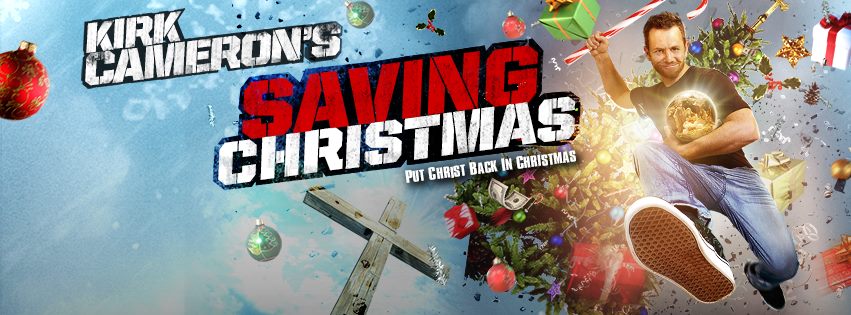
savingxmas2

I think the conclusion here is that 2014 is a year that we are all going to have to “agree to disagree” when it comes to movies. I’m personally very interested to see how this shakes out on the other end of the spectrum: a lot of people are expecting an equally competitive field in the “Best of 2014” category, which is going to be quite a firefight once awards season rolls around.


Plotopsy Podcast #7 – Springtime For Hitler

Springtime For Hitler (The Producers)

producers producers1

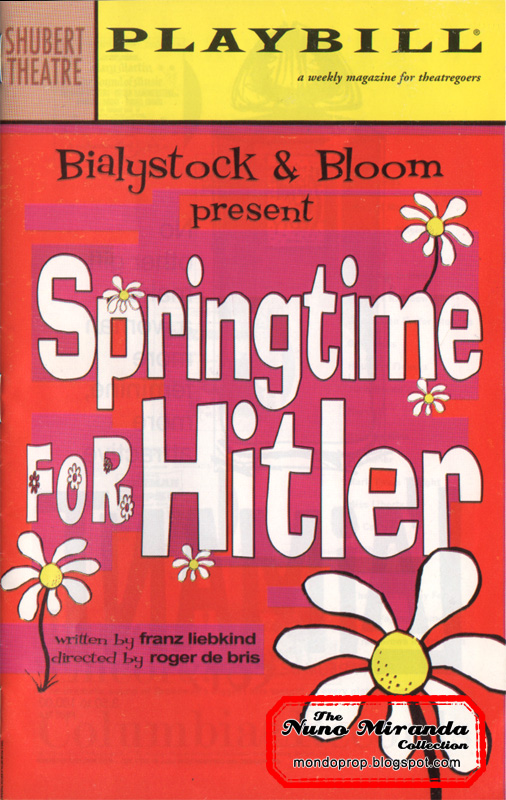
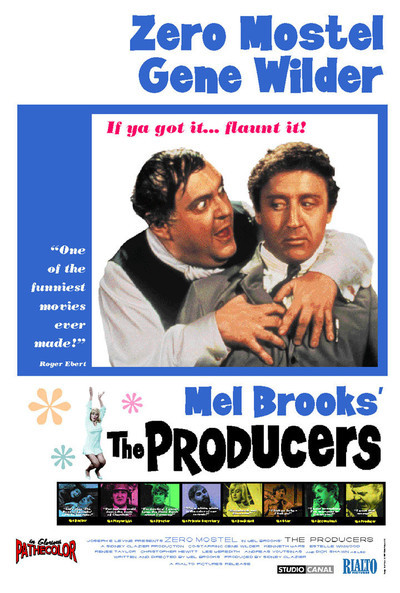
Welcome back to the (Plot)opsy Podcast! Today’s episode is a bit of an oddball, in that I’m going to be covering a play instead of a movie. Well, sort of. The play doesn’t actually exist, but a movie about it does. Also, there’s a play adaptation of the movie about the play that doesn’t exist, and a further movie adaptation of that play. Sound confusing? You have Mel Brooks to thank for “Springtime for Hitler,” the fictitious Broadway smash at the center of the acclaimed film-turned play-turned film again, “The Producers.”

Recently, I caught a fantastic American Masters documentary about the legendary Mel Brooks. The movie chronicles his entire impressive and lengthy show-business career, and offers a lot of the behind-the-scenes insights that I always enjoy learning about. This, of course, sent me through a re-watch of some of Mel’s film highlights, including his Hitchcock-inspired “High Anxiety” and the beautifully executed “Young Frankenstein,” just to name a couple.

While I love a lot of the Mel Brooks movies, I don’t think any of his later films quite match up in quality to his 1967 Academy Award winning debut, “The Producers” (and its subsequent musical adaptation). Given my fondness for the aesthetics of the awful, I’m admittedly a bit biased here: the plot of “The Producers” is about creating the worst play of all time, so of course that is up my alley. Coming from a place of affection for “The Producers” and Mel Brooks, I want to analyze the baffling success of the film’s fictitious Broadway blitzkrieg: “Springtime for Hitler.” Hang with me here, this could be interesting.

Believe it or not, I think there is very good reason as to why “Springtime for Hitler” is successful within the world of “The Producers.” In the Broadway adaptation, Bloom and Bialystock share a musical number called “Where Did We Go Right?”. I think that I can adequately explain exactly what went “right” about “Springtime for Hitler.” Here’s a look at some of the lyrics to get us started:

We searched Broadway on and off
For singers with a cough
We had tryouts and auditions by the score
And to trip the light fantastic
We picked dancers who were spastic
If anyone jetted, we jetted them out the door

They shouted hooray for that sausage on display
Where did we go right?
Our leading man was so gay he nearly flew away
Where did we go right?
A show so easy to despise
Now it’s up for the Pulitzer prize
Oh, where, oh, where, tell us
Where did we go right?

In “The Producers,” the lead characters are attempting to craft a genuinely bad play, which should be a fairly simple task in theory. So, the question is: how did Bialystock and Bloom stumble into the elusive realm of the “good-bad” aesthetic? First off, it helps to understand the accepted contributing factors to “good-bad” status.

It has been alleged that one cannot intentionally create a “good-bad” feature, because one of the most widely accepted requirements for the pseudo-genre is a healthy degree of earnestness. Basically, in order for a movie or play to be “good-bad,” it needs to have honest and genuine effort thrown into it by at least a healthy number of the cast and crew. Thus, trying to intentionally capture the “good-bad” aesthetic is impossible (or is it?).

I believe that “The Producers” actually stumbled across a fascinating way to intentionally create a good-bad work, even though that isn’t what Bialystock and Bloom set out to do in the movie. As mentioned previously, earnestness is absolutely key to the good-bad aesthetic. In most cases, an attempt to create something awful will lose that all-important creative honesty. However, the plot of “The Producers” skirts around this roadblock: the only two characters who are in on the plan are the eponymous producers, who are not part of the hands-on creative team. Their influence on the play is limited to the assembling of the pieces: they are shown selecting the director, the script, and the cast, for instance. That means that the creative team of “Springtime for Hitler” is unaware of the dishonest motivations of the production, and are therefore earnest in their efforts with the play.

While earnestness is a major key in creating a good-bad feature, there is more to the success of “Springtime for Hitler” than that alone. After all, earnestness is essentially atmospheric, and doesn’t guarantee entertainment value. For that all important entertainment value, most good-bad movies rely on the actors. Sometimes this is achieved by over-the-top performances (like Nicolas Cage’s in “Vampire’s Kiss” and “The Wicker Man”), other times it may come from astounding underacting (as is found in “Birdemic”). Or, best of all, the acting can provide a peculiar mix of the two, as was the case in “The Room,” which features a cavalcade of simultaneously emotional, intense, and completely vapid performances.

The cast of “Springtime for Hitler” is one of the few things that significantly varies between the initial film version of “The Producers” and the later musical adaptation. They both function more or less the same way and lead to the same ultimate result, but the differences are worth pointing out.

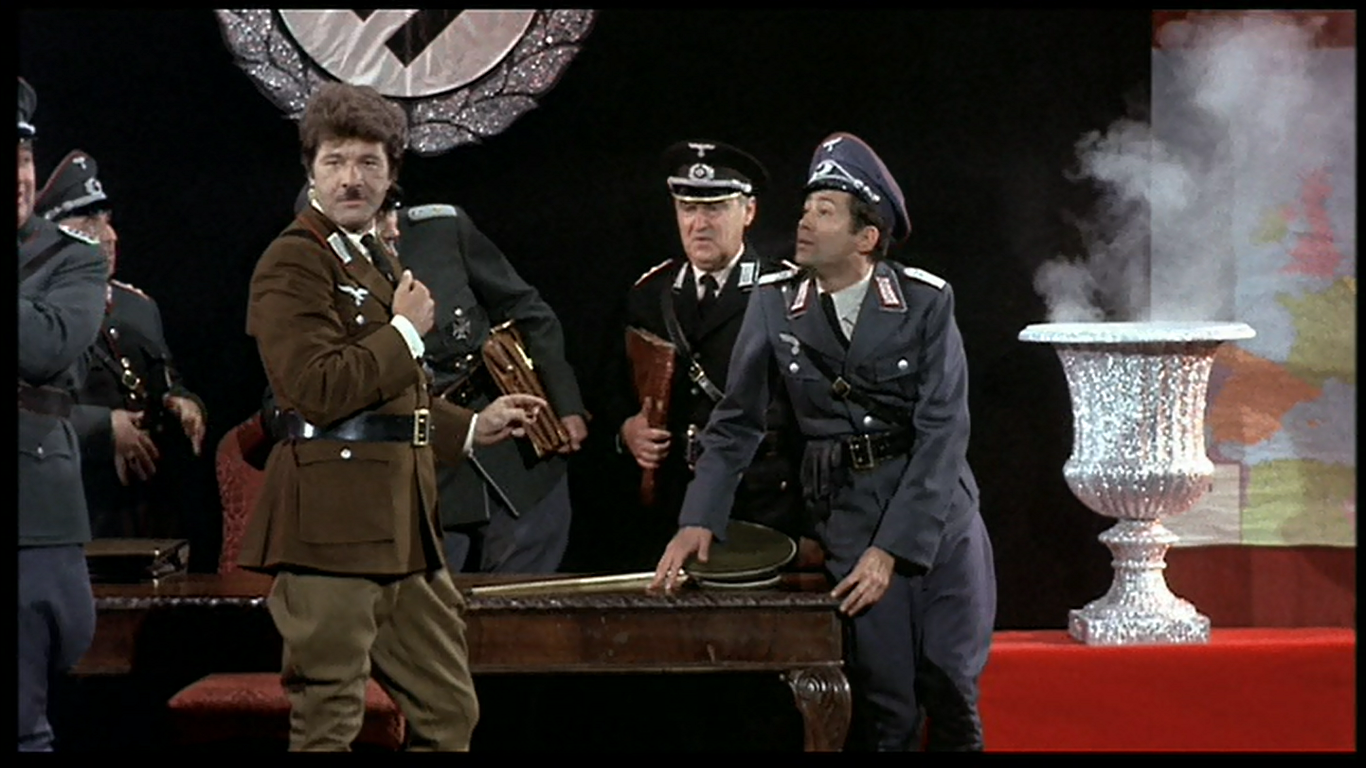
In the initial film version, Hitler is played in “Springtime for Hitler” by a hippie named Lorenzo St. Dubois (LSD). He apparently performs while drugged out of his mind, and improvises most of his dialogue (to the intense disdain of the play’s author, Franz Liebkin). However, his performance is what turns the audience around: before he takes the stage, the audience has already started parading out of the theater in disgust. Once he gets going, however, his baffling exploits quickly win over the crowd. Adding a cherry on top of the performance are the antics of the infuriated Franz Liebkind, who takes to the stage in a fit of rage while clad in his German army helmet. The audience mistakes this for part of the surreal act, responding with immense applause.

producers2
LSD as Hitler in the original film version of “The Producers”

In the musical adaptation and subsequent film, the character of LSD is cut from the story. Instead, the writer of the play (Franz Liebkind) is initially cast as Hitler, but is injured before opening night. The director, Roger De Bris, takes over the role or the great dictator for the show. The play goes much the same way as in the initial movie, with the audience storming out just before Hitler takes the stage. Instead of drugged improvisation, De Bris wins the audience over with flamboyant innuendo and comedic song and dance (“Heil Myself”). I personally think that the De Bris Hitler version works better for the film by eliminating an unnecessary and light character, but the LSD version is certainly more surreal. In either case, the curious and hilarious performances of the leads wind up providing the entertainment value behind “Springtime for Hitler”, and save the play from the dull fate that it seemed all but doomed to. They make the final difference between bad-bad and good-bad for “Springtime for Hitler”.

The last and perhaps most important factor in the success of “Springtime for Hitler” as a fictional good-bad smash is entirely the fault (or credit) of Bialystock and Bloom: the assembly of the “Springtime for Hitler” creative team.

In general, all of the decisions that the producers made in the creation of the “Springtime for Hitler” team were big, obnoxious, and loud: they couldn’t settle a bad, boring script; it had to be the worst, most offensive script. They wouldn’t take a mediocre director, they wanted the absolute worst. Their Hitler had to be the most atrocious Hitler since the actual Hitler. Arguably, if they had settled in any one of those categories, the flop may very well have been assured.  What led the producers to going so over the top with their assembly, though? Why go for all of the biggest personalities and extreme outliers? The obvious answer is that they wanted a guarantee of failure, but I think it goes a little deeper than just that.

At the beginning of the story, it is made clear that Bialystock had been producing flops for years, with Broadway success just a fading memory from his distant past. When Bloom reveals the theoretics of the flop scam that ultimately drives the film, there is a perceptible change in the character of Max Bialystock. His desire for failure brings back the drive and ambition that he had clearly been missing, and was almost surely what made him successful in the first place. This is particularly driven home in the musical adaptation’s number “The King of Broadway”, which paints a clearer picture of the pro-Bloom, downtrodden Bialystock.

In essence, Bloom’s scam reawakens Bialystock’s motivations, and he is once again driven and capable of assembling a team. While he tries to build something to fall apart, I think he underestimates himself: despite his many flops, he lacks the innate ability to create failure, which is something he wrongfully believes to be the case. His failures, as much as the audience sees of them, come from a place of apathy. The mere fact that he is expending energy and displaying passion for “Springtime for Hitler” is the kind of intangible that can positively effect a production. Just looking at the way he desperately courts and pleads with Roger De Bris and Franz Liebkind is intriguing when viewed from this perspective. They don’t know why, but they know that something about “Springtime for Hitler” has Bialystock exited to produce again. Remember: no one other than the producers know about the scam until after opening night. For all they know, this script has genuinely reignited Max Bialystock.

“Springtime For Hitler,” a play created to fail, is ultimately a success within the story of “The Producers” for the same reasons that we have cult classic good-bad movies in the real world. The play is made in absolute earnest by an outlandish, eccentric, and boisterous cast and crew, led a highly eclectic lead with  a peculiar charisma that is capable of captivating audiences. Despite it all being assembled by crooked producers with impure motivations for failure, “Springtime For Hitler” was unintentionally crafted with an ideal, elusive formula for a good-bad smash, along the same lines as beloved films like “Troll 2” and “Birdemic.”

That’s all for today’s (Plot)opsy Podcast here at Misan[trope]y Movie Blog! Be sure to like Misan[trope]y Movie Blog on Facebook, and subscribe to the (Plot)opsy Podcast on iTunes. That way you’ll never miss a new post!