Tag Archives: film

Stuart Gordon Spotlight: “Robot Jox”

Robot Jox

robotjox7

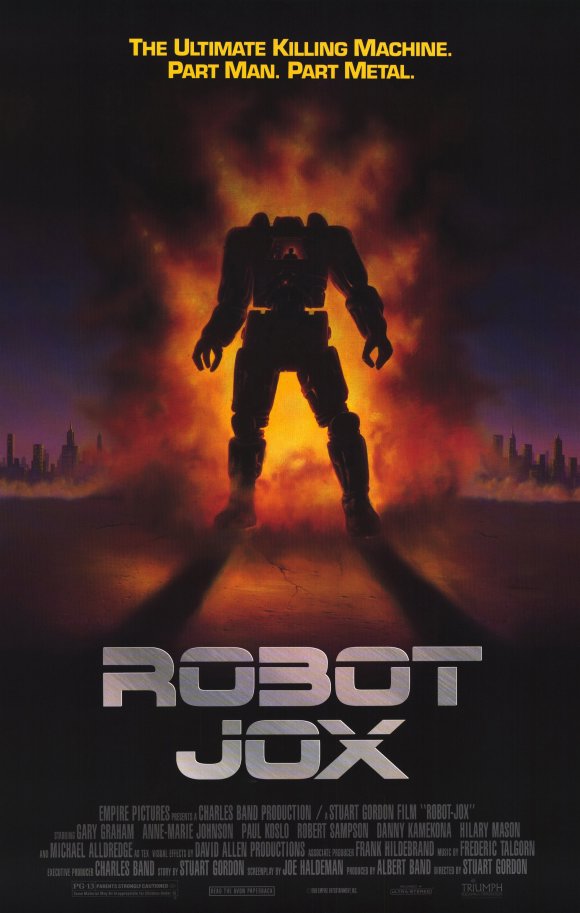
Welcome back to Misan[trope]y Movie Blog! Next up in the two week spotlight on writer/director Stuart Gordon is 1989’s ridiculously fun giant robot movie, “Robot Jox.”

“Robot Jox” was co-written by the acclaimed Hugo and Nebula winning sci-fi author Joe Haldeman, best known for the 1974 novel “The Forever War.” Reportedly, he is not a fan of the ultimate product of “Robot Jox” that made it to the screen. In 2008, he was quoted as saying:

Some people enjoy [Robot Jox], but to me it’s as if I’d had a child who started out well and then sustained brain damage

This opinion can almost certainly be attributed to frequent clashes between the author and director/co-writer Stuart Gordon over what the direction and tone of the film should be, which caused much of the production to apparently become a nightmare. Gordon wanted an audience-friendly story that could act as a visual, action-packed spectacle, whereas Haldeman was more interested in the story being a serious, harder sci-fi war drama. These visions proved, of course, to be generally incompatible.

Charles Band and his company, Empire Pictures, produced “Robot Jox,” just as they had done for Stuart Gordon’s earlier films “Dolls,” “From Beyond,” and “The Reanimator.” However, “Robot Jox” proved to be a much larger project for the company: the budget reportedly eventually hit $10 million, making it the most expensive undertaking by far for the b-movie outfit.

“Robot Jox” suffered significant delays on its release date due to the (perhaps predictable) bankruptcy of Charles Band’s Empire Pictures, which left it in limbo for a couple of years after the film was finished shooting.

One of the most distinguishing aspects of “Robot Jox” is its inspiring, top-notch score. The music on the film was provided by Frédéric Talgorn, who also worked on the Stuart Gordon film “Fortress,” as well as the animated “Heavy Metal 2000.”

The cinematography on “Robot Jox” was once again provided by frequent Stuart Gordon collaborator Marc Ahlberg, who had a handful of credits to his name in 1989. Included among these is the hilarious sci-fi boxing movie “Arena,” also a product of Charles Band’s Empire Pictures. It is worth checking out for die-hard b-movie fans in need of a deep cut: I have often summed up the film as “Rocky in Space.”

The extensive visual effects and stop motion work in “Robot Jox” was supervised and directed by David Allen, who worked the stop motion on b-movies such as Larry Cohen’s “Q” and “The Stuff,” IMDb Bottom 100 feature “Laserblast,” and Stuart Gordon’s own “Dolls.” Apparently, his work ran into multiple delays due to weather, as he insisted on filming against open sky. Stuart Gordon has stated that the weather issues caused the Mojave desert stop-motion filming to stretch on for “a year and a half…[because] everything that could have gone wrong went wrong.”


robotjox8 robotjox9The box office results on “Robot Jox” proved to be nearly as unfortunate and disastrous as the production process. On the rumored $10 million budget, the movie barely grossed $1.2 million in its limited theatrical release. Audiences at the time weren’t particularly thrilled with the movie, though it has certainly gained cult acclaim in the years since its release. It currently hold a 5.2 rating on IMDb and a 41% audience score on Rotten Tomatoes, through you would certainly get a different response from a group of bad movie lovers today.

The story of “Robot Jox” takes place in a post-apocalyptic world where international conflicts are settled through competitive combat utilizing large, piloted robots. A particular pilot, Alexander, has been causing havoc on the United States, defeating nine pilots in a row as the story begins. The meat of the story follows Achilles, an American pilot who is burned out following a traumatic bout with Alexander that proves fatal to a group of spectator civilians. He is forced to deal with the disdain from his fellow pilots and people for his decision to withdraw from competition, and has to make hard choices that will have global consequences.

The popularity of “Robot Jox” has significantly grown in the years since its flubbed theatrical release. It has recently been featured on the internet review show “Best of the Worst” by RedLetterMedia, it has inspired the Bad Movie Fiends Podcast to name it’s positive review scale “1-5 Jox” in honor of the film, and it even had sound bites remixed into a Nine Inch Nails track by Trent Reznor. Its cult status has even gotten it 35mm theatrical screenings at a couple of the Alamo Drafthouse Theaters in recent years. The release and popularity of Gullermo Del Toro’s “Pacific Rim” has also brought increased attention and viewership to the cult classic in the past few years, drawing many comparisons between the films by bringing giant, piloted robots back to the big screen.

“Robot Jox” does a pretty decent job of building up the desensitized and callous dystopian society that surrounds the plot. I wouldn’t quite call the details subtle, but the hostile and unempathetic behavior of the average person in the world is always noticeably in the background. Personally, I think this makes the peaceful ending all the more impressive and optimistic, but I am sure that many out there would disagree.

robotjox1Something that I noticed through reading reviews of “Robot Jox” is that even most of the negative reviews admit that the film is oddly endearing and fun to watch. Most of the complaints strike me as anachronistic gripes about the use of stop motion, or express issues with the overacting in one breath, only to ironically praise it in the next. This is clearly regarded as a classic good-bad film for a reason.

Personally, I think that the stop motion work in “Robot Jox” still looks pretty good for what it is. The method has fallen out of favor in recent years due to the expense involved, and because of the increasing availability of more (ironically) “realistic” computer-generated effects. At the time, however, this was as good as a live action giant robot movie could get effects-wise.

robotjox2My personal favorite sequence of “Robot Jox” is probably during the pilot training program, in which about 20 people are forced to climb an electrified jungle gym in a strobe-lighted room. It is at once clever, ridiculous, unnecessary, and perfectly placed in a movie filled with outlandish concepts and designs.

As iconic as the last shot of “Robot Jox” is, I feel like the ending probably turned off many typical action movie fans at the time. Conventional logic would have Achilles defeat Alexander, and Alexander pay for his murderous asshattery with a gruesome death. However, the ending winds up showcasing growth on the parts of both men, and they are able to bond over the camaraderie of being driven combatants who struggle to find meaning outside of the fight. The more I think about it, the more I like it. It helps that the acting is hilariously over-the-top and melodramatic, and that it ends on a freeze-frame. You just can’t ask for anything better than that.

Speaking of which, the over-the-top performances in “Robot Jox” define the movie just about as much as the robots themselves. Particularly, Michael Alldredge as “Tex” and Paul Koslo’s Alexander steal the show, chewing every bit of scenery that they can get their hands on. Gary Graham is perfectly melodramatic as Achilles, and clashes with Koslo’s Alexander in just about every way you can imagine. Keen eyes might also spot Stuart Gordon regulars such as Jeffrey Combs and Carolyn Purdy-Gordon filling in background roles.


robotjox6 robotjox5 robotjox3Overall, “Robot Jox” is one of the better good-bad movies out there that hasn’t quite seeped into the public consciousness yet. It isn’t on the level of “Troll 2,” “The Room,” or “Birdemic,” but it may very well be on its way. It is a fantastic showcase of Stuart Gordon’s peculiar style, which is particularly unusual given it is outside of his usual genre of horror. Despite the poor reception at the time, the second wind of this film in the secondary market is more than deserved, and I hope to see a blu-ray release at some point in the future. In any case, many regard this as their favorite Stuart Gordon movie, and I certainly get where they are coming from. It goes without saying that this is a strong recommendation from me: “Robot Jox” will serve for any of your potential bad movie nite needs without any doubt. If you go in knowing what this is, you won’t suffer the disappointment that 1990 theatrical audiences did. Just stop worrying, and love the Jox. Crash and burn.

Stuart Gordon Spotlight: “Dreams in the Witch House”

Dreams In The Witch House

witchhouse2

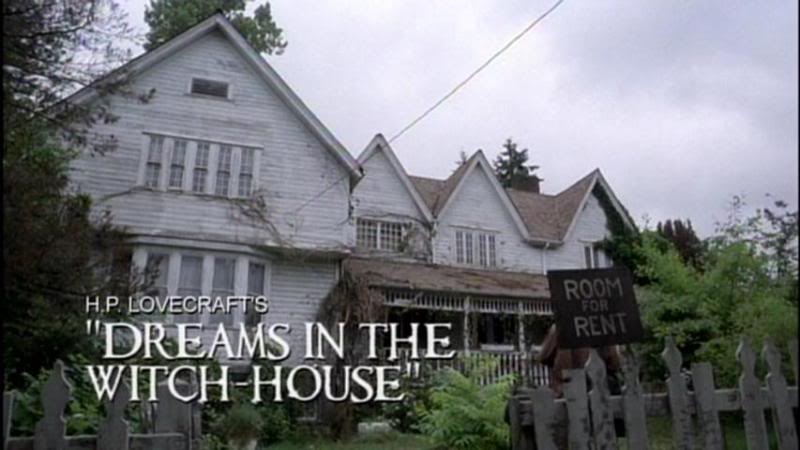
Welcome back to the Misan[trope]y Movie Blog! Next up in the spotlight series on horror writer/director Stuart Gordon is “Dreams In The Witch House,” a short H.P. Lovecraft adaptation that Gordon created for the television program “Masters of Horror.”

“Masters of Horror” was a television series on Showtime that ran for two seasons from 2005-2007, specifically featuring short films (under 1 hour) developed by notable horror directors and writers. Apart from Stuart Gordon, the series spotlighted such notables as Tobe Hooper, Larry Cohen, John Landis, John Carpenter, Dario Argento, Clive Barker, and many others. “Dreams In The Witch House” aired in the first season of the show, and Stuart Gordon later returned to the second season of the program with an episode adapting the Edgar Allan Poe story “The Black Cat.”

“Dreams In The Witch House” is based on an H.P. Lovecraft short story published in 1933, and is Stuart Gordon’s fourth film adaptation of his works. Dennis Paoli once again returns as Stuart Gordon’s writing partner on “Dreams In The Witch House” and “The Black Cat”, but to date these two “Masters of Horror” episodes are the last works they have collaborated on.

The effects on “Dreams In The Witch House” were provided by the KNB EFX group, an Emmy and Academy Award winning outfit that has worked on productions such as “Django: Unchained,” “The Walking Dead,” “Breaking Bad,” “Army Of Darkness” “Drag Me To Hell,” “Kill Bill,” “Casino,” “Reservoir Dogs,” and “Grindhouse.” They undoubtedly provide one of the strongest aspects of the film, particularly with the incredibly creepy human-faced rat effect and the concluding “chest-burster” sequence.

witchhouse1

The cinematography on the film was provided by Jon Joffin, who has done extensive work on television movies, and worked on a number of early episodes of “The X-Files.” The production design for the movie was provided by one David Fischer, who is best known for his work on “Friday the 13th Part VIII” and “Reefer Madness: The Movie Musical.” Last but certainly not least, the music for “Dreams In The Witch House” is provided by Richard Band, brother of Charles Band, who also scored a number of Stuart Gordon’s earlier films, including “Re-Animator,” “From Beyond,” and “Castle Freak.”

The cast of “Dreams In The Witch House” is led by Ezra Godden, who re-teamed with Gordon after working together on another of his Lovecraft adaptations, “Dagon.” The human-faced rat, Brown Jenkin, is played by a Ukrainian magician named Yevgen Voronin, who was cast based on his facial structure, and has done no acting work before or since. Chelah Horsdal was given her role because she exuded an atmosphere in her audition that was both “maternal and vulnerable,” making her more than believable for her part of a struggling single mother. She has since appeared in television shows such as “Hell on Wheels” and “Arrow,” and has been getting consistent work over the past few years. The old man character, Masurewicz, was initially going to be played by long-time Stuart Gordon collaborator Jeffrey Combs, but he unfortunately had to back out at the last minute. His replacement was Campbell Lane, who proves to be capable (though unremarkable) in the role.

“Dreams In The Witch House” follows a young physics doctoral student who is working on completing his graduate work. The story starts when he decides to rent a room in a secluded house so that he can focus on his work, but his accommodations quickly prove to be much creepier than he initially suspected. He befriends a young mother who is also a tenet in the home, but slowly starts to lose his grip on reality as he repeatedly sees a small creature that appears to be a rat with a human face. The apparent hallucinations become more vivid and disturbing as time goes on, and the promising young mind begins to consider that his research may have other-worldly applications.

witchhouse4

“Dreams In The Witch House” is not as over the top or fun as many Stuart Gordon movies, but it is pretty solid for what it is. It is certainly better than your average TV horror film for sure, at the very least. It does have your typical Lovecraft downer ending, which probably didn’t sit well with many, especially given the fact that it involves a particularly bloody child sacrifice. A bloody baby death is something you do not get very often in any genre, and many people found that to be a particularly upsetting aspect of the movie, (including Stuart Gordon’s wife, interestingly enough).

witchhouse3

Among the complaints I have seen about this film are that it doesn’t have enough true scares or horrifying moments. I think there is at least a case to be made there, but I feel like Lovecraft stories shouldn’t rely on shocks or jump-scares, but are more crucially reliant on atmospheric horror: something I think “Dreams In The Witch House” nails down pretty well.

The DVD commentary track for “Dreams In The Witch House” offered some fantastic insights from Stuart Gordon, including the following quotes:

“A good actor can make you believe anything, a good effect sometimes does and sometimes doesn’t”

“In horror…you always have to find a different way to get under people’s skin”

“[the actors I use] are not afraid to make themselves look ridiculous…if the character isn’t scared, why should the audience be scared? If you have an actor who won’t be afraid, you need to get another actor”

According to Stuart Gordon, “Dreams In The Witch House” was regarded as his ‘truest’ Lovecraft adaptation by many in attendance when he screened it at the Lovecraft Film Festival in Portland, OR. Lovecraft fans are definitely split on Gordon’s Lovecraft adaptations, particularly over his often apocryphal inclusion of nudity in the features, and sometimes dramatic alterations from the source material.

Overall, this is a pretty well crafted short film, especially considering the limited time and budget devoted to it. Gordon clearly enjoys Lovecraft and this story in particular, and has said that he wanted to do this adaptation since the 1980s. For those that might complain that Gordon’s works are too often tongue-in-cheek, this is the perfect work to show that he can take on horror without any side humor.

“Dreams In The Witch House” is a pretty strong recommendation from me. It is definitely a slight departure from the usual Stuart Gordon fare in that there is little to no comedic element to be found, but it is a pretty fantastically creepy and unsettling Lovecraft adaptation that is easy for any horror fan to enjoy.

Interestingly enough, the source material for “Dreams In The Witch House” inspired another adaptation: a Lovecraftian rock opera of the same name, which can be checked out in part on YouTube. I’ll recommend checking that out as well, if only for the novelty of the thing.

Stuart Gordon Spotlight: “From Beyond”

From Beyond

frombeyond3

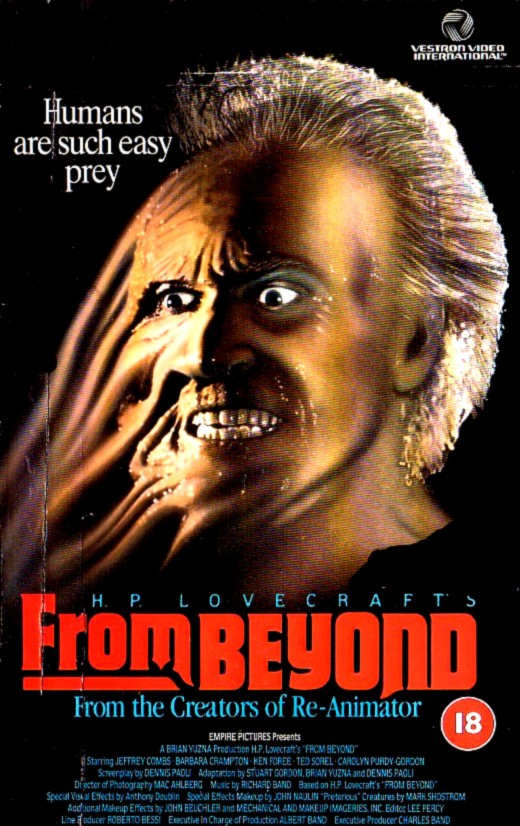
Welcome back to Misan[trope]y Movie Blog! Next up in the two week spotlight on the career of writer/director Stuart Gordon is 1986’s “From Beyond.”

“From Beyond” is the spiritual follow-up to Stuart Gordon’s smash debut, “Re-Animator.” It would be the second of Stuart Gordon’s eventual four H.P. Lovecraft adaptations, and reunited much of the same cast and crew that created the cult classic predecessor. Gordon went back to Lovecraft again for inspiration on his later films “Dagon” and “Dreams in the Witch House,” but neither of those films got the same kind of attention as “Re-Animator” and “From Beyond.”

As mentioned, multiple players from “Re-Animator” return for “From Beyond,” most notably Jeffrey Combs and Barbara Crampton. Apparently, producers on the film opposed Crampton’s casting due to her youth, but Stuart Gordon specifically fought to let her have the role. Also in the cast is Ken Foree, who later pops up in the Gordon-penned movie “The Dentist,” and Stuart Gordon’s wife, Carolyn Purdy-Gordon. Ted Sorel, a character actor who never saw much success,  rounds out the cast, playing the mad doctor who loses himself in the “beyond” world.

Stuart Gordon shares screenwriting credit on “From Beyond” with two of his most frequent career collaborators, Brian Yuzna and Dennis Paoli, who were both involved with other Stuart Gordon-associated films such as “Re-Animator,” “The Dentist,” and “Castle Freak.”

Charles Band, the primary producer on the flick, is best known for the “Puppet Master” series of films. He specifically arranged for “From Beyond” to be done back to back with “Dolls” on the same sets as a cost-saving maneuver, in true Roger Corman tradition.

The cinematographer on “From Beyond” is Marc Ahlberg, who was also a frequent collaborator with Stuart Gordon for many years. Apart from working on Gordon movies such as “Dolls,” “Re-Animator,” and “Space Truckers,” he also did such notable gems as “Good Burger,” “Evil Bong,” and Joe Dante’s “The Second Civil War.”

The music in “From Beyond,” as was the case with “Re-Animator,” “Dolls,” and later “Dreams In The Witch House,” was provided by Charles Band’s brother, Richard: a veteran B-movie music master who additionally worked on the “Puppet Master” and “Demonic Toys” films with his brother.

The special effects on “From Beyond” were provided by Mechanical and Makeup Imageries, who also worked on the Stuart Gordon films “Dolls” and “Robot Jox,” as well as other b-films such as  “Ghoulies,” “Troll,” and “Trancers.” As was the case with “Dolls,” it is clear that the special effects team had an absolute blast with this movie. Outside of a few cheesy effects to create the translucent “beyond” world, the creatures and mutants manifested via practical effects look like they were a dream to create, and look pretty fantastic for a lower-budget feature. The effects reminded me of some of David Cronenberg’s movies, such as “Videodrome” and “Scanners,” in the use of imaginative visceral entities and squibs.

frombeyond4“From Beyond” follows the story of a young physics graduate student, who is working with a cruel and obsessive professor on creating a device (the resonator) aimed at expanding human perception. When the initial test of the resonator is successful, a creature from a “beyond” dimension kills the professor, leaving the student apparently insane. A controversial psychiatrist decides to take the student on as a patient, intrigued by his experiments and their potential applications for the treatment of schizophrenia, Alzheimer’s, and other brain-related diseases. She convinces him to once again operate the resonator, resulting in further other-worldly shenanigans.

Outside of the effects work, the biggest strength of “From Beyond” are the performances. Particularly, I thought Barbara Crampton knocked her role out of the park, which is both a heavier and more dynamic character than the role she was given in “Re-Animator.” Jeffrey Combs is once again a blast, and gives the same 110% performance that anyone should expect from him. There is a particularly great moment where he is confronted by Carolyn Purdy-Gordon’s character while frantically eating a handful of brains. Boy, is that a sequence for the Jeffrey Combs career highlight reel.

frombeyond2 frombeyond1“From Beyond” was a financial failure on release, making back less than half of its $4.5 million budget. However, it was generally well received by audiences and critics, currently holding a 6.8 rating on IMDb and Rotten Tomatoes scores of 69% (audience) and 71% (critic).

While I think “From Beyond” is pretty enjoyable, it certainly isn’t without flaws. With so many returning players from “Re-Animator” and all of the other obvious similarities between the two films, it feels like there was too much of an effort put towards trying to replicate “Re-Animator,” rather than trying to create a work to stand on its own. It feels like an attempt to catch lightning in a bottle, and result of that is a number of moments that feel artificial and forced, and steals away some of the charm that the movie might have otherwise retained.

Something else that I certainly found off-putting about “From Beyond,” and something that also feels imitative of “Re-Animator,” is the amount of uncomfortably forced sexuality. There is an attempt to explain it away in dialogue as being a side-effect of the resonator, but I am quite curious if that was actually part of the source material. One of the biggest popular complaints about Gordon’s adaptations of Lovecraft are his insertions of nudity and sexuality into the tales, and I can’t help but wonder if that was the case here. There is certainly a way to use eroticism as a way to enhance a horror movie, but Gordon has never been able to find that balance if you ask me, mostly because most of his notable sex scenes are massively uncomfortable and non-consensual. That might have been what he was going for, but I feel like the emotions conjured from the inclusion of that kind of scene somewhat clashes with the traditional, squibby horror that makes up most of “From Beyond” and “Re-Animator.” Personally, I find it at best clashing and distracting, and at worst a potential detriment to the entire genre by turning both creative people and audiences away from the films.

frombeyond5The only other minor gripe I have about “From Beyond” is that the pacing of the story feels oddly stilted, and a number of moments feel like they could function as endings. It still functions fine, but it starts to feel a bit repetitive towards the end of the film.

“From Beyond” is a movie I expected to like more than I actually did. It is still pretty enjoyable, particularly the performances of Jeffrey Combs, Barbara Crampton, and Ken Foree, but it really lives in the shadow of “Re-Animator,” which is unfortunately a comparison that the film constantly draws thanks to the casting and style. I would be interested to see how someone would feel about this film if they hadn’t seen “Re-Animator” first, as I get the feeling that this is a case where the film’s context almost certainly dooms it. In any case, this is a somewhat more serious Stuart Gordon movie that is still a good bit of fun, and is worth checking out if you enjoyed any of his other films.

Stuart Gordon Spotlight: “Space Truckers”

Space Truckers

spacetruckers9

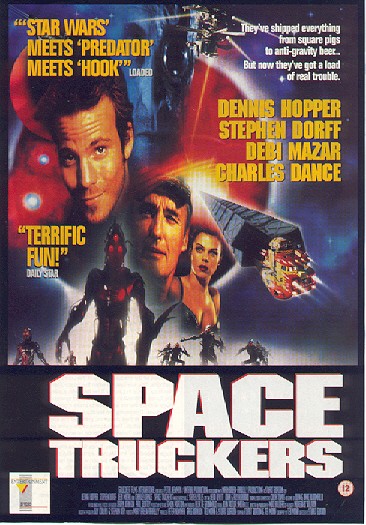
Welcome back to the Misan{trope]y Movie Blog! Next up in the Stuart Gordon Spotlight is 1996’s blue-collar sci-fi flick, “Space Truckers,” featuring the one and only Dennis Hopper.

Stuart Gordon both directed and co-wrote “Space Truckers,” sharing writing credit with one Ted Mann. Mann has primarily done television writing and producing on shows such as “NYPD Blue” and “Deadwood,” with his most recent high-profile credit being the 2012 mini-series “Hatfields & McCoys,” which starred Kevin Costner and Bill Paxton.

The cast of “Space Truckers” is undoubtedly headlined by the presence of Dennis Hopper, though it has more depth than you might expect. Charles Dance (“Last Action Hero,” “Game of Thrones”) plays one of the primary antagonists, Stephen Dorff (“Blade,” “Public Enemies”) plays a sidekick rookie trucker, and Debi Mazar (“L.A. Law,” “Entourage”) rounds out the main cast as the quasi love interest. In the background you might spot Jason O’Mara in his first theatrical credit, character actor Sean Lawlor, Shane Rimmer of “Dr. Strangelove,” and George Wendt of “Cheers.”

spacetruckers8 spacetruckers5The cinematography on “Space Truckers” was done by Marc Ahlberg, his fifth of an eventual seven collaborations with director Stuart Gordon. His career included an assortment of B-movies going all the way back to the 1950s (“Arena,” “Evil Bong,” “Trancers,” “Ghoulies”)and he worked all the way up until his death in 2012.

The plot of “Space Truckers,” interestingly enough, revolves around the secret development of a killer robot army intended to overthrow the Earth’s government. Dennis Hopper’s character is unknowingly tasked with hauling the robots to Earth, a trek which ultimately (and fortunately) features a number of unexpected obstacles.

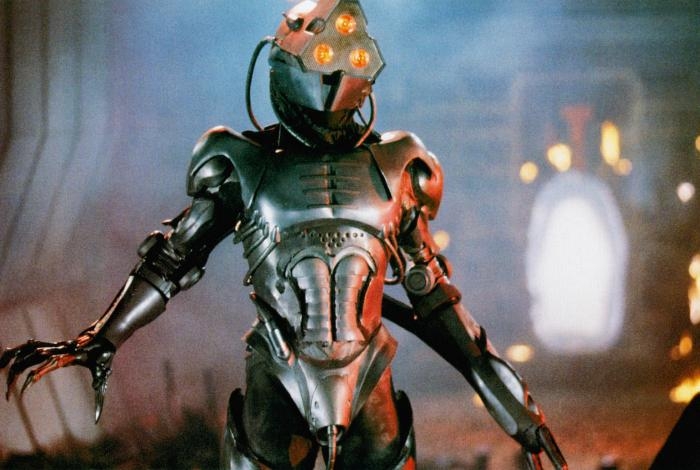
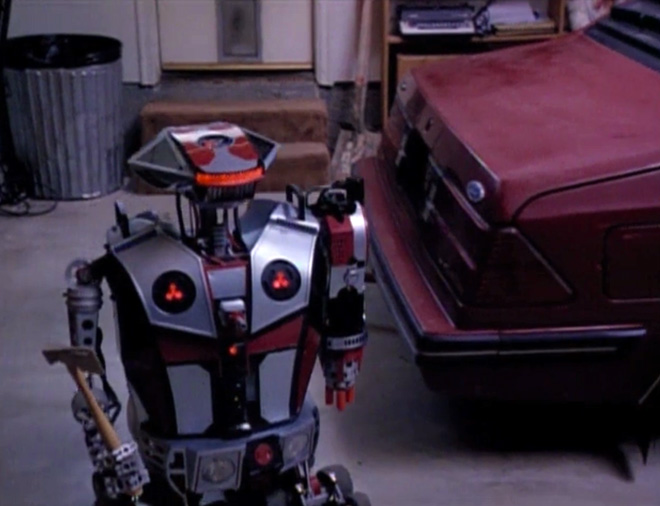
spacetruckers6I initially got the idea of doing a Stuart Gordon Spotlight after seeing “Space Truckers” on a list of killer robot movies when researching potential flicks for my Killer Robot Week, which is why I didn’t cover it last week. Speaking of which, however, the robots featured in “Space Truckers” are much sleeker than what I expected. They were designed and constructed by Cannom Creations, who provided work for movies such as “Cocoon,” “Cocoon 2,” “Cyborg,” and “Blade.” Despite a couple of questionable / cheesy effects work, the robots themselves are pretty solid, and are fortunately mostly portrayed with practical effects. Instead of constructing actual robots like “Evolver” or “Chopping Mall,” the robots in “Space Truckers” are much more similar to the xenomorphs from the “Alien” franchise, in the sense that they are suits that feature humans inside to make their motions more realistic.

spacetruckers1 spacetruckers3“Space Truckers” was a massive financial failure, grossing less than $2 million on a reported budget of $25 million. It was likewise loathed by audiences and critics alike: it currently has a 5.1 rating on IMDb, which looks downright impressive next to the Rotten Tomatoes scores of 9% (critic) and 27% (audience). I am a little surprised at how hated this film was: from my perspective, it is very clearly a b-movie comedy, and I found it to be plenty enjoyable for being that. Just judging from the marketing I saw for the film, however, it appears that this was a difficult movie to pitch to audiences. Particularly in the secondary market, there was a clear attempt to make this appear to be a space drama akin to “Armageddon.” Just check out this DVD re-release cover:

spacetruckers11To be generous, that doesn’t exactly convey the tone of “Space Truckers” accurately. It does seem that people are looking back more fondly on this film in retrospect, as the IMDb score might indicate. Personally, I thought this movie worked pretty well: the idea was to make a blue collar sci-fi film, and I think this pulled off that concept. It isn’t exactly laugh-out-loud funny, and a lot of jokes land flat, but it is a notch higher than your typical television sci-fi movie. However, at a budget of $25 million, perhaps the product should have been more impressive than that.

In general, “Space Truckers” manages to nail the atmosphere it set out for. It conveys a self-awareness without winking, acknowledging its outlandish premise through the set design (square pigs, beet cans in space, etc) and dialogue (“Did you hear something back there that sounds like there’s something back there?”). It could have used a bit of comedy script-doctoring to help with the laughs, but it is still a fun watch in my opinion.

spacetruckers12As far as criticisms go, there are certainly problems with “Space Truckers.” I mentioned the lack of effective comedy in the script, but there are a few other things worth mentioning. First off, the general passage of time is very unclear between the prologue and the main story. The film opens with a demonstration exercise of the developed killer robots, in which Charles Dance’s character is nearly killed. When the main story starts, Dance has managed to turn himself into a cyborg and take over / build a gang of space pirates, which I assume would take some time. However, the killer robots are just then being shipped to Earth as the main plot begins, being hauled by Hopper’s character. How long has it been since that training exercise that nearly killed Charles Dance’s character? Have the killing robots just been sitting in storage for years? What sense does that make? It is later revealed that Saggs (played by Shane Rimmer) was able to conquer the Earth without any help from the robots at all…but why would he do that? Any way you cut it, some explanation of the passage of time should have been included.

spacetruckers7The only other major issue I have with the film is also related to the writing: the love triangle between Hopper, Dorff, and Mazar feels very forced, and makes Hopper’s supposed protagonist much less likable. He is essentially forcing Mazar to marry him in exchange for passage to Earth, which is incredibly fucked up, and is not-at-all made up for by his eventual faux-redemption in the conclusion. The age difference and history between Mazar and Hopper is also a little perplexing: it is established that they have known each other for years, and that Hopper has proposed multiple times to her. When he asks about Mazar’s mother, he is shown a picture of her which is “20 years back,” which was from when Mazar was either very young or before she was born. So…how old is Mazar’s character supposed to be, and how old is Hopper? How long has Hopper been pursuing her? It just gets creepier the more you think about it.
Despite those issues, this is a pretty strong recommendation as a good-bad watch. It is almost certainly one of the lesser Stuart Gordon movies, but it is still quite a bit of fun. I wouldn’t go in expecting “Re-Animator,” because this is a comedy at its core, and that should be kept in mind. There aren’t any huge squib explosions here, and you shouldn’t be anticipating them. It is dumb fun, and might justify turning your brain off for a little bit to get maximum enjoyment.
Stuart Gordon Spotlight: “Dolls”

Dolls

dolls1

Today, I’m starting a series of posts spotlighting the career of acclaimed horror writer/director Stuart Gordon, and the many cult classic films he has produced. Arbitrarily, I have chosen to kick off this celebration with 1987’s “Dolls.”

Stuart Gordon directed “Dolls” on the order of Charles Band, who was executive producing Gordon’s next planned feature: an H.P. Lovecraft adaptation called “From Beyond,” which was to be Gordon’s follow-up to the hit “Re-Animator.” Charles Band is now best known for a number of horror franchises that clearly drew inspiration from “Dolls”: “Puppet Master,” “Demonic Toys,” and “Dollman,” but Band has been a prolific B-movie writer and producer since the late 1970s.

In true Corman-esque fashion, Charles Band proposed that Stuart Gordon could direct “Dolls” on the same sets that had already been arranged in Italy for “From Beyond,” thus saving the production a significant amount of money. After reading the Ed Naha penned screenplay, Gordon agreed to the arrangement, and made “Dolls” and “From Beyond” back-to-back on the same sets.

dolls6Ed Naha, at the time of writing “Dolls,” only had a small handful of writing credits under his belt. The previous year, Charles Band was a driving force behind getting “Troll,” a now-infamous film which Naha wrote, to the screen. Before that, Naha only had two writing credits on a couple of unnotable Roger Corman movies. Since 1987, Naha has continued writing on B-movies, including films like “CHUD II” and “Omega Doom.” He later worked with Stuart Gordon again on “Honey, I Shrunk The Kids!,” and reunited with Band on a number of films, including “Dollman” and “Dollman vs Demonic Toys.”

Ed Naha has cited the 1944 horror film “Curse of the Cat People” (the sequel to the 1942 horror classic “Cat People”) as one of the biggest influences on the screenplay for “Dolls.” Specifically, the idea of using the point-of-view of a scared child, who easily sees evil and shapes in shadows, is a borrowed mechanic from that film. Of course, where the “Cat People” movies tend to toy with the question of whether the supernatural threat is real or imagined, there isn’t a whole lot of room for doubt in the “Dolls” screenplay.

According to Ed Naha, he wrote the entire screenplay for “Dolls” based on a single concept image given to him by Charles Band, which was later re-purposed for the poster: an eerie humanoid doll holding its detached, realistic eyeballs in its hands. The image is even incorporated briefly into the film, when the audience is first presented with a victim who has been “dolled up.”

dolls3“Dolls” notably features as a producer Brian Yuzna, a frequent collaborator with Stuart Gordon who would later go on to direct “The Dentist,” “Bride of Re-Animator,” and “Beyond Re-Animator.”

“Dolls” is an interesting horror movie that borrows many elements from classical fairy tales (specifically, as Gordon has mentioned, from “Hansel & Gretel”). While it is as dark as most horror films you will find from the era, it also has a distinct element of whimsy, as well as moments of genuinely humor (which isn’t particularly unusual for Gordon movies). Stuart Gordon claims to have spent an extensive amount of time reading about fairy tales, including the book “The Uses of Enchantment” by Bruno Bettleheim, while working on the film. Gordon also still had young children at the time he was making “Dolls,” which may have somewhat inspired the tone and direction of the movie.

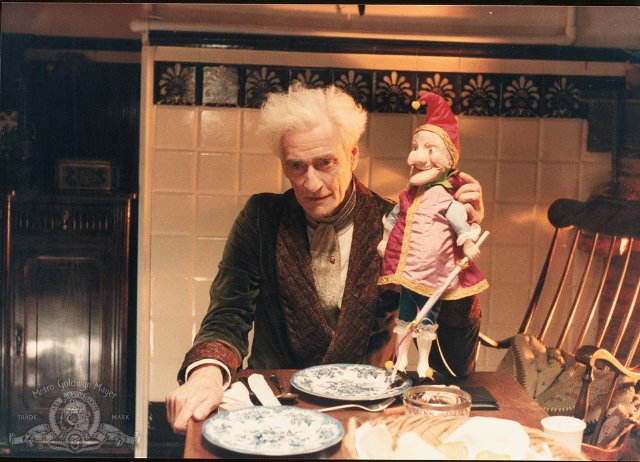
dolls2The story of “Dolls” follows a young child, her father, and her wicked stepmother as they become stranded on a remote road, and seek shelter in a seemingly abandoned house. They find the house to be occupied by an eccentric elderly couple who specialize in making toys, and things quickly begin to go awry from there.

The cast of “Dolls” has some definite ups and downs. Stephen Lee manages to add some decent comic relief as a “young at heart” stranded hitch-hiker who befriends the young girl, while Guy Rolfe delivers a simultaneously menacing and warm performance as Mr. Hartwicke, the designer of the enchanted dolls. Even Carolyn Gordon-Purdy, Stuart Gordon’s wife, plays a fantastically over-the-top Cruella De Vil inspired evil step-mother.

dolls5On the flip side, I absolutely cannot stand the child actor protagonist in “Dolls.” The actress, Carrie Lorraine, has unsurprisingly not done any acting work since. Her casting was primarily done because of her appearance (cute, younger than her age, believably average) according to Stuart Gordon, and she certainly fits the part from that perspective. Her line reading, however, is just awful. Luckily, the off-kilter light-heartedness of this horror movie offsets her inabilities, and she comes off as just another piece of the quirky, creepy atmosphere.

Something that I definitely appreciate about “Dolls” is that it plays on a latent fear that many people have. The idea of toys coming to life while you weren’t looking, particularly in the pre “Toy Story” days, was genuinely frightening to many people. It also doesn’t help that antique dolls are almost always extremely creepy, so it is hard to blame people for the fear. My mother used to have a collection of antique dolls on display, and that had the potential to be down-right terrifying under the right circumstances.

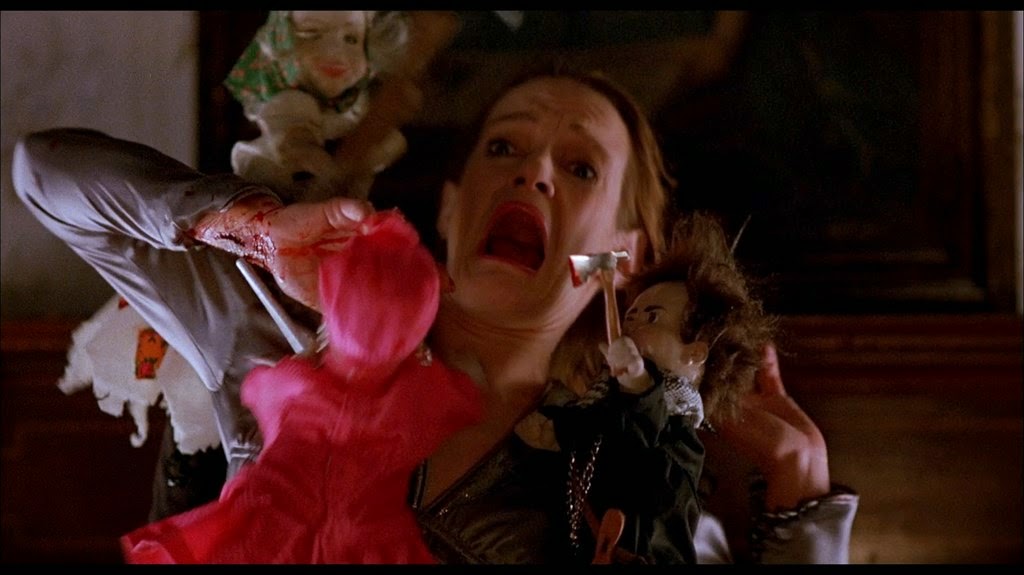
The effects for “Dolls” are generally pretty good, particularly given the low budget of the production. There is hybrid use of stop motion, marionettes, and traditional makeup effects for the various doll shots, which can be slightly jarring from sequence to sequence. Overall, however, the dolls still come off as plenty creepy, particularly as they are destroyed: revealing human flesh and blood underneath the toy outer skins. In particular, there is one climactic scene (a transformation) which manages to showcase the good and the bad of the effects work. Predictably, the practical aspects of the sequence are superb, but the one moment of computer assisted “shrinkage” has aged very poorly, and might take a viewer today out of the moment.

dolls7Outside of some really uncomfortable child abuse, “Dolls” is a great, fun movie that absolutely lives up to the Stuart Gordon tradition. He has a knack for creating enjoyable B-horror movies that defy the label of “bad,” despite their low quality and often tongue-in-cheek style. Stuart Gordon movies are always bloody, squibby, and cheesy, but they are also almost guaranteed to be fun to watch.

As with most of the Stuart Gordon movies I am going to cover, “Dolls” is an absolute recommend for any b-movie fans. Gordon is a consistent producer of entertaining b-level films, and “Dolls” certainly isn’t an exception. If nothing else, I would recommend anyone to watch the infamous “teddy bear scene” from this movie, particularly if it is free of context. The toy soldier death is also worth looking up, but the teddy bear scene is the crown jewel.


Killer Robot Week: “Class of 1999”

Class of 1999

class19998

Today’s final entry into Killer Robot Week is “Class of 1999,” a film about a team of cyborg teachers cracking down in an unruly, seemingly post-apocalyptic high school.

“Class of 1999” was written and directed by Mark L. Lester, and was envisioned as a follow-up to his 1980 cult film “Class of 1984.” Lester is best known for his extensive work in action and horror movies, in particular “Firestarter” and “Commando.” Recently, Lester appears to be focusing more on the producing side of B-movies, doing work on such films as “Dragon Wasps,” “Toxin,” “Dragons of Camelot,” and “Poseidon Rex.”

The executive producer on “Class of 1999” is the somewhat infamous Lawrence Kasanoff, who is known for producing such B-films as “Blood Diner,” “Chud II,” and both “Mortal Kombat” films. However, his most recent abhorrent credit is as both writer and director on 2012’s “Foodfight!,” one of the most abysmal films released in years, and perhaps the worst animated feature of all time.

Mark Irwin, the cinematographer on “Class of 1999,” has had a significant career working on a wide range of features. He has credits on well-regarded films such as “The Fly,” “Scanners,” “The Dead Zone,” “Scream,” and “Robocop 2,” but has also had some less-than-lauded works: “Deck the Halls,” “Big Momma’s House 2,” “The Last Godfather,” and “Super Buddies.” He is still active today, and his most recent notable credit is on the Adult Swim show “Black Jesus.” However, the rest of his recent credits lead me to believe that he’ll be working on Tyler Perry productions before too long.

The cast of “Class of 1999” includes a number of well-regarded character actors, led most notably by Malcolm McDowell (“A Clockwork Orange,” “Time After Time,” “Caligula”) and Pam Grier (“Jackie Brown,” “Coffy”). The rest of the cast includes Stacy Keach (“American History X”), John P. Ryan (“It’s Alive,” “Bound”), and Patrick Kilpatrick (“Minority Report,” “Eraser”).  Given the setting of a high school, the lead roles in the film were given to younger, less experienced actors: Traci Lind, who popped up in a handful of movies (“Bugsy,” “My Boyfriend’s Back”) afterwards before falling off of the screen in the late 1990s, and Bradley Gregg, who has recently resurfaced after only a handful of credits in the new millennium.

class199910The story of “Class of 1999” takes place in the distant future of 1999, in which numerous major cities have been overrun by drug-addled youth gangs. In an attempt to salvage the public schools in these areas, the “Department of Educational Defense” pilots a program to use robotic teachers to run classes in the most hostile school environments. The plot follows a handful of students at the first school to use these robot teachers, and shows the robots’ violent decline as their programming (of course) begins to go awry.

The film portrays school violence, drug use, and gang activity amplified to an absolute maximum, which fits with the generally over-the-top tone and concept of the film. The robot teachers, in contrast, are designed on very traditional stereotypes, and instantly clash with the student body. This, of course, results in a significant amount of friction, which culminates in the liberal use of flamethrowers and high explosives on school grounds in a grand showdown of a conclusion.

class19997“Class of 1999” currently holds a 5.7 rating on IMDb, as well as a 52% audience score on Rotten Tomatoes. That doesn’t look so great, but you can only expect so much of a positive reaction to this sort of B-movie. BoxOfficeMojo.com reports that the movie’s total gross was just under 2.5 million, but I’ve found estimate that put the budget at well above 5 million, making it an overall financial loss. Despite all of this, the movie bizarrely received a direct-to-video sequel, “Class of 1999 II,” in 1994, without the involvement of Mark Lester.

For me, the most memorable aspect of “Class of 1999” are the hammy performances by the assorted villains. The robotic teachers, for instance, are constantly dropping one-liners, almost as if it was written into their programming. Perhaps even better than the teachers themselves is their overseer, Dr. Forrest, played by Stacy Keach. His constant leering and over-the-top menacing presence is only outshone by his bizarre appearance in the movie. Just take a look at this guy:

class199912
class19993
class199913 You can’t do much better than that.

Something that I never quite understood about the concept of “Class of 1999” is why a group of kids in an officially lawless territory bothered to show up to a public school at all. There isn’t anything binding them to the school, and the students seem to flow in and out of the classes without aim anyway. Also, if the area is deemed too dangerous for police, then why is the government still putting teachers at risk to keep a public school open in the dead center of the area? It just doesn’t quite make sense to me.

class19999For a movie released in 1990, “Class of 1999” may seem notably (and unrealistically) pessimistic about the near future. It is worth keeping in mind the context of the time: 1989-1990 was arguably the height of anti-drug panic, anxiety over a perceived rise of violence in schools, and public fears about gang violence. “Class of 1990” hones in on all of these fears, and inflates them as much as possible to create a dramatic (and perhaps ridiculous) vision of a worst-case-scenario for the new millennium.

In the opening sequence of “Class of 1999,” while a robotic voice over is laying out the background for the story, a map pops up on screen showing the major urban areas in the United States that have been overrun by gangs. It might be a bit of a minor detail, but I couldn’t help but notice how dramatically misplaced Cleveland is. Check it out:

class19995

For those who might not be aware, Cleveland is on the shore of Lake Erie, on the northern boundary of Ohio:class199911I decided to check out Google Maps to see where Cleveland had been relocated to in this outlandishly depressing vision of 1999, and the closest place I could come up with is a small town called Cambridge, OH. Last I checked, Cleveland has not yet moved there in reality, though, but let’s keep our eyes peeled on that.

Something that is impossible not to note in “Class of 1999” is that it, along with countless other killer robot films, uses the same explanation for the robot’s sinister behavior. As with “Small Soldiers,” “Red Planet,” and “Evolver,” the teachers in “Class of 1999” are re-purposed military prototypes that revert to their original field programming. It isn’t necessarily a bad way to set up the background for the robots, but it has clearly been done now. I can’t particularly blame “Class of 1999” for this, given it was made in 1990, but writers of potential robot flicks should probably take note of how often this mechanic has already been used.

Overall, “Class of 1999” is a fun, good-bad flick. The acting is perfectly over-the-top, the premise and setting is ludicrous, and the deaths and effects certainly don’t disappoint. If you are looking for a bad movie to watch with friends, this is one worth putting on your list.

—-

Alas, with “Class of 1999,” Killer Robot Week has finally come to an end. So, here are some final thoughts.

First off, there are lots of fun killer robot movies out there. I only just started to scratch the surface with Killer Robot Week. I’m sure that there are plenty more robot movies out there that I don’t know anything about at all.

However, I couldn’t help but notice that there hasn’t been much in the way of high profile killer robot movies in recent years, outside of “Transformers” movies, bad “Terminator” sequels, and that wholly unnecessary recent RoboCop reboot.  Killer robots seem to have been sidelined in recent years, which is a bit of a shame.

2015, however, is going to be a Killer Robot renaissance: I can just feel it. High profile films like “Chappie,” “Avengers: Age of Ultron,” and “Terminator: Genisys” are bringing mechanized marauders back to the forefront of cinema in a big way, and if history tells us anything, imitation flicks will be right on their heels. In other exciting news, even BattleBots is coming back! Surely, these are signs of a bright future for our eventual robot overlords.

I’m looking forward to perhaps some more cerebral robot movies in coming years, incorporating the current popular anxieties over AI, the increased use of robotics for violence, and the arguably alarmingly rapid improvements in technology across the board in society. In a time of drones and practical robotics, now is the best time ever to see a real renaissance of robot and AI movies in general. Particularly in the horror genre, the best stories play on popular subliminal fears, which can often be pulled straight from the headlines. Just looking around, it seems to me that the Time of the Machines (for horror, anyway) is now. We live in a world that is increasingly dependent on technology, but still harbors significant luddite fears about our surroundings and our collective future. Here’s hoping someone can take advantage of all of this, and create some fantastic robot movies over the next few years.

Or, y’know, more vapid, fun killer robot movies couldn’t hurt either. I’d be ok with more of those, too.

If you want to catch up on the previous movies covered on Killer Robot Week, you can check them out here:

Red Planet

Robot Monster

Chopping Mall

Evolver

Killer Robot Week: “Evolver”

Evolver

evolver2

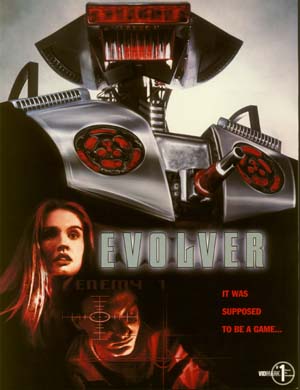
Welcome back to Misan[trope]y Movie Blog! Today’s entry into Killer Robot Week is 1995’s “Evolver”: a tale of an Augmented Reality video game beta test gone horribly awry.

“Evolver” was written and directed by Mark Rosman, a fellow who has had a bit of an odd career. Before “Evolver,” his film career kicked off by writing and directing the 1983 movie “The House on Sorority Row.” Between that flick and “Evolver,” Rosman only saw a handful of TV series and movie credits, including an episode of “Alfred Hitchcock Presents.” He followed up “Evolver” with a 1997 Daniel Baldwin feature called “The Invader,” which features this amazing plot summary on IMDb (word for word):

Good alien from a dying race must impregnate an Earth woman to avoid extinction of his race. Bad alien whose race helped wipe out good alien’s race doesn’t want to see this happen.

After that blockbuster, Rosman went back to television until the mid-2000s, inexplicably directing a number of episodes of family friendly shows such as “Lizzie McGuire” and “Even Stevens.” In 2004-2005, he directed back-to-back Hillary Duff vehicles (“The Perfect Man,” “A Cinderella Story”), before retreating to the small screen once again. He is still active as of 2015, with his latest being a Hallmark Channel movie by the title of “A Wish Come True.” Hallmark Channel features and Hillary Duff movies are quite a long way from killer robot movies, huh?

The cinematographer on “Evolver,” Jacques Haitkin, has loads of experience behind the camera on horror flicks, racking up nearly 90 credits as of 2012. These have included films such as “Wishmaster,” “Maniac Cop 3,” “Shocker,” “A Nightmare On Elm Street,” and “A Nightmare On Elm Street 2,” among many, many others.

evolver1The cast of “Evolver” includes a couple of recognizable actors, including the voice of William H. Macy as the Evolver robot, just one year before his big critical break-out in the Coen brothers’ masterful “Fargo.” Also instantly recognizable is John de Lancie of “Star Trek: The Next Generation,” “Breaking Bad,” and more recently “My Little Pony: Friendship is Magic.” I have to say, I didn’t expect there to be one degree of separation between this obscure 1990s killer robot movie and the “Brony” subculture.

evolver5The rest of the “Evolver” cast includes Cindy Pickett (most recognizable from playing Ferris Bueller’s mom), character actor Paul Dooley, Ethan Embry (“Once Upon A Time,” “Late Phases”), and Tim Griffin (“American Sniper,” “Grey’s Anatomy”). Griffin has probably had the most consistent work of the bunch in recent years, drifting in and out of minor action and military roles effortlessly since 2007.

“Evolver” follows a pretty simple story: a arcade ace wins a contest that allows him to personally and exclusively beta test a brand new augmented reality video game, which is essentially a laser tag game with an AI-enhanced robot. The learning AI in the “Evolver” robot starts going awry and reverting to its original, militaristic applications (not unlike the plot of “Small Soldiers”), maiming and killing a handful of local teens as it learns to more effectively hunt and destroy.

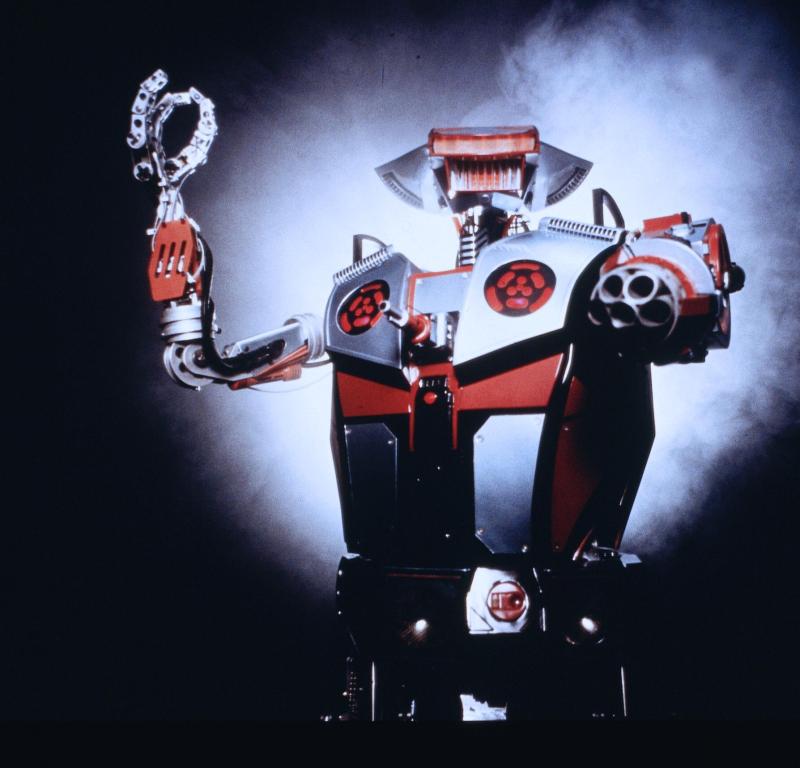
evolver4To start with, I absolutely love the Evolver robot. I like the design in general, and particularly the way it changes shape slightly as it develops and learns. For what is a pretty simple robot, the design allows it to do some emoting via body language, particularly through the use of head-tilting. That, combined with William H. Macy’s voice work, allows him to to come off as endearing in some scenes, and genuinely intimidating in others. I particularly enjoyed how happy Evolver gets on the few occasions where he things he has won: there’s something weirdly charming and adorable about it.

There are a few moments in “Evolver” that make me wonder if it was motivated by the parental panic in the mid-1990s over the perceived rise of violence in video gaming: there are a couple of instances of “Evolving” learning bad behavior from television programs, with the implication that this is part of what reawakens his military programming.  Honestly, looking back, I think that this half-hearted message just makes the movie funnier in retrospect. To think, this film predates even the first “Grand Theft Auto” game by a solid two years, and came out almost parallel with “Mortal Kombat 3.”

Much like “Chopping Mall,” “Evolver” has a whole lot of minor character deaths throughout the film. While he doesn’t fire eye lasers like the Killbots, Evolver makes use of a lot of improvised weaponry. The two most memorable deaths I recall were executed via ball bearings and an arcade machine, respectively, showing a good deal of creativity with the character dispatching.

At one point, it is believed that “Evolver” has been defeated, and the robotics company takes him away to be destroyed. In true “Halloween 4” Michael Myers fashion, he suddenly comes back to life and wrecks the transport van, which I thought was a pretty cool scene. Unfortunately, there aren’t a whole lot of clips of “Evolver” out there, so just picture this scene with a killer robot in it:

Overall, “Evolver” is a pretty fun killer robot movie, particularly if you are a fan of massively outdated technology. The sheer quantity of ancient computers, video games, and gadgets is enough to send you on a nostalgia trip, and that’s without even getting into the whole killer robot plot. It isn’t quite on the level of “Chopping Mall,” but there is still a lot to enjoy out of this mid-90s B flick.

evolver3
Remember when this kind of video gaming was the hot thing decades before the Oculus Rift?

In general, I would recommend this one for B-movie fans. It is a little off of the beaten path, though it apparently got a fair amount of air time on the early days of the Sci-fi television network. Most people nowadays probably haven’t seen it though, and it is definitely worth the minimal effort to dig up.

If you missed the previously entries in Killer Robot Week here at Misan[trope]y, you can check them out here:

Red Planet

Robot Monster

Chopping Mall


Killer Robot Week: “Chopping Mall”

 Chopping Mall

choppingmall1

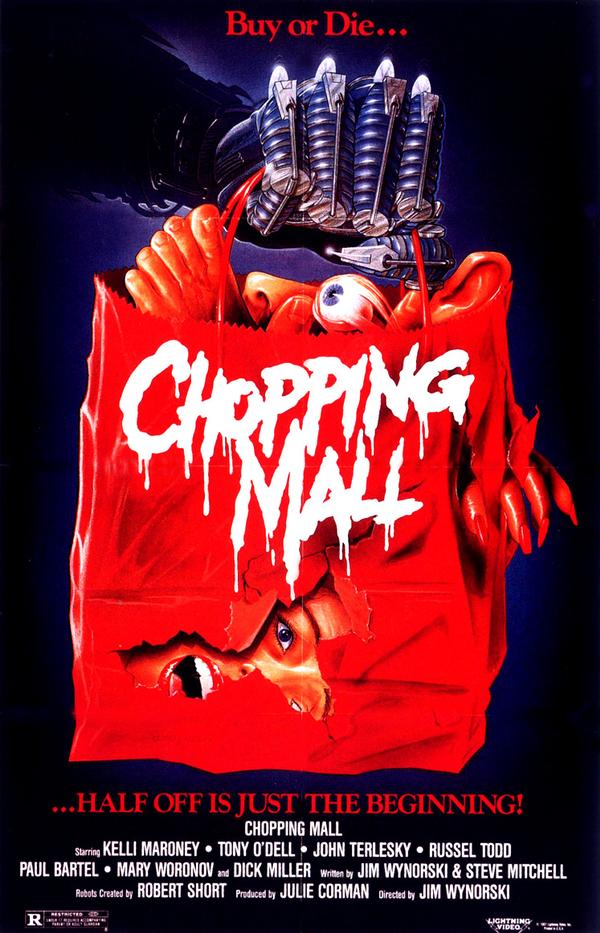
Welcome back to the Misan[trope]y Movie Blog! Today, in the third entry of Killer Robot Week, I’ll be taking a look at Jim Wynorski’s cult classic “Chopping Mall!”

“Chopping Mall” has just about everything you could possibly want from a B-movie: a dash of humor, over-the-top deaths that would make any highlight reel, and a fair share of one-liners. For example:

Let’s send these fuckers a Rambo-gram!

and

I’m just not used to be chased around a mall in the middle of the night by killer robots.

and of course, as is repeated by the robots after every human death:

Thank you, have a nice day!

What more could you possibly ask for?

choppingmall6
How about a head explosion?

Director Jim Wynorski is a bit of a notorious figure in the B-movie world. He spent a long time working under Roger Corman early on, and has now accrued 98 directorial credits to date over his career. However, a number of these have been pseudonymous soft-core porn features, such as “The Hills Have Thighs,” “The Devil Wears Nada,” and “The House on Hooter Hill.”

In 2009, a documentary was made about Jim Wynorski’s career called “Popatopolis.” In the film, a crew follows him over the course of three days, during which time he astoundingly completes an entire film (“The Witches of Breastwick”). The documentary was generally well-received, and brought a number of new eyes to the B-movie stalwart. It currently holds a 7.0 rating on IMDb.

As mentioned, Jim Wynorski has used a number of pseudonyms for his soft-core pornography and otherwise lesser works over the years. These have included “Rip Masters,” “H.R. Blueberry,” “Jay Andrews,” “Bob E. Brown,” “Tom Popatopolous,” “Noble Henry,” and “Arch Stanton.”

Jim Wynorski’s co-writer on “Chopping Mall,” Steve Mitchell, had a not-insignificant career in television writing after the film. His credits include episodes of classic shows like “Jem,” “G. I. Joe,” “Pacific Blue,” “Transformers,” and a movie from 1997 called “Against the Law.” However, he doesn’t have any credits more recent than 1998.

The distinctively 1980s music in “Chopping Mall” was composed and arranged by one Chuck Cirino, who has had a long career in B-movie music since. “Chopping Mall” was only his second film scoring gig, and he now claims over 60 (as well as a handful of Director and Cinematographer credits).

Director of Photography Tom Richmond has likewise had a long career post-“Chopping Mall,” including a number of cinematography credits on higher budget features such as “Mother Night,” “Killing Zoe,” “Little Odessa,” “The Singing Detective,” and “House of 1000 Corpses.” He is still active today, with a couple of shorts awaiting release.

choppingmall7

The designer of the robots in “Chopping Mall,” Robert Short, has had a long career in special effects. He designed the mermaid effects in “Splash,” worked on “1941,” “E.T.,” “Beetlejuice,” and “Piranha,” oversaw the effects work in “Punisher: War Zone,” and has work in three movies forthcoming in 2015. All together, he has been working on special effects in film for almost 40 years.

choppingmall2The cast of “Chopping Mall” includes a host of character actors that die hard bad movie fans might recognize. Barbara Crampton has featured in a laundry-list of Stuart Gordon movies (“The Re-animator,” “Castle Freak,” “From Beyond”), Dick Miller is a legendary Corman figure from his roles in “Little Shop of Horrors” and “A Bucket of Blood,”  and the combo of Mary Woronov and Paul Bartel have popped up all over Corman’s filmography. Star Tony O’Dell has had a number of small acting roles over the years, but appears to be more prolific in recent years as a dialog and voice coach on television shows such as “Girl Meets World,” “Emeril,” and “George Lopez.”

choppingmall4
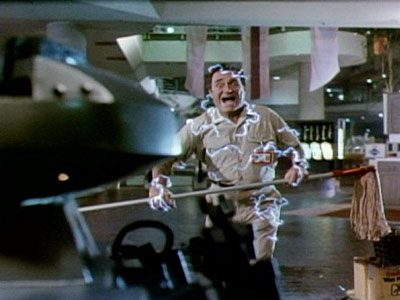
Dick Miller being shocked to death in “Chopping Mall”

Something that stands out quite a bit about “Chopping Mall” are the numerous references to other B-movies hidden throughout. Two characters (played by Bartel and Woronov) are directly borrowed from the 1982 movie “Eating Raoul,” and the janitor played by Dick Miller is credited as being the same character he portrayed in the infamous Roger Corman movie “A Bucket of Blood,” creating an unlikely shared universe between the three films. There is also a brief clip shown from the Corman movie (“Attack of the Crab Monsters”), as well as a split second shot of the book “They Came From Outer Space,” which features the source material for another Corman-produced classic, “Death Race 2000.”

The “Chopping Mall” security robots are undoubtedly the most memorable part of the film. Their robotic voices were recorded by Jim Wynorski himself, who clearly had a blast with them. The robots themselves were functional and remotely controlled, down to the gripping rubber claws. Five were ultimately created for the production, just in case of damage over the course of filming. I wasn’t able to find out what happened to the robots themselves, but I want to believe that Jim Wynorski has one in his living room.

choppingmall3
Personally, I might use them to scare away Jehovah’s Witnesses. But I bet you can modify them to be Roombas too.

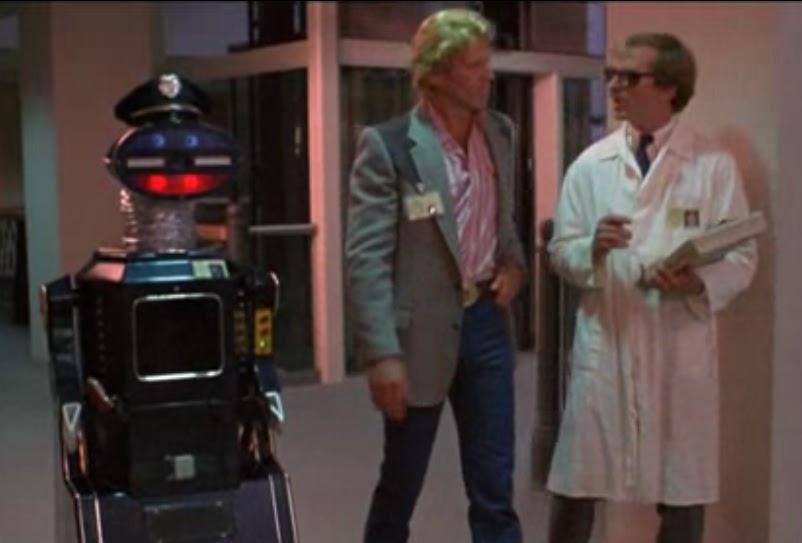
The robot design here is pretty simple: they operate, sensibly enough, with tank-style treads. Their laser eyes and electrical powers look excellently cheesy now, which is hardly something to complain about with this movie. They don’t have a ton of mobility, which makes them a little less terrifying that other killer robots I will cover this week, but they do get the job done. I also noticed that they look very similar to the police robot from “R.O.T.O.R.,” but that is neither here nor there.

robot-copThe plot is likewise pretty straightforward: a handful of kids are having a party in a mall after closing, and an electrical storm causes the brand new, untested security guard robots to malfunction. The story follows the group of teens as they attempt to find a way out of the locked-down mall, all while evading the blood-thirsty killbots.

“Chopping Mall,” released originally as “Killbots” in theaters (changed because it was believed to sound too kid-friendly), wasn’t a big hit upon release. It eventually did make money on its shoestring budget ($800,000), but this is one of those movies that has benefited immensely from word of mouth, cable replays, and its eventual cult status in the long run.

Given its unarguable cult classic status, “Chopping Mall” is frequently reviewed and discussed in bad movie forums, podcasts, blogs, etc. Personally, I’m a big fan of the coverage done by the We Hate Movies gang and the Bad Movie Fiends podcast, and recommend checking those out if you were a big fan of the film.

It probably goes without saying, but I highly recommend “Chopping Mall” for any bad movie fans. This is just about a must-see for hardcore aficionados of cinematic awfulness, and a good choice for introducing people to the style. The pacing is good, the deaths are memorable, and it infuses enough humor to be entertaining and plenty bearable for even casual audiences. If you are looking to show a bad movie to a mixed audience, this is a pretty good selection for you.

If you missed the previously entries in Killer Robot Week here at Misan[trope]y, you can check them out here:

Red Planet

Robot Monster

Killer Robot Week: “Robot Monster”

Robot Monster

robotmonster1

Welcome back to Killer Robot Week here at the Misan[trope]y Movie Blog! For those that missed the first entry, you can check out the “Red Planet” review here.

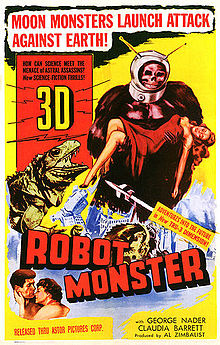
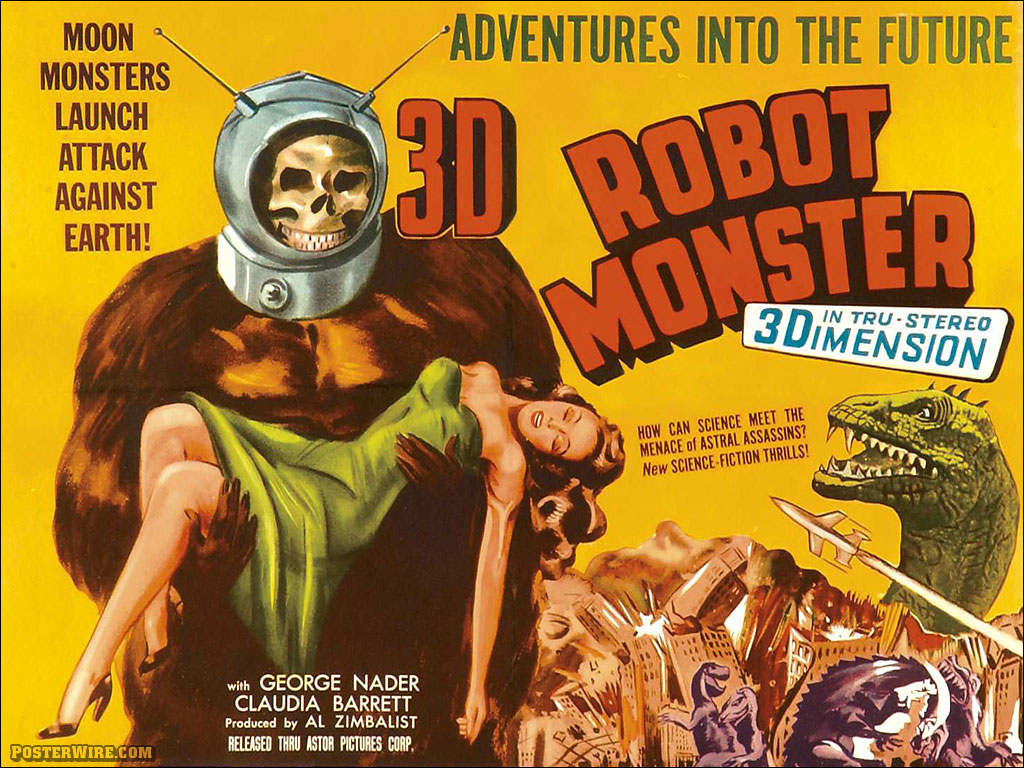
Today’s installment into Killer Robot Week is a truly beloved B-movie classic: “Robot Monster.”

“Robot Monster” is a classic among classics in the realm of B-movies. You will rarely find an elite ranking of “good-bad” films that fails to mention it in some way, and that back-handed praise is more than deserved for this feature.

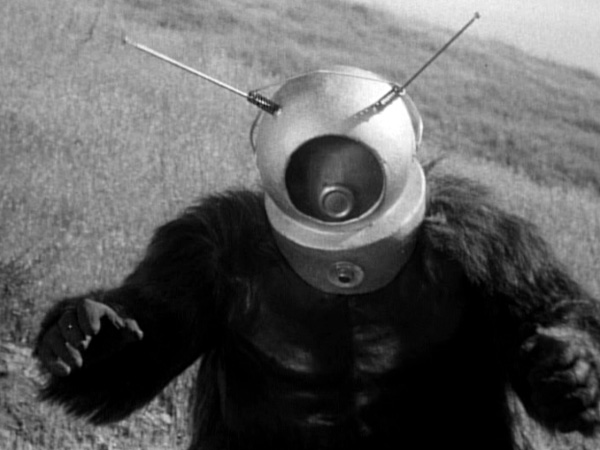
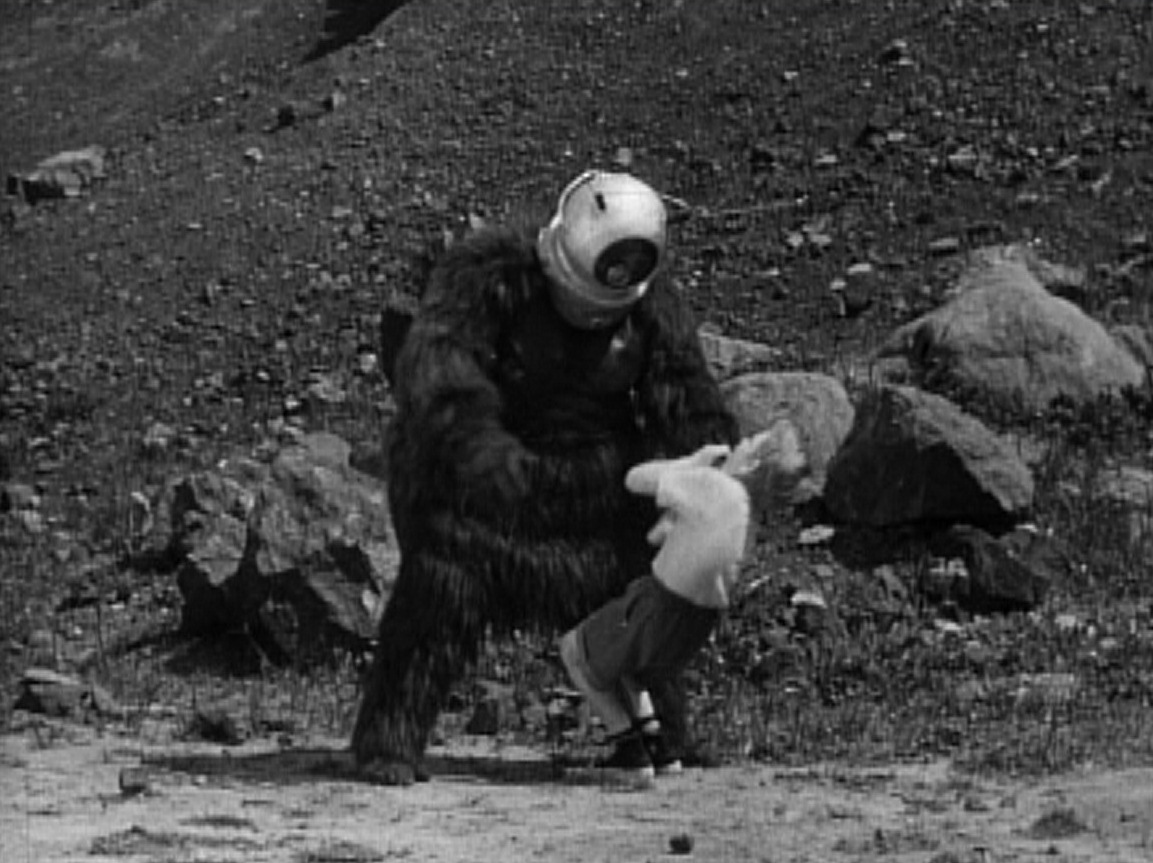
The most memorable aspect of “Robot Monster,” and what consistently keeps it mentioned in the same breath with films like “The Creeping Terror,” is the awful monster design. The eponymous Robot Monster, Ro-Man, is instantly recognizable by movie buffs, given his simplistic wardrobe of a gorilla suit and a slightly modified diving helmet.

robotmonster5

I’ve mentioned before that a poor monster design isn’t a death sentence for a movie, but “Robot Monster” makes a lot of the same mistakes in that department that “The Creeping Terror” does: most notably, the embarrassingly awful monster gets way too much exposure and screen-time. The only way you can get away with a bad monster is by being creative with its absence, which can’t very well happen if the creature is never absent.

The writing in Robot Monster is nothing short of astounding. The story feels like a “Twilight Zone” episode written by an 11-year-old with dialogue penned by a younger sibling, and the allusions to Cold War anxieties are brandished towards the audience like a bludgeon. In short, the writing has all of the subtlety and sophistication of a man in a gorilla suit with a robot head. Here are a few choice lines worth noting:

[Ro-man]: I cannot – yet I must. How do you calculate that? At what point on the graph do “must” and “cannot” meet? Yet I must – but I cannot!

…and some more gold from Ro-Man:

[Ro-Man]: Hu-mans, listen to me. Due to an error in calculation, there are still a few of you left.

And, of course, Ro-Man threatening a child. This happens a fair amount:

[Johnny]: I think you are just a big bully, picking on those smaller than you are!

[Ro-Man]: Now I will kill you.

It certainly doesn’t help the dialogue that the acting isn’t exactly stellar to begin with. The movie features not one, but two major child characters, which is almost always a recipe for disaster. As you might expect, the two precocious kids can’t act with a damn, and are on screen almost as much as the robot monster himself. The rest of the characters include an elderly scientist and a love-hate couple, none of which are portrayed much better than the kids.

robotmonster4
Peripheral vision is negated by true love

There is an interesting question that I had to ask myself while watching this movie: is Ro-Man, as the title suggests, actually a robot? It seems like a necessary question to ask, given this is Killer Robot Week and all. His behavior and speech are very mechanical and robotic until later in the film, which seems to be a trait of his race (also called Ro-Man? There’s an anti-individualism aspect to them). It is also unclear if the diving helmet is part of a uniform / space suit, or if it is biologically part of the creature. Ro-Man’s commander, who is not on the planet, also wears the same helmet, so I don’t think it is a necessary breathing apparatus. In any case, I’m tempted to say that the Ro-Man are a sort of cyborg race, which incorporates both robotic and biological aspects. Interestingly enough, the term “cyborg” wouldn’t be officially coined for another 7 years after the release of “Robot Monster,” so maybe there actually is a little forward thinking there?

robotmonster2

“Robot Monster” was directed by a man named Phil Tucker, who didn’t do much else with his career. He has a few other directorial credits on films like “The Cape Canaveral Monsters” and “Dream Follies,” but nothing particularly notable.  He popped back up briefly in the 1970s as an editor and production manager, working on movies like “King Kong (1976),” “Orca,” and the “Wonder Woman” television show.

In the acclaimed book of film failures, “The Golden Turkey Awards” by the Medved brothers, it is stated that Phil Tucker attempted suicide after the abysmal critical reception to “Robot Monster.” From what I could find, this a bit of a bending of the truth: it is reported that the film’s distributor refused to pay him for his work on “Robot Monster,” which left him unemployed, broke, and in general dire straits. In addition to his history with depression, all of these factors apparently culminated in his suicide attempt in December 1953.

The writer of “Robot Monster” is listed as Wyott Ordung, who likewise doesn’t have a whole lot credited to his name. He had a few directing credits, specifically “Walk the Dark Street” and “Monster from the Ocean Floor,” but didn’t do much at all outside of the 1950s.

The cast of “Robot Monster,” to the surprise of no one, did not produce any major stars.  George Nader, who plays Roy in “Robot Monster,” seemed poised for stardom after winning a Golden Globe in 1954 as one of the most promising male newcomers, but never really managed to break out. Selena Royle, who is credited in “Robot Monster” as “Mother,” was a character actress throughout the 1940s for MGM, but was publicly accused of being a communist sympathizer in 1951, which was enough to essentially destroy her movie career going forward. “Robot Monster” would be her next-to-last big screen credit, with her movie career concluding in 1955 with “Murder is My Beat.”

robotmonster3

“Robot Monster” was filmed at Bronson Canyon, a particularly famous B-movie filming site outside of Los Angeles that has seen the likes of “Eegah!,” “Army of Darkness,” “They Saved Hitler’s Brain,” “The Searchers,” and countless others. “Robot Monster” has the distinction of having been filmed almost entirely at that location, with only one sequence being filmed in a nearby residential neighborhood. You will probably recognize the cave from “Robot Monster” as being the same one used for external shots of the Bat Cave in the Adam West “Batman” television show.

robotmonster6

A handful of clips from other films are used throughout “Robot Monster,” including a number of shots of stop motion dinosaurs from “Lost Continent” and a sequence of lizards fighting from “One Million B.C.” to make up the perplexing catastrophic conclusion.

Overall, “Robot Monster” is more than deserving of its reputation, regardless of how you want to interpret that statement. The film is a showcase of incompetence at every level, and the end result is absolutely entertaining.

For bad movie fans, this is a must see. “Robot Monster” is essentially a foundational work, on the level of “Manos: The Hands of Fate” and the more notorious Ed Wood films. Particularly for monster movies, this stands amongst the elite of the awful.


Kingsman: The Secret Service

Kingsman: The Secret Service

kingsman3

For those of you who are veterans of the Misan[trope]y Movie Blog, you’ll likely have noticed that I don’t do a whole lot of coverage of current cinematic fare. I prefer sniffing around in actor/director filmographies, sifting up obscure titles, and digging things out of bargain bins to cover. However, I’m going to make an exception on the case of “Kingsman: The Secret Service.”

As a caveat, this review absolutely necessitates SPOILERS. Now, I am the sort of person who will often forgo spoiler warnings, but I really want to emphasize that “The Kingsman” is worth going into unspoiled.

So.

****SPOILERS****

“The Kingsman” is very much a movie created in deep affection for the spy movie genre. In that way, it feels very similar to Edgar Wright’s Cornetto trilogy (“Shaun of the Dead,” “Hot Fuzz,” “The World’s End”). There is, to say the least, a lot to like about “The Kingmen” if you are a fan of the genre. Send ups come fast and furious, from everything from James Bond, to “Get Smart,” to the Bourne Trilogy. It plays with the  familiar tropes and stereotypes of the genre in just the way you would expect from a Wright/Pegg/Frost movies, and manages to play them almost entirely straight-faced while also turning them into something that feels new.

I absolutely recommend seeing this movie if you have any affection for spy or action flicks. I think the film is fantastic. That said, I have a handful of issues with it.

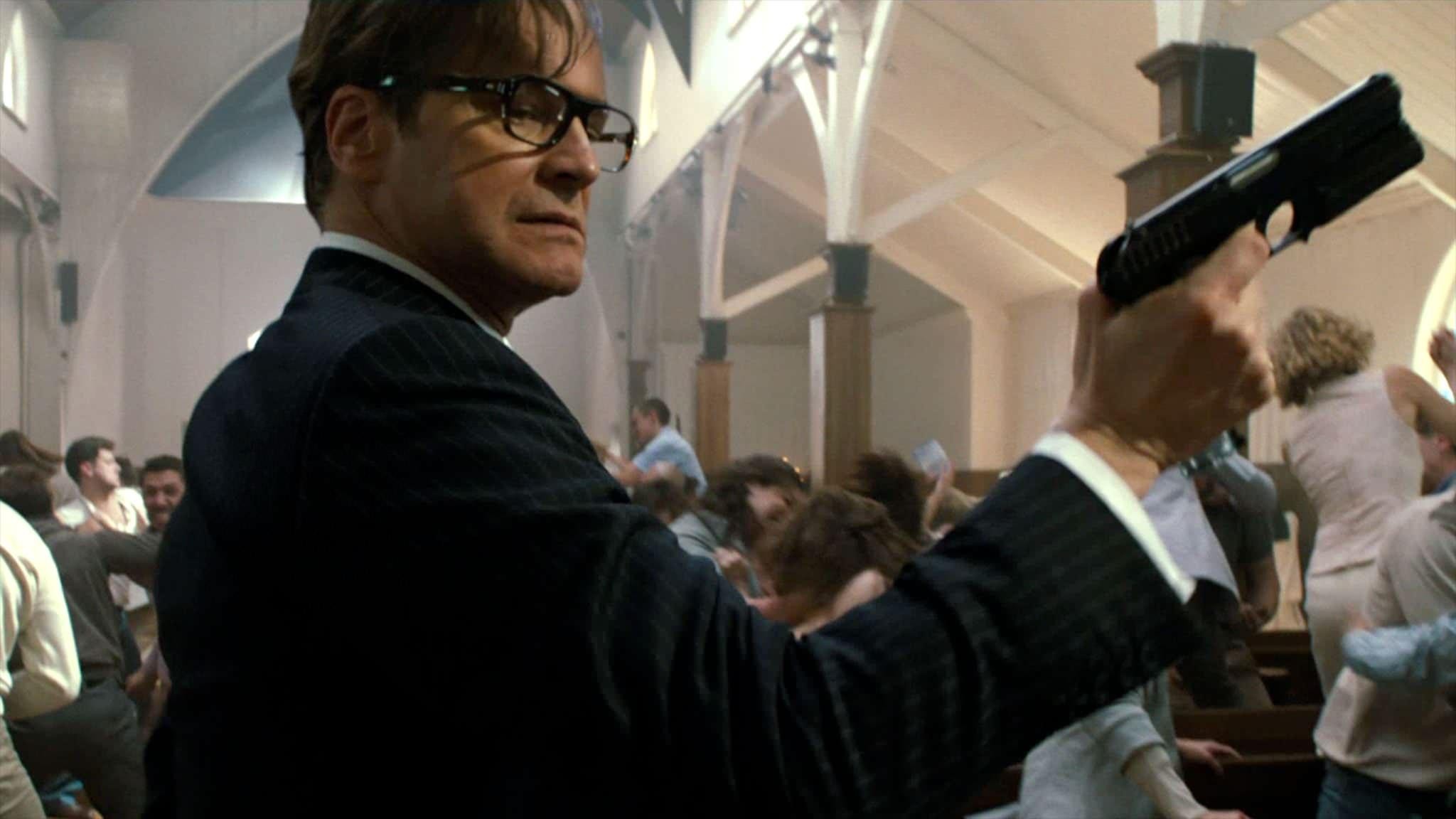
After the sure-to-be-infamous (and fantastically done) church scene, and the subsequent departure of Colin Firth, this film starts to fall apart. The last act doesn’t hold up with the rest of the film, which is kind of a shame. First off, it feels very rushed. It is true that they are put against a countdown for the last act, but it definitely feels hastily tossed together. I expected a little bit more internal infiltration of The Kingsmen to deal with, which could have gotten another solid fight scene out of the movie. It also would have put a more direct class conflict battle into the film, which is a theme that never quite comes to a head outside of the “poisoned drink” standoff with Caine (which is great, for sure).

Next thing: the climactic symphony of colorful head explosions. It is something to see, without a doubt. However, I was reminded of some of the Sony correspondences that came out regarding “The Interview.” In particular, discoloring the viscera from a head explosion was key in getting a desired MPAA rating out of that film, which leads me to wonder if the colorful head-explosion orgy in the climax of “The Kingsman” was actually creatively motivated, or was a compromise for the sake of a ratings board. In any case, you could argue that this was intentionally cartoonish, but I feel like this film would have served better with a more “Scanners”-esque style of head popping with practical effects. I’ll be interested to see what comes up in the Director’s commentary on this scene, anyway. Also, we get a close-up shot of an awful CGI head explosion of the Swedish Prime Minister during that sequence, and it looks absolutely godawful.

Last but not least, the “Princess” feels like a character and scenario that belongs in the bloopers. I understand it being a send-up to 007 and playing for laughs, but it does not fit with the movie in any way, and undercuts the potential romance with Lancelot that was alluded to throughout the film. It also cheapens a character who, in her only other major scene, seemed like an intriguing and ethical political leader. Her being reduced to a lazy sex joke at the 11th hour was disappointing for a number of reasons, not the least of which was the amount of screen-time set-up for a joke that wasn’t particularly funny.

Something that I still can’t decide is a positive or a negative is Samuel L. Jackson’s performance. I feel like he was going too far with the quirks, particularly with the speech impediment. With this kind of movie, Colin Firth’s character is correct: it is always made by the megalomaniacal, larger-than-life villain. Jackson just isn’t quite that. I did like his complicated motivations, which harkened to eugenicist’s logic and “The Watchmen” ethics.

kingsman2I’m going to be lenient on the lack of character depth across the board in this movie, because this is just a flashy, fun flick. It doesn’t make sense to complain about Mark Strong being a wooden board, or the main character being often insufferable, or Roxy getting almost nothing to do until she is shot into space (and out of the plot). I can forgive a lot of this stuff, because this is an action movie, and that naturally comes with the territory.

Now, again, I loved this movie. It was a boatload of fun. These are overall pretty minor issues, but I felt like they were worth throwing out there. So, here is a short list of things I thought were fantastic about the movie.

  • Holy shit, is it good to see Mark Hamill on the screen again
  • Car chase in reverse is fantastic
  • Michael Caine’s death scene. His last grunts are A+
  • Everything about the sequence introducing Lancelot and Gazelle (though the “split” still looks goofy 13 years on from “Equilibrium”)
  • The church sequence is one of the best action scenes in years
  • The design of Gazelle. Definitely feels like a character in the vein of Jaws and Oddjob
  • Galahad’s death
  • The final fight scene between Gazelle and Eggsy
  • Taking a balloon into space to blow up a satellite
  • Fitting room #3, and all of the gadgets therein
  • The idea of a philanthropist as the modern day, eccentric villain
  • Colin Firth’s performance 100% channeling early Michael Caine
  • Kingsman training was a fun way to kill time
  • Comedic moments, with rare exception, are right on target
  • All of the subtle (and not-so-subtle) references to “Get Smart,” James Bond, Jason Bourne, Jack Bauer, and others

See? I have lots of good things to say about this movie! If you disregarded the spoiler warning, I want to make it absolutely clear that this is a movie worth your time, and that my complaints shouldn’t dissuade you from attending a screening. If you even remotely think you would enjoy this movie, then go see it! Odds are good you will not be disappointed.

kingsman1
This scene will not disappoint you

Kudos to Matthew Vaughn, who is now 5/5 as a director if you ask me (“Layer Cake,” “Stardust,” “Kick-Ass,” “X-Men: Days of Future Past,” “Kingsman”). “Layer Cake,” his first, is probably my favorite British gangster movie of the modern era that isn’t directed by Guy Ritchie, and is a movie that I will absolutely recommend for anyone who enjoyed “Kingsman.”