Stuart Gordon Spotlight: “Dolls”

Dolls

dolls1

Today, I’m starting a series of posts spotlighting the career of acclaimed horror writer/director Stuart Gordon, and the many cult classic films he has produced. Arbitrarily, I have chosen to kick off this celebration with 1987’s “Dolls.”

Stuart Gordon directed “Dolls” on the order of Charles Band, who was executive producing Gordon’s next planned feature: an H.P. Lovecraft adaptation called “From Beyond,” which was to be Gordon’s follow-up to the hit “Re-Animator.” Charles Band is now best known for a number of horror franchises that clearly drew inspiration from “Dolls”: “Puppet Master,” “Demonic Toys,” and “Dollman,” but Band has been a prolific B-movie writer and producer since the late 1970s.

In true Corman-esque fashion, Charles Band proposed that Stuart Gordon could direct “Dolls” on the same sets that had already been arranged in Italy for “From Beyond,” thus saving the production a significant amount of money. After reading the Ed Naha penned screenplay, Gordon agreed to the arrangement, and made “Dolls” and “From Beyond” back-to-back on the same sets.

dolls6Ed Naha, at the time of writing “Dolls,” only had a small handful of writing credits under his belt. The previous year, Charles Band was a driving force behind getting “Troll,” a now-infamous film which Naha wrote, to the screen. Before that, Naha only had two writing credits on a couple of unnotable Roger Corman movies. Since 1987, Naha has continued writing on B-movies, including films like “CHUD II” and “Omega Doom.” He later worked with Stuart Gordon again on “Honey, I Shrunk The Kids!,” and reunited with Band on a number of films, including “Dollman” and “Dollman vs Demonic Toys.”

Ed Naha has cited the 1944 horror film “Curse of the Cat People” (the sequel to the 1942 horror classic “Cat People”) as one of the biggest influences on the screenplay for “Dolls.” Specifically, the idea of using the point-of-view of a scared child, who easily sees evil and shapes in shadows, is a borrowed mechanic from that film. Of course, where the “Cat People” movies tend to toy with the question of whether the supernatural threat is real or imagined, there isn’t a whole lot of room for doubt in the “Dolls” screenplay.

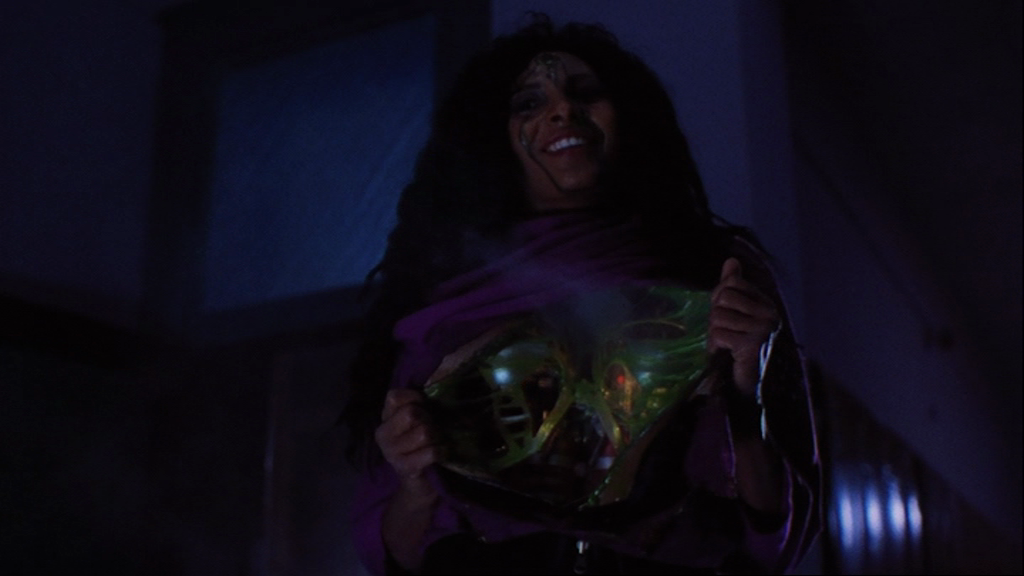
According to Ed Naha, he wrote the entire screenplay for “Dolls” based on a single concept image given to him by Charles Band, which was later re-purposed for the poster: an eerie humanoid doll holding its detached, realistic eyeballs in its hands. The image is even incorporated briefly into the film, when the audience is first presented with a victim who has been “dolled up.”

dolls3“Dolls” notably features as a producer Brian Yuzna, a frequent collaborator with Stuart Gordon who would later go on to direct “The Dentist,” “Bride of Re-Animator,” and “Beyond Re-Animator.”

“Dolls” is an interesting horror movie that borrows many elements from classical fairy tales (specifically, as Gordon has mentioned, from “Hansel & Gretel”). While it is as dark as most horror films you will find from the era, it also has a distinct element of whimsy, as well as moments of genuinely humor (which isn’t particularly unusual for Gordon movies). Stuart Gordon claims to have spent an extensive amount of time reading about fairy tales, including the book “The Uses of Enchantment” by Bruno Bettleheim, while working on the film. Gordon also still had young children at the time he was making “Dolls,” which may have somewhat inspired the tone and direction of the movie.

dolls2The story of “Dolls” follows a young child, her father, and her wicked stepmother as they become stranded on a remote road, and seek shelter in a seemingly abandoned house. They find the house to be occupied by an eccentric elderly couple who specialize in making toys, and things quickly begin to go awry from there.

The cast of “Dolls” has some definite ups and downs. Stephen Lee manages to add some decent comic relief as a “young at heart” stranded hitch-hiker who befriends the young girl, while Guy Rolfe delivers a simultaneously menacing and warm performance as Mr. Hartwicke, the designer of the enchanted dolls. Even Carolyn Gordon-Purdy, Stuart Gordon’s wife, plays a fantastically over-the-top Cruella De Vil inspired evil step-mother.

dolls5On the flip side, I absolutely cannot stand the child actor protagonist in “Dolls.” The actress, Carrie Lorraine, has unsurprisingly not done any acting work since. Her casting was primarily done because of her appearance (cute, younger than her age, believably average) according to Stuart Gordon, and she certainly fits the part from that perspective. Her line reading, however, is just awful. Luckily, the off-kilter light-heartedness of this horror movie offsets her inabilities, and she comes off as just another piece of the quirky, creepy atmosphere.

Something that I definitely appreciate about “Dolls” is that it plays on a latent fear that many people have. The idea of toys coming to life while you weren’t looking, particularly in the pre “Toy Story” days, was genuinely frightening to many people. It also doesn’t help that antique dolls are almost always extremely creepy, so it is hard to blame people for the fear. My mother used to have a collection of antique dolls on display, and that had the potential to be down-right terrifying under the right circumstances.

The effects for “Dolls” are generally pretty good, particularly given the low budget of the production. There is hybrid use of stop motion, marionettes, and traditional makeup effects for the various doll shots, which can be slightly jarring from sequence to sequence. Overall, however, the dolls still come off as plenty creepy, particularly as they are destroyed: revealing human flesh and blood underneath the toy outer skins. In particular, there is one climactic scene (a transformation) which manages to showcase the good and the bad of the effects work. Predictably, the practical aspects of the sequence are superb, but the one moment of computer assisted “shrinkage” has aged very poorly, and might take a viewer today out of the moment.
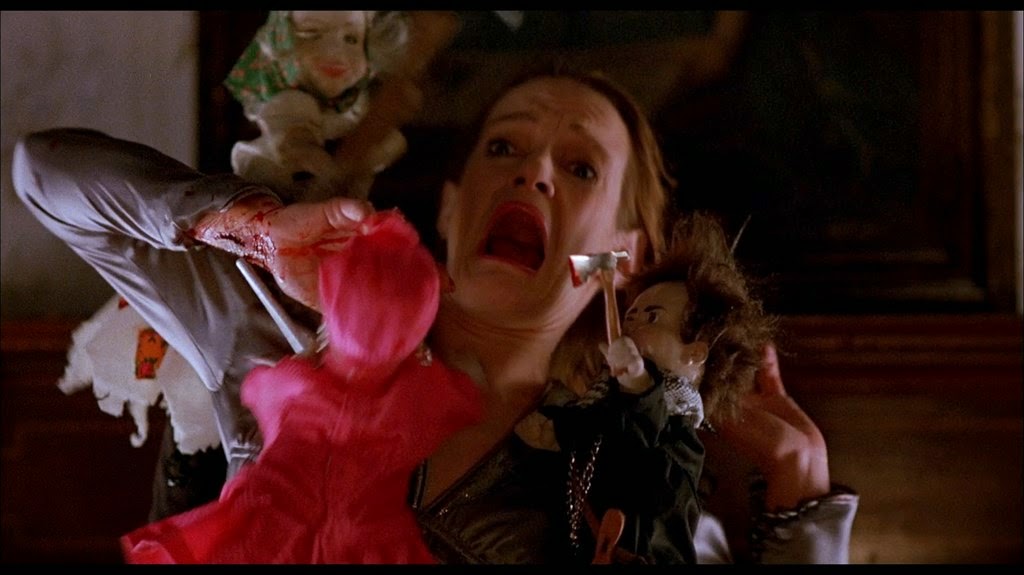
dolls7Outside of some really uncomfortable child abuse, “Dolls” is a great, fun movie that absolutely lives up to the Stuart Gordon tradition. He has a knack for creating enjoyable B-horror movies that defy the label of “bad,” despite their low quality and often tongue-in-cheek style. Stuart Gordon movies are always bloody, squibby, and cheesy, but they are also almost guaranteed to be fun to watch.

As with most of the Stuart Gordon movies I am going to cover, “Dolls” is an absolute recommend for any b-movie fans. Gordon is a consistent producer of entertaining b-level films, and “Dolls” certainly isn’t an exception. If nothing else, I would recommend anyone to watch the infamous “teddy bear scene” from this movie, particularly if it is free of context. The toy soldier death is also worth looking up, but the teddy bear scene is the crown jewel.


Killer Robot Week: “Class of 1999”

Class of 1999

class19998

Today’s final entry into Killer Robot Week is “Class of 1999,” a film about a team of cyborg teachers cracking down in an unruly, seemingly post-apocalyptic high school.

“Class of 1999” was written and directed by Mark L. Lester, and was envisioned as a follow-up to his 1980 cult film “Class of 1984.” Lester is best known for his extensive work in action and horror movies, in particular “Firestarter” and “Commando.” Recently, Lester appears to be focusing more on the producing side of B-movies, doing work on such films as “Dragon Wasps,” “Toxin,” “Dragons of Camelot,” and “Poseidon Rex.”

The executive producer on “Class of 1999” is the somewhat infamous Lawrence Kasanoff, who is known for producing such B-films as “Blood Diner,” “Chud II,” and both “Mortal Kombat” films. However, his most recent abhorrent credit is as both writer and director on 2012’s “Foodfight!,” one of the most abysmal films released in years, and perhaps the worst animated feature of all time.

Mark Irwin, the cinematographer on “Class of 1999,” has had a significant career working on a wide range of features. He has credits on well-regarded films such as “The Fly,” “Scanners,” “The Dead Zone,” “Scream,” and “Robocop 2,” but has also had some less-than-lauded works: “Deck the Halls,” “Big Momma’s House 2,” “The Last Godfather,” and “Super Buddies.” He is still active today, and his most recent notable credit is on the Adult Swim show “Black Jesus.” However, the rest of his recent credits lead me to believe that he’ll be working on Tyler Perry productions before too long.

The cast of “Class of 1999” includes a number of well-regarded character actors, led most notably by Malcolm McDowell (“A Clockwork Orange,” “Time After Time,” “Caligula”) and Pam Grier (“Jackie Brown,” “Coffy”). The rest of the cast includes Stacy Keach (“American History X”), John P. Ryan (“It’s Alive,” “Bound”), and Patrick Kilpatrick (“Minority Report,” “Eraser”).  Given the setting of a high school, the lead roles in the film were given to younger, less experienced actors: Traci Lind, who popped up in a handful of movies (“Bugsy,” “My Boyfriend’s Back”) afterwards before falling off of the screen in the late 1990s, and Bradley Gregg, who has recently resurfaced after only a handful of credits in the new millennium.

class199910The story of “Class of 1999” takes place in the distant future of 1999, in which numerous major cities have been overrun by drug-addled youth gangs. In an attempt to salvage the public schools in these areas, the “Department of Educational Defense” pilots a program to use robotic teachers to run classes in the most hostile school environments. The plot follows a handful of students at the first school to use these robot teachers, and shows the robots’ violent decline as their programming (of course) begins to go awry.

The film portrays school violence, drug use, and gang activity amplified to an absolute maximum, which fits with the generally over-the-top tone and concept of the film. The robot teachers, in contrast, are designed on very traditional stereotypes, and instantly clash with the student body. This, of course, results in a significant amount of friction, which culminates in the liberal use of flamethrowers and high explosives on school grounds in a grand showdown of a conclusion.

class19997“Class of 1999” currently holds a 5.7 rating on IMDb, as well as a 52% audience score on Rotten Tomatoes. That doesn’t look so great, but you can only expect so much of a positive reaction to this sort of B-movie. BoxOfficeMojo.com reports that the movie’s total gross was just under 2.5 million, but I’ve found estimate that put the budget at well above 5 million, making it an overall financial loss. Despite all of this, the movie bizarrely received a direct-to-video sequel, “Class of 1999 II,” in 1994, without the involvement of Mark Lester.

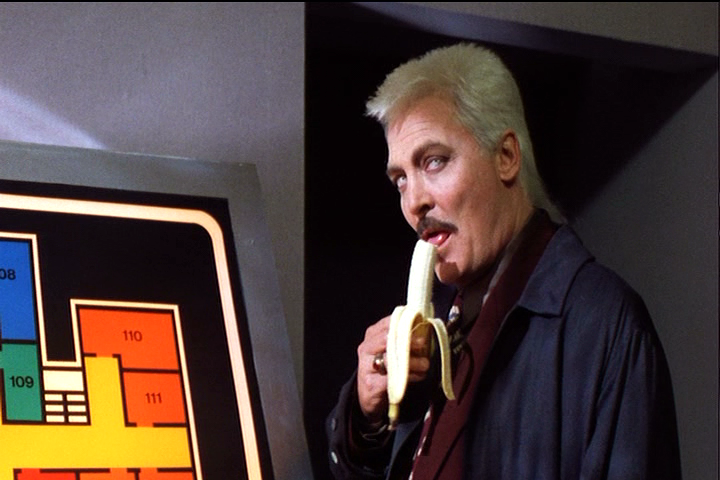
For me, the most memorable aspect of “Class of 1999” are the hammy performances by the assorted villains. The robotic teachers, for instance, are constantly dropping one-liners, almost as if it was written into their programming. Perhaps even better than the teachers themselves is their overseer, Dr. Forrest, played by Stacy Keach. His constant leering and over-the-top menacing presence is only outshone by his bizarre appearance in the movie. Just take a look at this guy:

class199912
class19993
class199913 You can’t do much better than that.

Something that I never quite understood about the concept of “Class of 1999” is why a group of kids in an officially lawless territory bothered to show up to a public school at all. There isn’t anything binding them to the school, and the students seem to flow in and out of the classes without aim anyway. Also, if the area is deemed too dangerous for police, then why is the government still putting teachers at risk to keep a public school open in the dead center of the area? It just doesn’t quite make sense to me.

class19999For a movie released in 1990, “Class of 1999” may seem notably (and unrealistically) pessimistic about the near future. It is worth keeping in mind the context of the time: 1989-1990 was arguably the height of anti-drug panic, anxiety over a perceived rise of violence in schools, and public fears about gang violence. “Class of 1990” hones in on all of these fears, and inflates them as much as possible to create a dramatic (and perhaps ridiculous) vision of a worst-case-scenario for the new millennium.

In the opening sequence of “Class of 1999,” while a robotic voice over is laying out the background for the story, a map pops up on screen showing the major urban areas in the United States that have been overrun by gangs. It might be a bit of a minor detail, but I couldn’t help but notice how dramatically misplaced Cleveland is. Check it out:

class19995

For those who might not be aware, Cleveland is on the shore of Lake Erie, on the northern boundary of Ohio:class199911I decided to check out Google Maps to see where Cleveland had been relocated to in this outlandishly depressing vision of 1999, and the closest place I could come up with is a small town called Cambridge, OH. Last I checked, Cleveland has not yet moved there in reality, though, but let’s keep our eyes peeled on that.

Something that is impossible not to note in “Class of 1999” is that it, along with countless other killer robot films, uses the same explanation for the robot’s sinister behavior. As with “Small Soldiers,” “Red Planet,” and “Evolver,” the teachers in “Class of 1999” are re-purposed military prototypes that revert to their original field programming. It isn’t necessarily a bad way to set up the background for the robots, but it has clearly been done now. I can’t particularly blame “Class of 1999” for this, given it was made in 1990, but writers of potential robot flicks should probably take note of how often this mechanic has already been used.

Overall, “Class of 1999” is a fun, good-bad flick. The acting is perfectly over-the-top, the premise and setting is ludicrous, and the deaths and effects certainly don’t disappoint. If you are looking for a bad movie to watch with friends, this is one worth putting on your list.

—-

Alas, with “Class of 1999,” Killer Robot Week has finally come to an end. So, here are some final thoughts.

First off, there are lots of fun killer robot movies out there. I only just started to scratch the surface with Killer Robot Week. I’m sure that there are plenty more robot movies out there that I don’t know anything about at all.

However, I couldn’t help but notice that there hasn’t been much in the way of high profile killer robot movies in recent years, outside of “Transformers” movies, bad “Terminator” sequels, and that wholly unnecessary recent RoboCop reboot.  Killer robots seem to have been sidelined in recent years, which is a bit of a shame.

2015, however, is going to be a Killer Robot renaissance: I can just feel it. High profile films like “Chappie,” “Avengers: Age of Ultron,” and “Terminator: Genisys” are bringing mechanized marauders back to the forefront of cinema in a big way, and if history tells us anything, imitation flicks will be right on their heels. In other exciting news, even BattleBots is coming back! Surely, these are signs of a bright future for our eventual robot overlords.

I’m looking forward to perhaps some more cerebral robot movies in coming years, incorporating the current popular anxieties over AI, the increased use of robotics for violence, and the arguably alarmingly rapid improvements in technology across the board in society. In a time of drones and practical robotics, now is the best time ever to see a real renaissance of robot and AI movies in general. Particularly in the horror genre, the best stories play on popular subliminal fears, which can often be pulled straight from the headlines. Just looking around, it seems to me that the Time of the Machines (for horror, anyway) is now. We live in a world that is increasingly dependent on technology, but still harbors significant luddite fears about our surroundings and our collective future. Here’s hoping someone can take advantage of all of this, and create some fantastic robot movies over the next few years.

Or, y’know, more vapid, fun killer robot movies couldn’t hurt either. I’d be ok with more of those, too.

If you want to catch up on the previous movies covered on Killer Robot Week, you can check them out here:

Red Planet

Robot Monster

Chopping Mall

Evolver

Killer Robot Week: “Evolver”

Evolver

evolver2

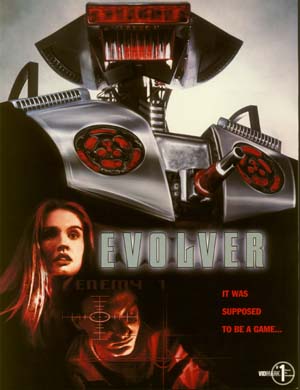
Welcome back to Misan[trope]y Movie Blog! Today’s entry into Killer Robot Week is 1995’s “Evolver”: a tale of an Augmented Reality video game beta test gone horribly awry.

“Evolver” was written and directed by Mark Rosman, a fellow who has had a bit of an odd career. Before “Evolver,” his film career kicked off by writing and directing the 1983 movie “The House on Sorority Row.” Between that flick and “Evolver,” Rosman only saw a handful of TV series and movie credits, including an episode of “Alfred Hitchcock Presents.” He followed up “Evolver” with a 1997 Daniel Baldwin feature called “The Invader,” which features this amazing plot summary on IMDb (word for word):

Good alien from a dying race must impregnate an Earth woman to avoid extinction of his race. Bad alien whose race helped wipe out good alien’s race doesn’t want to see this happen.

After that blockbuster, Rosman went back to television until the mid-2000s, inexplicably directing a number of episodes of family friendly shows such as “Lizzie McGuire” and “Even Stevens.” In 2004-2005, he directed back-to-back Hillary Duff vehicles (“The Perfect Man,” “A Cinderella Story”), before retreating to the small screen once again. He is still active as of 2015, with his latest being a Hallmark Channel movie by the title of “A Wish Come True.” Hallmark Channel features and Hillary Duff movies are quite a long way from killer robot movies, huh?

The cinematographer on “Evolver,” Jacques Haitkin, has loads of experience behind the camera on horror flicks, racking up nearly 90 credits as of 2012. These have included films such as “Wishmaster,” “Maniac Cop 3,” “Shocker,” “A Nightmare On Elm Street,” and “A Nightmare On Elm Street 2,” among many, many others.

evolver1The cast of “Evolver” includes a couple of recognizable actors, including the voice of William H. Macy as the Evolver robot, just one year before his big critical break-out in the Coen brothers’ masterful “Fargo.” Also instantly recognizable is John de Lancie of “Star Trek: The Next Generation,” “Breaking Bad,” and more recently “My Little Pony: Friendship is Magic.” I have to say, I didn’t expect there to be one degree of separation between this obscure 1990s killer robot movie and the “Brony” subculture.

evolver5The rest of the “Evolver” cast includes Cindy Pickett (most recognizable from playing Ferris Bueller’s mom), character actor Paul Dooley, Ethan Embry (“Once Upon A Time,” “Late Phases”), and Tim Griffin (“American Sniper,” “Grey’s Anatomy”). Griffin has probably had the most consistent work of the bunch in recent years, drifting in and out of minor action and military roles effortlessly since 2007.

“Evolver” follows a pretty simple story: a arcade ace wins a contest that allows him to personally and exclusively beta test a brand new augmented reality video game, which is essentially a laser tag game with an AI-enhanced robot. The learning AI in the “Evolver” robot starts going awry and reverting to its original, militaristic applications (not unlike the plot of “Small Soldiers”), maiming and killing a handful of local teens as it learns to more effectively hunt and destroy.

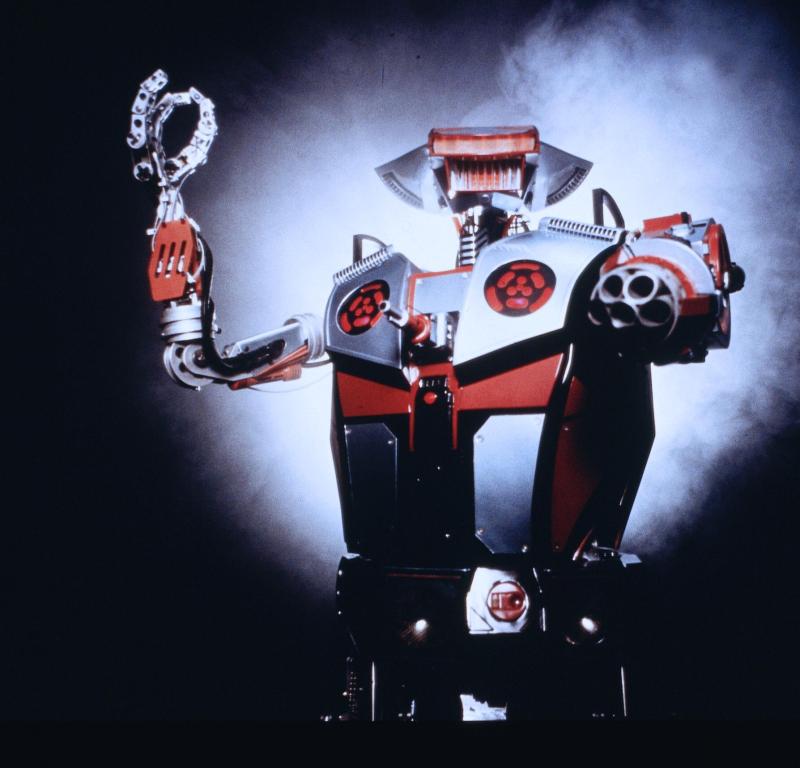
evolver4To start with, I absolutely love the Evolver robot. I like the design in general, and particularly the way it changes shape slightly as it develops and learns. For what is a pretty simple robot, the design allows it to do some emoting via body language, particularly through the use of head-tilting. That, combined with William H. Macy’s voice work, allows him to to come off as endearing in some scenes, and genuinely intimidating in others. I particularly enjoyed how happy Evolver gets on the few occasions where he things he has won: there’s something weirdly charming and adorable about it.

There are a few moments in “Evolver” that make me wonder if it was motivated by the parental panic in the mid-1990s over the perceived rise of violence in video gaming: there are a couple of instances of “Evolving” learning bad behavior from television programs, with the implication that this is part of what reawakens his military programming.  Honestly, looking back, I think that this half-hearted message just makes the movie funnier in retrospect. To think, this film predates even the first “Grand Theft Auto” game by a solid two years, and came out almost parallel with “Mortal Kombat 3.”

Much like “Chopping Mall,” “Evolver” has a whole lot of minor character deaths throughout the film. While he doesn’t fire eye lasers like the Killbots, Evolver makes use of a lot of improvised weaponry. The two most memorable deaths I recall were executed via ball bearings and an arcade machine, respectively, showing a good deal of creativity with the character dispatching.

At one point, it is believed that “Evolver” has been defeated, and the robotics company takes him away to be destroyed. In true “Halloween 4” Michael Myers fashion, he suddenly comes back to life and wrecks the transport van, which I thought was a pretty cool scene. Unfortunately, there aren’t a whole lot of clips of “Evolver” out there, so just picture this scene with a killer robot in it:

Overall, “Evolver” is a pretty fun killer robot movie, particularly if you are a fan of massively outdated technology. The sheer quantity of ancient computers, video games, and gadgets is enough to send you on a nostalgia trip, and that’s without even getting into the whole killer robot plot. It isn’t quite on the level of “Chopping Mall,” but there is still a lot to enjoy out of this mid-90s B flick.

evolver3
Remember when this kind of video gaming was the hot thing decades before the Oculus Rift?

In general, I would recommend this one for B-movie fans. It is a little off of the beaten path, though it apparently got a fair amount of air time on the early days of the Sci-fi television network. Most people nowadays probably haven’t seen it though, and it is definitely worth the minimal effort to dig up.

If you missed the previously entries in Killer Robot Week here at Misan[trope]y, you can check them out here:

Red Planet

Robot Monster

Chopping Mall


Killer Robot Week: “Chopping Mall”

 Chopping Mall

choppingmall1

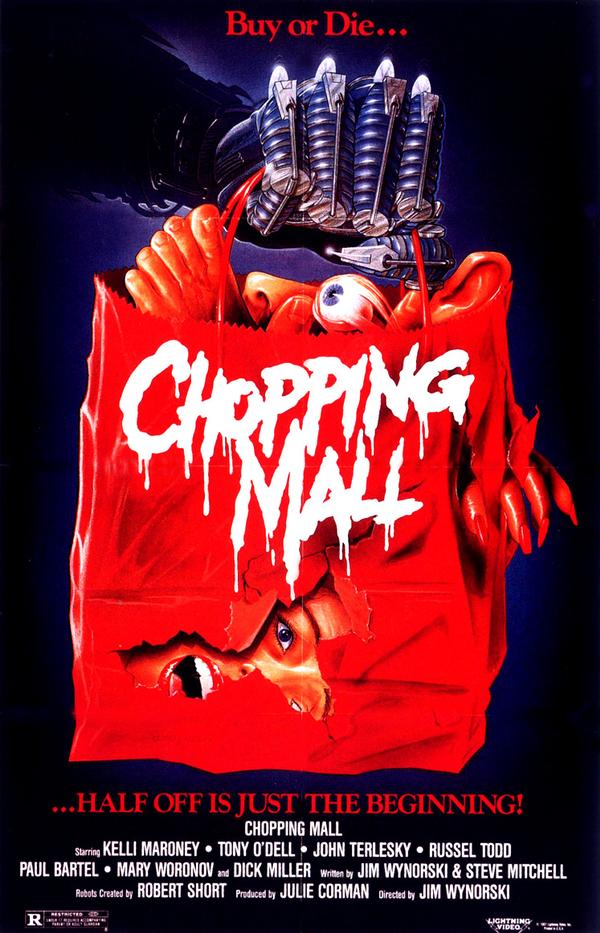
Welcome back to the Misan[trope]y Movie Blog! Today, in the third entry of Killer Robot Week, I’ll be taking a look at Jim Wynorski’s cult classic “Chopping Mall!”

“Chopping Mall” has just about everything you could possibly want from a B-movie: a dash of humor, over-the-top deaths that would make any highlight reel, and a fair share of one-liners. For example:

Let’s send these fuckers a Rambo-gram!

and

I’m just not used to be chased around a mall in the middle of the night by killer robots.

and of course, as is repeated by the robots after every human death:

Thank you, have a nice day!

What more could you possibly ask for?

choppingmall6
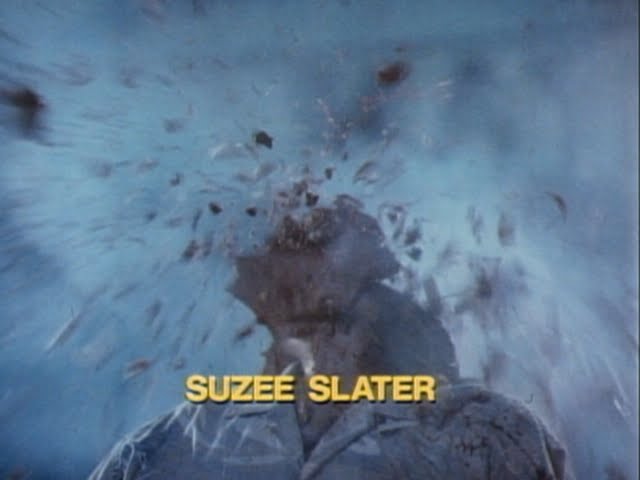
How about a head explosion?

Director Jim Wynorski is a bit of a notorious figure in the B-movie world. He spent a long time working under Roger Corman early on, and has now accrued 98 directorial credits to date over his career. However, a number of these have been pseudonymous soft-core porn features, such as “The Hills Have Thighs,” “The Devil Wears Nada,” and “The House on Hooter Hill.”

In 2009, a documentary was made about Jim Wynorski’s career called “Popatopolis.” In the film, a crew follows him over the course of three days, during which time he astoundingly completes an entire film (“The Witches of Breastwick”). The documentary was generally well-received, and brought a number of new eyes to the B-movie stalwart. It currently holds a 7.0 rating on IMDb.

As mentioned, Jim Wynorski has used a number of pseudonyms for his soft-core pornography and otherwise lesser works over the years. These have included “Rip Masters,” “H.R. Blueberry,” “Jay Andrews,” “Bob E. Brown,” “Tom Popatopolous,” “Noble Henry,” and “Arch Stanton.”

Jim Wynorski’s co-writer on “Chopping Mall,” Steve Mitchell, had a not-insignificant career in television writing after the film. His credits include episodes of classic shows like “Jem,” “G. I. Joe,” “Pacific Blue,” “Transformers,” and a movie from 1997 called “Against the Law.” However, he doesn’t have any credits more recent than 1998.

The distinctively 1980s music in “Chopping Mall” was composed and arranged by one Chuck Cirino, who has had a long career in B-movie music since. “Chopping Mall” was only his second film scoring gig, and he now claims over 60 (as well as a handful of Director and Cinematographer credits).

Director of Photography Tom Richmond has likewise had a long career post-“Chopping Mall,” including a number of cinematography credits on higher budget features such as “Mother Night,” “Killing Zoe,” “Little Odessa,” “The Singing Detective,” and “House of 1000 Corpses.” He is still active today, with a couple of shorts awaiting release.

choppingmall7

The designer of the robots in “Chopping Mall,” Robert Short, has had a long career in special effects. He designed the mermaid effects in “Splash,” worked on “1941,” “E.T.,” “Beetlejuice,” and “Piranha,” oversaw the effects work in “Punisher: War Zone,” and has work in three movies forthcoming in 2015. All together, he has been working on special effects in film for almost 40 years.

choppingmall2The cast of “Chopping Mall” includes a host of character actors that die hard bad movie fans might recognize. Barbara Crampton has featured in a laundry-list of Stuart Gordon movies (“The Re-animator,” “Castle Freak,” “From Beyond”), Dick Miller is a legendary Corman figure from his roles in “Little Shop of Horrors” and “A Bucket of Blood,”  and the combo of Mary Woronov and Paul Bartel have popped up all over Corman’s filmography. Star Tony O’Dell has had a number of small acting roles over the years, but appears to be more prolific in recent years as a dialog and voice coach on television shows such as “Girl Meets World,” “Emeril,” and “George Lopez.”

choppingmall4
Dick Miller being shocked to death in “Chopping Mall”

Something that stands out quite a bit about “Chopping Mall” are the numerous references to other B-movies hidden throughout. Two characters (played by Bartel and Woronov) are directly borrowed from the 1982 movie “Eating Raoul,” and the janitor played by Dick Miller is credited as being the same character he portrayed in the infamous Roger Corman movie “A Bucket of Blood,” creating an unlikely shared universe between the three films. There is also a brief clip shown from the Corman movie (“Attack of the Crab Monsters”), as well as a split second shot of the book “They Came From Outer Space,” which features the source material for another Corman-produced classic, “Death Race 2000.”

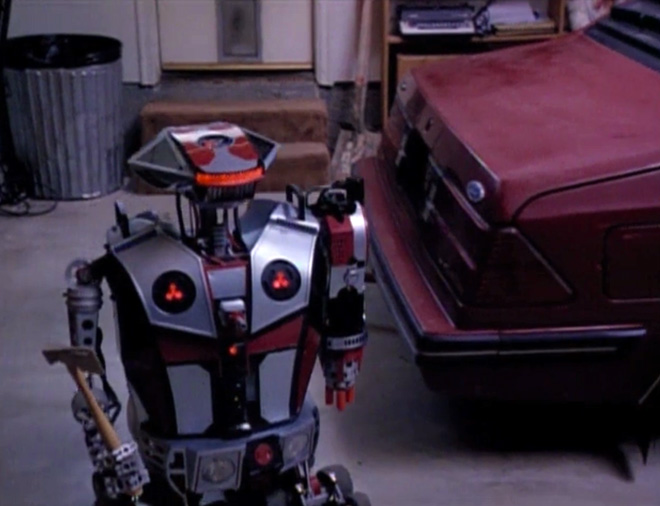
The “Chopping Mall” security robots are undoubtedly the most memorable part of the film. Their robotic voices were recorded by Jim Wynorski himself, who clearly had a blast with them. The robots themselves were functional and remotely controlled, down to the gripping rubber claws. Five were ultimately created for the production, just in case of damage over the course of filming. I wasn’t able to find out what happened to the robots themselves, but I want to believe that Jim Wynorski has one in his living room.

choppingmall3
Personally, I might use them to scare away Jehovah’s Witnesses. But I bet you can modify them to be Roombas too.

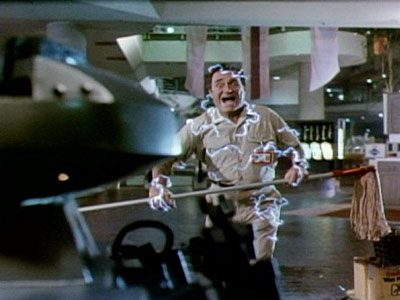
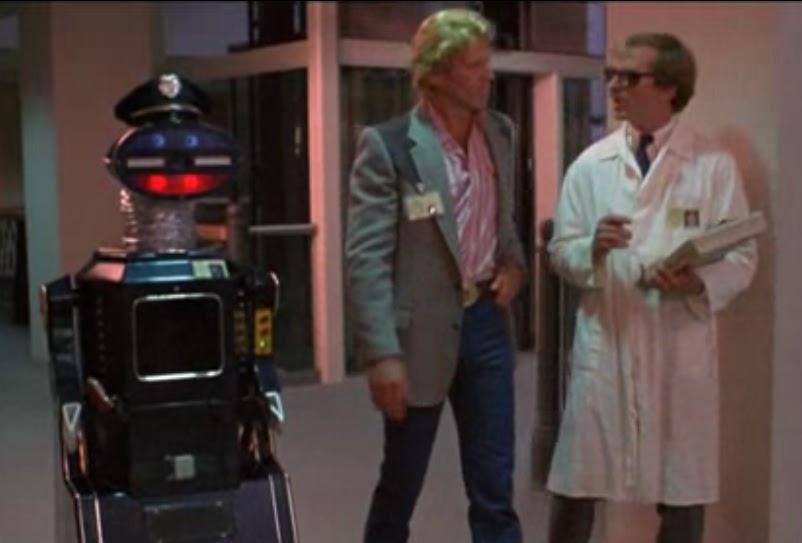
The robot design here is pretty simple: they operate, sensibly enough, with tank-style treads. Their laser eyes and electrical powers look excellently cheesy now, which is hardly something to complain about with this movie. They don’t have a ton of mobility, which makes them a little less terrifying that other killer robots I will cover this week, but they do get the job done. I also noticed that they look very similar to the police robot from “R.O.T.O.R.,” but that is neither here nor there.

robot-copThe plot is likewise pretty straightforward: a handful of kids are having a party in a mall after closing, and an electrical storm causes the brand new, untested security guard robots to malfunction. The story follows the group of teens as they attempt to find a way out of the locked-down mall, all while evading the blood-thirsty killbots.

“Chopping Mall,” released originally as “Killbots” in theaters (changed because it was believed to sound too kid-friendly), wasn’t a big hit upon release. It eventually did make money on its shoestring budget ($800,000), but this is one of those movies that has benefited immensely from word of mouth, cable replays, and its eventual cult status in the long run.

Given its unarguable cult classic status, “Chopping Mall” is frequently reviewed and discussed in bad movie forums, podcasts, blogs, etc. Personally, I’m a big fan of the coverage done by the We Hate Movies gang and the Bad Movie Fiends podcast, and recommend checking those out if you were a big fan of the film.

It probably goes without saying, but I highly recommend “Chopping Mall” for any bad movie fans. This is just about a must-see for hardcore aficionados of cinematic awfulness, and a good choice for introducing people to the style. The pacing is good, the deaths are memorable, and it infuses enough humor to be entertaining and plenty bearable for even casual audiences. If you are looking to show a bad movie to a mixed audience, this is a pretty good selection for you.

If you missed the previously entries in Killer Robot Week here at Misan[trope]y, you can check them out here:

Red Planet

Robot Monster

Killer Robot Week: “Robot Monster”

Robot Monster

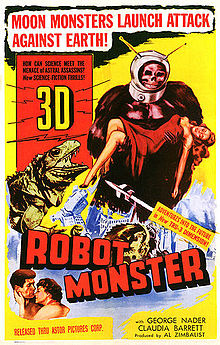
robotmonster1

Welcome back to Killer Robot Week here at the Misan[trope]y Movie Blog! For those that missed the first entry, you can check out the “Red Planet” review here.

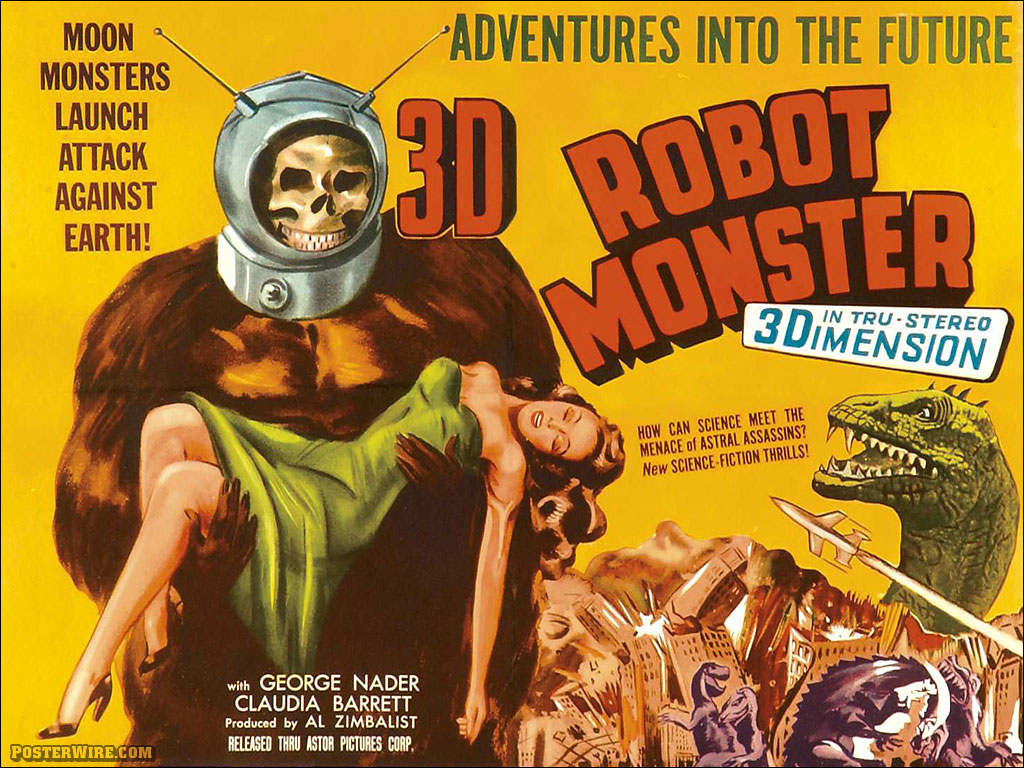
Today’s installment into Killer Robot Week is a truly beloved B-movie classic: “Robot Monster.”

“Robot Monster” is a classic among classics in the realm of B-movies. You will rarely find an elite ranking of “good-bad” films that fails to mention it in some way, and that back-handed praise is more than deserved for this feature.

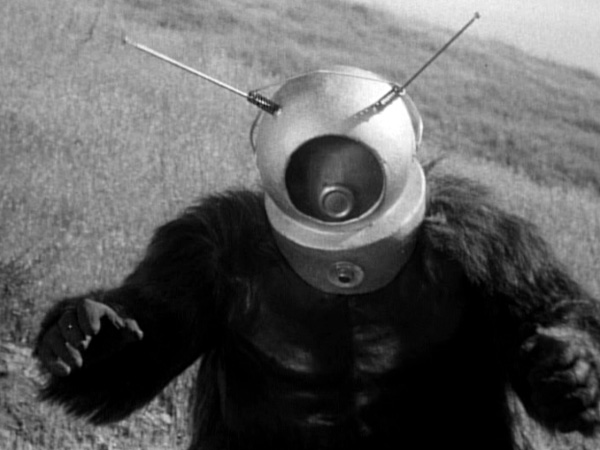
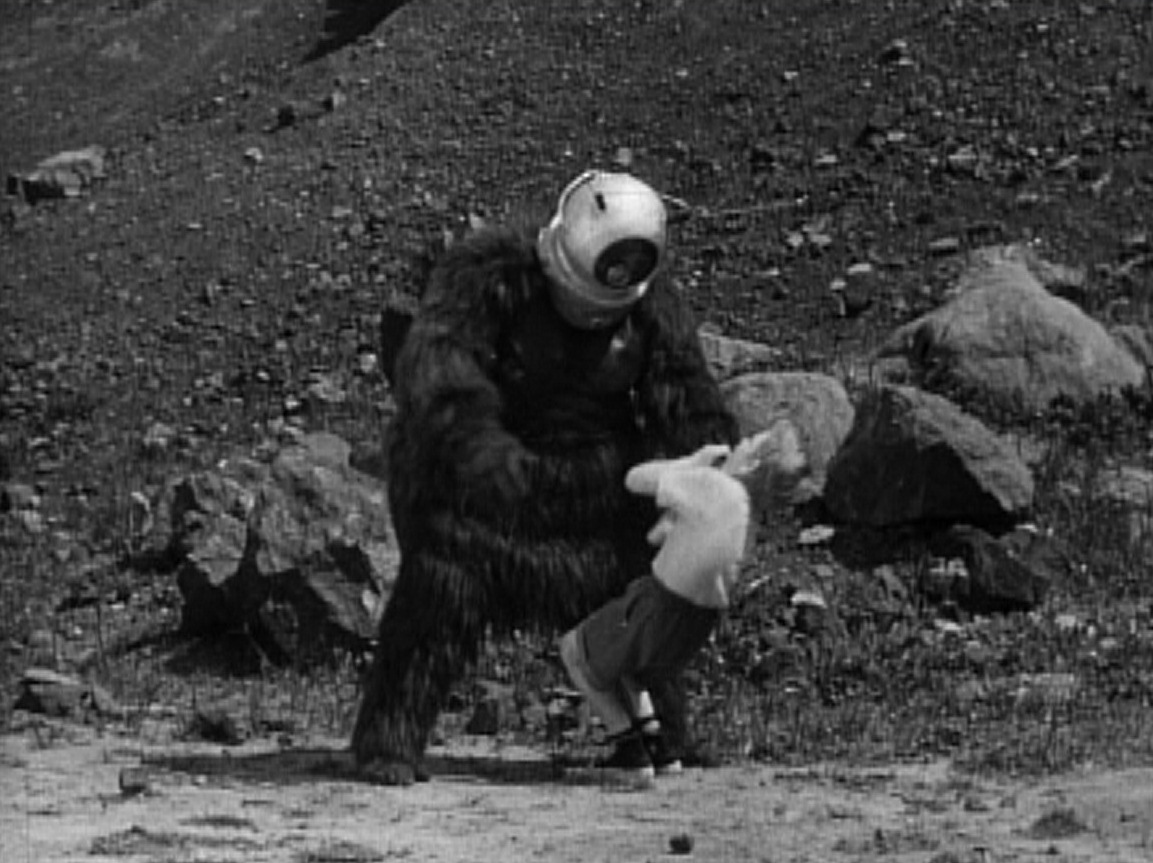
The most memorable aspect of “Robot Monster,” and what consistently keeps it mentioned in the same breath with films like “The Creeping Terror,” is the awful monster design. The eponymous Robot Monster, Ro-Man, is instantly recognizable by movie buffs, given his simplistic wardrobe of a gorilla suit and a slightly modified diving helmet.

robotmonster5

I’ve mentioned before that a poor monster design isn’t a death sentence for a movie, but “Robot Monster” makes a lot of the same mistakes in that department that “The Creeping Terror” does: most notably, the embarrassingly awful monster gets way too much exposure and screen-time. The only way you can get away with a bad monster is by being creative with its absence, which can’t very well happen if the creature is never absent.

The writing in Robot Monster is nothing short of astounding. The story feels like a “Twilight Zone” episode written by an 11-year-old with dialogue penned by a younger sibling, and the allusions to Cold War anxieties are brandished towards the audience like a bludgeon. In short, the writing has all of the subtlety and sophistication of a man in a gorilla suit with a robot head. Here are a few choice lines worth noting:

[Ro-man]: I cannot – yet I must. How do you calculate that? At what point on the graph do “must” and “cannot” meet? Yet I must – but I cannot!

…and some more gold from Ro-Man:

[Ro-Man]: Hu-mans, listen to me. Due to an error in calculation, there are still a few of you left.

And, of course, Ro-Man threatening a child. This happens a fair amount:

[Johnny]: I think you are just a big bully, picking on those smaller than you are!

[Ro-Man]: Now I will kill you.

It certainly doesn’t help the dialogue that the acting isn’t exactly stellar to begin with. The movie features not one, but two major child characters, which is almost always a recipe for disaster. As you might expect, the two precocious kids can’t act with a damn, and are on screen almost as much as the robot monster himself. The rest of the characters include an elderly scientist and a love-hate couple, none of which are portrayed much better than the kids.

robotmonster4
Peripheral vision is negated by true love

There is an interesting question that I had to ask myself while watching this movie: is Ro-Man, as the title suggests, actually a robot? It seems like a necessary question to ask, given this is Killer Robot Week and all. His behavior and speech are very mechanical and robotic until later in the film, which seems to be a trait of his race (also called Ro-Man? There’s an anti-individualism aspect to them). It is also unclear if the diving helmet is part of a uniform / space suit, or if it is biologically part of the creature. Ro-Man’s commander, who is not on the planet, also wears the same helmet, so I don’t think it is a necessary breathing apparatus. In any case, I’m tempted to say that the Ro-Man are a sort of cyborg race, which incorporates both robotic and biological aspects. Interestingly enough, the term “cyborg” wouldn’t be officially coined for another 7 years after the release of “Robot Monster,” so maybe there actually is a little forward thinking there?

robotmonster2

“Robot Monster” was directed by a man named Phil Tucker, who didn’t do much else with his career. He has a few other directorial credits on films like “The Cape Canaveral Monsters” and “Dream Follies,” but nothing particularly notable.  He popped back up briefly in the 1970s as an editor and production manager, working on movies like “King Kong (1976),” “Orca,” and the “Wonder Woman” television show.

In the acclaimed book of film failures, “The Golden Turkey Awards” by the Medved brothers, it is stated that Phil Tucker attempted suicide after the abysmal critical reception to “Robot Monster.” From what I could find, this a bit of a bending of the truth: it is reported that the film’s distributor refused to pay him for his work on “Robot Monster,” which left him unemployed, broke, and in general dire straits. In addition to his history with depression, all of these factors apparently culminated in his suicide attempt in December 1953.

The writer of “Robot Monster” is listed as Wyott Ordung, who likewise doesn’t have a whole lot credited to his name. He had a few directing credits, specifically “Walk the Dark Street” and “Monster from the Ocean Floor,” but didn’t do much at all outside of the 1950s.

The cast of “Robot Monster,” to the surprise of no one, did not produce any major stars.  George Nader, who plays Roy in “Robot Monster,” seemed poised for stardom after winning a Golden Globe in 1954 as one of the most promising male newcomers, but never really managed to break out. Selena Royle, who is credited in “Robot Monster” as “Mother,” was a character actress throughout the 1940s for MGM, but was publicly accused of being a communist sympathizer in 1951, which was enough to essentially destroy her movie career going forward. “Robot Monster” would be her next-to-last big screen credit, with her movie career concluding in 1955 with “Murder is My Beat.”

robotmonster3

“Robot Monster” was filmed at Bronson Canyon, a particularly famous B-movie filming site outside of Los Angeles that has seen the likes of “Eegah!,” “Army of Darkness,” “They Saved Hitler’s Brain,” “The Searchers,” and countless others. “Robot Monster” has the distinction of having been filmed almost entirely at that location, with only one sequence being filmed in a nearby residential neighborhood. You will probably recognize the cave from “Robot Monster” as being the same one used for external shots of the Bat Cave in the Adam West “Batman” television show.

robotmonster6

A handful of clips from other films are used throughout “Robot Monster,” including a number of shots of stop motion dinosaurs from “Lost Continent” and a sequence of lizards fighting from “One Million B.C.” to make up the perplexing catastrophic conclusion.

Overall, “Robot Monster” is more than deserving of its reputation, regardless of how you want to interpret that statement. The film is a showcase of incompetence at every level, and the end result is absolutely entertaining.

For bad movie fans, this is a must see. “Robot Monster” is essentially a foundational work, on the level of “Manos: The Hands of Fate” and the more notorious Ed Wood films. Particularly for monster movies, this stands amongst the elite of the awful.


Kingsman: The Secret Service

Kingsman: The Secret Service

kingsman3

For those of you who are veterans of the Misan[trope]y Movie Blog, you’ll likely have noticed that I don’t do a whole lot of coverage of current cinematic fare. I prefer sniffing around in actor/director filmographies, sifting up obscure titles, and digging things out of bargain bins to cover. However, I’m going to make an exception on the case of “Kingsman: The Secret Service.”

As a caveat, this review absolutely necessitates SPOILERS. Now, I am the sort of person who will often forgo spoiler warnings, but I really want to emphasize that “The Kingsman” is worth going into unspoiled.

So.

****SPOILERS****

“The Kingsman” is very much a movie created in deep affection for the spy movie genre. In that way, it feels very similar to Edgar Wright’s Cornetto trilogy (“Shaun of the Dead,” “Hot Fuzz,” “The World’s End”). There is, to say the least, a lot to like about “The Kingmen” if you are a fan of the genre. Send ups come fast and furious, from everything from James Bond, to “Get Smart,” to the Bourne Trilogy. It plays with the  familiar tropes and stereotypes of the genre in just the way you would expect from a Wright/Pegg/Frost movies, and manages to play them almost entirely straight-faced while also turning them into something that feels new.

I absolutely recommend seeing this movie if you have any affection for spy or action flicks. I think the film is fantastic. That said, I have a handful of issues with it.

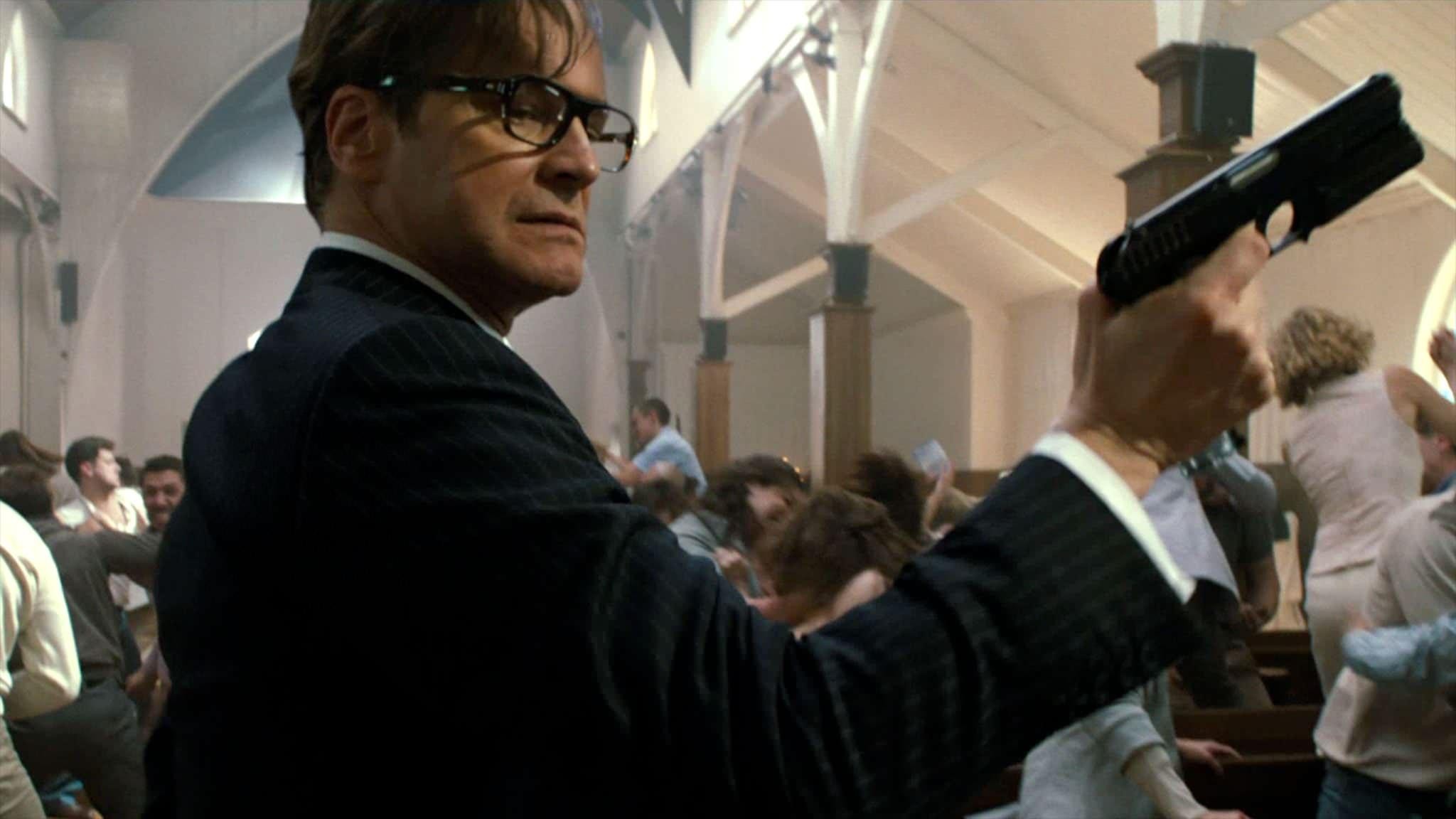
After the sure-to-be-infamous (and fantastically done) church scene, and the subsequent departure of Colin Firth, this film starts to fall apart. The last act doesn’t hold up with the rest of the film, which is kind of a shame. First off, it feels very rushed. It is true that they are put against a countdown for the last act, but it definitely feels hastily tossed together. I expected a little bit more internal infiltration of The Kingsmen to deal with, which could have gotten another solid fight scene out of the movie. It also would have put a more direct class conflict battle into the film, which is a theme that never quite comes to a head outside of the “poisoned drink” standoff with Caine (which is great, for sure).

Next thing: the climactic symphony of colorful head explosions. It is something to see, without a doubt. However, I was reminded of some of the Sony correspondences that came out regarding “The Interview.” In particular, discoloring the viscera from a head explosion was key in getting a desired MPAA rating out of that film, which leads me to wonder if the colorful head-explosion orgy in the climax of “The Kingsman” was actually creatively motivated, or was a compromise for the sake of a ratings board. In any case, you could argue that this was intentionally cartoonish, but I feel like this film would have served better with a more “Scanners”-esque style of head popping with practical effects. I’ll be interested to see what comes up in the Director’s commentary on this scene, anyway. Also, we get a close-up shot of an awful CGI head explosion of the Swedish Prime Minister during that sequence, and it looks absolutely godawful.

Last but not least, the “Princess” feels like a character and scenario that belongs in the bloopers. I understand it being a send-up to 007 and playing for laughs, but it does not fit with the movie in any way, and undercuts the potential romance with Lancelot that was alluded to throughout the film. It also cheapens a character who, in her only other major scene, seemed like an intriguing and ethical political leader. Her being reduced to a lazy sex joke at the 11th hour was disappointing for a number of reasons, not the least of which was the amount of screen-time set-up for a joke that wasn’t particularly funny.

Something that I still can’t decide is a positive or a negative is Samuel L. Jackson’s performance. I feel like he was going too far with the quirks, particularly with the speech impediment. With this kind of movie, Colin Firth’s character is correct: it is always made by the megalomaniacal, larger-than-life villain. Jackson just isn’t quite that. I did like his complicated motivations, which harkened to eugenicist’s logic and “The Watchmen” ethics.

kingsman2I’m going to be lenient on the lack of character depth across the board in this movie, because this is just a flashy, fun flick. It doesn’t make sense to complain about Mark Strong being a wooden board, or the main character being often insufferable, or Roxy getting almost nothing to do until she is shot into space (and out of the plot). I can forgive a lot of this stuff, because this is an action movie, and that naturally comes with the territory.

Now, again, I loved this movie. It was a boatload of fun. These are overall pretty minor issues, but I felt like they were worth throwing out there. So, here is a short list of things I thought were fantastic about the movie.

  • Holy shit, is it good to see Mark Hamill on the screen again
  • Car chase in reverse is fantastic
  • Michael Caine’s death scene. His last grunts are A+
  • Everything about the sequence introducing Lancelot and Gazelle (though the “split” still looks goofy 13 years on from “Equilibrium”)
  • The church sequence is one of the best action scenes in years
  • The design of Gazelle. Definitely feels like a character in the vein of Jaws and Oddjob
  • Galahad’s death
  • The final fight scene between Gazelle and Eggsy
  • Taking a balloon into space to blow up a satellite
  • Fitting room #3, and all of the gadgets therein
  • The idea of a philanthropist as the modern day, eccentric villain
  • Colin Firth’s performance 100% channeling early Michael Caine
  • Kingsman training was a fun way to kill time
  • Comedic moments, with rare exception, are right on target
  • All of the subtle (and not-so-subtle) references to “Get Smart,” James Bond, Jason Bourne, Jack Bauer, and others

See? I have lots of good things to say about this movie! If you disregarded the spoiler warning, I want to make it absolutely clear that this is a movie worth your time, and that my complaints shouldn’t dissuade you from attending a screening. If you even remotely think you would enjoy this movie, then go see it! Odds are good you will not be disappointed.

kingsman1
This scene will not disappoint you

Kudos to Matthew Vaughn, who is now 5/5 as a director if you ask me (“Layer Cake,” “Stardust,” “Kick-Ass,” “X-Men: Days of Future Past,” “Kingsman”). “Layer Cake,” his first, is probably my favorite British gangster movie of the modern era that isn’t directed by Guy Ritchie, and is a movie that I will absolutely recommend for anyone who enjoyed “Kingsman.”


Killer Robot Week: “Red Planet”

Red Planet

redplanet6

Today, we’re kicking off Killer Robot Week with a bit of a forgotten sci-fi feature: 2000’s much maligned “Red Planet,” which features the killer military tracking robot AMEE.

“Red Planet” was directed by South African Antony Hoffman, and is to date the director’s only feature. He did a short in 2014, but has no other planned credits listed on IMDb. The best information that I could find indicated that he apparently does commercials these days, which I suppose is better than nothing.

A fellow named Chuck Pfarrer is listed as both the writer and a producer on “Red Planet,” and it has been his only credit in the new millennium. Previously, he had an assortment of writing credits on movies like “Hard Target,” “Darkman,” and “The Jackal.” However, his most telling credit is on the film “Virus,” just one year prior to “Red Planet.” Back to back high-profile, high-budget failures in consecutive years is just about what it takes to sink a career.

Another writer credited on “Red Planet” is Jonathan Lemkin, who is still around today. He went on to write the action movie “Shooter” starring Mark Wahlberg, and is listed as working on “G.I. Joe 3” at the moment. Before “Red Planet,” he mostly did television writing (“Hill Street Blues,” “21 Jump Street”), but did do screenplay work for “The Devil’s Advocate” and “Lethal Weapon 4.”

One other notable name in the crew is one Peter Suschitzky, who has most recently been the go-to cinematographer for David Cronenberg (“Crash,” “Eastern Promises,” “History of Violence,” “eXistenZ,” “Maps to the Stars”). However, his earlier credits go back a good ways, and include “The Man In The Iron Mask,” “Krull,” and a stand-out director of photography credit on “The Empire Strikes Back.”

The Art Department and Production Design team feature a couple of names still quite active today. Owen Paterson, who is credited with the production design, is currently attached to “Captain America: Civil War,” and has recently worked on “Godzilla (2014).” He also had a lengthy connection with the Wachowskis, doing the production design for all three “Matrix” movies, “V For Vendetta,” and “Speed Racer.” Hugh Bateup, who is credited as one of the Art Directors on “Red Planet,” took over Paterson’s Production Design role for the later Wachowski movies “Cloud Atlas” and “Jupiter Ascending” after serving as an art director for the siblings on the “Matrix” trilogy and “Speed Racer.”

“Red Planet” boasts a pretty interesting cast: Simon Baker (“The Mentalist”), Val Kilmer, Terrence Stamp, Carrie-Anne Moss, and Tom Sizemore lead the way in a minimal cast of astronauts who are sent to investigate a Mars terraforming project. Apparently, a lot of creative shooting had to be done with stand-ins and body doubles due to a major feud between Kilmer and Sizemore on set, which led to numerous instances where they refused to be present together for filming.

redplanet4

“Red Planet” was thoroughly loathed by critics and audiences upon release in 2000: Rotten Tomatoes has it at an abysmal 14% for critics, and an only slightly higher 28% for audiences. The box office didn’t fair much better: in total, the movie failed to rake in even half of its estimated 80 million dollar budget, making it a massive financial flop. However, opinion on the movie may be softening with time: its IMDb rating is up to a 5.6, and I’ve heard from a number of people who feel that it was unappreciated. Phil Plait of “Bad Astronomy” offers one of the few positive reviews out there:

“I was expecting a really bad movie, both plot-wise and astronomy-wise. What I got was an enjoyable movie. It is not very fast paced, which may be why the critics didn’t like it. The plot was not great, but good, and I thought the pacing was just fine. I expected Val Kilmer to chew up the scenery, but his character was actually a rather modest, likable fellow, and Kilmer played him very well. The special effects were also really good.”

First off: I definitely agree on (most of) the effects. AMEE, the killer robot of the story, is primarily done with CGI, but looks absolutely fantastic for being from 2000. Some other things in the story look less impressive (the oxygen bugs), but AMEE is undoubtedly the centerpiece.

Speaking of which, the design of AMEE is damn cool. The monoeye design of the infamous HAL is incorporated into a complex, impressively thought-out convertible robot that functions in both bipedal and quadrupedal modes.  I’m not a big fan of the kung-fu bipedal mode, but the quadropedal mode is really unsettling: AMEE’s motions are modeled after those of large, predatory cats, and the sense of cat-and-mouse in the plot is really punched home with that detail. It is also worth pointing out that some of the most recent robotics developments at Boston Dynamics bear some resemblances to AMEE’s quadropedal mode, which is interesting to see. Another bit of sci-fi technological foresight here is the inclusion of a helicopter drone on AMEE, a solid year or so before the recognized inception of the modern UAV program in the United States military and CIA.

Staying on the topic of science and technology, Phil Plait of the “Bad Astronomy” blog, who typically tears movies asunder for technical inaccuracies, actually had some good things to say about “Red Planet”:

…they used spinning wheels on the ship to simulate gravity, which would work. I was amazed to see two wheels, spinning in opposite directions. This is exactly what you want to do!

I did like this movie. While not action packed, I liked the pacing and the thoughtfulness of it. There were a few plot devices: (1) the gamma flare (2) why didn’t the military disable AMEE’s military mode before giving it to civilians? and (3) the bugs making oxygen. However, this is a factor of ten fewer plot devices than in most movies.

…it is my great pleasure to say that “Red Planet” is vastly better than “Mission to Mars”. Of course, the stomach flu is better than “Mission to Mars”.

That is pretty high praise coming from Plait, who is quite the stickler in the realm of depicting science accurately on screen.

So, why was “Red Planet” such a huge failure? One of the most common criticisms I saw of the film over a cursory glance of the Rotten Tomatoes critics blurbs was a perceived lack of originality, a  complaint that I think justifies some context.

“Red Planet” released in November of 2000, placing it 8 months after another Hollywood Mars expedition Sci-Fi flick: “Mission to Mars.” The two movies are rarely discussed separately, and are often a go-to example of similar movies racing to the box office, right next to “Armageddon”/”Deep Impact” and “Volcano”/”Dante’s Peak.” I can understand critics feeling over-saturated on the premise, and not giving “Red Planet” a fair shake on its own merits on the heels of “Mission to Mars.”

Another criticism of the film I have seen is the perceived lesson of “faith > science”, arguing that the movie has some concealed Luddite tendencies. I mean, there is a killer robot and a lot of wayward technology, so I can definitely see where that criticism comes from. There are also some painfully cringe-inducing lines of dialogue about faith that just feel strange and out of place: I have to wonder if this popped out of a rewrite or something, because the moments seem to pop out of nowhere, and don’t really contribute anything to the story. Val Kilmer’s extreme Christian Scientist beliefs have popped up recently in the news, proving that he is almost certainly devout to a fault as far as his personal health is concerned. I’m a little curious if he had any sway on the inclusion of these lines, which isn’t something that would be unheard of. In any case, they are a distraction and a weakness to the movie if you ask me. There isn’t anything strictly wrong with “science gone too far” stories, but it didn’t quite work here. I thought the more interesting line to follow would have been the “Jurassic Park” ‘life finds a way’ route, given that life manages to pop up despite all of the odds against it on Mars. Oh well.

Another frequent comment that I saw about “Red Planet,” which was treated as a positive or a negative depending on the critic, was how much the movie felt like a 1950s B-picture. Check out this excerpt from Roger Ebert’s positive take on the film:

“Red Planet” would have been a great 1950s science fiction film. It embodies the kind of nuts-and-bolts sci-fi championed by John W. Campbell Jr. in his Astounding magazine–right down to the notion that a space mission would be staffed by research scientists, and although there would be a woman on board, she would not be the kind of woman depicted in an aluminum brassiere on the covers of his competitors. This is a film where much of the suspense involves the disappearance of algae.

In contrast, here is the summary of a negative review from the Philadelphia Inquirer:

Feels a lot like a B-movie from the 1950s.

I actually think the biggest problems with this movie were external. The release of “Mission to Mars” and its negative reception was beyond the “Red Planet” team’s control, as was the apparent public disinterest in the style of movie they made. “Red Planet” doesn’t feel like a movie that went wrong at any point in its creation, but rather like a movie that became exactly what it was meant to be, only to find that no one wanted it. I think that “Red Planet” is a 1950s B movie that was trying to compete in a field of early 2000s techno-action, and it was not what people wanted or expected. It isn’t sophisticated enough to be “Contact,” but also not entertaining enough to cut it as a summer blockbuster. It may just be a project that was doomed from inception. That’s really a shame, because I don’t think this is a particularly bad movie: it isn’t great, but I think it is worth a solid “C.”

As far as the plot goes, I appreciated the bit of mystery element included around the terraforming. It reminded me of the similar mechanic used recently in “Interstellar,” which I think served well in that film as well. I wish that the oxygen bugs made a little more sense and some more time was spent on it, but the tension wasn’t ultimately built on that mystery when it comes down to it, so that might have been the right decision. “Interstellar” put weight on saving Earth, whereas there isn’t the same urgency with “Red Planet”: these astronauts are just trying to survive.

redplanet7
I mentioned a few members of the art and production design team earlier. I specifically read into them, because the work on this movie is nothing short of fantastic. I love all of the gadgets, the equipment, the ship, the set: all of the trim in this film is top notch without a doubt. Everything seemed vaguely futuristic, but not so far that it was beyond belief: that can be hard to pull off in sci-fi, which I think any creative futurist could tell you. The near future is tricky business, because you are never quite sure when/where the big technological jumps are going to come in.

redplanet2 redplanet1
As I mentioned before, I think “Red Planet” merits a pretty solid “C,” but I’m still going to recommend it, if only because this deserves a second, retroactive look by more people, unpolluted by the context that surrounded its release. Also, the visuals of the robot and the production design are just cool, and are worth giving it a watch alone.

“Sharknado”

Sharknado

sharknado6

Wednesday, Rifftrax’s live take on “Sharknado” from July will be available for download and streaming on their website. It was a damn good show (as all of their live ones typically are), and I highly recommend giving it a watch.

Of course, this Rifftrax release gives me a fantastic excuse to talk about the burgeoning franchise of centrifugal carcharadons, and whether these “Sharknado” flicks are worth the attention that they are garnering.

For those unaware, The Asylum, who creates the Sharknado movies, has been around since the late 90s, distributing and producing B-features. Over the past few years, they have made a name for themselves making two specific kinds of B-movies. First, they do a wide array of monster flicks: the “Mega Shark” movies, “2-Headed Shark Attack,” “Shark Week,” etc. Second, they have essentially created their own quasi-genre of the “mock-buster”: films designed to resemble current Hollywood releases as closely as possible, in order to parasitically feed on DVD sales. These have included such titles as “Snakes on a Train,” “Transmorphers,”  and “Atlantic Rim.” Unsurprisingly, this has gotten them into a little bit of legal hot water here and there, particularly with 2012’s “American Battleship,” whose name was eventually changed to “American Warships.” “Sharknado” obviously follows in the vein of the first type, clearly drawing inspiration from the outlandish “Mega Shark” series, which saw success similar to “Sharknado” a few years back, though not on the same scale.

Most of the movies put out by “The Asylum” are of pretty low quality by Hollywood standards, but are certainly leagues above Troma movies as far as production qualities go. They have particularly relied on cheap CGI in recent years to carry their films, which doesn’t enthrall today’s hardcore horror fans by any means. I mentioned in my “Lake Placid” review that I felt like the CGI used there really set the precedent for these Asylum monster movies, for better or worse. “Deep Blue Sea,” also from 1999, deserves some credit/fault as well for the first major modern CGI showcase of sharks on the big screen.

It is worth noting that while The Asylum’s movies are all of similarly low quality in regards to production values and CGI, they are not all equally entertaining. “Sharknado” is without a doubt one of the most genuinely entertaining products that they have put out, and I don’t think many would argue otherwise. Most of their movies are poorly paced, dull, and unmemorable, all of which are criticisms that I don’t think are valid to level at “Sharknado.” I will say that one of my favorite Asylum movies (maybe more so than “Sharknado”) was “Sherlock Holmes,” a mock-buster which was released just after the first Robert Downey Jr. / Guy Ritchie blockbuster. However, instead of just being satisfied with taking on a Holmes story, Asylum managed to wedge in an Iron Man suit, hologram dinosaurs, robots, and a hot air balloon battle. Really.

There is a really good video that circulated a bit last year that ruminated on the concept of good-bad (“nanar”) movies, and whether one could be made intentionally, a question that was clearly aimed at “Sharknado.”

The video did get me thinking, and I responded to it last month with a lengthy analysis of “The Producers” and “Springtime for Hitler,” in which I posit that there is a way to intentionally craft a bad movie. But, right now I want to dig into something that the video neglects to cover: the long tradition of intentionally made bad movies, which I believe deserves its own classification.

I mentioned Troma earlier in this post: in a lot of ways, they operate the same way that the Asylum does, but with a more tongue-in-cheek disposition and fondness for practical effects. They definitely have a cult following, and some of their films are regarded in the highest echelon of good-bad movies, but I don’t think anyone honestly believe that Troma goes into any of their movies aiming to create something conventionally “good.” “Surf Nazis Must Die,” “The Toxic Avenger,” “Tromeo & Juliet,” etc. are all clearly intentionally made bad movies, yet they have a loyal following of people who swear by them. They are still undoubtedly a divisive entity in the B-movie world though, so lets look at another example: Roger Corman.

troma2
Lloyd Kaufman, mastermind of Troma

Roger Corman is the undisputed King of the B-movies. Even beyond that, he is one of the most renowned fosterers of filmmaking talent in history, giving first breaks to people like Peter Bogdanavich, Francis Ford Coppola, Martin Scorcese, Jack Nicholson, and James Cameron, among many others. His career has spanned the better part of a century, and he, without any doubt, creates intentionally bad movies that are often widely adored. Recently, his producing credits have included the “Sharktopus” movies, the next of which is slated for 2016. On the other end of his long list of credits is 1955’s “The Beast With a Million Eyes”: he’s been doing this for a long, long time, and I think you would be hard-pressed to find someone who would claim that Corman movies don’t deserve recognition in a “good-bad” movie discussion.

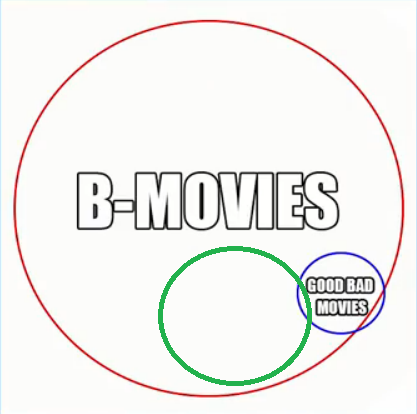
When it comes down to it, I think this video misses the category that “Sharknado” really belongs in. Here is a Venn diagram shown at 1:32:

sharknado1

I think that this diagram merits another circle. As he mentions, there are a few different definitions of what a “B-movie” is out there, and not all of them are made with the same sort of intentions of a Troma or Roger Corman film: to be outlandish for the sake of outlandishness. I’m going to include this category as a green circle on a modified version of the above graph, with the acknowledgement that not all of these intentionally made bad movies are “nanar”-style enjoyable, but some definitely are.

sharknado2So, I would claim that “Sharknado” gets the rare distinction or being in the intersection of the green and blue circles, alongside a handful of the more enjoyable Corman movies, treasured B-movie flicks like “Chopping Mall,” and a debatable selection of Troma’s filmography.

Getting back to “Sharknado,” I do not think is as bad as it is by design alone.  Particularly after seeing it on a big screen for the Rifftrax event, I believe that this is an incompetently made film beyond just the outlandish concept and writing. I think “Sharknado” is kind of like someone laughing at themselves to try to cover up a genuine weakness. As we all should know, laughing at it doesn’t make a flaw magically go away.

The CGI sharks and, more noticeably on a big screen, CGI weather effects look damn awful throughout this movie, and are probably the biggest weaknesses to the whole thing. Given how often the sharks and weather need to be shown on screen for this film to work, it is a pretty big issue that they look so poorly done. To be fair, they aren’t “Birdemic” birds, but they still look pretty awful.

sharknado5Something else that stands out more upon re-watching is the cinematography of “Sharknado,” in the sense that it is just god-awful. The camera movements are frankly nauseating, far more so than is ever justified. It isn’t like there are people out there who find bad cinematography hilarious, this is just honest incompetence in the film-making showing through.

So, I suppose my point with all of this is that “Sharknado” 1) follows in a long tradition of outlandish concept films, 2) is incompetent beyond just the concept, and 3) is still an entertaining film. I understand the detractors that aren’t fond of The Asylum’s brand of B-movies, but I do think that the success of “Sharknado” isn’t an accident: despite being an incompetently crafted movie, it is fun, and is almost certainly the result of a boiling down of The Asylum’s past successes. It isn’t the same kind of fun that “Troll 2” or “The Room” offers, but it is definitely similar to the old Corman-esque tradition.

sharknado7“Sharknado 3” is slated for debut in July 2015, and it looks like it will mark yet another change of venue for the franchise, this time to the nation’s capital. After the second film’s location of New York, NY, I hope there are some more twists in store for this third flick apart from new monuments to level. It is going to be hard to compare with a shark assault on the Big Apple.

And, again, Rifftrax’s take on Sharknado will be available on Wednesday, February 18th at Rifftrax.com. It was a fun show to watch, and if you enjoyed Sharknado, it is sure to enhance the experience for you.

sharknado3

Jason X (Friday the 13th Part 10)

Jason X (Friday the 13th Part 10)

jasonx6

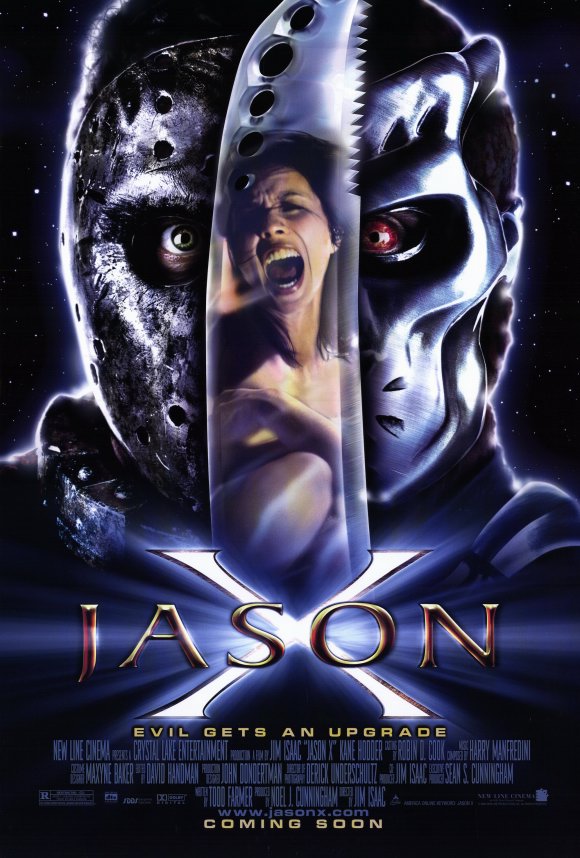
Happy Friday the 13th everyone! Given I have already covered parts VIII and V of the treasured horror film series that has so popularized the holiday, I figured that this would be an opportune time to take a look at one of the other much-maligned later entries into the franchise: specifically, the futuristic, sci-fi infused “Jason X.”

“Jason X” was written by Todd Farmer, and was his first major writing project. He has since gone on to write the “My Bloody Valentine” remake and the Nic Cage movie “Drive Angry,” which has a similar tongue-in-cheek tone to “Jason X.” The director of “Jason X,” James Isaac, doesn’t have many other directorial credits, but has worked in special effects on movies such as “Gremlins,” “Virtuosity,” and “eXistenZ.”

The cast of “Jason X” is headlined by Kane Hodder, who plays his famous role of Jason for the last time in the film. The rest of the cast is made up of various bit players and television actors, but lauded director David Cronenberg makes a brief cameo in the opening sequence of the film.

jasonx3“Jason X” is perhaps best known for being widely hated by critics and audiences alike. It currently hold a critic score of 20% and an audience score of 25% on Rotten Tomatoes, which is decidedly in the realm of the rotten. The film made just under 17 million at the box office on an estimated budget of 11 million, making it at least a profitable venture in spite of the poor reception.

“Jason X” was initially pitched because of developmental issues with getting the next planned movie in the series, “Freddy vs. Jason,” off of the ground. While that crossover was stuck in development hell, it was decided that another “Friday the 13th” movie should be made to keep the character of Jason in the public consciousness. And thus, the hockey-masked killer was sent into space.

In an attempt to keep the series fresh, “Jason X” is a film that tried a lot of new things. Unfortunately, most of them didn’t work out very well. The new, futuristic look for Jason wasn’t warmly received, and neither was the stilted attempt to make the movie a partial parody of the series. To make matters worse, “Jason X” was also one of the first major horror movies to rely heavily on CGI effects, which is something that still doesn’t sit well with horror purists. After all, this is a series that once claimed one of the kings of practical horror effects, Tom Savini. The writer and director tried to replicate some of the successful elements of “Alien” into the movie, but all of those attempts fall pretty flat and barely break out of being shallow, hollow pastiches. All of that said, at least the movie marked an attempt to try something new, and that is worth some credit. You can only terrorize campers at Crystal Lake so many times.

jasonx1While most of the attempts at humor in “Jason X” are really poorly executed, there is at least one segment that I thought was pretty great. At one point in the film, Jason is trapped in a holodeck. In an attempt to distract him, a simulation is produced of Camp Crystal Lake, complete with promiscuous, pot-smoking teenagers. Jason reacts by, of course, killing them, but does so in a way that nods to one of the most memorable deaths in the franchise up to that point:

That’s a pretty good way to nod at the history of the franchise, and poke at how over the top it had become. If only the whole film were so clever…

The acting and dialogue in “Jason X” is unarguably awful, but it is possible that this was done by design for the sake of self-parody. I think that might even be likely, but it unfortunately doesn’t make the movie any more entertaining, despite the best of intentions.

jasonx5It is interesting to note how much “Jason X” differs from the 2009 reboot of the franchise. Effectively, the reboot goes in the opposite direction stylistically, favoring a very dark and serious tone over any kind of camp. Interestingly, this approach also failed to resonate, earning scores just barely higher than “Jason X” from critics and audiences. This brings up an interesting question: what kind of “Friday the 13th” would satisfy audiences today? I suppose it would have to find a median between “Jason X” and “Friday the 13th” (2009), but I wonder if anyone will ever be able to find that balance. The entire reason that “Jason X” took so many chances is because the premise and the character of Jason have just been done to death, and there aren’t many places left to take it. I suppose we’ll see if Jason will ever be left dead indefinitely.

jasonx2“Jason X” surprisingly saw a number of sequels in the form of paperback books that were marketed for young adults. I never read any of them, but I have a hard time believing that Jason translates particularly well into the written word.

The good folks at MythBusters took on one of the more infamous scenes in the film, in which a character’s head is dunked into nitrogen and then smashed to pieces. In case you were curious, it was busted:

“Jason X” has the distinction of being the most lethal installment in the “Friday the 13th” franchise, clocking in with 28 deaths in total. Here they are, all handily compiled into a YouTube video:

So, how does “Jason X” hold up with the rest of the franchise? I know a lot of people who say it is the worst, but I don’t think that is quite fair. It definitely missed its mark with audiences, but the film itself isn’t poorly made. I think “Jason X” just took on too many (arguably poorly advised) risks that failed to pay off. The movie is at least watchable and has moments of entertainment when it comes down to it. “Jason X” certainly deserves to be considered as on the lowest tier of the franchise, along with V, VIII, and IX. However, I don’t think it can quite claim the bottom slot. I haven’t gone back to watch IX in a good while, but I’m leaning towards V being the worst in the franchise, and I think both of those films merit being ranked lower than “Jason X.”

jasonx4Personally, I would only recommend “Jason X” for “Friday the 13th” fans that want to burn through the entire franchise. I know that there are some people who appreciate “Jason X” as a good-bad flick, and I will admit that it has some good moments, but overall I don’t think that it is particularly noteworthy. It doesn’t quite deliver on its ambitions, and the result is an unfocused movie that isn’t quite sure what it is supposed to be.


Interview with “Bad Movie Nite!”

Bad Movie Nite! is a monthly showcase of classic bad movies shown in a handful of theaters around the country. I first came across them at Studio 35 Drafthouse and Cinema in Columbus, OH, and had to know more about the folks behind the madness. I recently caught up with Scott, the mysterious figure behind the programming, and ran a few questions by him.

“Bad Movie Nite!”: The title might be self explanatory, but what is it that you do?

Scott: The name “Bad Movie Nite!” to me means these are not good movies we’re showing, but only not good by conventional standards. I also mean bad as in Baaaaad.  Movies your Mom and Dad wouldn’t be happy you’re watching. Wait ’til they go to bed and keep the sound low. Bad in that way. As long as the movies entertain, they can never be all bad, right?

bmn3

What can you tell me about the mysterious (and, I assume, cloaked/hooded) figures behind “Bad Movie Nite!”? What inspired you to start doing these shows?

Scott: BMN! is the brainchild of me. I grew up watching Nite Owl Theater, USA Up All NIght, and TNT Night Flight. This show just basically recreates fond memories of my childhood. I started watching some of my favorites with a few friends on a weekly basis maybe 10 years ago as a way to ensure we get together consistently. Many of my friends had never heard of any of these. We loved cracking up watching them, but also getting caught up in the world of b-movies. We were getting exposed to any of the same actors, directors, stock footage, etc. 

Missing a BMN! became sacrilege. I’d play some trailers or a cheesy educational/social hygiene short beforehand. Shortly thereafter we started watching two movies and making a clip show of youtube clips in-between the movies like and intermission we call FILLER (to this day we call the clip show FILLER). The FILLER would get more and more elaborate. People took turns making it. Sometimes we would call in sick to work just to get it done. Over time, friends of friends would come over and either be baffled or engaged with BMN! I started getting the idea that what we were doing would be something others might be interested in seeing. 90% of the shows have been made by me, but early on and increasingly lately a few of my friends (including my wife) have been getting more and more involved. My wife designs the graphics for the show and the buttons we give away. 

bmn4

The BMN logo has a definite Svengali vibe to it. Is there a reason for that? Are you subconsciously controlling our minds with your show?

Scott: Thank you! That’s exactly the feeling I was going for. Become intoxicated by the insanity of BMN…

bmn1

A handful of theaters have shown your stuff around the country now. Where are they? Do you attend the shows? How did you wind up with multiple venues?

Scott: We have about 6 theaters all across the country. Just small theaters similar to S35 [Columbus, OH’s Studio 35] that we’ve known over the years for various things. We contacted a majority of them, but a few sought us out. Have never been to another location, but the Pittsburgh locale is on our to-visit list.

bmn12

Do you consider what you do akin to “horror hosts”? Or is this something that you think of as totally different?

Scott: I don’t really see myself / ourselves as a horror host. I see BMN! as a more of a secret broadcast that you tune into. I secret, sinister channel between the regular channels. A broadcast you’re not supposed to see. Goes back to the Svengali aspect of the logo you mentioned…

Part of the charm of your shows is definitely the editing. How much time do you spend on each new show?

Scott: Oh boy. Usually about 3 weeks from inception to finished product. It’s not really enough time. Every other month involves at least one sleepless night. The concrete showtime is the only thing that gets the show done each month. We’ve scraped entire shows the week of (The Hard Ticket show a few months back was made in less than 3 days). Long time… It’s never perfect, but I suppose that’s part of the charm too. The extremely gracious and loyal fans (BMNers) is ultimately what the drives the show to get finished. Disappointing them is not an option.bmn2

The first time I saw your show, I was reminded in some ways of “Everything is Terrible” (particularly your amazing pre-features). Are you fans of theirs?

Scott: I do like EIT. Also Found Footage Festival. There was a public access show in Albuquerque, NM a few years back called Forbidden Transmission. I loved that so much…

You’ve shown a lot of love for old VHS cover art in your pre-shows. What are a couple of your favorites?

Scott: Hmm… Let me peruse some. BRB… (Frantically looks at VHS tapes)

      
DOLLS
dolls1
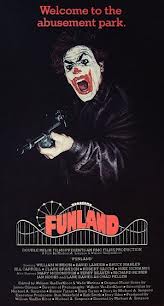
FUNLAND
bmn5
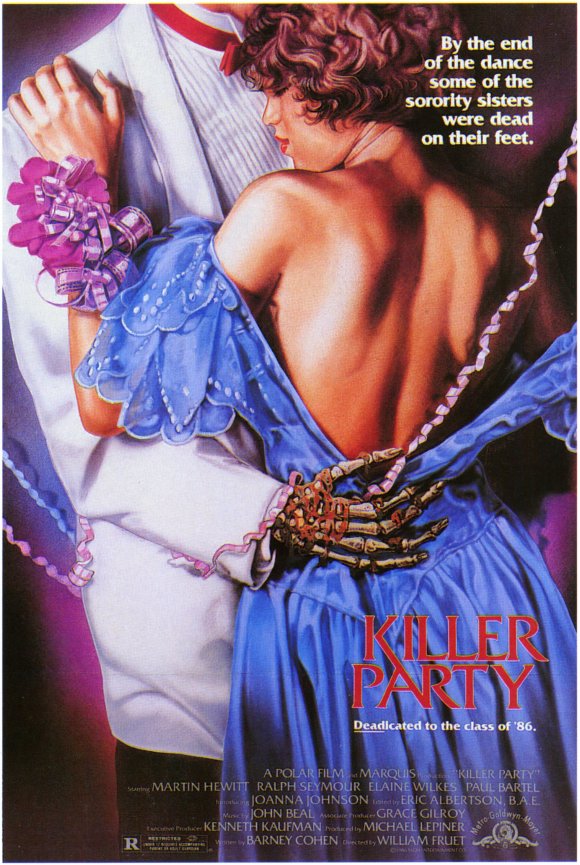
KILLER PARTY
bmn6
HELLO MARY LOU: PROM NIGHT 2
bmn7
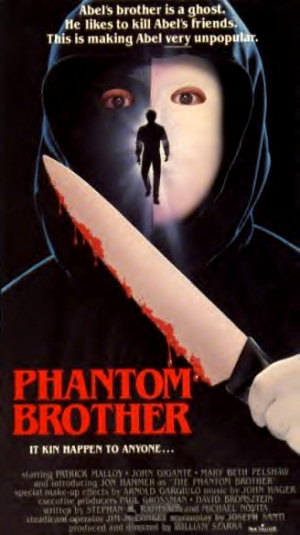
PHANTOM BROTHER
bmn8
SLASH DANCE
bmn9
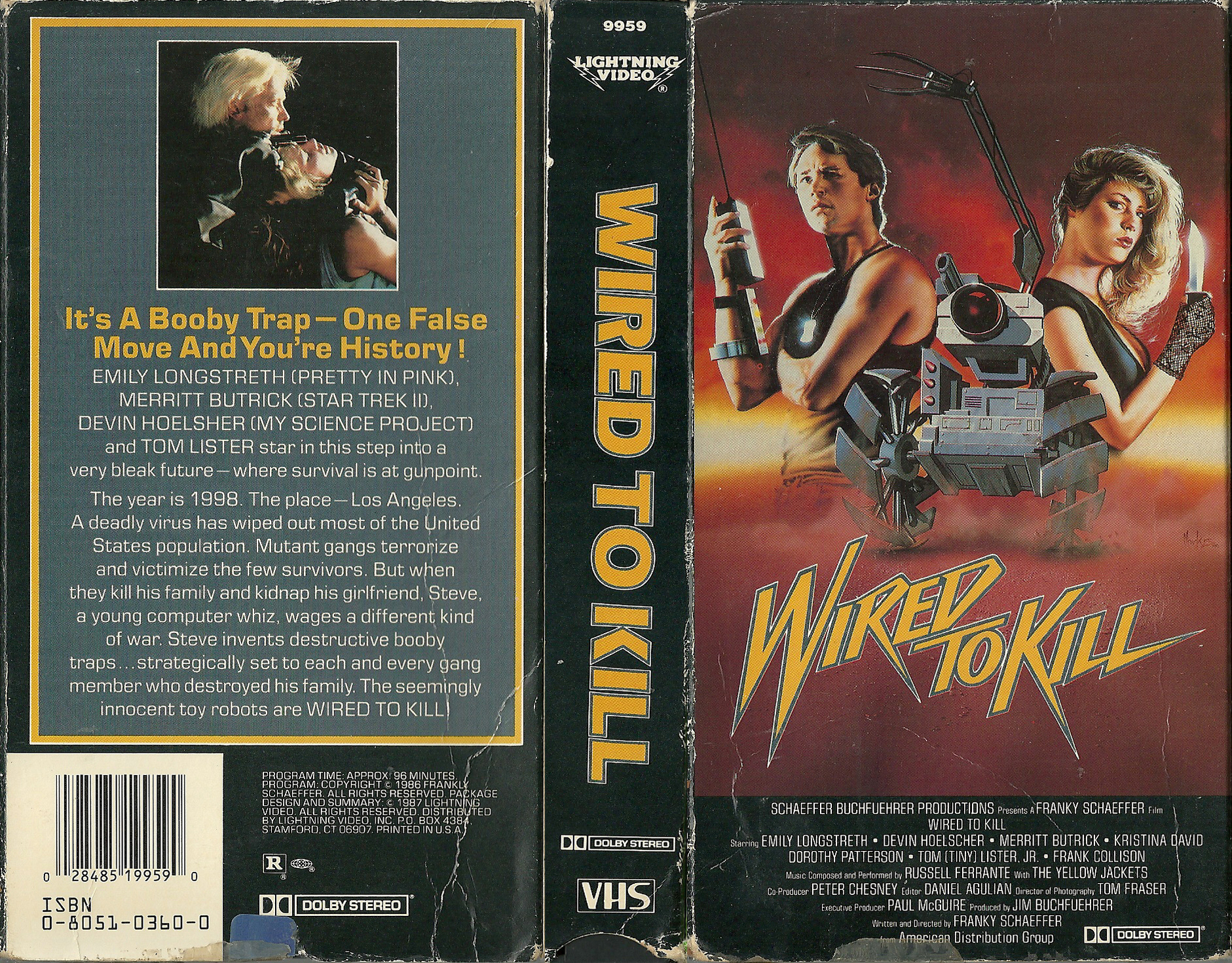
WIRED TO KILL
bmn11
MY MOM’S A WEREWOLF
bmn10

Too many to list really…

What was your introduction to the world of “bad movies”?

Scott: Again, watching late night shows like Nite Owl Theater and USA Up All Night. These cheesy movies, along with the hosts, and the late night commercials… I was seeing a whole different world. Taudry, violent, gratuitous… Loved it.fritz1

Are you MSTies (fans of Mystery Science Theater 3000)? If so, Mike or Joel?

Scott: I do enjoy MST3K. Don’t have a fave host.

joel

What is your favorite “good-bad” flick that people probably haven’t heard of?

Scott: #1 with a bullet for all-time: DR. ALIEN

Do you have a particular favorite “good-bad” movie director?

Scott: Jim Wynorski is probably too obvious. Adam Rifkin has made a couple legendarily bad b-movies that I love…

What do you think is the most important element to a “good-bad” movie?

Scott: FUN. A movie that delivers the goods on a variety of these  fronts (lasers, aliens, nudity, teens, drug use, cheesy dialogue, explosions). A movie that feels like it wasn’t just a cash grab. Something unique…

What has been your favorite movie covered so far in your show, in terms of entertainment value? Related: what do you think your best show has been so far? Is it the same?

Scott: Hard to say. I think the absolute show-stopper was DEADLY PREY. I really enjoyed showing STAR SLAMMER. The crowd liked that one too.

Are there any “bad movies” that you absolutely will not cover for BMN?

Scott: THE ROOM / BIRDEMIC / SHARKNADO The b-movies I love come from a by-gone era. Although there are redeeming qualities to all of these, there’s something missing, something hollow that I’m never totally on board with.

You’ve recently booked a second monthly show at Studio 35 in Columbus, OH, where you are doing shows dedicated to specific actors.The inaugural show, Nicolas Cage-a-thon, was a blast. Who can we expect to be featured in the future? (If you don’t do a Christopher Walk-a-thon, I will be disappointed)

Scott: HELL YES Walken will be a subject. Norris, Stallone, Busey are all in the pipeline. Arnold is the next one on February 27th.

What, in your opinion, are 5 movies that every bad movie lover absolutely must see?

Scott: Chopping Mall, Prom Night 2, Hard Ticket to Hawaii, Star Slammer, Frankenhooker

Do you have any upcoming shows to plug?

Scott: The Real Arnold Classic on 2/27 and our Gettin’ Unlucky in Space themed show on March 6th.

You can follow Bad Movie Nite! on Twitter and Facebook, and catch them every month at Columbus, OH’s Studio 35.