Tag Archives: movies

Carnage

Clerk’s Pick

Clerk:
Hannah, Video Central (Columbus, OH)

videoc

Movie:
Carnage
carnage1

Pitch:
“The casting is really great. You would think it would be a dark comedy from looking at it, but it is almost more…physical? It is about two couples whose children get into a fistfight on a playground, and they start teaming up against each other over the course of the movie. It is one of those movies where a minor thing winds up becoming a really big deal. I think it was adapted from a play, because it definitely feels really stage-y. I really love the tagline: ‘a comedy of no manners.’

Background:

“Carnage” is a 2011 movie directed and co-written by Roman Polanski, the once-lauded director (and noted scumbag pedophile-on-the-run) who was behind such classic movies as “Chinatown” and “Rosemary’s Baby.” “Carnage” is an adaptation from an award-winning French play called “God of Carnage” by Yasmina Reza, who shares co-writing credit on the film with Polanski.

Outside of the opening and closing scenes that are set in a Brooklyn park, the entirety of “Carnage” takes place in a single apartment. The bulk of the scenes were shot in France by Polanski, while the few exteriors and the playground scenes were shot by a second unit in the US (given Polanski is a fugitive and all).

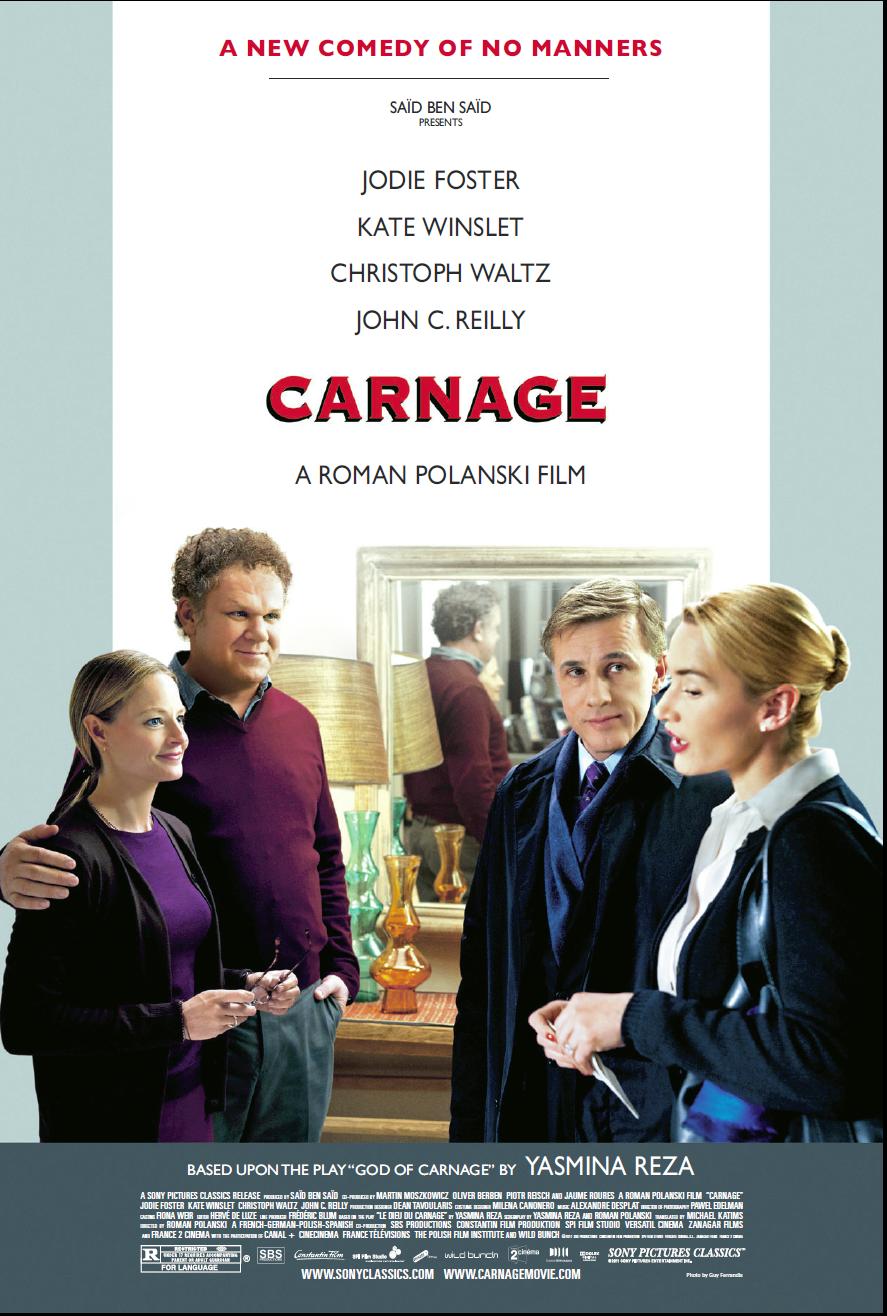
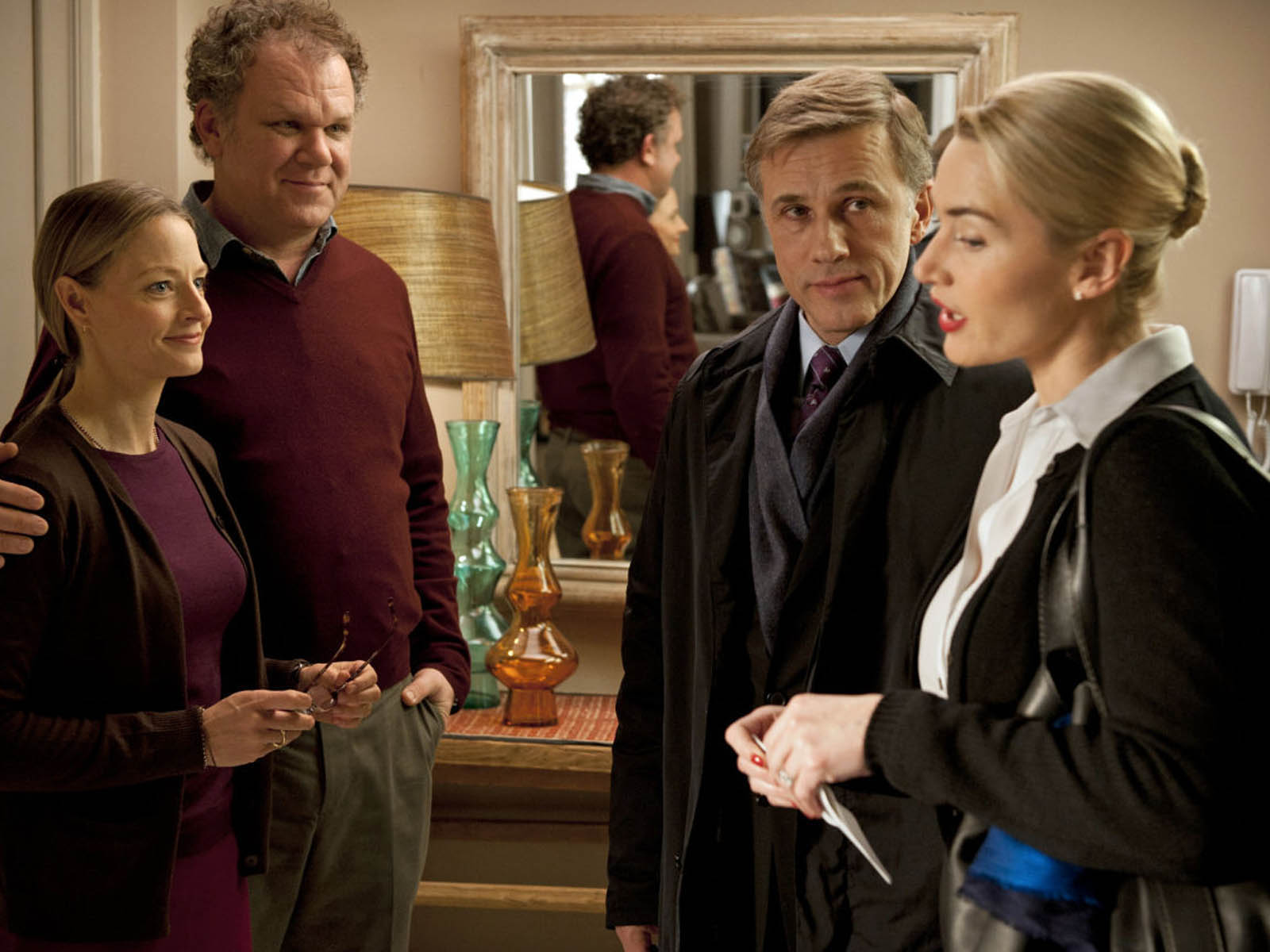
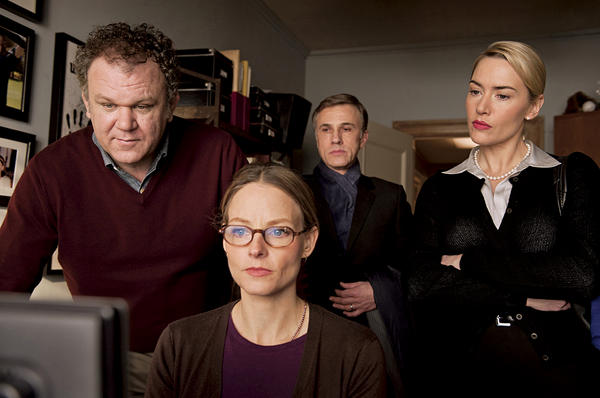
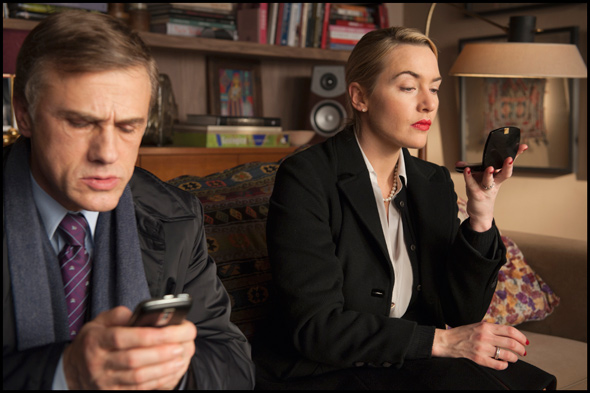
The cast of “Carnage” is very small, and is primarily comprised of notable actors Jodie Foster, Kate Winslet, Christoph Waltz, and John C. Reilly. Foster and Reilly play a couple whose son is attacked by the child of Waltz and Winslet, and the story picks up with the parents meeting to talk over the situation and the consequences for the children.

carnage1The music in “Carnage” is done by french composer Alexandre Desplat, who has recently scored critically-acclaimed films such as “Argo” and “The King’s Speech,” and previously worked on movies such as “The Fantastic Mr. Fox” and “The Curious Case of Benjamin Button.” Desplat has worked with Polaski on a number of films besides “Carnage,” including on “The Ghost” and “Venus in Furs.”

“Carnage” was nominated for a litany of awards, primarily in Europe. Winslet and Foster both earned Golden Globe nominations, however, but neither of them took home the prize.

Despite the many awards it accrued, the film’s ratings are only moderately above average. It currently holds a 71% critic score on Rotten Tomatoes, a 66% audience score, and a 7.2 rating on IMDb.

Review:

“Carnage,” unfortunately, is kind of forgettable. There is nothing particularly bad about the movie, but nothing much stands out about it either. All of these actors are better in other things, and at times it feels like they are just trying too hard to stand out *cough*Jodie Foster*cough*. It seems like they are acting at each other at times, which doesn’t make for a very compelling watch.

carnage4All of that said, the casting is pretty great. These are all generally good actors, but none of them put up their best performances for this one. The best thing I can compare this to is “Who’s Afraid of Virginia Wolf?”, but “Carnage” doesn’t seem to be or feel like it is as heartfelt or genuine as that cinema classic.

I would wager that this is a great play to see on stage, but something just doesn’t gel quite right with this as a film. I’m not sure what the issue is, but the movie feels really run-of-the-mill. I would expect this sort of film from just about any indie director out there, but not Roman Polanski. It just feels oddly…sterile? It is like all of the right elements are being heated in a beaker, but the reaction just isn’t happening.

carnage3“Carnage” interestingly feels like it drags on too long, despite being a pretty short movie (80 minutes). There isn’t a lot of motion to the film, and the characters mostly talk themselves into concentric circles through the story, which is almost certainly why it feels so much longer than it is. After a while, the only interesting thing about the film is watching Academy Award winners pretending to get progressively drunk.

“Carnage” reminded me a little of an earlier Clerk’s Pick, “It’s A Disaster”, but I think that movie was actually pulled off better. It has the same sort of bottle scenario and rapidly degrading sanity that are both present in “Carnage”, but it just seems to move along better. I would wager that “Carnage” offers the better performances of the two, but it just doesn’t feel quite as entertaining.

carnage5After all of the meandering conversation, argumentation, and outright yelling, “Carnage” comes to what feels like a really abrupt ending that doesn’t feel earned or justified. It bookends pretty nicely, but nothing seems to be resolved or changed as a result of the story. I’d also say that no one really learned anything or grew as a result of the story, so it all ultimately feels kind of pointless. Then again, that might have been the point. In any case, I didn’t come out of it feeling entertained.

All of that said, “Carnage” has a very interesting concept. I don’t think it was pulled off particularly well, but there are undoubtedly good elements to it. Although, I will say that I have no idea how either Winslet or (especially) Foster got Golden Globe nominations out of this. That is just boggling my mind, because Foster is just downright chewing scenery in this thing, and Winslet spends a non-trivial part of the movie fake-vomiting.

Recommendation:

I think that some people would really enjoy this movie, but that most would be better advised to skip it. I even like this kind of bottled-setting drama, but I wasn’t particularly impressed with “Carnage.” At times it feels both overacted and excessively preachy, and neither of those things do the movie any favors. If this is the kind of movie you are looking for, I would think that there are a lot better ones to find with very similar setups.

Maybe if you are a big fan of Foster or Winslet, this will be a better watch for you. I am not particularly high on either of them, and their performances in this didn’t change my mind. They certainly look their parts and were cast well, but they just didn’t quite do it for me.


Groundhog Day Marathon Recap

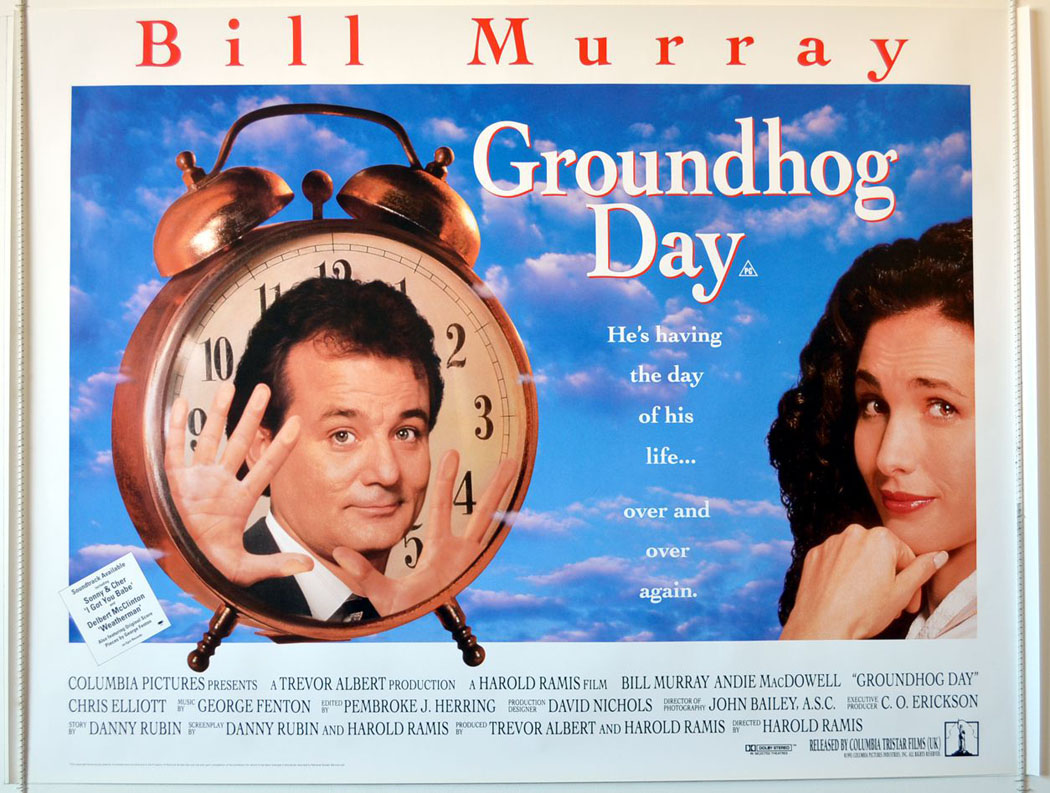
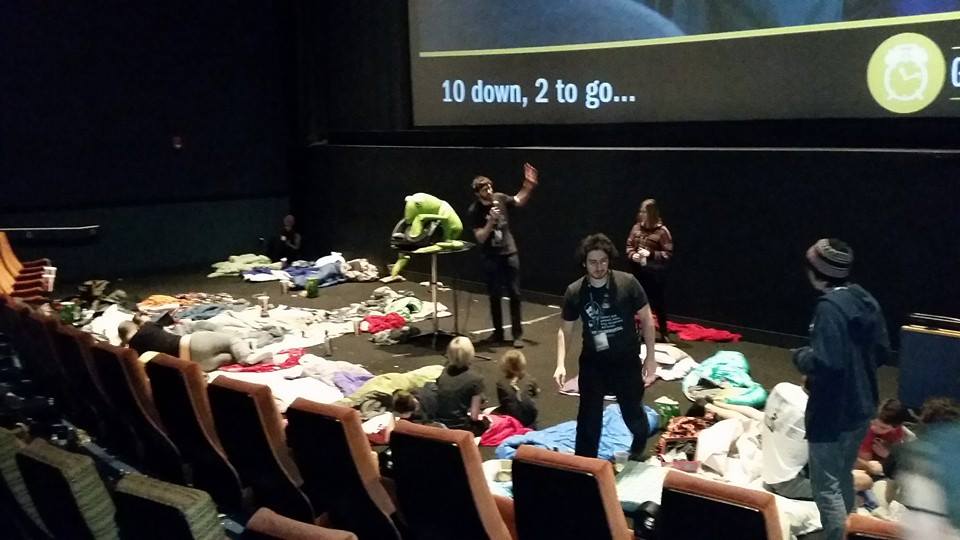
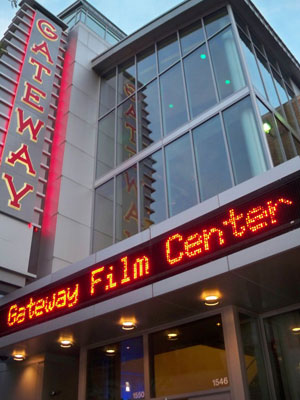
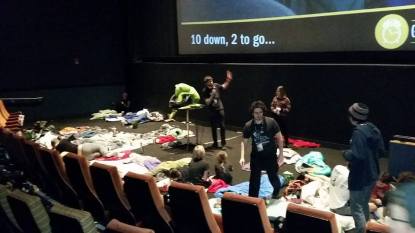
This past Sunday, I participated in a 24-hour “Groundhog Day” marathon at the Gateway Film Center in Columbus, OH. To keep things interesting and lively, I decided to do a review between each of the 12 consecutive screenings of the movie.

Yesterday, I picked up a DVD copy of the movie, and went through Harold Ramis’s commentary while doing some research. Below are each of the reviews I wrote during the 20 minute intermissions, with some follow-up comments based on my research in italics.

“Groundhog Day” Review #1

I haven’t watched this movie in years, so it was good to get a fresh start. Bill Murray has a great way of delivering dialogue (of course), but I think the power of this movie is in the periphery cast: they are the control, and their performances have to be meticulously detailed for the story to work. If you don’t notice an aberration, then everything is working perfectly. Might be Tobolowski’s best role, and he is a dude who has been around the block.

Ramis made a specific note of the careful attention to continuity on the part of the crew. He also spoke at length about the casting process, noting that Tobolowski earned the role straight off of his audition. Of course, Murray did a fair amount of improvisation on the film, both in his physical acting and his dialogue.

Next thing: Phil creeps me out. Not just when he is supposed to, but the whole time. He is still obsessively catering his life to fit the desires of his “love interest,” even after he supposedly learns his lesson. Take the piano lessons: not something he did in earnest. I also wish they delved a little deeper and darker: the side plot with mortality, the homeless dude, deification, etc. doesn’t actually go anywhere: where is his epiphany from that, other than to refocus and re-obsess on attaining a specific mate? Creepy creepy creeptown. I would love to see some earlier drafts of the script…


“Groundhog Day” Review #2

I frequently watch movies twice in succession, so this isn’t too weird. However, I usually have time to research in between, which wasn’t the case here.

What stood out this time was how fucking awful Andie MacDowell’s character is. They tried to write what they thought was an ideal person: the result of which is inevitably boring. Characters need little flaws and tics to be interesting (beyond just not liking fudge, ffs). The only thing notable about her other than being “nice to people” is that she comes off as incredibly pretentious on a number of occassions. There should have been a glass-shattering moment where Murray realized she is human and has flaws, and learns to accept them. But nope. She also doesn’t exactly react realistically or consistently, which is kind of a problem for a character who ONLY REACTS TO THINGS.

As the marathon wore on, the audience became increasingly hostile to the character of Rita and MacDowell’s performance. Her in-and-out South Carolina accent, consistent breaking of character in scenes (noted by Ramis: Murray kept cracking her up), and increasing pretentiousness became more grating than anything else about the film after about 5 or so screenings.

I think I’m going to hate the shit out of this movie by midnight. Stay tuned.

I surprisingly don’t hate it, but it is hard to look at it objectively after being so saturated with it. I kind of consider it middle-of-the-road in content, but with a incredibly clever premise and structure. 


“Groundhog Day” Review #3

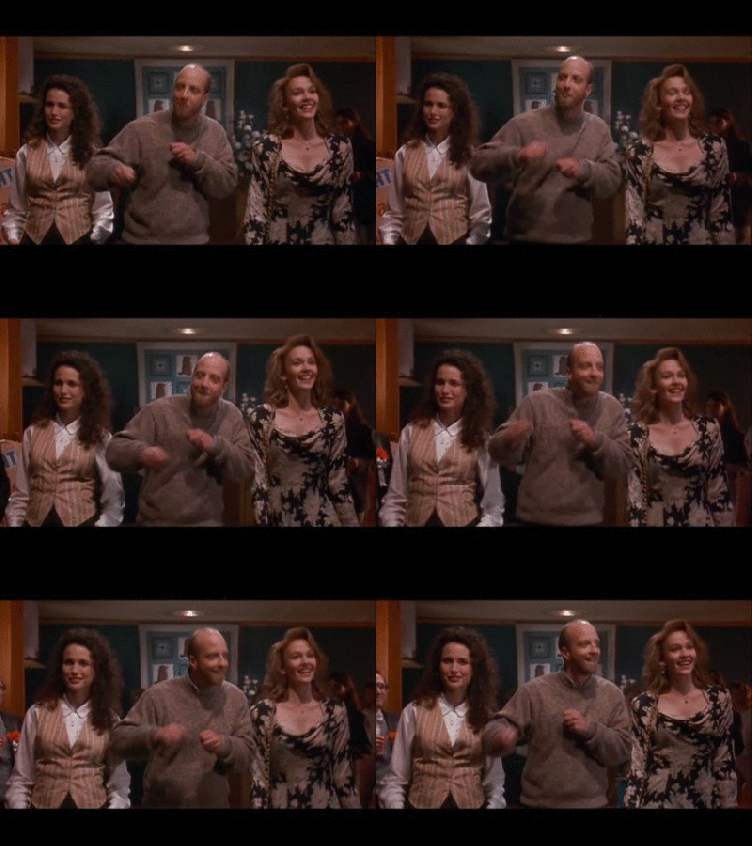
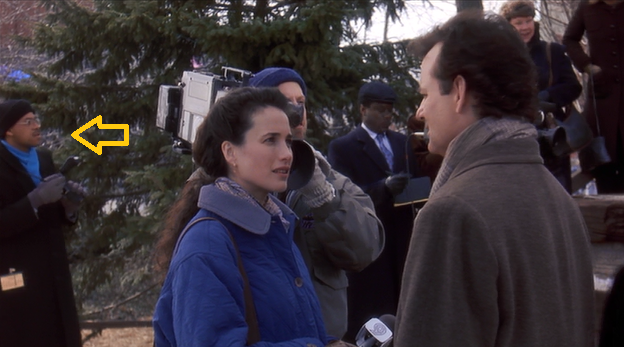
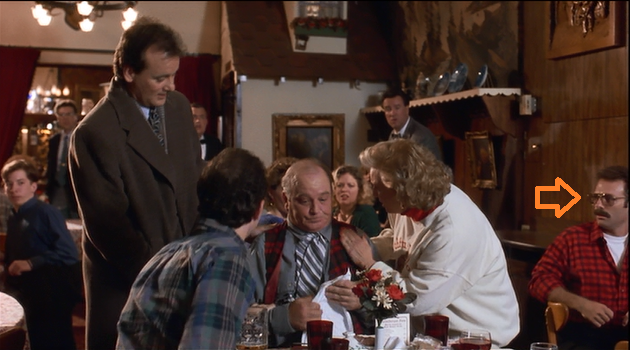
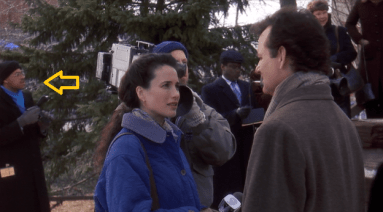
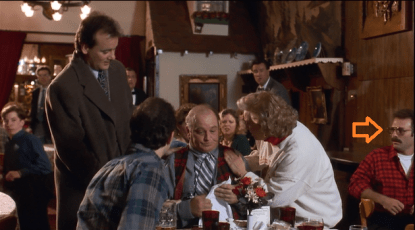
I’ve reached the point where background details are starting to stand out. Not the typical stuff, like Michael Shannon in his first film role, but like the dude in the background of the Gobbler’s Knob sequences who looks exactly like a young James Earl Jones. The amount of applause in the movie is astounding and rapidly becoming surreal. Why is there so much clapping in this movie? Is it intentional? Last but not least, there is a shocking amount of incredible “white people dancing” moments. Just everywhere.

The quantity of applause in the movie is surely the most surreal detail that came to the surface after multiple viewings. There are just a lot of crowd shots and group events in the movie, which means you rarely go a couple of scenes without some kind of applause break. The white people dancing moments never got less funny.
groundhog1
groundhoggif
There are still more editing and pacing details that are bugging me that I’ll cover on the next round, but I’m generally far less grumpy now than I was after Round 2. Let’s see how the next one goes.

“Groundhog Day” Review #4

I’ve started using sectional divisions to make the screenings go by faster. The cyclical structure of GH makes it more difficult to sit through, because the script beats are a bit unconventional, so the sectioning has been helping me pace it personally. It has always helped on long drives, and this isn’t so different from that in principle. The sections are 1) introduction 2) indulgence 3) “romance” 4) depression 5) renaissance 6) conclusion.

This sectional breakdown is about the only way I made it though 24 hours of this movie. Interestingly enough, Ramis noted that the structure was inspired by the Kubler-Ross model (Five Stages of Grief). Mine is really similar, only really differing in a few spots. The Introduction covers denial, indulgence covers anger, “romance” is bargaining, depression is the same, and then I broke the acceptance into the renaissance and conclusion.

Section 3 is when Murray is at his creepiest and MacDowell’s character’s lack of depth really shows. Consistently, this has been when the literal chorus of snores has started, every time.

Every showing, this is where the audience disappeared. Until Murray started getting slapped in the face, at least.

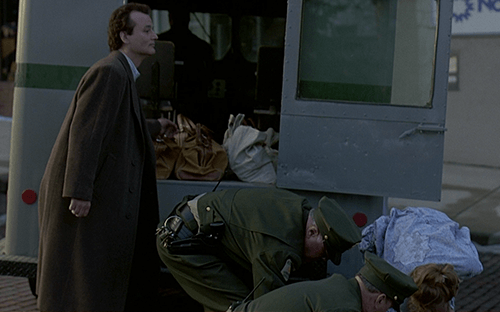
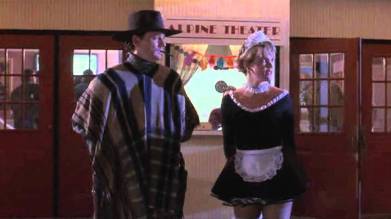
Section 2 has a specific sequence that really encapsulates the hit/miss nature of the film. Murray robs a banking truck by memorizing the habits of the guards, which shows you his crooked nature and that he is getting more meticulous and experienced with details.

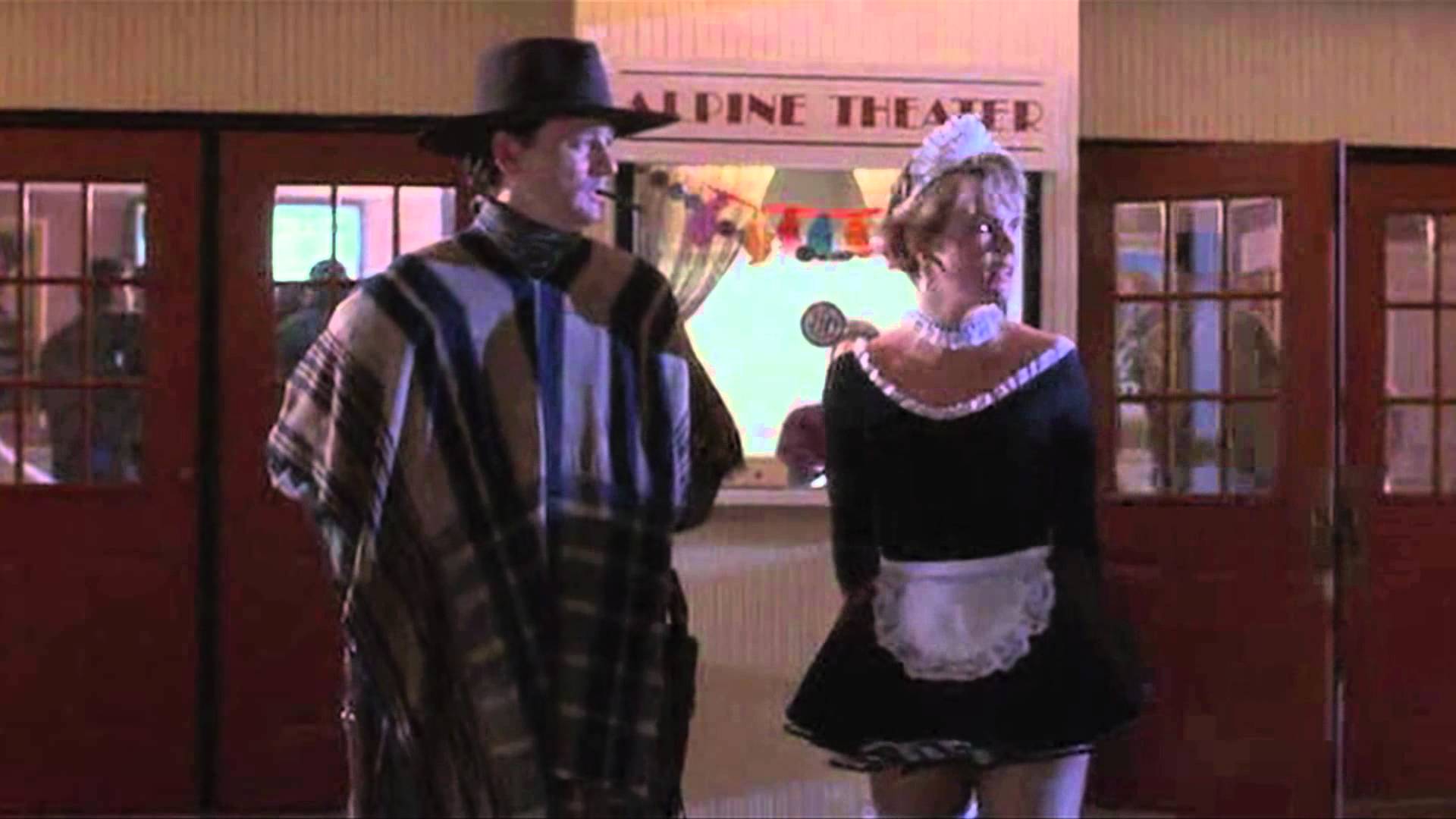
The second half of the sequence, however, serves no purpose at all. Murray is shown to have spent the money on a Benz, a prostitute, and a replica Clint Eastwood outfit. The sequence introduces a character that never returns, a location that never returns, and a number of objects that have no importance. It also establishes that characters don’t retain memories of previous days, but that is already laid out. Did Murray just really want in on “Three Amigos?” Anyway, the only attempt at a joke is an uncomfortable reference to the prostitute being underaged. Was Murray blackmailing Ramis to include his Eastwood impersonation? Why is this in the movie?

I hit the nail on the head on this one. In the DVD commentary, Ramis noted that this was entirely Murray’s idea, and that he did the Clint Eastwood impression “because he could.” We all have hits and misses, Bill Murray included. Ramis did mention that a lot of sequences were cut, so maybe this was supposed to tie in somewhere else? More importantly, how did this get through the final cut?

Anyway, more to come.
groundhog7

“Groundhog Day” Review #5

GH is, in many ways, a time travel movie. So, consequently, you have to talk about consequence! (Hurr)

GH tries to keep things simple, and evades what it can. However, there are some issues that can’t be skipped over. On day 3, Phil, in a panic, skips two conversations that he had on both previous days. This puts him at, underestimating, 30 seconds to 1 minute ahead of pace. However, that change fails to affect his subsequent encounter with Ned. That may seem petty, but I’d recommend looking at how a similar film dealt with the issue of temporal consequence: “Run Lola Run.”

In “Lola,” the beginning of her story cycle is affected differently each time it starts. The difference is only a handful of seconds each cycle, but it proves vital to the story. A few seconds is the difference between missing traffic, being impeded by it, or being nailed by a car. Looking at it from that angle, a minute being gained or lost is a lifetime.

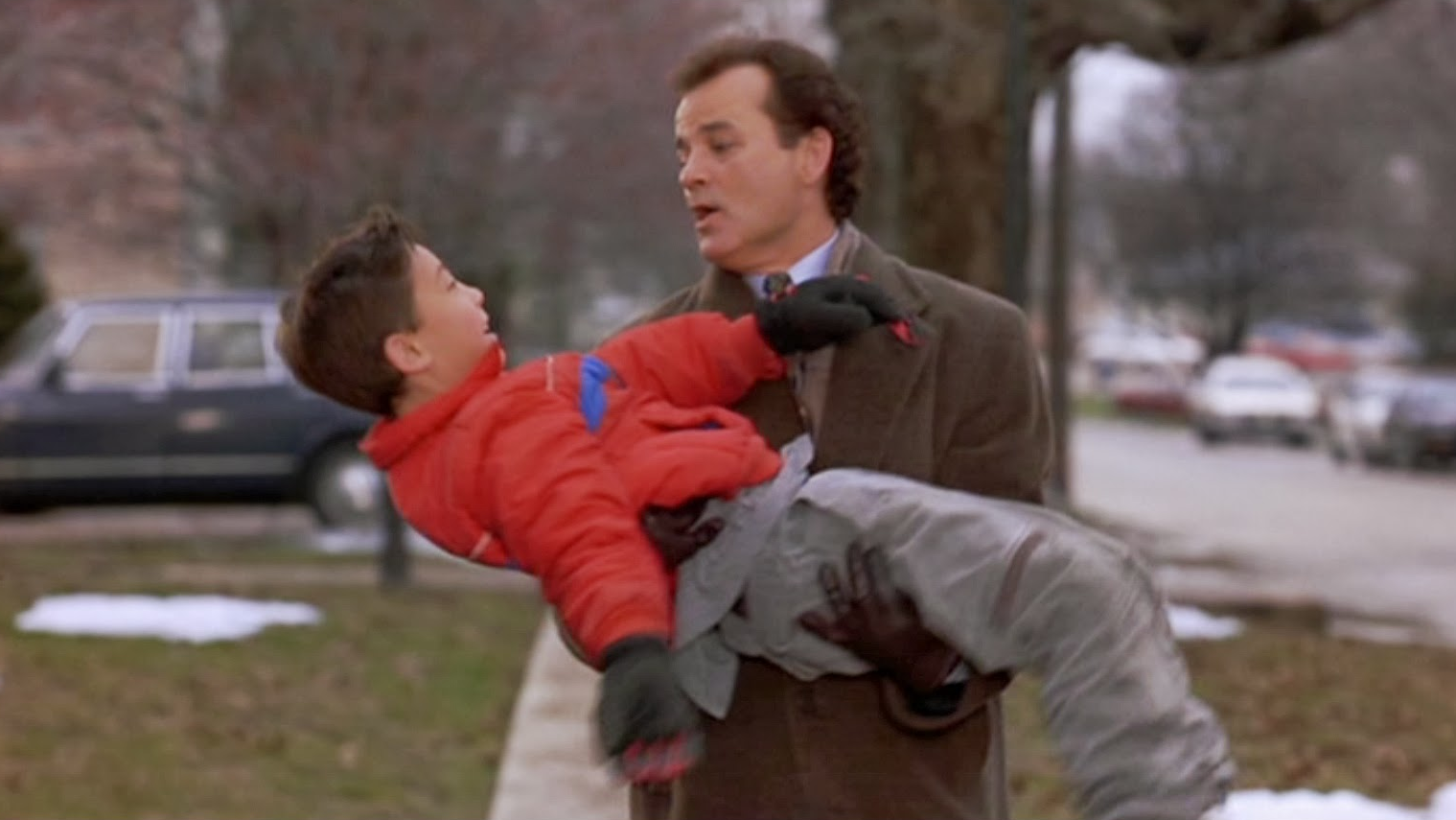
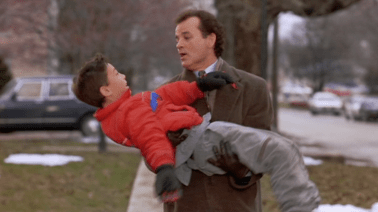
Elsewhere, the film also dodges the consequences of Phil’s inaction. The finale focuses on the positive effects he has on townsfolk, but it is never shown what the consequence of his inaction is for them. Does a child break a bone because Phil didn’t catch him? Does a man choke to death? The thing is, Phil knows: he lived through it all. But we aren’t shown any of these potentially compelling interactions. BTTF managed to thread these things in subtly, so it isn’t impossible.

I spotted one background instance of the consequence of Phil’s inaction later on, which is mentioned in a future review. But, in general, there isn’t much.

Let’s not even start in on how GH deals with the butterfly effect…I have another screening to get to.

I still don’t want to go into this. Let’s just say that the film is inconsistent on Phil’s ability to influence future events.

“Groundhog Day” Review #6

Let’s take a little Tarantino-esque turn, shall we?

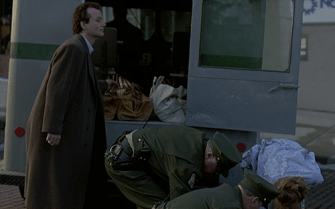
Early in the film, Phil steals a large amount of money from a bank car. He clearly researched it out, and memorized people’s patterns to execute the plan flawlessly. However, it is only shown once, when he is still exploiting his “power.”

In the second showing, I started wondering if he made the heist part of his daily routine, like the piano lessons. I initially dismissed it because it appears to be in the afternoon, and Doris, the diner waitress, is already off – duty (she is an unwitting accomplice). But still, Phil throws out a lot of money in the movie, all the way up to the finale. 1000 dollar piano lessons, multiple insurance policies on a whim, handing hundreds in cash to the homeless…is it unreasonable to think he is commiting a daily, perfect heist?

If that’s true, then Phil walks out of the movie with a literal fat stack o’ cash. Surely enough to rent a small place in a Pennsylvania town…?

Is it Marcellus’s briefcase or Mr. Pink’s diamonds? Nah, but it is fun to think about!

I mentioned this in an interview at one point in the night. I’ll be sure to post it if I ever come across it on YouTube.
groundhog4

“Groundhog Day” Review #7

Apparently, GH was intended as a curse movie according to early drafts. Even if you count that as apocryphal, there is some supernatural force at work in the story, and those are always bound by their own internal logic. The rules weren’t divulged, but that doesn’t mean that they didn’t exist!

Ramis spoke at some length about the decision to ultimately omit the background on the curse, but he did mention that one draft involved a spurned ex-lover.

So, what actually broke the GH curse? True love? I don’t think so. I would argue that he already “had the girl” before the last cycle, and that also isn’t much of a lesson (I expect a little more from Ramis). If that was all, surely it would have broken earlier. Was it learning the value of good deeds? Nope, he had clearly been through the motions on every divulged good deed in the film, and knew them by heart to the last detail. I think the real game – changer / curse – breaker was entirely internal: in the last cycle, Connors finally accepted his conditions, and was content with them. I think love and good deeds were learned and done as means to the end of Connors learning contentedness with the world around him.

Ramis mentioned that his co-writer on the script, Danny Rubin, is a bit of a Zen Buddhist, which seems to support this theory.

I think this is a sort of anti-ambition, anti-corporate message as much as it is a love story. Connors goes from being a perpetual climber with no love or need for little things or little people to being appreciative and happy with his current station and his environment. Makes sense for late 80s early 90s, yeah?

“Groundhog Day” Review #8

Finally managed to do a little research on production history, so how about some casting factoids? Before Murray got the part, Tom Hanks was considered, but it was eventually decided he was too nice in the public mindset. Kind of a shame, because he has solid comedy upside (“The ‘Burbs” = ♥). Michael Keaton turned down the role, and I can definitely picture that choice. Interesting that most of the considered leads were drama – heavy with comedy bonus, as opposed to vice versa (which Murray certainly is).

Ramis mentioned that Andie Macdowell was always the first choice for her role, and that she asked permission to use her (arguably mangled) South Carolina accent. The rest of the cast features a bunch of Second City players brought down from Chicago, as well as a couple of SNL alum (Brain Doyle-Murray, Bill’s older brother, among them).

Definitely pushing into the final stretch, and my body is starting to feel it. I think I’m the only one who has been awake the whole time…bunch a cheaters, these folks.

“Groundhog Day” Review #9

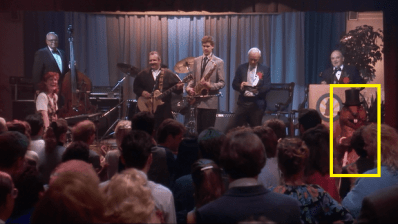
There are so many goddamn groundhogs in the background of this movie. I just noticed a six foot carved groundhog in a top hat prominently featured in the auction scene. On the 9th consecutive show. It is gigantic, and I have been looking for details. Really. They are everywhere. Dancing mascots. Wall art. Everywhere. To the point of saturation.
groundhog2

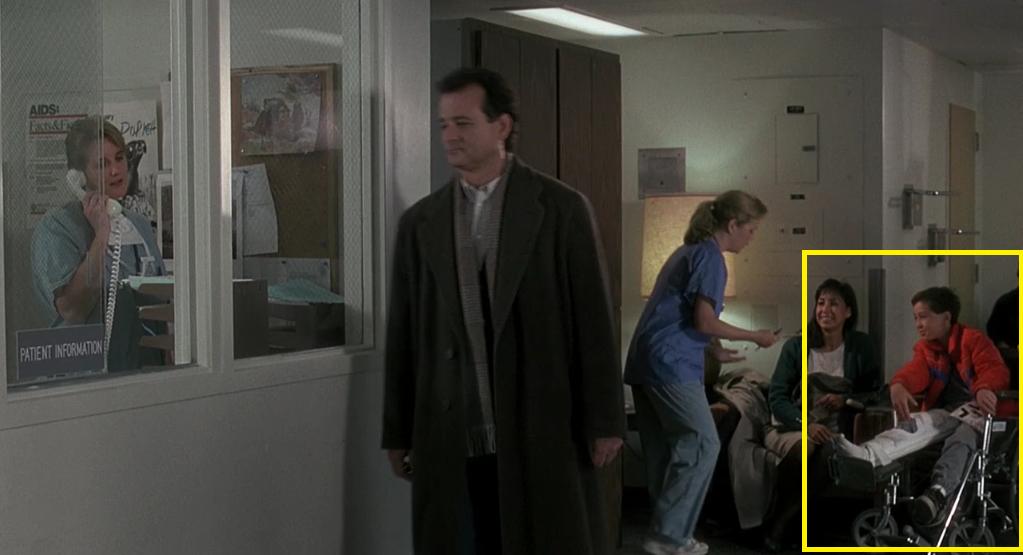
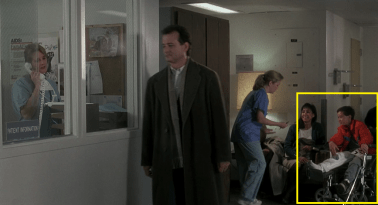
In other small details, I was pleased to find one instance of the consequence of Phil Connor’s inaction! The kid who falls out of the tree is in the background of a wide shot earlier in the film (in a hospital) with a broken leg in a cast. He is only identifiable by his distinctive red and blue striped jacket, or else there would be no way to catch it otherwise. I might have missed a few other background details, but I doubt anything else that interesting or semi-prominent.
groundhog5 groundhog6

“Groundhog Day” Review #10

One of the things that has stuck out with multiple viewings is the soundtrack / score. It has to do a lot of work, and manages to fit the variety of tones required of it. It definitely feels dated now, but it manages to do what it needs to. I particularly liked how music was used to accentuate on-screen surprise, discomfort, and confusion. I feel like a weak score could have sunk or seriously harmed a film that delicately balances its tone.

Ramis brought on Academy Award nominated composer George Fenton in to do the music, who worked on movies such as “Gandhi.” He instructed Fenton to imitate the style of Nino Rota, a renowned film score composes who worked on movies like “The Godfather.”

Speaking of which, I imagine this wasn’t the easiest film to market. I can see why so much deliberation went into casting the lead, because that had to be their biggest selling point for general audiences. Difficult to classify almost always means difficult to market. Anyway, It made a fair amount of money, particularly given it was competing in 1993, which was one hell of a deep year.

Adding to the marketing issues was the fact that “Groundhog Day” is uniquely American, meaning alternate titles had to be cooked up for foreign markets.
groundhog3

“Groundhog Day” Review #11

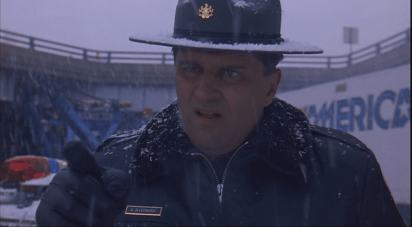
Gotta specifically call out the bit parts that I have come to love in this movie. Freddie Mercury Lumberjack? Yes. 1992 hair in the background of every scene? Of course. Highway patrolman who acts exclusively by emphatically pointing? Love em. Hilarious dancing white people everywhere, enough to explode the internet? Hoo boy.

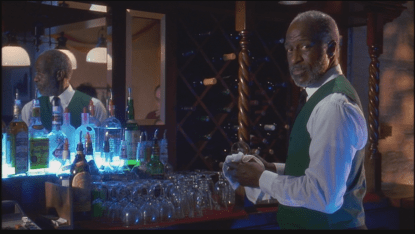
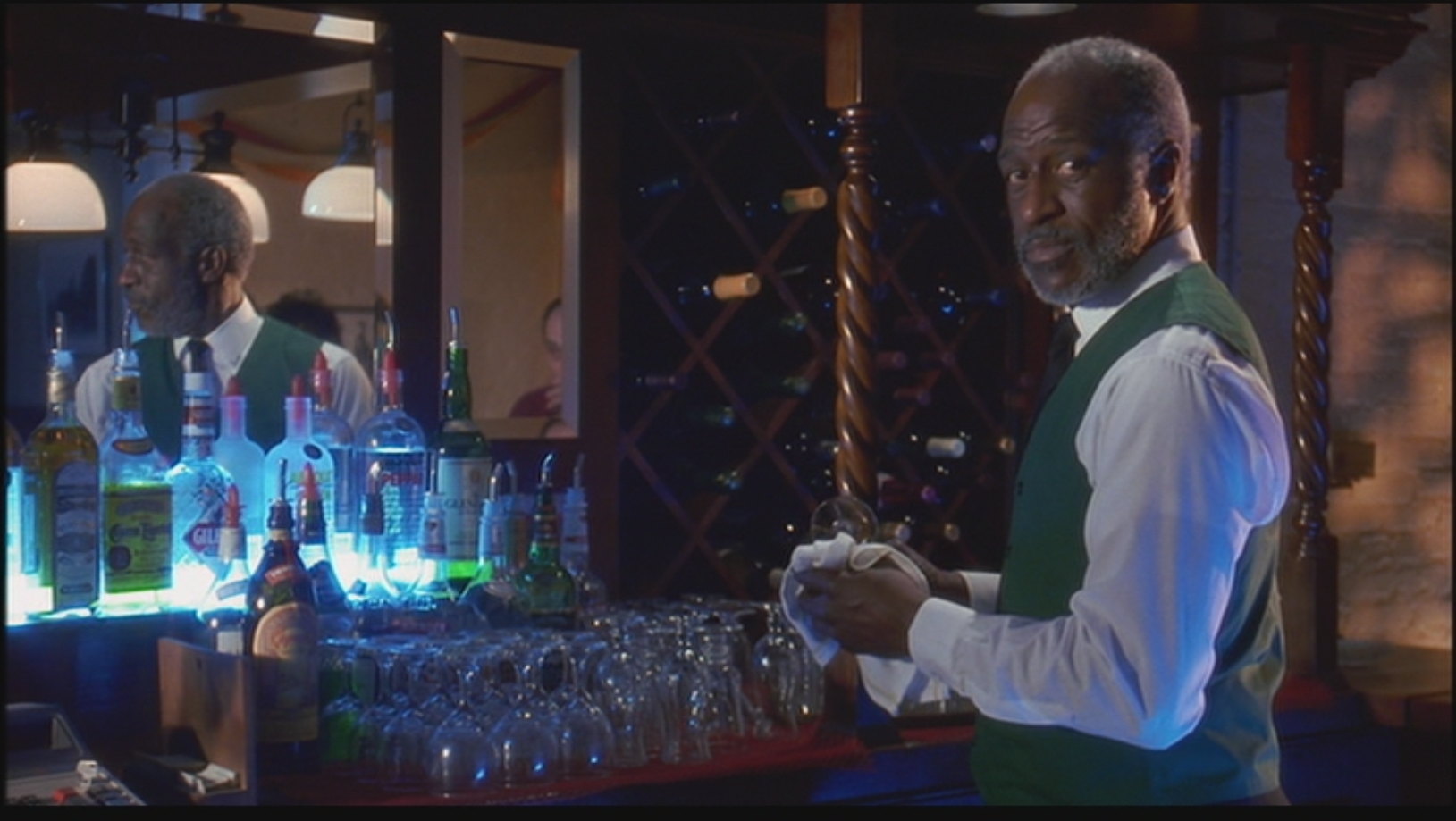
Last but not least though: the bartender who exists solely to shake his head in disapproval and clean glasses. He has maybe three lines, all a variation of “what are you having?”. His unimpressed, dismissive glass washing and head shaking, though…his performance ties the whole movie together. Astounding. Inspiring.

Can you tell that I was completely exhausted at this point? It turns out that the police officer / highway patrolman’s dialogue was completely unusable due to the amount of wind on set, so all of his dialogue is dubbed in after the fact by an entirely different actor.
groundhog1 groundhog groundhog2

Conclusion

So, I made it through the whole 24 hours. Surprisingly, I don’t hate “Groundhog Day” after all of that. Certainly there is nothing out there that is meant to be consumed in this way, but the structure of “Groundhog Day” makes it almost ideal for this kind of viewing.

A lot of details and issues popped up after so much repetition, but it stayed generally watchable the whole time. I still love Bill Murray’s improvisational sharpness and the unique concept behind the film, but the romance elements are definitely weak. I think people are very selective in what they remember about this movie: there are a lot of hits, but also a lot of misses here. The Clint Eastwood scene is very weak, the lack of thought put into the temporal consequences of actions, Andie Macdowell’s performance and writing: there are flaws scattered throughout. It is still good without any doubt, but a long shot away from great.

I have had a couple of days to sit on it, but I’m not sure if I’ll ever be able to totally look at “Groundhog Day” with a conventional critical eye after all of this. So, take it all with a grain of salt.

BibleMan vs Evil Soft Drinks

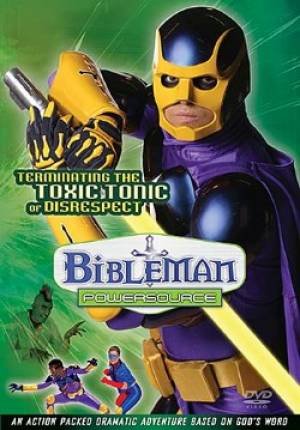
BibleMan: Terminating the Toxic Tonic of Disrespect
biblemantt1

It has been a while since I covered my favorite ol’ evangelical costumed crusader, so I figure it is about time to delve back into the cinematic cesspool that is my BibleMan DVD collection. Speaking of which, here it is:

biblemancollection

Today’s episode is entitled “Terminating the Toxic Tonic of Disrespect.” It doesn’t have the same ring as “A Light in the Darkness” or “The Six Lies of the Fibbler,” does it? In any case, this is the first BibleMan episode to feature Josh Carpenter after his initial, formal introduction as the new BibleMan in “A Fight for Faith.” This episode marks the beginning of the “PowerSource” run of the show, which is the most recent (and last?) incarnation of the character.

First off, the new BibleMan is definitely a bit of a downgrade. Robert Schlipp, who plays Josh Carpenter, is definitely just a preacher in a hero suit. To Willie Aames’s credit, his character of Miles Peterson definitely projected himself as a super-hero in the role, which is a pretty stark contrast next to Schlipp’s take on the role.

“Toxic Tonic” introduces a new sidekick in Melody, who is surely one of the worst actors in the entire universe. Bible Girl doesn’t entirely disappear, but is relegated to an off-screen support role for the episode. Cypher, BibleMan’s resident Black Friend(TM), also returns for the new series, and continues his role as the only half-bearable member of the team.

biblemantt5
The PowerSource Bible Team (Melody on the far right)

The introduction of Melody offers the only actually good lesson that I have seen in the entire series: BibleMan and Cypher at first assume that she is a delivery girl when she shows up at the base, and initially dismiss her as a moron despite her expertise with technology. Of course, in typical BibleMan form, they never acknowledge the obvious sexism of their assumptions, and only ultimately apologize for not respecting her as one in “God’s image.” So close, BibleMan. So close.

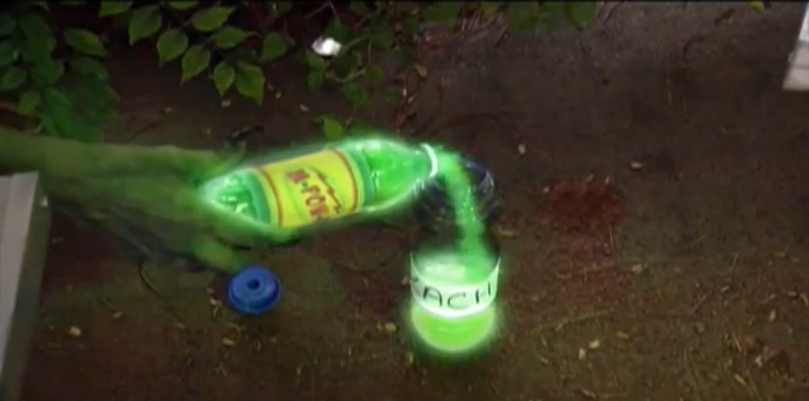
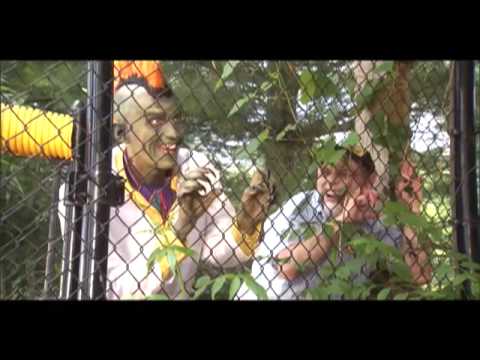
The villains, in a bit of a separation, aren’t the offensive stereotypes I typically expect of the series. Instead, the antagonistic duo is comprised of run-of-the-mill zany mad scientists: the neon-mohawked Dr. E. Meritus Snortinskoff (yeah, good job on that one) and his henchman named Stench. The two sinister scientists are executing a plan to make a bunch of kids indignant and rebellious by selling them “Empower” energy drinks made from sugar, water, and “pure evil.” The Bible team realize what is happening after noticing a bunch of burgeoning teenagers acting shitty to authority figures. You know what, BibleMan? Never change.

biblemantt3

The Bible Team ultimately wind up getting a sample of the “Empower” energy drink, and discover its contents (pure evil, bad attitudes, and probably a lot of high fructose corn syrup I assume?). This leads to a rambling, scripture-laced train of thought that could rival the revelation scene from “Black Dynamite.” Somehow, through rambling about trees for a while, the team figures out where to find the evil scientists.

Maybe my favorite aspect of this episode is that a good few minutes of run-time towards the beginning are eaten up through the use of what appears to be totally unnecessary recycled footage from the episode “Crushing the Conspiracy of the Cheater,” which, confusingly, wasn’t released until two years after “Toxic Tonic.” This brings up some serious questions of continuity in the series, but I am not going to dare delving into that.

biblemantt4Predictably, the Bible Team wins the day through grace, goodness, and the violent use of laser swords. The bad guys do get away this time (instead of dying horribly), but I don’t believe that either of them show back up later in the series.

biblemantt2This isn’t one of my favorite episodes, and certainly doesn’t compare to the “BibleMan vs The Internet” entry. However, it definitely has the same old heavy-handedness that all of the incarnations have. The episode of course ends with a prayer, and a plea for all of the viewers to convert to Christianity. As far as entertainment goes, I do kind of love how shitty the kids are who imbibe the “toxic tonic,” and how generally panicked the creators are about the idea of teenage rebellion. There is definitely something to enjoy here, but it isn’t one of the stronger good-bad entries in the show. That might have a little to do with the change of creative team with the dawn of the “Powersource” series, but I’ll need to watch more of them to see if there is a significant perceptible difference between the incarnations.

The Ladykillers

The Coen brothers, Joel and Ethan, are two of the most acclaimed filmmakers working today, and are almost certainly the most lauded currently active film-making duo. Their filmography is rife with cult classics and best picture nominees alike, and at times it seems that everything that they touch turns to gold. However, that was not always the case.

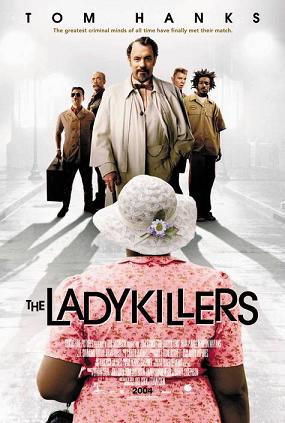
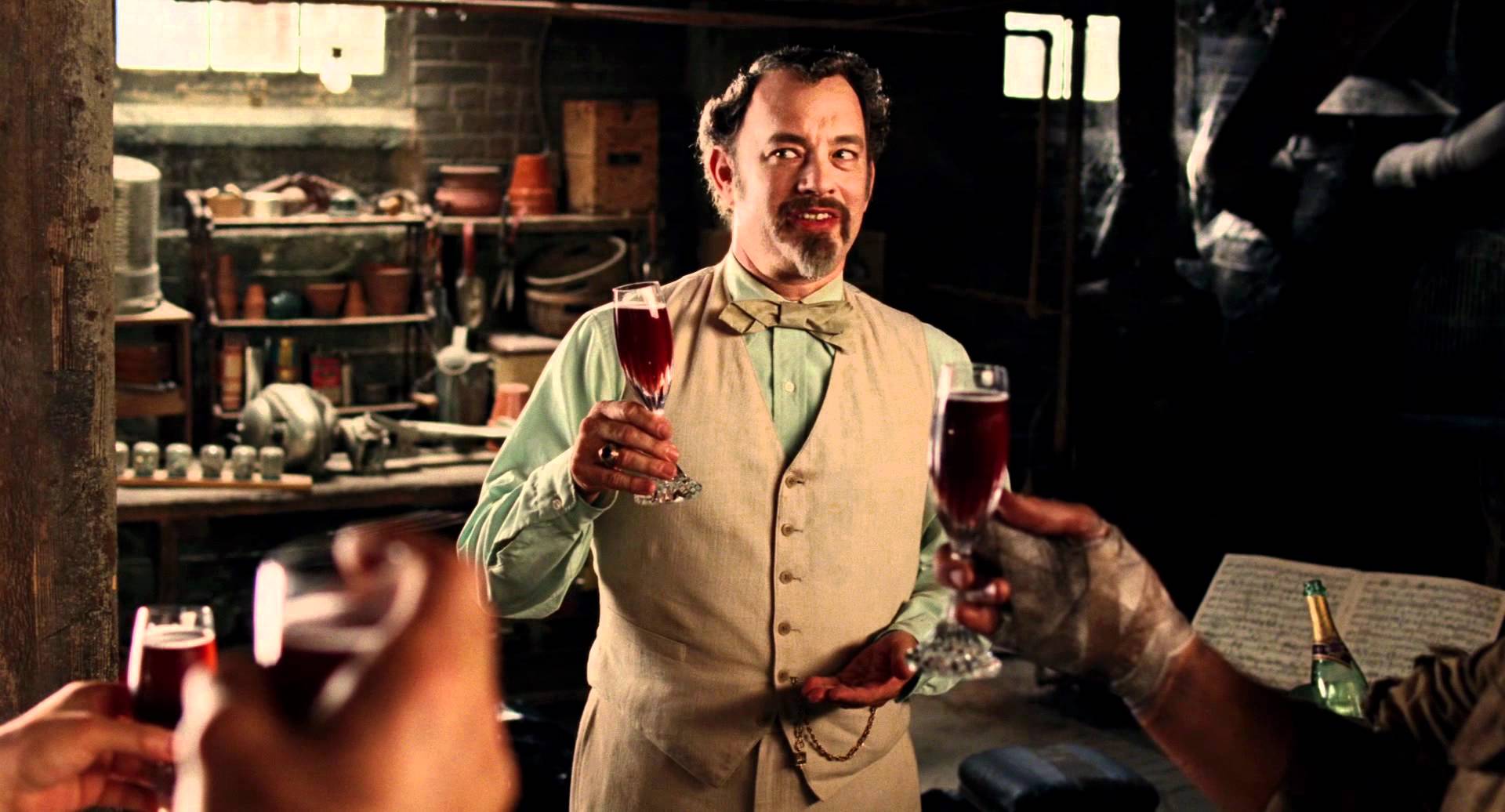
In 2004, the Coen’s released a quasi-remake of the Peter Sellers / Alec Guinness movie “The Ladykillers,” starring one of the most acclaimed contemporary actors in Tom Hanks. The match seemed destined for glory, with Hanks coming off of acclaimed roles in “Catch Me If You Can” and “Road to Perdition,” and the Coens having just released a series of acclaimed films (“O Brother, Where Art Thou?,” “Intolerable Cruelty,” “The Man Who Wasn’t There”). Even T-Bone Burnett, who produced the highly acclaimed music for “O Brother Where Art Thou?” and “The Big Lebowski,” was attached to work on the soundtrack.  Every aspect of the film seemed crafted with winning in mind. “The Ladykillers,” however, was not received well.

ladykillers1Despite being nominated for the Palme d’Or at Cannes and Irma P. Hall receiving wide acclaim for her role in the film, “The Ladykillers” was widely panned, and is often considered to be the weakest of the Coen brothers’ works. The film has an underwhelming 55% critic score on Rotten Tomatoes, and an even lower audience score at 43%. The IMDb users have the film at a slightly higher 6.2, which is still far from a fantastic score for the Coens.

This is one of those films where I think the context of the movie is absolutely essential to understanding the critical response to it. For instance, most of the criticisms of “The Ladykillers” that you will find pulled together on Rotten Tomatoes fall into one of three categories:

1. The Coens can do better than this / Why isn’t this another “Fargo?”

‘Frankly, this doesn’t have that Coen magic.’

‘When the Coen brothers are capable of making brilliant stuff like Fargo, should they really be spending their time making pictures like The Ladykillers?’

‘There’s a hint of the usual Coen genius here…but only a hint.’

‘If you set your expectations low enough there are real laughs to be had, but coming to the Coens with low expectations somehow just feels wrong.’

2. The characters are too quirky and unbelievable

‘…a series of hoops the characters must jump through to prove just how strange they are.’

‘A lukewarm live-action Loony Tunes cartoon’

3. It isn’t as good as the original “The Ladykillers”

‘The Coen Brothers try their hand at remaking one of the best of the 1950s Alec Guinness comedies. A version that has little to offer anyone who has seen the original.’

‘Uninvolving and tedious rendition of the 1955 British classic, film is too slow at the gate with longwinded speeches bogging down the momentum.’

‘Such a slight effort compared to the original Ladykillers and past Coen works.’

Just looking at 1 and 3, you can start to see why people were so hard on “The Ladykillers.” Not only is the film a remake of a beloved classic that could not possibly be lived up to, but people had very high expectations of the Coens. Although “Intolerable Cruelty” received generally better reviews “The Ladykillers,” it also faced the perhaps unrealistic criticism by many of being “too normal” or “not Coen enough.” I personally think that the timing of “The Ladykillers,” following only a year after “Intolerable Cruelty,” likely suffered from being the second of two consecutive a-typical Coen brothers movies. Critics that tolerated “Cruelty” as an experiment by the Coens weren’t going to forgive another film that didn’t fit the preordained Coen mold, which I think is a real injustice for the film.

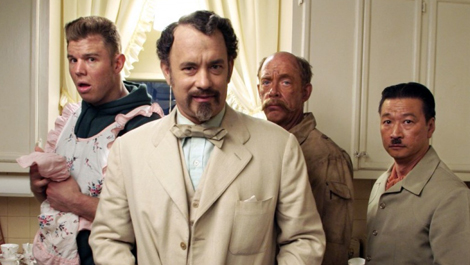
ladykillers2Looking at “The Ladykillers” on its own merits, it is definitely a strange, dark comedy with highly exaggerated characters. The criticism that the characters are too unrealistic and quirky isn’t exactly wrong, but I think that they all fit the generally off-kilter ambiance of the film perfectly. In any case, I don’t think that the way the characters behave or interact is an error on the part of the Coens: I think that “The Ladykillers” is exactly the movie that they intended to make. It may not be in accordance with the tastes of general audiences, but since when has that ever stopped the Coens from making whatever movie they felt like making?

“The Ladykillers” may very well be the weakest of the Coen brothers filmography, but I would say that it is far from being a bad film overall. The negative critical reception at the time was, in my opinion, unfair. I believe that both the acclaim of the Coens, the popularity of the source material, and the fatigue of the critics after the “a-Coen-esque” “Intolerable Cruelty” set this movie up to fail from the start, as the Coen’s vision of the film was never in accordance with what audiences and critics wanted or expected from them. One of my favorite negative criticisms of “The Ladykillers” listed on Rotten Tomatoes unintentionally illuminates this point:

“Increasingly, the Coens seem more intent on amusing themselves than the audience.”

Y’know what? There is nothing at all wrong with that. I think that same attitude has produced a number of more recent Coen movies, such as “Burn After Reading” and “A Simple Man.” Particularly, “A Simple Man” is not a film that ever had a chance at a wide draw, but they made it anyway. If the Coens started making movies just to amuse an audience, then they wouldn’t have the integrity and acclaim that they have today as artists in the film world. At the time of “The Ladykillers,” I don’t think audiences or critics were ready for the free-wheeling Coens that we have now. Hell, there were a good number of critics that greatly disliked “The Big Lebowski” at the time, and that film looks damn near mainstream compared with the sort of movies they have put out since then.

ladykillers3On the flip side, the negative reaction to “The Ladykillers” almost certainly directly led to one massive positive: “No Country For Old Men.” Functioning as the opposite end of the pendulum swing to “The Ladykillers,” the Coen’s follow-up was exactly the dark, brooding spectacle that people were craving from them, and the brothers reaped their rewards for it. Perhaps the Coens would have done “No Country” regardless of how “The Ladykillers” was received, but I’m willing to bet that having “The Ladykillers” blow up in their face gave them a little more incentive to give the people what they wanted, for better or worse.

The Langoliers

The Langoliers
langoliers3

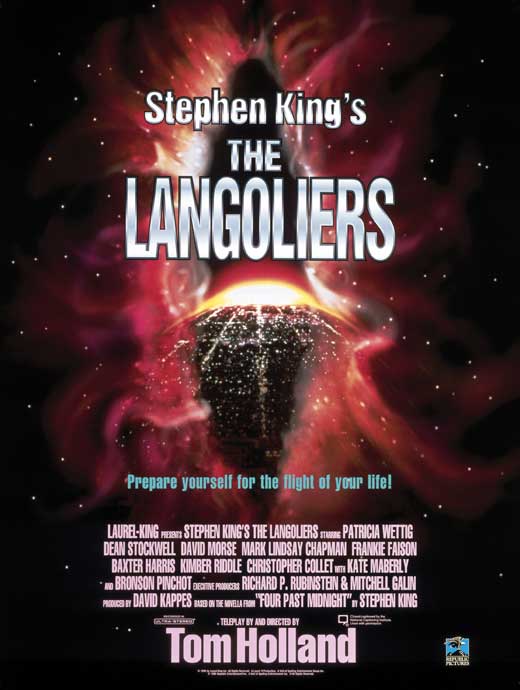
“The Langoliers” is a 1995 ABC miniseries adapted from a Stephen King novella of the same name (it came from the same collection that later produced the Johnny Depp movie “Secret Window”).  I think most people have forgotten about it (for good reason, I might add), but I definitely remember watching this on TV when I was a kid. Specifically, I remember the hilariously terrible eponymous ‘langoliers,’ that look something like evil mollusks crossed with a chainsaw.

langoliers1Apart from the langoliers themselves, the series is chock full of other crappy CG effects, and they have all aged about as well as an open bowl of shrimp. For instance, the plot involves a rift in space-time, which an airplane accidentally flies through. Here’s what that looks like:

langoliers2Not so great, huh? For even more CG fun, here is the climax of the film set to “Guile’s Theme” from “Street Fighter.” Just look at those giant Pac-Man raisins go!

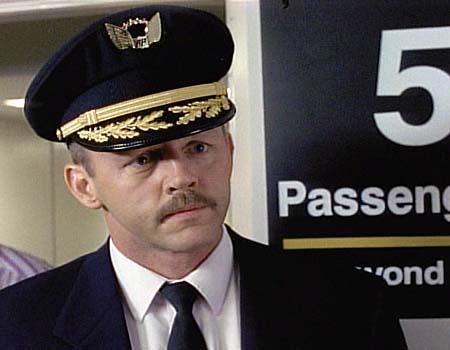
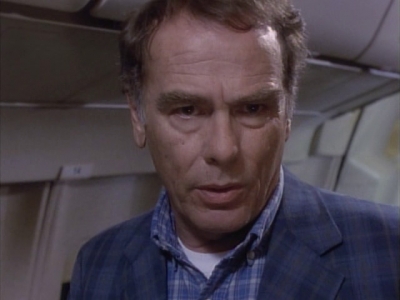
Aside from the awful CG throughout, the next most memorable aspect of the series are the performances. There are a handful of decent actors featured, such as Dean Stockwell and David Morse, but they all wind up looking pretty abysmal in this thing. Stockwell in particular winds up playing a heavy-handed Sherlock Holmes analogue, which is surprisingly one of the less distractingly awful performances in “The Langoliers.” Morse, who I guess is supposed to be the lead, plays one of the most generic characters I have ever seen on screen. Conveniently for the story though, he also happens to be a pilot! Of course, if he were anything else, everyone would have just died before the end of the first act, and the movie/series wouldn’t be 3 hours long.

langoliers7langoliers6Chewing the scenery with arguably more gusto than the langoliers themselves is Bronson Pinchot, who plays the increasingly unhinged character of Craig Toomy: a stock broker of some sort who is in the midst of a breakdown as the story begins. His performance is, to say the least, memorable.  Here’s a clip of Toomey hallucinating an argument with his father. Honestly, it is on the level of “amazingly awful”:

On the other end of the acting spectrum is Kate Maberly, who plays a young blind girl with inexplicable psychic powers named Dinah. Her performance is, in a word, bad. You can check out a little bit of it in the trailer, though it hardly scratches the surface of how terrible her line reads are:

Rounding out the cast are a few more notables: Frankie Faison, who would later play Commissioner Ervin Burrell in “The Wire”, Patricia Wettig, who has does extensive acting work on television, and Mark Lindsay Chapman, who most would probably only recognize as the Chief Officer from “Titanic.” While Wettig gets her fair share of ridiculous lines in the third act (“Are we the new people?!?”), Chapman definitely steals the show for most of the movie. Essentially, Chapman plays a grittier version of James Bond: a rough around the edges assassin and hit man with some sort of connection to the British government. As with Stockwell’s Holmes-ian character and Morse’s pilot, it is ridiculously handy to the story that a super-agent with field training winds up in the crew of survivors, particularly once Toomey finally snaps.

langoliers5
I mean, he looks so harmless though?

The entire reason I went back to watch “The Langoliers” in the first place was because I noticed a handful of similarities while watching the recent Nicolas Cage “Left Behind” film. Particularly, both stories involve people inexplicably disappearing from aircraft, leaving personal possessions behind. Here is a clip from the earlier Kirk Cameron adaptation, which I think shows a lot of the similarities:

It turns out that the first “Left Behind” novel came out in 1995, 5 years after King published “The Langoliers,” and the same year that “The Langoliers” miniseries aired on ABC. It turns out that I’m not the only one to notice the similarity: you’ll find comments all over the internet pointing out the parallels. I’m sure it is only a coincidence, but it sure is a fun one: that makes 3 awful movies with almost the exact same premise!

The director and screen-writer of “The Langoliers” is Tom Holland, who is almost certainly best known for writing and directing “Fright Night” and “Child’s Play.” However, he has pretty much fallen off the map in recent years. I imagine this has a little bit to do with his abysmal follow-up to “The Langoliers”: another Stephen King adaptation called “Thinner.” I recently watched that as well, and it makes “The Langoliers” look like “Touch of Evil.”

Due to the mixed bag of underacting, overacting, and hilariously bad CG effects, I think there is a lot of entertainment value to be had from “The Langoliers.” I particularly enjoyed the handful of instances where the actors have to stare out of plane windows and react to the langoliers, which they obviously can’t see. That’s just the sort of thing that can set me a-giggling.

The series / movie (the DVD cut just sort of merges them) is definitely too long at 3 hours, but I didn’t think it was impossible to sit through. All the same, I think a super-cut of the highlights gets the entertainment across without wasting a significant portion of your day. The Nostalgia Critic pulls together a good number of clips for his review of the series, so I can recommend checking that out for anyone curious:


The Brothers Grimm

Clerk’s Pick

Clerk:
Hannah, Video Central (Columbus, OH)

videoc

Movie:
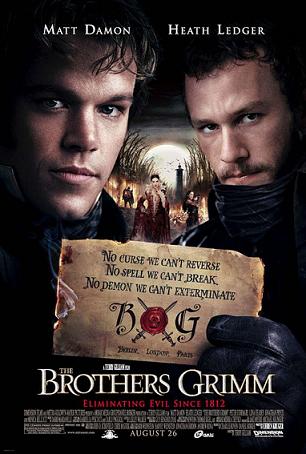
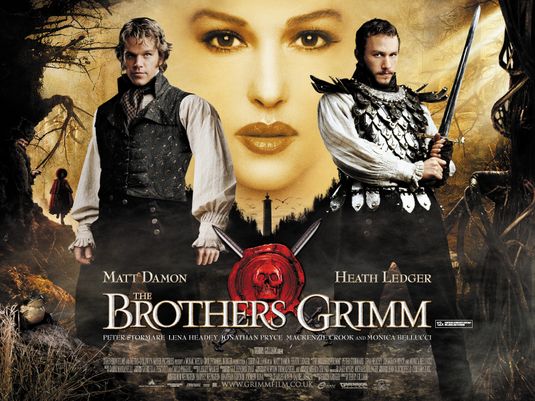
The Brothers Grimm
grimm2

Pitch:
“It almost has a USA series sort of concept. They are the brothers Grimm, but they are con artists. I love the little references to the Grimm tales, and it is just a generally fun movie. Also, it is beautiful, being a Terry Gilliam movie. Critics really didn’t care for it, but I think it is pretty fun, and I enjoyed it when I watched it again recently.”

Background:

“The Brothers Grimm” seems like a winning combination from the start: the Grimm tales are some of the most beloved, dark fairy tales of all time, and here they are put into the hands of one of the most visionary and imaginative directors out there in Terry Gilliam, who specifically specializes in the bleak and strange (“12 Monkeys,” “Brazil”).

grimm1The writer of “Brothers Grimm” is credited as Ehren Kruger, who is probably best known for his involvement in writing a number of the “Transformers” films. He has a number of other credits to his name that predate “Grimm,” such as the Ben Affleck flick “Reindeer Games” and the much-maligned third “Scream” movie. His only particularly well-liked work seems to be “The Ring,” for which he wrote the adapted English screenplay. Interestingly, the writing credit on “Grimm” was the subject of much controversy: Terry Gilliam and Tony Grisoni (“Fear and Loathing in Las Vegas”) apparently extensively re-wrote Kruger’s script, but were denied writing credits by the Writers Guild of America.

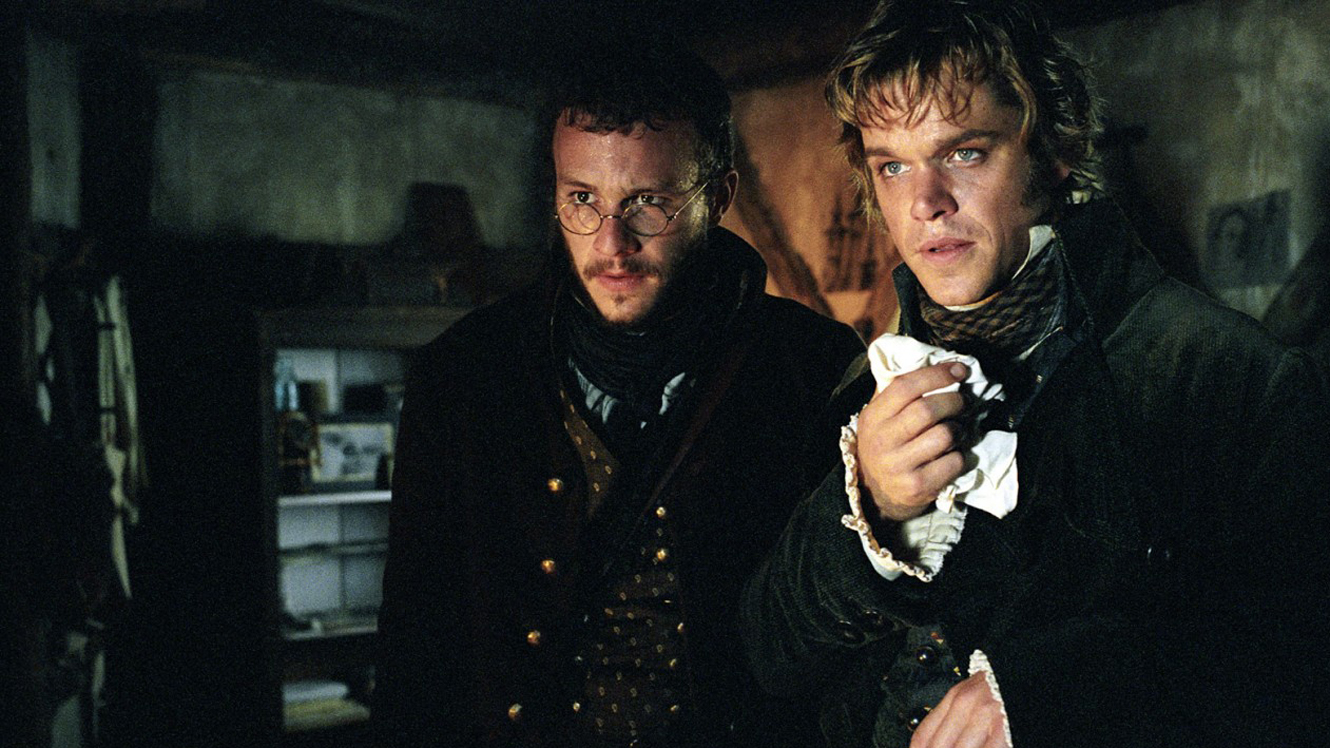
The cast of “Grimm” features the late Heath Ledger and Matt Damon as the eponymous Brothers. Outside of them, the cast features Gilliam favorite Jonathan Pryce (“Brazil”), the now-acclaimed Lena Headey (“Game of Thrones”), Peter Stormare (“Fargo”), Monica Bellucci (“Irreversible”), Mackenzie Crook (“Pirates of the Caribbean”), and character actor Roger Ashton-Griffiths. Interestingly enough, Headey, Pryce, Crook, and Ashton-Griffiths have all appeared in recent seasons of “Game of Thrones” in an assortment of roles.

grimm3Interestingly, it is reported that Gilliam wanted Johnny Depp for Damon’s role, but Bob Weinstein dissented, claiming that Depp was not commercial enough. Of course, Depp’s “Pirates of the Caribbean” released during the production (2003), changing his status overnight. Stormare’s role was apparently given to Robin Williams initially, but he dropped out before filming.

grimm6Among the producing credits on “The Brothers Grimm” are the notorious Weinstein brothers, Harvey and Bob. This movie released just as the brothers were fleeing Disney (and their original company of Mirimax) in 2005, for the greener pastures of their new incarnation, The Weinstein Company. Technically, “Grimm” released under Bob Weinstein’s Dimension Films label (in cooperation with MGM and Summit due to the budget), though it could be considered one of the first productions of The Weinstein Company.

Unsurprisingly, the Weinsteins clashed significantly with Gilliam over the course of the film’s production. In a 2009 interview, Gilliam had some choice words about the brothers and the ultimate product that is “The Brothers Grimm”:

“…they’re interesting producers, but they are people who are good at those jobs and not at directing movies. And yet they want to be filmmakers. They interfered more than I’ve ever been interfered with before.”

“it’s not the film they wanted and it’s not quite the film I wanted. It’s the film that is a result of two people, or two groups of people, who aren’t working well together.”
As Hannah mentioned, “The Brothers Grimm” was not well-received on release. It currently holds a critic score of 38% and an audience score of 39% on Rotten Tomatoes, a rare case of agreement between the two barometers. However, the IMDb user score is notably higher at a 5.9, which may indicate that the movie has been looked back on more fondly in recent years (though not dramatically). It did manage to make some money on a high budget of an estimated $88 million, but not much. It is really something when a movie can break $100 million total in ticket sales and not make an impressive gross.

Review:

The best aspect of “The Brothers Grimm” is almost unarguably the effects. They are a little dated a decade down the line (the werewolf transformations, particularly), but not excessively so. Visually, the film is really solid all around, with an interesting mix of CG and practical effects. There is also some masterful use of lighting (particularly in a couple of the Mirror Queen sequences), which is to be expected from Terry Gilliam.

You can tell that there are the makings of a good Gilliam movie here, but that it just couldn’t come to fruition. I’m sure Gilliam would blame the Weinsteins’ constrictions for that, but I think that Gilliam’s vision was just too big for the realistic budget: the film almost didn’t get released at all due to the skyrocketing budget of the flick. Of course, the writing wasn’t exactly stellar either, which didn’t give the movie much of a foundation to work with.

The script is pretty shoddy on the dialogue front, to the point that the actors can’t really salvage it. They are still pretty charming and do what they can with the material, but it just isn’t very good. The constant nods to the Grimm Fairy Tales are to be expected, but they come a little too often and a little too blatantly for my taste. It isn’t as bad as “League of Extraordinary Gentlemen” or “Van Helsing” by a longshot though, which some have (I think unfairly) drawn parallels to. Probably worst of all though is the fact that the plot just isn’t very interesting or engaging. I loved the initial concept, but the plot’s inane complexities really took me out of it by the third act. I just couldn’t stay invested in the labyrinthine details as the story progressed.
grimm5There is another pretty big problem with this film, and I think it is one that significantly impacted the behind the scenes tensions: this movie is just too long for what it is. I know that one of the fighting points between the Weinsteins and Gilliam was over  the director’s right to final cut (final say on the editing of the movie), and I’m willing to bet the Weinsteins wanted him to tighten it up against his wishes. And you know what? They were right in this case. One of Gilliam’s greatest weaknesses is pacing, and a number of his more recent movies have been criticized for this problem. I don’t think it is as bad here as it has been in some other films of his, but the 2 hours of run-time here feels as long as a Peter Jackson Tolkien adaptation, and it isn’t nearly entertaining enough to justify it.

Recommendation:

Unless you are a die hard fan of the Grimm Fairy Tales, or are a Terry Gilliam completest, I think “The Brothers Grimm” is pretty skippable. It has some good moments, and I don’t think it is as bad as the critics treated it on release, but I found it to be a mediocre film overall. Gilliam is capable of a whole lot better, and it is hard to divorce the ultimate product of this movie from the incredible potential it had.

Groundhog Day Marathon

groundhog

I recently found out that the good folks over at Columbus, OH’s Gateway Film Center do an annual 24 hour marathon of “Groundhog Day” ahead of that most marmot-friendly of holidays. As an incentive to take on the challenge, they offer free movie tickets for a year to anyone daring enough to sit through 12 consecutive showings of the Bill Murray classic.

gateway2

So, of course, I’m going to be giving it a shot. This Sunday, I’m going to be holed up in the Gateway Film Center for just over 24 hours with a bunch of other film nuts, and I’m going to make it all the way through this meta-Sisyphean experience. Laptops are unfortunately banned from the theater, or else I would definitely liveblog it. In any case, we will get 15 minutes between screening, so I’ll be sure to take notes on all of the little details in the movie that are sure to surface after repeated viewings, as well as on my general mental state following each viewing. Here’s to making it through to the other side!

Be sure to check back next week to see how the marathon went, and if I managed to prove my cinematic endurance.

Hesher

Clerk’s Pick

Clerk:
Max, Video Central (Columbus, OH)
videoc

Movie:
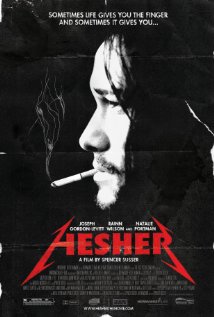
Hesher
hesher1

Pitch:
“It is like ‘Metalocalypse’ meets ‘Mary Poppins.’ It is probably my favorite Joseph Gordon-Levitt role: he plays a stoner asshole, but he manages to help the other characters get over the loss of their wife/mother.”

Background:

Spencer Susser, co-writer, editor, and director of “Hesher,” doesn’t have a whole lot of credits to his name to delve into. For the most part, he has only created a handful of short films over the years since 1999, perhaps most notably the mockumentary “R2-D2: Beneath the Dome.” “Hesher” remains his only full-length feature, and his only notable work recently is directing a 2014 episode of the Netflix series “Hemlock Grove.”

The writing team behind “Hesher,” outside of Susser, consists of writer/director David Michod (who has gained acclaim for his recent films “Animal Kingdom” and “The Rover”) and a guy named Brian Charles Frank, who at the time had no other credits. However, Frank more recently wrote a television show called “Wolfpack of Reseda” for Fox Digital Studios, but doesn’t appear to have anything else in the pipeline.

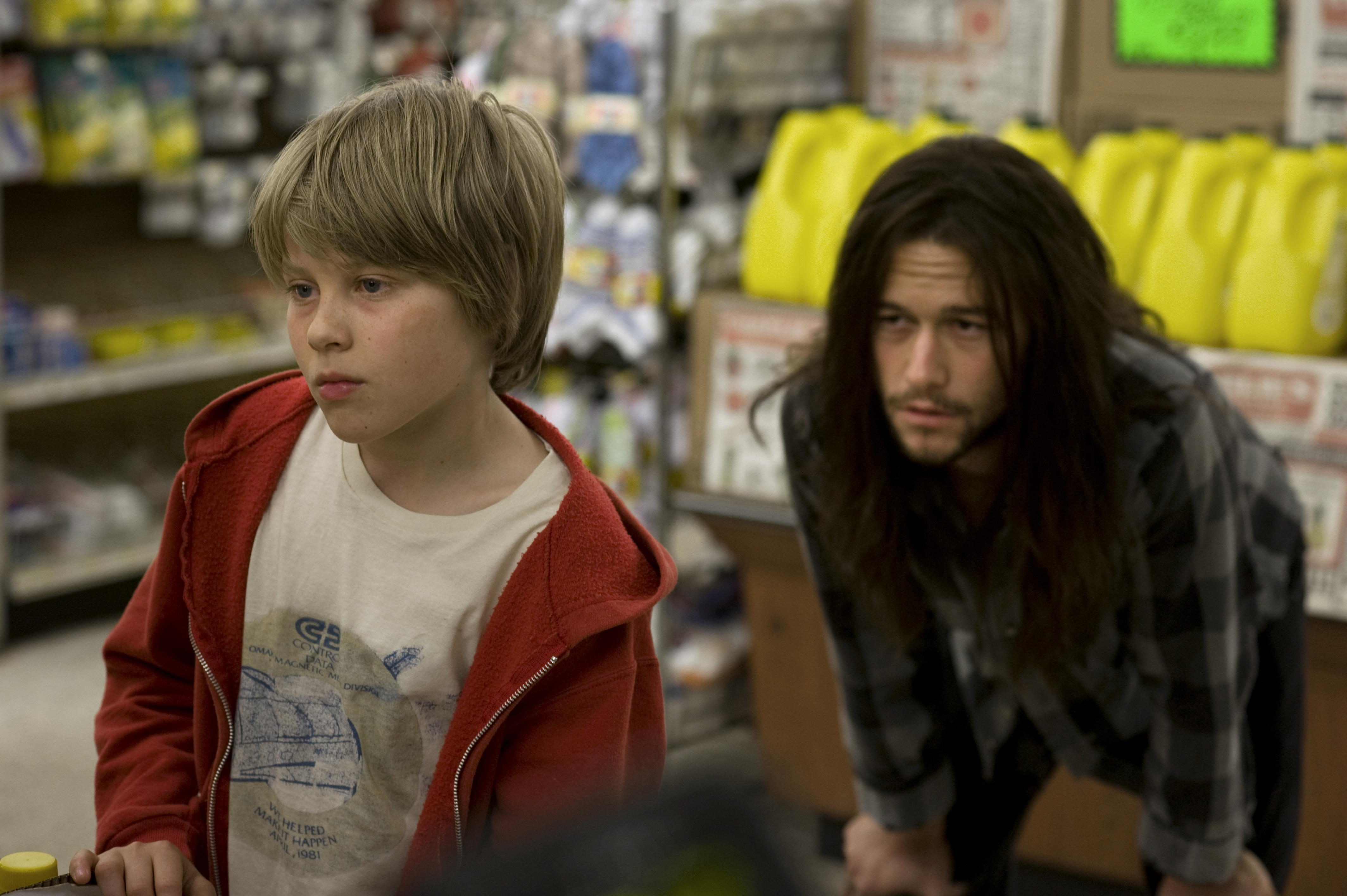
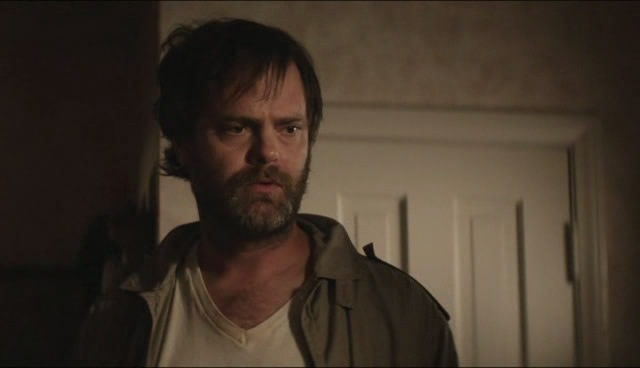
The cast of “Hesher” not only includes Joseph Gordon-Levitt in the title role, but also a handful of Hollywood regulars, including Rainn Wilson and Natalie Portman. The movie technically centers on a child character, meaning that there is a lot of pressure put on the lead child actor in Devin Brochu, who has been in movies like “Rubber” and “In the Valley of Elah.” The rest of the cast includes the much-lauded Piper Laurie (“Carrie,” “Twin Peaks,” “The Hustler”), character actor John Carroll Lynch, and another child actor in Brendan Hill.

hesher5

Although “Hesher” was nominated for the Grand Jury Prize at the 2010 Sundance Film Festival, it didn’t get much love from critics in general. It has a Rotten Tomatoes score of 54%, with an average rating of 5.7.  Audiences seem to appreciate the film a bit more, as it holds an IMDb rating of 7.1 and a Rotten Tomatoes audience score of 61%.  Still, those aren’t exactly stellar numbers.

The character of Hesher is reportedly based on Metallica bassist Cliff Burton: a long-haired, hard-partying musician who was killed in a bus crash in 1986. Appropriately, the soundtrack of “Hesher” includes a number of Metallica tracks that feature Burton.

Review:

Much like another movie I recently reviewed, “House of Yes,” “Hesher” is fairly dependent on one character. Unsurprisingly, that character is Joseph Gordon-Levitt’s title role of “Hesher.” Almost everything that happens in the film is somehow catalyzed by Hesher, or is done in reaction to him. However, he is interestingly not the main character: he is just a roving force of destruction that creates the plot in his wake. It probably goes without saying, but JGL is thoroughly impressive in the role.

The actual lead of the film is portrayed by Devin Brochu, whose character is a young child trying to deal with the recent death of his mother and family’s financial hardships (not to mention an obnoxious school bully). For a child performance, it is beyond impressive. It is always a gamble to put a kid in the dramatic center of a serious movie, but in this case it certainly paid off. I hope Brochu sticks around in film, I’m looking forward to seeing him in more things in the future.

hesher3

Brochu’s father is played by Rainn Wilson, who is maybe the most under-appreciated dark comedy actor out there today. Though he is best known for his role from the American adaptation of “The Office,” Wilson has been brilliant in movies like James Gunn’s “Super,” and has just recently started a leading role in the dark comedy cop show “Backstrom.” In “Hesher,” his character is a straight foil for JGL, but the intensity and sorrow that Wilson brings to the role is incredibly humanizing for a character that could easily have been dull and forgettable.

hesher4

In general, this is a film that is powered by performances. The only real weak spot I noted was Natalie Portman, who doesn’t really have a whole lot to do in the movie: her character doesn’t get the same kind of screen time or opportunities as most of the others, making her more or less just a distant satellite in the story.

Spencer Susser earned a commendation for “Best First Time Director” at the Philadelphia Film Festival for “Hesher,” and I think it is definitely well-merited. The way the film is shot plays a solid role in how the drama plays out, and a number of moments are particularly impressive at building tension. I also really like how the film is lit: the only time anything is brightly lit or colored is during a flashback sequence, which not only makes it stand out, but also emphasizes the dark ambiance of the movie in general. It is subtle enough that you don’t particularly notice it, which basically means it is done well.

I can recommend this one pretty heartily. The performances and direction are really solid, and I definitely don’t see eye-to-eye with the critical detractors on this one. A number of the complaints I saw cited issues with the narrative flow and with the general vulgarity of the movie, and more specifically with the lack of likeability in the character of Hesher. While the plot is slow, I don’t see  how the vulgarity or unlikeability of Hesher is a weakness to the film: it is kind of essential to it. “Hesher” is a quirky indie movie to be sure, and it is definitely rough around the edges, but there is enough good going on in this movie to forgive some of the indie stereotypes it holds to. It is by no means a great movie, but it is definitely in the realm of “good.”


Paper Man

Clerk’s Pick

Clerk:
Max, Video Central (Columbus, OH)
videoc

Movie:
Paper Man
paper1

Pitch:
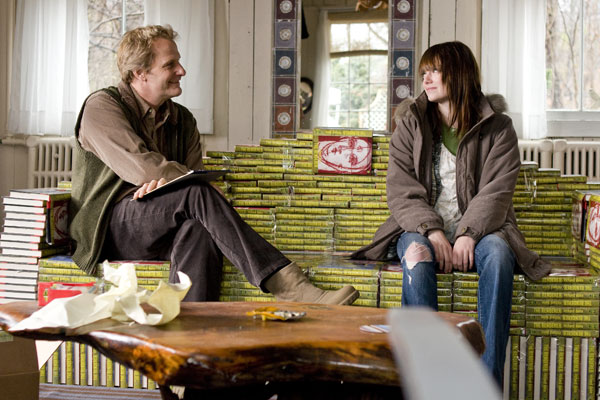
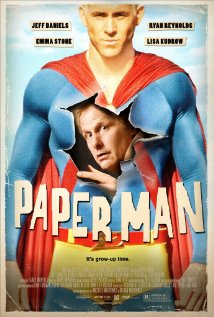
“It is a coming of age story, where Ryan Reynolds plays Jeff Daniels’s imaginary friend from childhood, who is still sticking around as an adult. I wind up recommending it to a lot of people who like Emma Stone, as this was one of her first really big roles.”

Background:

“Paper Man” is the creation of a co-writer, co-director team of spouses Kieran and Michele Mulroney. This is the only film that either of them has directed, and their writing credits are also pretty limited: Guy Ritchie’s 2011 “Sherlock Holmes: A Game of Shadows” is the only other major feature attributed to them. However, Kieran has a good number of bit acting roles here and there.  Notably, he is also the brother of the more prolific actor, Dermot Mulroney (“Zodiac,” “August: Osage County”).

paper2“Paper Man” features an interesting cast, including Jeff Daniels (still a couple of years off from his resurgence on “The Newsroom”) and Ryan Reynolds, who was coming off of his role as Wade Wilson in the high budget action flick “X-Men Origins: Wolverine” (a character he is set to reprise in 2016’s “Deadpool”). As Max mentioned, it also features Emma Stone before she really hit the map. Probably my favorite surprise in the cast, however, is Kieran Culkin, who is well known for his roles in “Igby Goes Down” and “Scott Pilgrim vs. The World,” but doesn’t do a whole lot of acting. He also featured in the first two “Home Alone” movies with his brother Macaulay, not that he is particularly recognizable from those.

“Paper Man” was not well relieved by critics or audiences at the time: the film currently holds a 31% score on Rotten Tomatoes, with an average score of 4.7 from critics and 3.2 from audiences. However, for whatever reason, it has a much higher score with the IMDb users, where it currently has a 6.7.

The crew of “Paper Man” includes editor Sam Seig, who has worked on films such as “Minority Report,” “Munich,” and “Catch Me If You Can,” and cinematographer Eigil Bryld, who has worked on the film “In Bruges” and the acclaimed American adaptation of “House of Cards.”

Review:

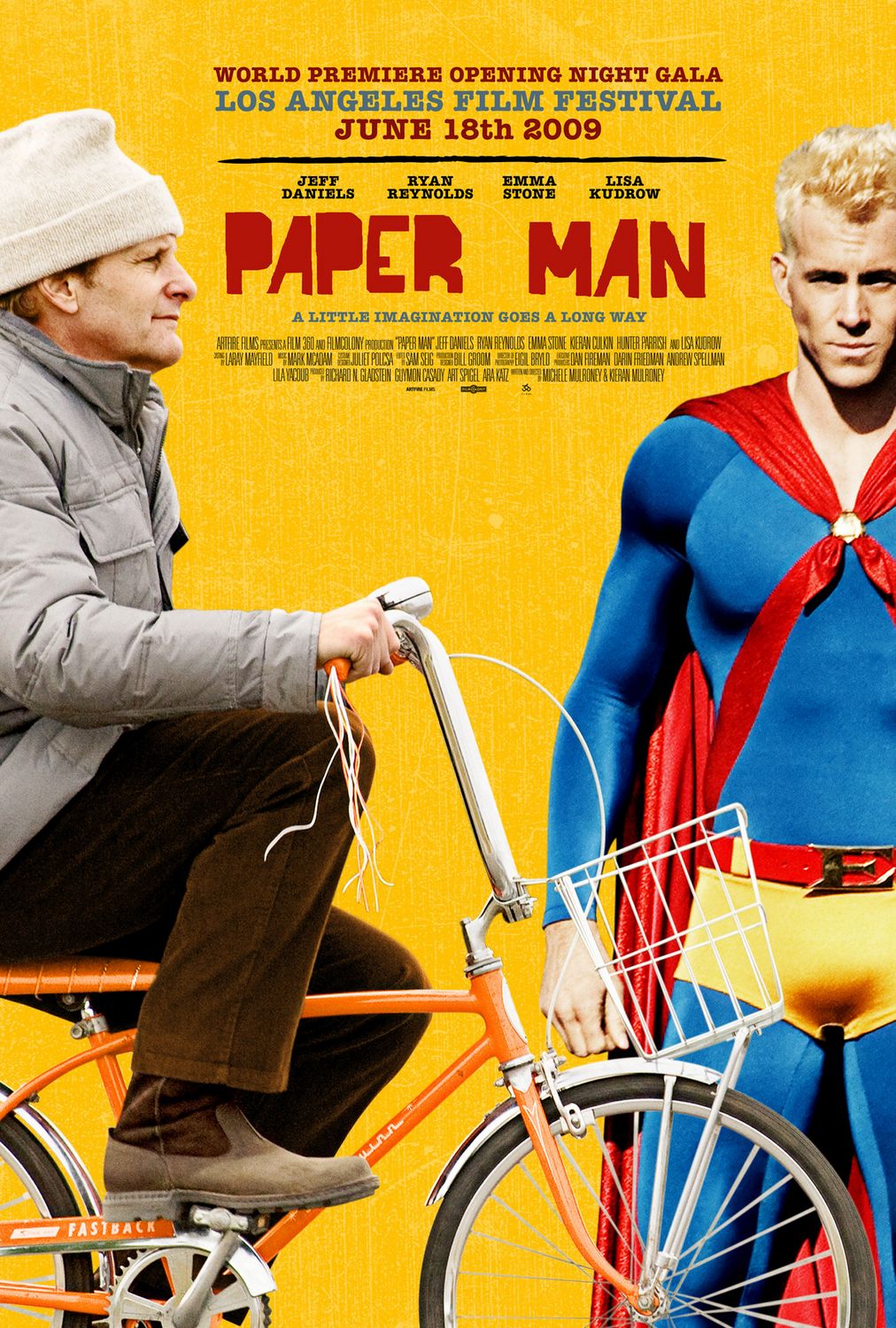
I’ve always liked Ryan Reynolds’s comedic roles, even though he hasn’t necessarily picked them well. In “Paper Man,” he is really the comedic force: Jeff Daniels isn’t absent, but he mostly reacts to other characters, and awkwardly stumbles around the film. Reynolds is a great sort of interior monologue / hallucination for Daniels’s character, and definitely illustrates his self-loathing through the dialogue. Without Reynolds’s comedic timing and superhero good looks, the movie probably wouldn’t work so well.

paper3On another front, Emma Stone really proves herself as a dramatic actor in “Paper Man,” and I can see what she started getting better roles after this. Her character has a lot of dramatic weight to haul around in the film, and she definitely makes it work.

paper5
The film has a really interesting premise (a writer with an imaginary friend), but it doesn’t quite work here. A number of the characters are just quirky enough to be beyond belief, but not enough to be outlandishly entertaining on their own. Also, Daniels and Culkin often just come off as…creepy. These are both actors I like, but something about the way they are written is at times off-putting and uncomfortable, and I definitely don’t feel any sort of connection to them (which I assume was intended). Culkin’s character and behavior starts to make a lot more sense as the movie goes on, at least. Again, Reynolds is great comedically and Stone is fantastic dramatically, but the rest of the world around them just isn’t quite up to par. The film also seems to drag on longer than it particularly needs to, but that might just be because there isn’t a whole lot interesting going on (particularly whenever there is an extended on-screen absence of Ryan Reynolds). However, when either Daniels/Reynolds or Daniels/Stone are on screen together, everything clicks into place fantastically either dramatically or comedically, depending on the combo. It is kind of a shame that the rest of the film fails to live up to their respective chemistry.

paper4When it comes down to it, this is a film I can certainly recommend to people who are fond of quirky indie comedies. It isn’t great, but if that is your cup of tea, it is probably worth a watch. Outside of that, I can recommend this to people who are either curious to see a more obscure Emma Stone role, or to anyone who is just dying to see Ryan Reynolds in spandex outside of “Deadpool” or “Green Lantern.” I wish it held together better, but the product as it exists isn’t bad. I think critics were mostly just over-saturated on quirky indie comedies at the time, and were perhaps a bit too harsh on it as a result.

Escape From Hell

Escape From Hell
hell3

It is about time I got back to (God)Awful Movies, the segment of the blog dedicated to the worst of religious cinema.

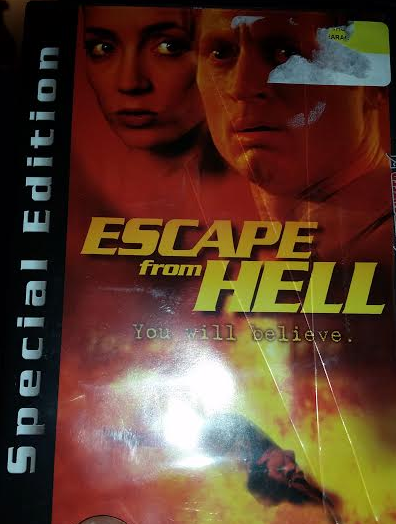
Today’s feature, “Escape From Hell,” is one that I have come across a couple of times in bargain bins in the deep south. I’m not sure how far it actually got distributed, but I’ve certainly never seen it outside of Alabama or Georgia. Here’s what my copy looks like:

hell1

I’m sure glad to know that I got the special edition! Hopefully that means there is some CGI Jabba the Hutt to enjoy.

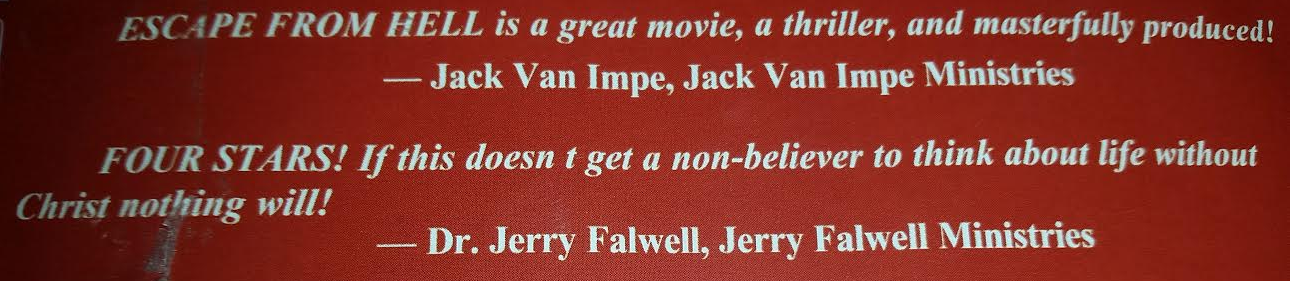
The reason that I initially picked this up, apart from the title and the cover art, is because of the amazing blurbs on the back of this box. Here are a couple of them, including two from noted film critics Jerry Falwell and televangelist Jack Van Impe:

hell2

Well, I’m sold. I can’t wait to see if this film makes me think about my “life without Christ.”

Out of curiosity, I decided to dig around to see if there is a trailer out there for this thing. I ultimately dug one up, but, to my joy, I found something even better as well: a clip collection, courtesy of the fantastic folks over at Everything is Terrible!

Now I am definitely psyched. Here is the trailer I dug up as well, in case you happen to be curious:

Director Danny Carrales and writer Michael Martin have apparently worked together on a number of Christian features outside of “Escape to Hell,” including films called “The Gathering” and “Second Glance.” Star Daniel Kruse pops up in “The Gathering,” as well as another movie that Carrales and Martin worked on called “Pilgrim’s Promise.” One of the other actors in “Escape to Hell,” Terry Jernigan, has managed to appear in an assortment of bit film roles over the years, but my favorite credit of his is on an upcoming movie called “Sasquatch vs. Yeti.” You can bet that I am looking that one up.

I think that the biggest red flag for me when sifting through the IMDb entry far “Escape to Hell” was finding someone credited as “2D/3D animation and effects / special effects supervisor.” That can’t spell out anything good for this movie. Also, the person with that credit has nothing else current listed to their name outside of another Carrales/Martin feature (“Pilgrim’s Progress”).

My next favorite credit on this movie is one of the producers, Randy Smith, who is apparently a professional boom operator who has worked on an assortment of actually good movies (“12 Monkeys,” “Fear & Loathing in Las Vegas,” “Phone Booth”) and occasionally not-so-good movies (“Thinner,” “The Langoliers”).

Now, let’s see how this thing is. Will it scare me into the arms of Jesus? Will I be forced to reassess all my sinful life choices? Will I be able to even stay awake through this whole thing? Let’s find out!

Review:

Wow, this is really awful. I’m not really sure where to start.

The cinematography is awful in nearly every way you can imagine. Some of the shots are nothing short of nauseating for no reason whatsoever (just people walking down a hallway, for instance). There are so many dutch angles that you will question if your head is even on straight. When the camera is being used half-sensibly, everything feels like an infomercial, or a soap opera at best. Unfortunately, even those moments are few and far between.

The acting is about what you would expect: most of them seem like they are reading directly off of the scripts. In the few cases where that isn’t the case, they either hilariously overact, or sound like they are giving half-rate sermons. Of course, a lot of that blame deserves to be leveled at the writing as well, which is more heavy-handed than a steel gauntlet.

It turns out that my nervousness about that “2D/3D animation and effects / special effects supervisor” was more than justified. There is way more reliance on special effects than there should be in this flick, and they look really bad. I’m pretty sure that they didn’t look good when they were done originally in 2000, and they certainly don’t look good 15 years down the line. I’d bet that they could have pulled off better practical effects with the money they spent on the CG here, and wound up with something way more convincing (the few moments that do involve practical effects in this movie do look passable). That at least would have looked like something realistic, whereas the CG here just looks downright laughable. Moments where characters are cast into hell are supposed to be intimidating and terrifying, but instead they are profoundly hilarious.

Overall, this isn’t a movie worth spending the time to sit through. For the most part, it is just boring dialogue between characters you just can’t give a damn about. I would recommend checking out the “Everything is Terrible” highlights (which has all of the best parts included), and just leaving it alone from there. This isn’t a film that is going to change your life, and it certainly isn’t going to send anyone running to Jesus who wasn’t on his team already.