“Track of the Moon Beast” is yet another forgettable entry in the IMDb Bottom 100. Like a good number of the films featured on MST3k, this is one that feels like background noise. There are a few memorable moments, but definitely not many. I haven’t had as much trouble recounting a movie since “Zombie Nightmare”, and I think that one is a good deal more entertaining than “Track of the Moon Beast”.
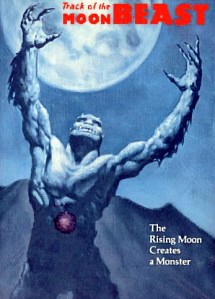
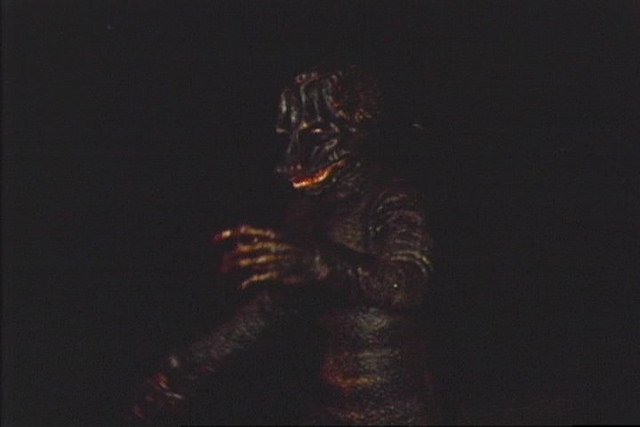
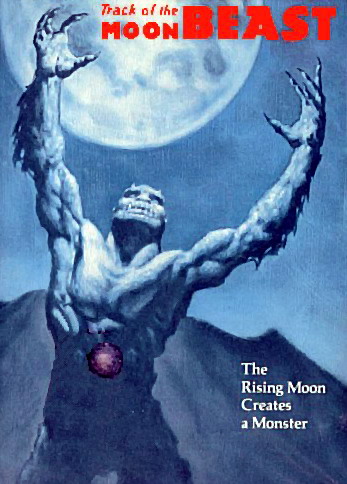
One thing I can give this movie credit for is some kick-ass box art. That muscle-bound blue alien creature stretching its claws towards the moon is pretty bad-ass. Unfortunately, the monster in the movie actually looks like this:
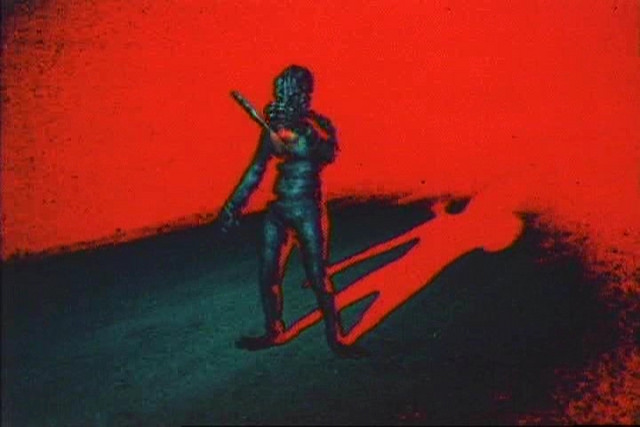
Not very impressive. And yes, the creature is shrouded in darkness almost the entire movie, probably an attempt to hide how crappy it looks. The only exception I can recall is the excessively colorful death scene, in which you still can’t make out much in the way of details:
So, bad effects are definitely an issue that hampers this movie. I will say that the transformation effects aren’t too bad, especially in comparison with something like “Laserblast”, where they just painted the actor’s face green. There is even some alternate box art featuring the transformation makeup that doesn’t look too bad.
some more box art that is way too good for this movie
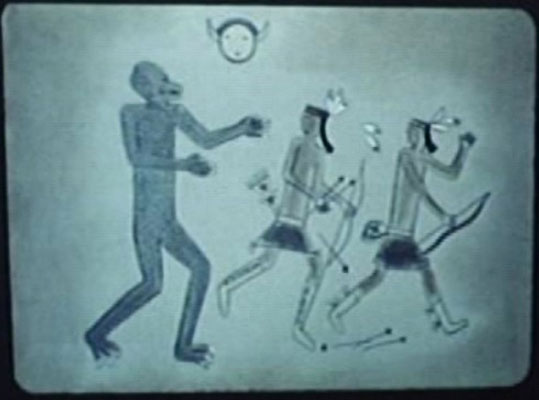
However, there are a lot of issues with this movie beyond the mediocre effects work. For instance, the plot is just a wee bit ridiculous. The main character becomes the “moon beast” because a tiny meteorite lodges into his brain without him noticing. Weirdly enough, it is later stated that there is a local, native legend about an identical creature existing in the past. So, the story implies that more than one person in the history of this town has had an evil moon rock lodged into their skull that transformed the victim into a were-alien. Honestly, it sounds like they had two origins written down, and couldn’t make up their mind between the two of them.
This monster looks better than the one that made it on screen
All of that said, you can make a good movie with a ridiculous plot. In fact, I like where they take the plot as it moves on. Unlike most werewolf features, doctors discover his ailment and try to fix it, and don’t hold him accountable for his crimes. Unfortunately, they ultimately can’t help him, and the main character decides to run away and attempt suicide so his moon beast form can’t hurt anyone else. He is eventually stopped from carrying out this plot, after which he to transform into the moon beast and is shot. The ending is kind of a bummer, really.
Honestly, there is some promise in this movie, but there’s not enough talent behind the film on any level to make it work. With better writing, better effects, better acting, and someone with a better eye for shooting in charge, this could have been a fun little sci-fi story. As it is, “Track of the Moon Beast” is a really boring movie to sit through, and it isn’t one I can recommend. I do, however, recommend the box art. That is, again, very bad-ass.
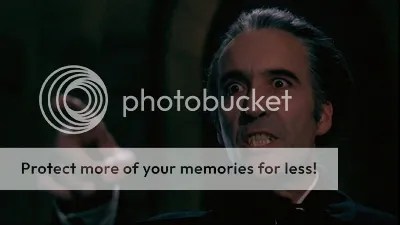
Cushing/Lee ’72 is a ticket that would have gotten my vote.
A couple of days ago, I decided to dive into my immense backlog of DVDs to find some blog fodder. I was planning to watch through some Hammer films to compare with Tim Burton’s “Sleepy Hollow”, based on an interesting theory I came across on “The Nostalgia Critic” last week.
That “Sleepy Hollow” theory is something I may get into at another time. In any case, I pulled a couple of Christopher Lee / Peter Cushing combos out of my collection, and popped them in for an evening of British horror. I honestly assumed from the casts that both would be Hammer films, which I don’t think was an outlandish assumption for a film from that time period. Interestingly enough, only one of them was Hammer, but both films came from the good ol’ year of 1972. Also, they were both thoroughly delightful. So, here they are!
First up is a delightful international flick called “Horror Express.” A couple of months ago, this was recommended to me based on some of the outrageously ridiculous science in the film, so I decided to pick it up when I spotted it in the bargain bin. What they didn’t mention is that the film is an absolute blast, and the cheesy pseudo-science in the plot is just icing on the cake.
There is a mad monk, a snarky Soviet commander who takes over the train (played by Terry Savalas, who is awesome), pale-eyed zombies, a possessed defrosted neanderthal, and an alien adversary that kills people by staring at them with glowing red eyes. It is a delightful time, and the whole thing is hanging out on YouTube.
Nearly the whole movie takes place on the Trans-Siberian Express, which gives the movie an interesting claustrophobic vibe (one of many things that reminded me of “The Thing” in this movie). Cushing and Lee play rival anthropologists who coincidentally wind up on the same train, but they learn to cooperate fast when things turn bad. Lee’s character has discovered a corpse he believes to be the “missing link” in the history of human evolution, and tries to hide his cargo for the first section of the film. Of course, things go wrong when the ancient corpse wakes up and starts killing people. It winds up being dispatched pretty quickly, at which point Lee and Cushing poke at its eyeballs a bit during an autopsy. After looking at images of dinosaurs and space in the creature’s eyeball fluid under a microscope, they come to the brilliant conclusion that the missing link was possessed by a parasitic alien, and that the parasite has found a new host on the train. Spooky!
The rest of the movie involves some great alien possessions, care bear stare deaths, a train explosion, and some generally delightful practical make up effects. Here are a few stills:
I can’t recommend “Horror Express” highly enough. It dances along the line of being a good-bad movie and being just a good movie, but it is a train-load of fun either way. It might actually be my favorite Cushing / Lee movie, though there are a lot of good ones out there. Including the next flick…
“Dracula AD 1972” is one of the later Hammer films Dracula movies, and probably the most ridiculous of the bunch. It starts with the supposed final battle between Cushing’s Van Helsing and Lee’s Dracula in 1872, which ends with both men dead (Lee is notably impaled to death by the spokes of a broken buggy wheel).
The movie then hops to the modern setting of 1972 (100 years to the day), where a young man named Alucard is dead set on reviving Dracula. He is played very hammily by Christopher Neame, who went on to have a successful career as a television character actor. Honestly, he is most of the reason why I like this movie so much. He goes over the top and beyond as Dracula’s #1 fan.
Coincidentally (or not?), Alucard is in a friend group that includes the great-great-granddaughter of the original Van Helsing. Cushing of course plays her protective grandfather (the identical grandson of the original Van Helsing), who is an aging expert on the paranormal. In fact, there isn’t any perceptible difference between this Van Helsing and the original at all, which I honestly didn’t mind so much. No need to mess with a good thing.
Through a particularly silly string of events featuring a plethora of 1970’s slang, partying, and astounding British-ness, Alucard successfully resurrects Christopher Lee’s Dracula via a blood sacrifice (of a Bond girl, no less) in an abandoned church. Dracula immediately makes it clear upon his reconstitution that he has come back specifically to wipe out the Van Helsing clan, but doesn’t do a whole lot to see that goal through. Most of the actual vampiric antics are left to Alucard and his goon, during which time Dracula presumably just hangs out in the abandoned church, mostly satisfied to let others take revenge for him.
“Hey, you. Go do my revenge plot.”
Most of the movie plays out kind of like a cop drama, with Peter Cushing offering advise to a somewhat skeptical police investigator who is digging into the string of clearly vampire-inspired murders of the Van Helsing granddaughter’s friends. My favorite piece of advice Cushing gives to the cops is that they should look into Alucard as a prime suspect, because his name spelled backwards is “Dracula”. That is some deep detective work.
“I think the guy with the teeth is the bad guy”
As you might expect, the young Van Helsing girl is ultimately kidnapped by the Dracula gang, leading to a pretty underwhelming final battle between Cushing and Lee that involves a tiny spiraling staircase. More notably I think is the fact that Alucard is dispatched by Van Helsing via a shower.
so, do vampires just not bathe?
“Dracula AD 1972” isn’t quite as fun or as good as “Horror Express”, but it was still a pretty good watch. The Alucard character and all of the 70’s youth slang are hilarious, and the Satanic blood sacrifice scene is delightful. Really, the first 30 minutes or so has most of the best parts, between the wagon chase battle opening, the Satanic sacrifice, and the 1970’s youthful partying. I’d recommend giving it a watch if you want to see a campy Dracula movie, or just need an emergency dose of the early 70’s in your life.
I empathize with the characters on the left
Ah, and last but not least, “Dracula AD 1972” has a theme song for the ages. It is just amazing. Nothing says Dracula quite like funky french horns and saxophones. Give it a listen:
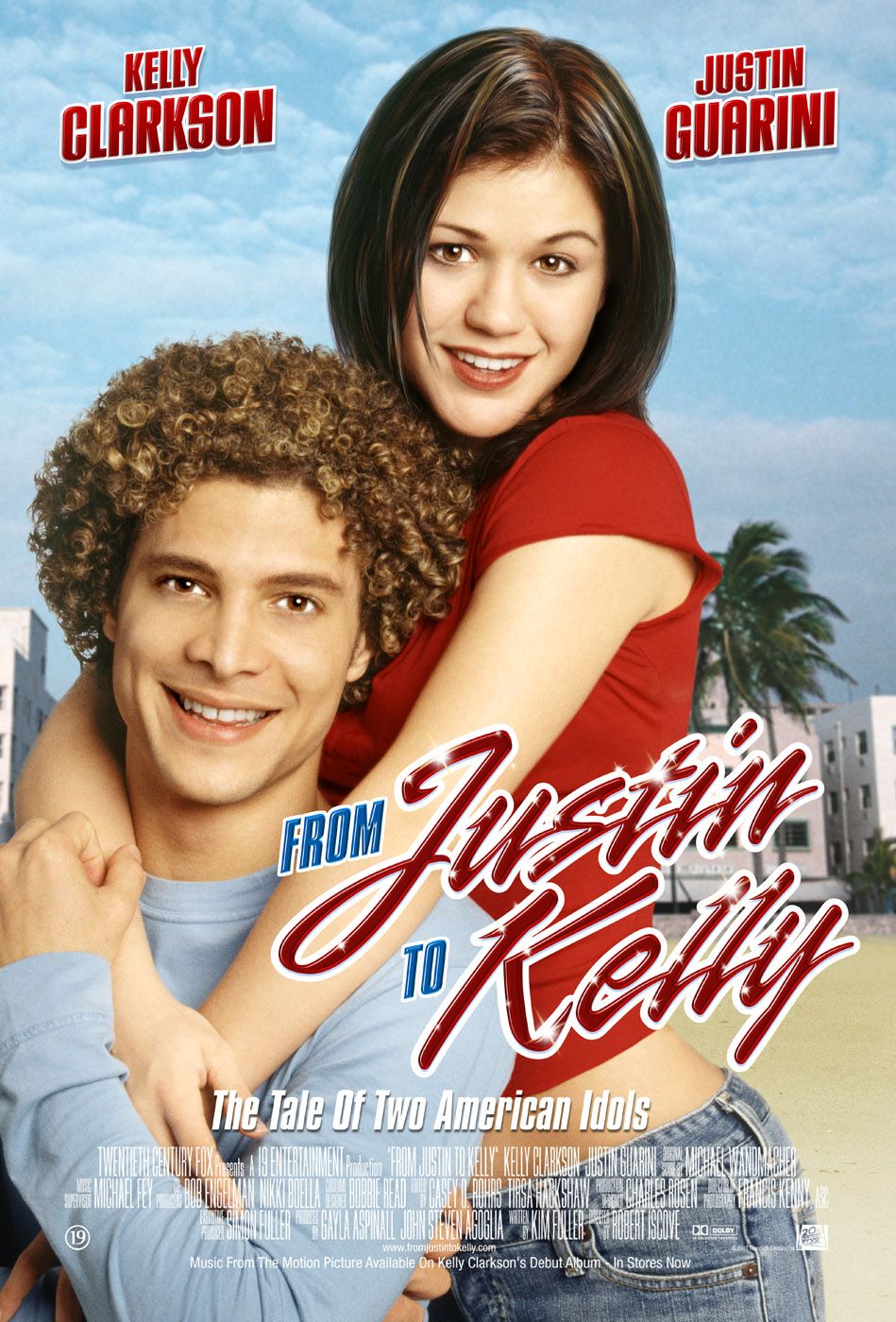
“From Justin to Kelly” is a somewhat unique member of the IMDb Bottom 100. It has been hovering at the bottom of the list for some time, and has held the top spot on a few occasions, but it isn’t quite what I typically expect from the list. The production values are good, it isn’t a parody movie, and Paris Hilton is nowhere to be seen. All of that said, this is a movie that deserves a slot in the Bottom 100, without any doubt.
As with many films, you can’t truly appreciate “From Justin to Kelly” without knowing a little bit of the story behind the scenes. In fact, this is a movie that doesn’t make any sense at all without context. Eponymous stars Justin Guarini and Kelly Clarkson were the finalists on the first season of the television singing competition “American Idol”. “From Justin To Kelly” was apparently an attempt to cash in on the popularity of the show in a different medium. Unfortunately, neither Justin nor Kelly had any meaningful acting experience, which should have sent a red flag up on the project from the start. The movie attempted to bank on their singing talents rather than their acting, and this relied on choreography and musical numbers to make up for the lack of a acting ability, sensible plot, or decent dialogue. This tactic, as you might imagine, did not work well.
A good number of movies on the IMDb Bottom 100 at least have a workable concept behind them, but are ultimately executed poorly. “From Justin to Kelly” has an inverse issue: the concept is unworkable (make a movie around two non-actors), and a lot of (more or less) competent people were brought in to try to make it work. So, the result is a movie that looks fine on the outside, but doesn’t have a foundation beneath it.
While the choreography and directing are done by veterans (though still pretty badly), the job of writing “From Justin to Kelly” was clearly not given the same amount of thought. All that was needed from the film was music and a serviceable trailer from a financial point of view, so why would anyone stress the script? It seems like everyone knew that they were dealing with non-actor leads anyway, so a good writing job would just be wasted on the flick. The writing was tasked to Kim Fuller, who has had a career in television, but is best known for penning another notable musical train wreck (and IMDb Bottom 100 alumnus), “Spice World.” That tells you all you need to know about how the horrendous writing of “From Justin to Kelly” came to be. The dialogue is stilted, the characters are entirely unbelievable, and the plot is a jumbled mess: all because no one particular cared to make it better.
The guy in the middle gets an entire side-story about internet dating or something. Ugh.
“From Justin to Kelly” feels like the manufactured product that it is, which makes it an incredibly off-putting viewing experience. Most movies, including bad ones, are made in the honest attempt to create something good. “From Justin to Kelly” has more in common with Z-grade exploitation films than it does any of the other Bottom 100 features, because it was made without any desire for quality or artistic value. Even more so than the many contrived blockbusters out there, this is a soulless movie. Blockbusters at least, on some level, aim to entertain an audience. “From Justin to Kelly” was not made to even entertain: it was made to profit. Luckily, it failed miserably in this regard, and is remembered as one of the most universally loathed movies of the decade.
The one in the middle with the cowboy hat is the villainous mastermind of the movie. Really.
There isn’t a whole lot of entertainment value to extract from this film. The characters are so inconsistent, unbelievable, and unlikable that there is at least somewhat of an awe factor involved in watching their stories unfold, though. In particular, one of Kelly’s cohorts is almost certainly the most inexplicably conniving villain that I have ever seen in a movie. Still, the vapid plot and tortuous, twisting love story between Justin and Kelly is immensely tiring. Not only can they not act, but their characters are written to be dumb as rocks, and are constantly manipulated into fighting each other. Their ineptitude is amusing for a while, but it gets old very fast. The fashion is pretty laughable as well, particularly the skirt made of ties, but none of it is enough to make it worth sitting through the movie.
tie skirt
So, I do not recommend watching “From Justin to Kelly.” Unless, of course, you want to watch a poorly-written, abysmally-acted, inexplicably PG spring break movie with a bunch of early 2000s pop music threaded throughout. And, hopefully, no one does.
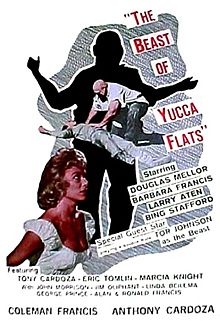
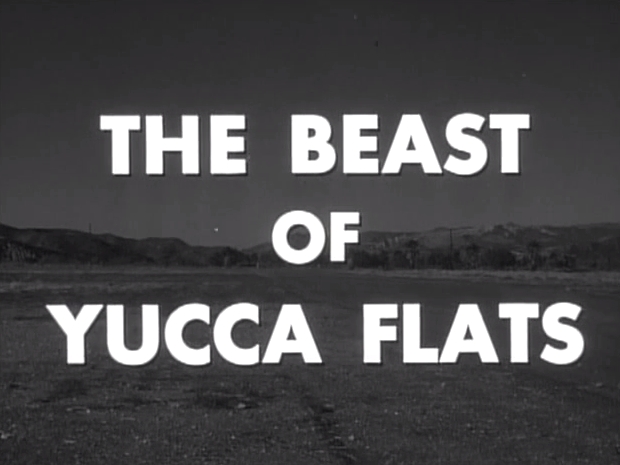
What happens when you put “Red Zone Cuba” and “Plan 9 From Outer Space” into the blast zone of an atomic bomb? Ideally, both movies would be destroyed. Alternatively, they could synthesize into a mindless creature of a movie called “The Beast of Yucca Flats”.
Starring the hulking Tor Johnson of “Plan 9 From Outer Space” infamy, and directed/written by “Red Zone Cuba” visionary Coleman Francis, “The Beast of Yucca Flats” is exactly the quality of movie you should expect: it is absolute garbage. The only saving grace of “Yucca Flats” is the curious charm that is occasionally the side effect of absolute incompetence.
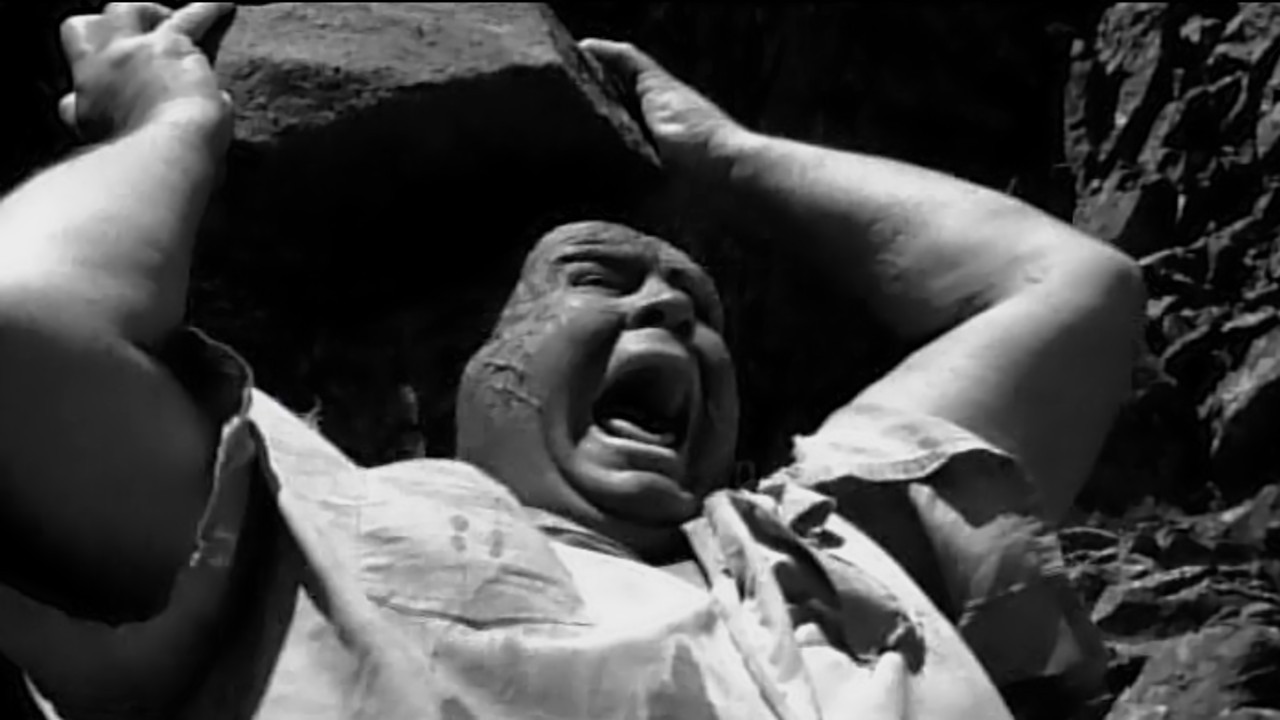
Pictured: charm
First off, eponymous “Beast” (Tor Johnson) cannot act. He spent most of his career in the background of movies as a muscle-man, but he never really had the chops for acting. Luckily (or unluckily, depending on how you look at it) for him, in “The Beast of Yucca Flats”, he doesn’t really have to act. Due to some of the most baffling sound work in cinema history, all of the dialogue in the film is spoken from off-screen. This means that Tor’s lead role is more or less relegated to a silent beast (I don’t recall if he even got a line before his transformation). This mechanical issue also leads to some awkward off-screen conversations set against still images, and numerous disembodied voices with unclear sources moving the plot along. Clearly in an attempt to cover this horrific sound work, the movie also has narration throughout. Unfortunately, the narrator rarely speaks in complete sentences, and never quite makes any sense. Ultimately, all of the film’s problems mentioned here (and many more) boil down to the same fellow at the rotten core of this attempted film: Coleman Francis.
Coleman Francis is the writer who cooked up all of the horrendously stilted dialogue. Coleman Francis is the narrator who rambles incoherently throughout the movie. Coleman Francis is the director who allowed the astoundingly horrible sound and cinematography decisions to made. “The Beast of Yucca Flats” is entirely and unequivocally the fault of Coleman Francis. Even the perplexing opening scene that has no connection to the rest of the film was reportedly inserted after-the-fact because Francis “liked nude scenes”.
The kind-of touching final shot had nothing to do with Francis. The rabbit just showed up.
Yet, despite the countless issues with the film (or maybe because of them), “The Beast of Yucca Flats” is almost certainly the most entertaining and best remembered of the Coleman Francis movies. As mentioned before, there is a certain intangible charm that certain movies have that can only come from the honest incompetence of the filmmaker, and “The Beast of Yucca Flats” has it. The movie is rightfully considered to be one of the classic considerations for “worst film of all time”, right alongside “Manos: The Hands of Fate” and “Plan 9 From Outer Space”. The Mystery Science Theater 3000 episode on the movie is also considered to be one of their finest:
It is mind-boggling to compare “Beast of Yucca Flats” to Coleman Francis’s other IMDb Bottom 100 movie, “Red Zone Cuba”. Both movies are arguably of equal incompetence, but “Yucca Flats” is far and away more entertaining to watch. Watching them back-to-back illustrates the hazy boundary between an entertaining bad movie and an unwatchably bad movie, at least in my opinion. In any case, I can recommend checking out the MST3K of “The Beast of Yucca Flats”. but I certainly wouldn’t say the same about “Red Zone Cuba”.
However, “Yucca Flats” doesn’t have nearly as catchy of a theme song:
“The Beast of Yucca Flats” isn’t going to be as much fun for a casual group today as “The Room” or “Birdemic”, but it rightfully has a place among the classic bad movies of yesteryear. If you can enjoy “Plan 9”, “Manos”, and other bad flicks from back in the day, then you don’t want to overlook “Yucca Flats”.
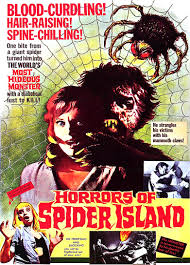
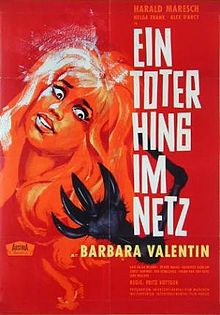
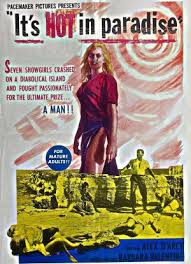
Here’s another IMDb Bottom 100 entry with a whole lot of alternate titles. Most commonly called “Horrors of Spider Island”, it also shows up under anglicized versions of the original German title (“Body in the Web” usually). The movie was re-released as “It’s Hot in Paradise” in an attempt to capitalize on a different marketing approach, but I have rarely seen it labeled under that title in the secondary market nowadays.
The plot of “Horrors of Spider Island” is pretty straight-forward: a plane full of dancers, accompanied by their manager, crashes into the ocean en rout to an overseas gig. All of the survivors wash up on an uninhabited island, which they learn contains a giant spider. The manager is ultimately bitten by the spider, after which he turns into a sort of were-spider-creature and starts hunting down the other survivors.
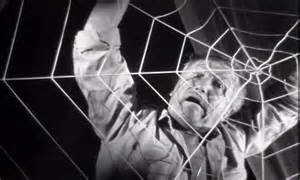
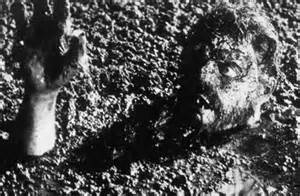
The eponymous “body in the web”
Once again, the basic plot-points here could make for a pretty decent movie. I would rather have seen the spider as the primary monster than a poorly designed man-spider, but in general the setting and set-up work for a monster movie. Unfortunately, the potential is absolutely squandered.
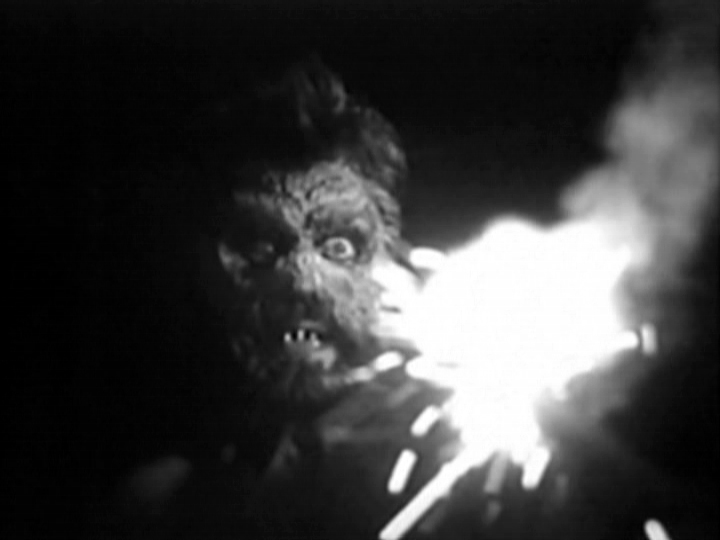
As mentioned, the monster design is less than inspiring to say the least. The movie is kept pretty dark to cover up the shoddy work, but there a few instances where it really stands out in a bad way. Particularly, the monster’s death is a moment where it appears prominently on screen. Speaking of which, the monster dies by wandering into quicksand and drowning, which is one of the worst anticlimaxes I’ve seen so far among the IMDb Bottom 100.
I’m not sure if the blame should lie more with the writing, the acting, or on equal shares of both, but absolutely none of the characters in this movie are interesting, and most of them are utterly indistinguishable. Part of this is just due to the cast being far too large and filled with too many similar characters (all of the dancers), but there were certainly no compelling personality traits or performances to make any of them stand out either. The movie tries to balance out the horror with some light-hearted romance, but none of the characters are strong enough for it to work, so those segments ultimately just drag the whole movie to a screeching halt.
This movie strangely reminded me of a very unrelated fellow IMDb Bottom 100 feature: “Miss Castaway and the Island Girls”. Despite the films being from different eras and made in different genres, there are some really distinct similarities. “Miss Castaway” features a group of models who are stranded on a deserted island after a plane crash, only to discover that there is a monster inhabitant that starts to pick them off. “Miss Castaway” came by that plot by combining “Miss Congeniality”, “Castaway”, and “Jurassic Park”, so I am pretty sure it is pure coincidence that the plots have so many similarities. Still, it was an unexpected find that was interesting to note.
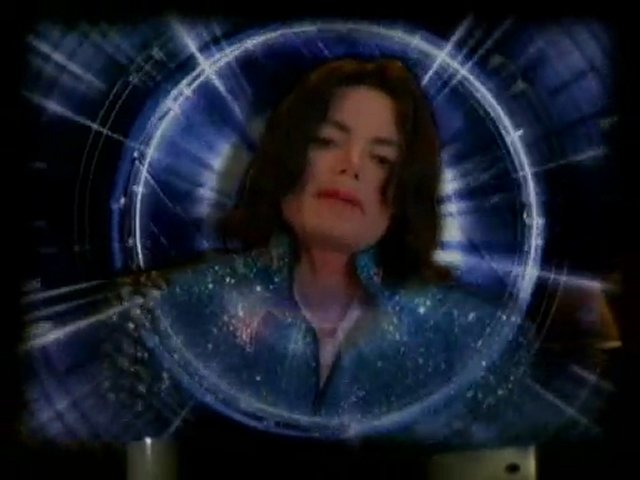
“Horrors of Spider Island” might have been better with a Michael Jackson cameo
There aren’t enough genuinely enjoyable moments in “Horrors of Spider Island” for me to recommend it, but it does have a pretty solid episode of Mystery Science Theater 3000. It is considered a classic B-movie, and it isn’t quite a painful watch, so I wouldn’t specifically advise against watching it either.
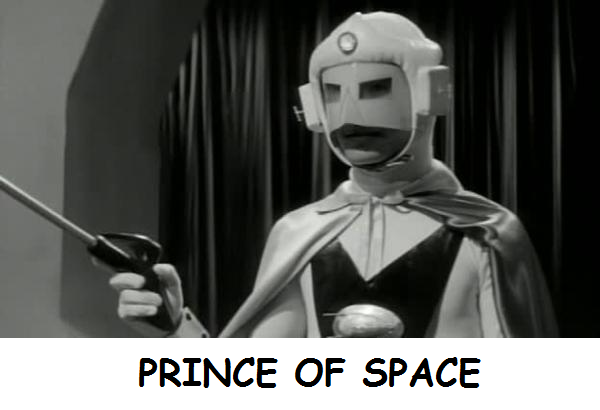
I honestly can’t tell the difference between “Invasion of the Neptune Men” and fellow IMDb Bottom 100 and Mystery Science Theater 3000 feature “Prince of Space”. They are so similar that I bet you could cut them together into a half-coherent movie. I initially made the mistake of watching these two back-to-back, not realizing how similar they were. You can even tell back in my “Prince of Space” review how difficult it was for me to distinguish between the two flicks. If it weren’t for the distinctive tones of Krankor, I wouldn’t have had a chance.
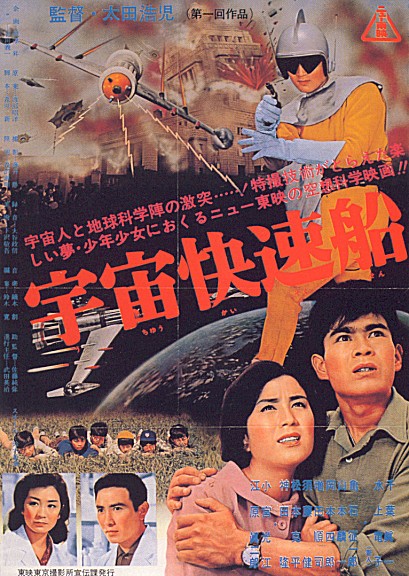
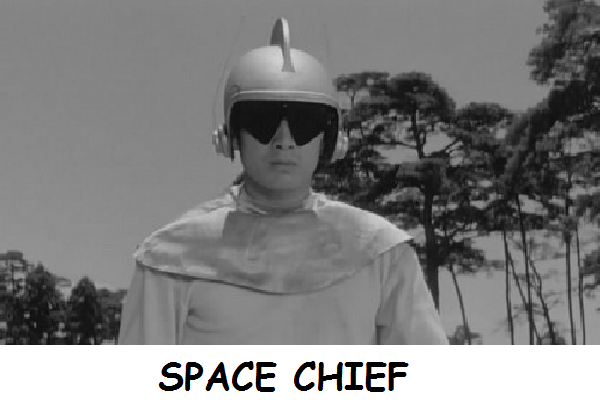
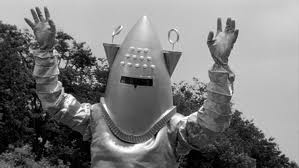
Given the similarities between these movies, most of the points I made in the “Prince of Space” review still stand here. There is a certain bizarre charm to these Japanese import movies, with all of the bad dubbing and dialogue. However, “Neptune Men” lacks a distinct, entertaining villain; which I saw as a big boon for “Prince of Space”. That being said, Sonny Chiba’s Space Chief is a little more interesting than his doppelganger, the eponymous Prince of Space. And I don’t use doppelganger lightly here, just check out how similar these characters look:
I am sure you can understand my confusion here. In addition to the near-identical heroes, the movies also have similar invasion plots, and both prominently feature a gang of poorly-dubbed children (which is to be expected from the genre). One of the key differences that helped me distinguish between the features were the alien designs. Both look horrendous, but they at least don’t look identically horrendous. “Prince of Space” featured chicken-like humanoids, whereas the Neptune Men wear stylized, conical spacesuits. I give the advantage to “Invasion of the Neptune Men” here, mostly because I could imagine these suits showing up in early “Doctor Who” serials or a weaker episode of “The Twilight Zone”. That’s not saying much though.
Overall, “Invasion of the Neptune Men” is a more forgettable flick than “Prince of Space”. Apart from the destruction of the Hitler building, there isn’t much that makes this movie stand out from the pack. It is a very long way from being good, but I don’t think it is distinctive or genuinely poor enough to be one of the worst movies of all time. Just like “The Starfighters”, I’m sure there were hordes of movies like this of similar quality that have been forgotten to time.
I can only recommend this movie in conjunction with “Prince of Space”, and with the MST3K treatment. The riffs are pretty good, and the similarities will throw you into confusion pretty fast once you get into the second of the films. As you would expect, you can find both films quite readily on YouTube with a little digging.
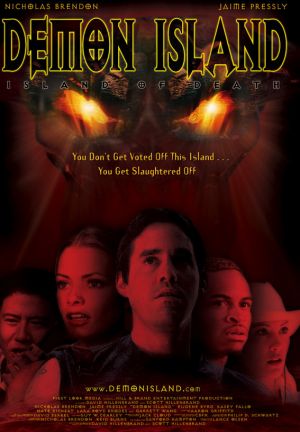
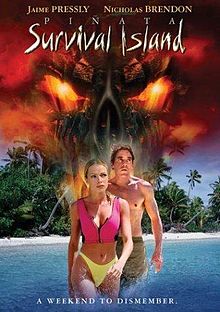
If someone told me that there was a really bad killer pinata movie out there, I would not be surprised. However, the movie I would picture would not be anything like “Demon Island”. There are a few similar elements, such as a monster pinata beating people to death with a stick, but not as many as I would have expected. For being a movie about a killer pinata, “Demon Island” somehow completely misses the mark.
Let us imagine for a moment that a b-movie outfit like Troma decided to take on a killer pinata movie (which certainly isn’t out of their wheelhouse). I would want a number of things to happen:
1) I expect the monster to be a multi-colored, dead-eyed horse creature.
2) There will be a scene where children break open a pinata, only to have human body parts and organs fall out instead of candy, to their shock and disgust.
3) The colorful horse creature will beat someone to death with a stick, and/or kill someone utilizing weaponized candy
This one at least sort of happened in “Demon Island”
Outside of those things, all I want from a killer pinata movie is a fun ride. It just needs to be a traditional gorey slasher movie with a silly plot and some tongue-in-cheek humor around the edges, and you have yourself a movie. “Demon Island” could not have messed up the concept more.
A lot of people initially mock “Demon Island” for the outlandish concept, but as demonstrated above, I think a killer pinata movie could totally be a decent horror/comedy set-up (In fact, there is another killer pinata movie just about to come out).The real problems with “Demon Island” are numerous, but the premise is not necessarily one of them. I mean, just check out this teaser for “Killer Pinata”, which has the same concept behind it:
Anyway, on to the multitude of issues with “Demon Island”. First and foremost, the central monster is a massive problem for the film. According to IMDb, the movie was initially filmed using a rubber suit monster and practical effects, but that it was later replaced with the hideously cheap CGI creature that appears in the final cut (given how bad the CG looks, I shudder to think of what the practical alternative looked like on screen).
Any time that you add in a monster after the fact, there are going to be serious issues with the film. In this case, there is never any sense of proximity between the characters and the monster due to the editing. There are only a couple of instances where it is clear that the monster is interacting with the same environment as the characters, and that is mostly achieved through using disorienting monster point-of-view shots with excessive after-effects.
The poor quality of the monster effects and the shoddy editing around it are enough to make this movie bad. The acting and writing on top of those issues make the film horrendous.
All of the acting is a good few rungs below what you would expect from a run-of-the-mill horror movie, and comes in just underneath the thespian quality that you would find in an Asylum SyFy Original movie. Honestly though, this is one of those cases where the actors couldn’t have saved the dialogue with all of the talent in the world. Writer/Director tag-team Scott and David Hillenbrand have a little more experience producing and directing now, but at the time neither of them were experienced in screen-writing or directing, and it shows throughout the movie. The movie feels like the work of overambitious amateurs that just don’t quite know what they are doing, and that comes through in the dialogue in a very bad way.
The following clip encapsulates almost every major issue with the film. Keep an eye out for the editing, the effects (including the monster vision), the sense of proximity, the acting, and the dialogue.
I don’t know if I can recommend this movie. It fills me a profound sense of disappointment at the wasted opportunity to make a fun killer pinata movie, and there aren’t enough enjoyable moments to justify sitting through the whole thing. It is kind of interesting to see how many things are wrong about it from a semi-academic point of view, but that is about the only saving grace of this thing. Instead of watching this, I recommend supporting a new attempt to create a killer pinata movie: appropriately name “Killer Pinata”. You can find them on IndieGoGo. Their funding period ends on November 1, 2014, so go help them hit their goal!
“Eegah” is, in my opinion, the epitome of the early 60s B-movie. There is a simple monster, unnecessary musical numbers, horrible voice-over, and nothing that approaches any sort of artistic depth. All of that said, I really don’t hate this movie. Despite all of its flaws, it is a not a difficult movie to sit through. It isn’t always particularly interesting (the scene where Eegah shaves isn’t exactly riveting), but I don’t recall ever being bored while watching it, which I can’t say about a lot of IMDb Bottom 100 movies.
Richard Kiel, best known as Jaws from the James Bond movies, does an adequate job of portraying the eponymous giant. Arch Hall Jr., who plays the swooning, dune-buggying “hero”, isn’t nearly so passable. I can’t even begin to describe how horrible his voice is in this movie, particularly in conjunction with his bizarre hair and perplexing face. The fact that his singing is so often spotlighted in the movie almost makes one long for his standard acting. Here are a couple of his numbers from the film:
As much as I dislike Arch Hall Jr. in this movie, those musical numbers are some of the most memorable segments of the movie, and his performance goes a long way towards distinguishing this movie from the pack of B-pictures from the time. That isn’t exactly a good thing in this case, but it could realistically be said that this movie would have been forgotten in time without his ludicrous performance.
I feel like it is worth mentioning again: I don’t hate this movie. I think “Eegah” is half decent for what it is: a cheaply made monster movie. Nothing about the movie is good, but outside of the acting, I think the weaknesses boil down mostly to the lack of funding available. Sure, the writing and directing aren’t stellar by any means, but they got the job done. There are some definite jarring moments of sound editing, but overall, nothing ruins the movie so much as to make it unwatchable. Arch Hall Jr. is the only huge problem I have with the movie, and he does at least serve to make the film memorable, so I can sort of forgive that.
The opening credits were pretty cheap, for example
As far as a recommendation goes, I can certainly say that the MST3k riff is worth digging up for any fans of the show. It is one of my personal favorites of the Joel years for sure. Otherwise, this sits right on the edge of being a good-bad movie. There are some good laughs to be had, but I don’t think it is quite as consistently over the top as “The Girl in Gold Boots”, if you happen to be looking for a fun music-infused B-flick. It isn’t excessively dull, which is ultimately its greatest strength, but there also aren’t a lot of gold moments to get laughs out of, making it not ideal for a bad movie night. I’d give it a generally loose recommendation, but I will also say that I will almost certainly be giving it another watch myself at some point down the line.
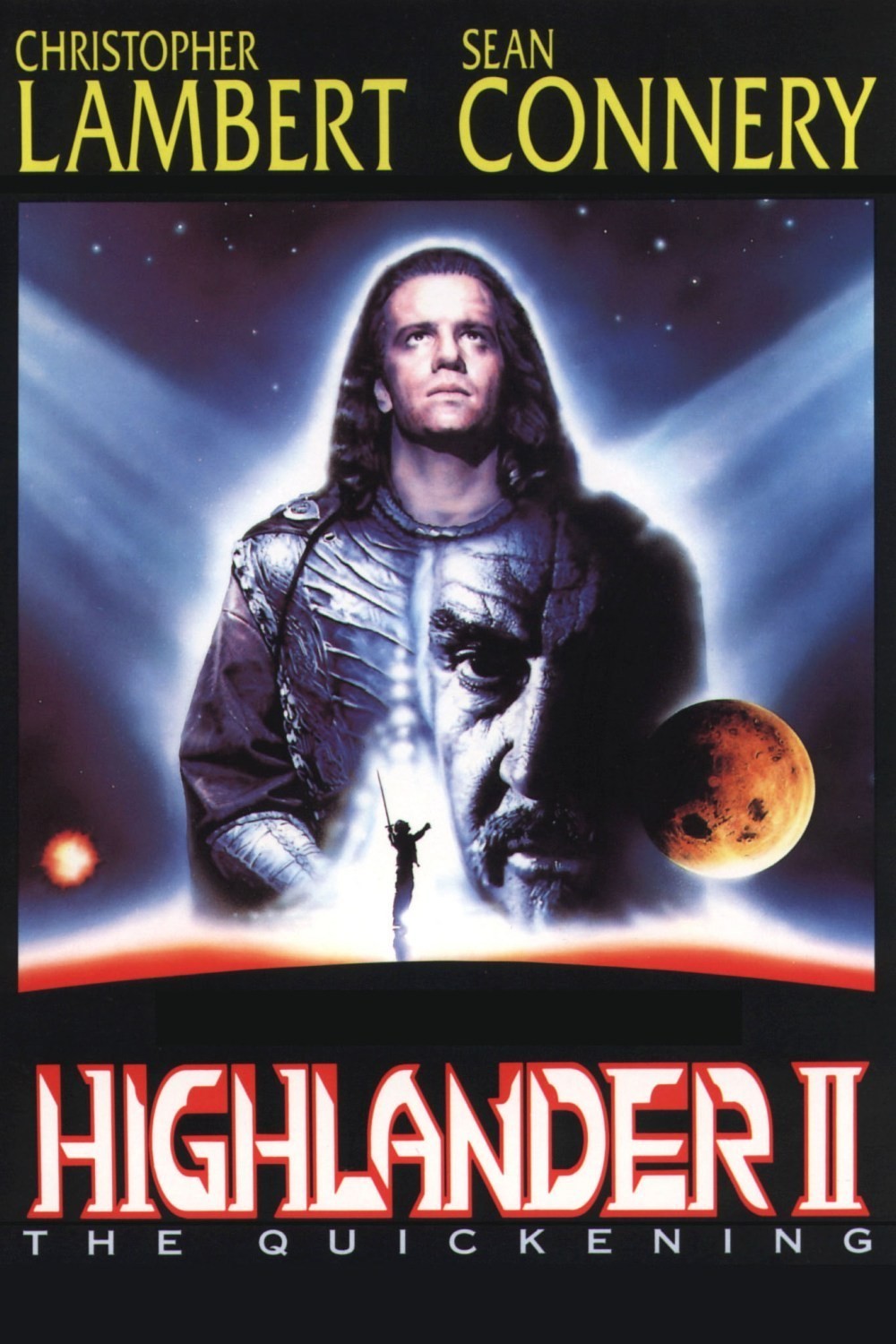
I don’t remember how exactly it happened, but I got into the “Highlander” movies when I was pretty young. I distinctly remember having all of the movies on VHS, including the ones that tied into the (in my opinion) not-so-great television series. In particular, I specifically remember watching “Highlander II: The Quickening” a number of times, and always feeling thoroughly confused by the plot and the seemingly incomprehensible details. At the time, I assumed it was just because I was a kid, but it turns out that the movie is actually deemed by society at large to be a babbling mess. Fun fact: I also thought that the only reason I couldn’t beat “BattleToads” was because I was a kid, and that it would be easy street once I got older. No dice there either, as it turns out.
I personally think of “Highlander II” as a good-bad movie, but only by a hair. The movie is powered by a handful of over-the-top performances that chew their way through the perplexing scenery and unnecessarily complicated plot. In particular, Michael Ironside and Sean Connery own the movie whenever they are on screen: Ironside as the primary villain, and Connery reprising his role as Connor MacLeod’s fan-favorite, katana-weilding mentor, Ramirez.
Unfortunately, Connery does not get much screen-time, and doesn’t factor into the plot in any way. Apparently, star Christopher Lambert only agreed to return to the movie if Connery was brought back, which led to some shoehorning of the script to bring the Ramirez character back to life. Even though he isn’t in it much, I am thankful that they made the effort to bring Connery in, because his comic relief is top-notch. Watching Ramirez interrupt a production of “Hamlet”, ride in a plane, and invade a tailor are all highlights in what can be a rather dull movie.
Michael Ironside, on the other hand, plays his villain as over the top as possible. In his own words:
“Yeah, listen, I hated that script. We all did. Me, Sean, Chris… we all were in it for the money on this one. I mean, it (the script) read as if it had been written by a thirteen year old boy. But I’d never played a barbarian swordsman before, and this was my first big evil mastermind type. I figured if I was going to do this stupid movie, I might as well have fun and go as far over the top as I possibly could. All that eye-rolling and foaming at the mouth was me deciding that if I was going to be in a piece of shit like that movie, I was going to be the most memorable fucking thing in it. And I think I succeeded.”
-Michael Ironside
To say that Ironside is a delight to watch in this movie does not even scratch the surface of how entertainingly ridiculous his character is. He essentially enters the movie by hijacking a subway, and subsequently wrecking it. He takes over a super-corporation via a *literal* hostile takeover of the board of directors. His performance is nothing short of amazing.
The writing of “Highlander II”, for better or worse, is thoroughly baffling. The primary plot involves a massive energy dome that has been constructed to protect society from the sun, constructed after massive casualties sustained once the ozone suddenly depletes. Inexplicably, the dome is revealed to have been designed by protagonist Connor MacLeod after the events of the first movie, after his love interest is murdered by the sun. It was never implied previously that MacLeod would be able to design such a device though, so this revelation comes purely out of left field. As the story begins, the audience is introduced to a terrorist group that believes that the “shield” is no longer necessary due to the ozone having repaired itself. They claim that the private interests behind the “shield” don’t want the world to know about the healthy ozone layer due to the profitability of the shield. MacLeod, by this time an old man, comes across the leader of this group, giving the movie an inexplicable, shoe-horned love interest.
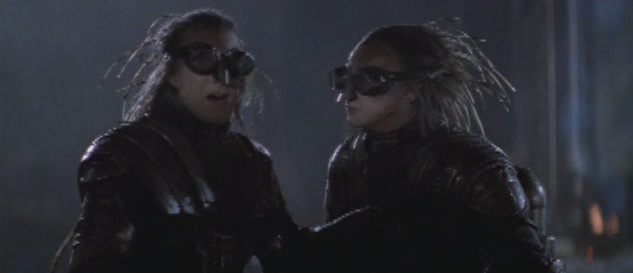
As complicated and unnecessary as the primary plot is, it pales in comparison to the secondary story. It is revealed through flashbacks that the “immortals” depicted throughout the first film (MacLeod and Ramirez included) are, in fact, exiled aliens. All of these “immortals” were members of an unsuccessful rebellion, who were banished into the future by Michael Ironside and forced into murderous competition until only one remains. After the competition concludes, the winner is theoretically given the option to either return to the past or live our his life in the distant future. At the beginning of the movie, Ironside is somehow aware that MacLeod has won the competition, but it unsatisfied that he is slowly dying of old age in the future. Perplexingly, he send two porcupine-headed assassins to kill the aging MacLeod, which predictably goes awry.
After MacLeod defeats the porcupine twins, his youth and strength is restored, which Ironside should have seen coming from a mile away. Instead of leaving well enough alone and leaving MacLeod to his shitty future world, Ironside decides to hunt the Highlander down himself.
If those two plots are not mind-numbingly bizarre for you, there is a third level introduced at this point in the story: the resurrection of Sean Connery’s Ramirez. Apparently, due to their BFF status, the process by which MacLeod’s youth and power are restored (after defeating the porcupine twins) also revives the centuries-dead Ramirez. Again, the only reason that this was written in was because Christopher Lambert threatened to walk off the movie, and it very much feels like it. Connery has absolutely nothing to do in this movie: the only real action he takes is sacrificing himself to a giant industrial fan, which was hardly a necessary aspect of the movie.
The plot fragments do eventually synthesize together into a conjoined wreck, but it never starts to make sense. The motivations stay unclear, the actions illogical, and the plot remains ludicrous. Luckily, the performances also stay hammy: apart from Ironside and Connery, John C. McGinley gets some solid time in the film, and that usually means it will be a good ride.
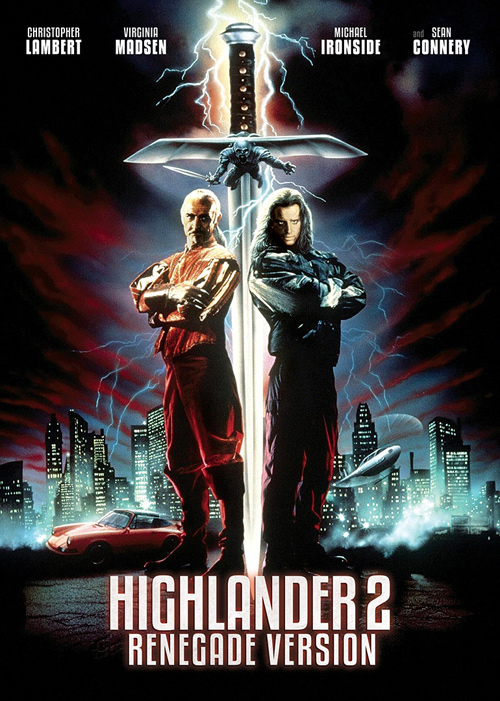
I love bad movies that have fascinating stories behind their productions, and “Highlander II” definitely falls in that category. Apart from the issues with the actors already covered, the IMDb trivia section seems to go on forever. The director was at odds with the producers and the backers, there was all sorts of on-location drama in Argentina, the actors couldn’t behave themselves, and even some notable on-set injuries occurred. I think it all adds some flavor to the film, which does it some pretty big favors. Apparently there is documentary out there about the production, as well as a Director’s Cut of the film (known as the Renegade Version). This revised version of the movie is the one I have most often come across, but it cuts out some of the more ridiculous elements, so I can’t recommend it at the same level I can recommend the theatrical version.
And yes, I definitely do recommend this as a good-bad movie. It doesn’t pace itself incredibly well, but there are enough baffling plot points and laughable performances to make it very much worth the time. The more you read into the stories behind the movie, the more interesting it becomes (not unlike “The Creeping Terror” and the enigmatic Vic Savage). “Highlander II” isn’t in the IMDb Bottom 100 anymore, and I think that actually makes sense. In a strange way, this is a genuinely enjoyable flick, and it perhaps doesn’t deserve the dishonor of being in the honest ranks of the bottom 100 movies of all time.
“The Mangler” is a movie about a laundry folding machine that becomes possessed by a demon during a collision with an ice box, after which it goes on a killing spree.
As you could probably guess from that brief synopsis, “The Mangler” is an adaptation from one of the lesser works of Stephen King. The premise is a bit over the top for sure, but it actually works better than I had expected. The bigger flaws with the film come from issues with the structure, as well as the constraints of the budget and available technology at the time.
Before diving into the negatives, there are actually some solid positives in “The Mangler”: Robert Englund plays a fantastically hammy villain who lights up every scene he is in, there are some pretty great gore effects, and the film does a good job of making the eponymous “Mangler” machine look honestly intimidating.
On to some negatives: the bulk of the story is put on the shoulders of Ted Levine, who seems incredibly miscast and uncomfortably as the lead. The plot gets really repetitive for most of the movie, with minimal forward momentum of the story until the last act. Worst of all are the special effects, which are glaringly terrible in the botched, awkwardly shot finale where the Mangler becomes mobile. It is evident throughout the sequence that there was no money available to show what the transformed Mangler looks like, so the audience is treated to awkward angles and the occasional CGI’d mechanical hand.
If it weren’t for the poor pacing and repetition in the body of the film, this would be an easy bad movie recommendation for me. There is hammy acting, silly effects, and the premise is unparalleled in outlandishness. The fact that the Mangler goes super-powered due to consuming antacids is just icing on the cake. If you can find a copy on the cheap, I can recommend giving it a shot, with the caveat that the entertainment value is inconsistent throughout the film.
Reviews/Trivia of B-Movies, Bad Movies, and Cult Movies.
![Misan[trope]y](https://misantropey.com/wp-content/uploads/2014/10/misantropeyhead1.png)
























 Misan[trope]y