Category Archives: Uncategorized

On Free Speech and Reddit

This post is based on a viewer request, which is being filled due to a donation to the Secular Student Alliance via during Secular Students Week (June 10-17, 2015). Thanks to all for your contributions!

This is probably the most interesting and difficult request I received over the course of Secular Students Week. Right in the middle of the week, the popular link aggregator site, Reddit, decided to have a collective breakdown after a handful of subreddit forums were banned based on spreading hate speech. The front page was flooded with negative images of Reddit CEO Ellen Pao and unflattering photos of obese people, due to the largest of the banned subreddits being r/fatpeoplehate. Countless redditors claimed that their right to free speech was being violated, and that they were being unfairly censored. So, someone decided to ask my opinion on the whole matter.

I’ve been using Reddit for a few years now, but I stay pretty compartmentalized to subreddits that suit my interest, which is really what the site seems to be designed for. The site also harbors a lot of vile, dark corners  dedicated hate speech, racism, sexism, and violence, most of which I have managed to stay blissfully ignorant to. However, this past week wasn’t the first time that the Reddit community threw a collective tantrum over a subreddit banning, even in just the time that I recall. r/jailbait, which was dedicated to often non-consensual pornographic images of women on the edge of legal ages of consent, was banned in 2011 after being the subject of a CNN segment by Anderson Cooper.

More recently, r/TheFappening, which was dedicated to the distribution of hacked nude photos of celebrities, was banned in 2014, which also led to backlash from the greater Reddit community.

From what I have seen, Reddit has historically been run and populated by extreme believers in free speech, who advocate for the forum to have little to no moderation or censorship of content. However, this certainly isn’t true across the board: each subreddit has a specific set of rules that can place any number of limitations on the smaller sub-communities.

Ellen Pao, who is the current target and pariah of these Reddit traditionalists, has a different direction and vision for Reddit. Her opinion seems to be that the position of Reddit as an unfiltered free speech platform has turned countless potential members away by harboring antagonistic hate groups, and wants the community to be more about acceptance and openness to all instead of being a staunch paragon of extreme free speech at the expense of certain groups. In the wake of all of the negative coverage about places like r/jailbait, r/TheFappening, r/creepshots, and others, I think it is pretty easy to understand why this is Pao’s projected direction.

The criticism of Pao comes from two distinct perspectives. One population wants her removed, and Reddit as a whole to refocus on being a broad and essentially lawless land of free speech. The other (less vocal) population has focused their criticisms on Pao not taking the policy far enough, noting that numerous subreddits that promote racism and sexism have been left unbanned. Obviously, it is impossible to make both of these populations happy at the same time, and Reddit is at a crossroads of which way it should go.

My opinion on the matter is that the flag-bearing advocates for absolute free speech on all platforms will always exist, but that they are a generally toxic element to communities. Their belief in equal-opportunity verbal assault and expression without repercussion naturally favors those who are in majority and privileged positions, and thus creates communities that primarily only serve those people (because everyone else is implicitly turned away). This population is naturally going to drift into the next platform that is going to be willing to accept them, and it is really inevitable that they will do so sooner or later. Growing communities have to diversify their user base, and the free speech brigade can serve to actively work against that goal, even if that isn’t what they intend.

The most common complaint that I have heard from the absolutist free speech advocates about the changing state of Reddit is that banning subreddits based on content will lead to subjective bannings in the future for everything from blasphemy to dissenting political opinions. Personally, I don’t think that is particularly realistic: places like r/atheism and r/politics aren’t in any danger, because they don’t (for the most part) actively harass people, and have their own internal guidelines dictating post content.

A good example of this in the film world is the MPAA ratings board, Despite all of the problems with the Motion Picture Association of America ratings board, it was initially created as an insurance of free speech in film: an internal policing/labeling organization for the film industry to subvert any attempts at censorship by local or state governments. It has become a thoroughly corrupt institution now, but that’s a conversation for another time. The point is, its purpose isn’t unlike subreddit moderators: to self-censor and label content, so the big guys (the government, Reddit) don’t have to get involved. As long as subreddits are held to a basic standard of not harboring hate speech, threats of violence, harassment, illegal activities, etc, then all should be fine and dandy. Subreddits already follow a labeling standard not unlike the one the MPAA started with: NSFW (not safe for work) and SFW (safe for work), and no one seems to be bothered by that. Of course, this isn’t a perfect parallel: Reddit, as a private entity, can ban subreddits, users, and content (as it should be able to) as retribution for violating guidelines, whereas the MPAA ratings are strictly about labeling, and the government is limited in how it can interfere with the individual films. Still, the parallels are notable.

Personally, I think the concepts of both the MPAA ratings board and the Reddit site-wide content standards are good. Reddit’s changing standards will hopefully continue to make the site more welcoming to a diverse set of users and drive away the darker, toxic elements of the community. The MPAA, on the other hand, has at least allowed for an effective system of labeling content (except for all of that corruption involved), and theoretically hasn’t stood in the way of films being made (in practice, that hasn’t been the case). Again, I could spend a lot of time just talking about the positives and negatives of the MPAA ratings, but that isn’t what this post is about.

I’m not going to get too deep into how misguided the free speech warriors of Reddit are, but I will say that they aren’t necessarily uniformly awful. Free speech is a serious issue, particularly when it comes to government censorship of art, protest, and blasphemy, and these die-hard free speech folk do a lot of speaking out on those fronts. However, a private company refusing to offer a platform to hate speech isn’t a free speech issue. When it comes down to it, they don’t have any obligation to provide soapboxes to anyone. Likewise, a movie studio turning down a proposed remake of Triumph of the Will isn’t a free speech issue: you can make that movie if you want, but nobody is under an obligation to help you do so. In a more realistic and current example, no one is under any obligation to help Uwe Boll make yet another shitty movie. So, regardless of how much good work these free speech warriors might otherwise do, it is pretty much irrelevant for this conversation, and it doesn’t make them any less damaging to the construction / cohesion of a diverse community.

Looking at Reddit as the private company that it is, I think that it is doing exactly what it needs to: in order to continue forward growth and diversification, the growing pains are going to be experienced in saying farewell to the free speech warriors who have historically provided the site’s foundation. Realistically, the free speech flag-bearers are going to find new platforms to suit them, and Reddit will be able to move on with a user base that doesn’t allow for as much hate and toxicity. I don’t think that is going to happen tomorrow, but I see it as an inevitability on both fronts. Reddit is never going to be able to serve the free speech warriors the way it used do, and the free speech warriors are only going to increasingly serve as an anchor to growth going forward.

So, I think Reddit should lean in, and continue becoming a place that is less hospitable to the free speech warriors. Of course there will be complaining and revolting, but all of that noise, I think, is going to work in the long run to Reddit’s benefit: it will sound a bell out to the previously disenfranchised ex-Redditors and folks who were turned off by the site’s darker elements that the coast is clearing, and that Reddit is re-branded and open for business.

There is a lot of tension between Reddit and a rival website, Tumblr. The two sites have no need to be at odds, though: they are fundamentally different in structure, and perfectly capable of co-existing for a cross-section of users. The tension that exists is solely because of the generally more progressive user base of Tumblr, which frequently butts heads with the free speech warriors who call Reddit home. If those free speech warriors can successfully be jettisoned, and Reddit refocused as a link aggregator and community host rather than a safe haven for hate speech and radical free speech advocates, then I think it can better serve the up and coming base of the internet. This might be to the malign of many, but it is what makes the most sense for the website going forward. It might mean a lot of shitposts from 14 year olds for the time being (which are both bearable and inevitable regardless, and are at least better than white supremacists flooding the site), but they will eventually grow into shitposting 24 year olds and 34 year olds in time, which is better for the site in the long run.

Just as I kind of expected, this post meandered and rambled a bit. I hope folks found it interesting, though, and I highly recommend checking out the documentary This Film Is Not Yet Rated for a crash course on the MPAA ratings board and the history of film censorship in the United States, and the YouTube video of Uwe Boll getting pissed off about Rampage 3 just for the hell of it (both videos are embedded in this post). Next week, I’ll be back to the usual movie reviews!
Borat

Borat

borat1

This post is based on a viewer request, which is being filled due to a donation to the Secular Student Alliance via during Secular Students Week (June 10-17, 2015). Thanks to all for your contributions!

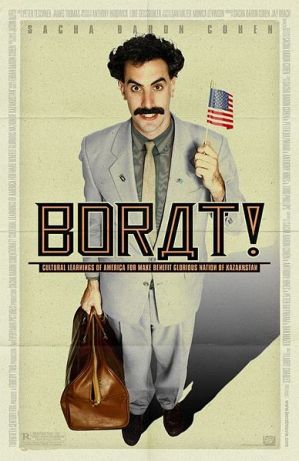
Today’s feature is Sacha Baron Cohen’s infamous shock-documentary, Borat: Cultural Learnings of America for Make Benefit Glorious Nation of Kazakhstan.

Borat was directed by Larry Charles, who has also been behind the documentary-style comedies Religulous, Bruno, and The Dictator, and has also served as a producer on television shows like Seinfeld, Curb Your Enthusiasm, Dilbert, The Tick, and Entourage.

Borat is based on a character originally created by Sacha Baron Cohen for Da Ali G Show, but the movie astoundingly has a total of 9 credited writers, including both story and screenplay credits for Cohen, Anthony Hines (Bruno), and Peter Baynham (I’m Alan Partridge), as well as a screenplay credit for Dan Mazer (Da Ali G Show) and a story credit for Todd Phillips (Old School, Road Trip, The Hangover Part II, The Hangover Part III).

The cinematography in Borat was provided by the duo of Anthony Hardwick (Bruno, Religulous, Entourage) and Luke Geissbuhler (Helvetica, A LEGO Brickumentary)

Borat in total had three primary editors: Craig Alpert (Pineapple Express, Funny People, Knocked Up), Peter Teschner (Horrible Bosses, Bride of Re-Animator, I Spy, Josie and the Pussycats), and James Thomas (The Muppets, Fanboys, Hot Tub Time Machine).

The music for Borat was provided by Sacha Baron Cohen’s brother, Erran, who has also provided the music for his other films The Dictator and Bruno.

The team of producers on Borat included co-writers Sacha Baron Cohen, Dan Mazer, and Peter Baynham, as well as Jay Roach (Meet the Parents, Meet the Fockers, Austin Powers: International Man of Mystery) and Monica Levinson (The Watch, Bruno).

The cast of Borat is made up mostly of unaware non-actors, outside of Sacha Baron Cohen and Ken Davitian (The Artist, Meet the Spartans, Get Smart, Frogtown II). A couple of recognizable faces do pop up in non-acting roles as themselves, like Pamela Anderson and politician Alan Keyes.

Todd Phillips was initially slated to direct the film, but left after filming just one sequence (the rodeo) due to creative differences with the rest of the team. He did wind up with a story credit on the final product, however.

The release of Borat unsurprisingly met with an immense amount of controversy, with countless individuals speaking out against the depictions and representations in the movie, as well as a handful of lawsuits being filed against the production.

In spite of the controversy, the initial response to Borat from critics and audiences was generally positive, and it still holds a 91% from critics on Rotten Tomatoes, as well as a MetaCritic score of 89%. However, time hasn’t been particularly kind to the movie: the continuously recorded IMDb rating has sunk to 7.3, alongside the currently updated Rotten Tomatoes audience score of 79% and MetaCritic user score of 7.2.

Borat made well over $128 million in its initial domestic theatrical release, on top of $133 million internationally, despite a number of national bans. The initial production budget was $18 million (what the hell was that money spent on?), making the movie wildly profitable, especially for a documentary.

There is a certain unfocused quality to Borat. Who is the audience supposed to laugh at in this movie? Instead of punching up or punching down, it just seems to flail, swinging limbs confusedly in every direction and hitting whatever it happens to come into contact with. This idea of the ‘equal opportunity offender’ seemed to be particularly popular at the time, using the idea that making fun of everyone excused making fun of stigmatized and oppressed groups in even the most lazy and demeaning ways. For an example of that, just take a look at Carlos Mencia’s Mind of Mencia, which ran on Comedy Central for 3 years from 2005 to 2008, operating specifically on this mentality.

borat3
“NOT very nice”

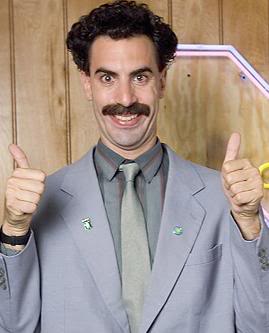
The moments of humor that are effective in Borat are pretty niche in their interest, having a specific focus on a combination embarrassment and schadenfreude. While this has gotten more popular over the years due to the correspondent segments on The Daily Show and the style of The Colbert Report, it still isn’t the sort of comedy that pops up a lot in blockbusters. This makes it all the more perplexing as to why it was so widely successful at the time. The best way to explain it is that the movie is satire gone wrong, and a lot of people were laughing at the ‘wrong things’. For instance, when Borat is referenced in popular culture, it is never done by playing on the humor of making common people look ridiculous for their hypocrisies and prejudices, but by mimicking the eccentricities of the character of Borat himself, like his bathing suit and his accent. Those aspects seem to me to be more of a means to an end in the movie, where the laughs are meant to be focused on the reactions of the people. Still, that doesn’t make these details ok, because they are still incredibly negative and shallow, but it is telling that those are the aspects of the film that people latched onto.

However, most of the humor throughout Borat is lazy and based on a ludicrous, concocted version of the nation of Kazakhstan: a lot of it seems to be based on massive misconceptions and general xenophobia towards people from the Middle East and Eastern Europe, making the movie not all that unlike the clueless conservative people it primarily aims to mock. Even the way the film is shot keeps the focus almost exclusively on the character of Borat, whereas Daily Show correspondent segments almost always stay trained on the target, with the character specifically being used to draw out reactions.

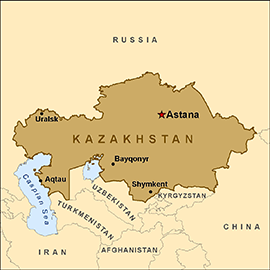
Speaking of which, why use Kazakhstan here? There is no resemblance between the portrayal in the movie and the actual country, so why not just make up a fake country? It just strikes me as being antagonistic without reason, just as a way to piss off yet another group of people. It is also a thoroughly confused portrayal, bouncing between considering the country Middle Eastern or Eastern European, which aren’t the same thing. Even worse, it isn’t really either of those things: It is a massive country, but is best classified as Central Asia. Hell, it has a massive Eastern border with China, and a significant Northern border with Russia. Honestly, I think they only picked Kazakhstan for this movie because it ends in “-stan,” and I guess that qualifies as ‘close enough’.

borat2

Borat definitely capitalizes off of domestic xenophobia and racism in the wake of 9/11 and the renewed American engagement in the Middle East, but it also punches hard at conservative and evangelical elements in the US, as I mentioned previously. It is also worth noting the amount of Russian and former Soviet influence on the style of pseudo-Kazakhstan, which provides kind of a double-whammy as far as ingrained negative bias from the perspective of western audiences.

It is worth pointing out that Cohen’s style of humor has seemingly rapidly decreased in popularity over time, with each of his Borat-esque films making less of an impact than the last. However, he has done some acting in a few acclaimed films in recent years, like 2012’s Les Miserables and Tim Burton’s Sweeney Todd, and isn’t awful as a comic relief element in those dramas.

On the Rotten Tomatoes aggregator, one review blurb in particular stood out to me, from critic Matthew De Abaitua of Film4:

“Borat is the funniest film imaginable right now.”

I think that kind of captures the phenomenon of this movie: for better or worse (mostly worse), it is a product of a specific time. I think a lot of people rightfully look back on it negatively now, but that should tell us a lot about the movie-going masses of 2006 in comparison to today’s audience more than anything else.

Sacha Baron Cohen made the decision to retire the character of Borat not too long after the film’s release, which I think was the best move for everyone. His reasoning is that he couldn’t surprise people anymore due to the character’s popularity, but I think there’s much more to it than that: Borat as an entity doesn’t belong in the present day, and it rapidly became the sort of tone-deaf portrayal that it was theoretically trying to mock. On some level Cohen must have known that, and it had to have influenced his decision to set the character aside.

I think Borat is worth rewatching for a lot of people, particularly to understand where society was at the time for it to become such a hit. The movie is honestly unremarkable, and suffers from being horrifically unfocused and poorly paced. If there is anything positive to say about it, it is that Cohen is capable of disappearing into a role, and that the film manages to sporadically capture the elusive quality of schadenfreude. However, it gets very bogged down in focusing on Borat as a semi-human caricature, rather than on the people around him. It does provide a semi-coherent example of how satire can so easily drift astray, and become a negative force.

Don’t Copy That Floppy

Don’t Copy That Floppy

copyfloppy

This post is based on a viewer request, which is being filled due to a donation to the Secular Student Alliance via during Secular Students Week (June 10-17, 2015). Thanks to all for your contributions!

There are few things in this world as delightful as dated Public Service Announcements and safety videos. There is so much nostalgia tied to these often extreme and tone-deaf cautionary messages, that it is hard not to look back fondly on them. Some of them have even become cultural staples of their times. Is there a better encapsulation of 1950s America than “Duck and Cover?” Or the late 1980s and early 1990s, as depicted by the Partnership for a Drug Free America?

But, of course, as you get deeper into the world of PSAs and children’s educational videos, things get much cheesier and weirder pretty quickly. This is the world where you might stumble across “Don’t Copy That Floppy,” right next to “Be Cool About Fire Safety” and “The Kids’ Guide To The Internet.”

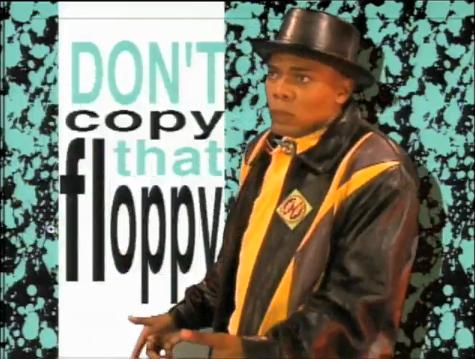
“Don’t Copy That Floppy” was created in 1992 by the Software Publisher’s Association, to raise awareness about copyright infringement and piracy. It was distributed to countless schools on VHS, but didn’t gain the popularity it has today until it popped up on YouTube many years later, and has gained a particular ironic popularity as a meme among the internet-savvy and technologically proficient. It even gained enough popularity that a sequel was produced in 2009, in order to update the message for a new era of technology and younger audiences.

There are a lot of reasons why this video has become so popular, not the least of which is the widespread nostalgia for the earlier days of computer technology. Given how quickly developments and improvements have occurred, it is hard not to giggle at the simpler days of floppy discs in a year when even CDs are on the way out as a storage device. However, in the case of “Don’t Copy That Floppy,” the message is what has really given it longevity (or the lack of it): anti-piracy.

Online piracy of video and music content is now easily commonplace, and is the topic of major legal battles and debate all over the world. Terms like “Napster” and “The Pirate Bay” are now in the public lexicon, in a way that the makers of “Don’t Copy That Floppy” just couldn’t have anticipated. The conversation over the ethics of online piracy is easily one of the biggest and most heated battlegrounds in the technological sphere today, so seeing it boiled down to such one-sided simplicity in the form of an early 1990s rap number is nothing short of ludicrous from the point of view of someone watching today.

Also, the video definitely goes over the top with its claims, such as implying that piracy will ultimately destroy the computer age, and that all computer businesses will have to shut down as a result of making duplicate copies of “The Oregon Trail.” It also only presents the most basic of straw man counterarguments, making it essentially propaganda as opposed to being an informative piece.

Last but not least, “Don’t Copy That Floppy” seems to perfectly capture the style of the early 1990s with its colorful backgrounds, dated hair styles, memorable fashion, awful music, and cheesy use of a green screen for effects. For anyone who lived through that decade, this video is an absolute delight.

I don’t remember ever actually seeing this video in school, but I certainly recall a whole bunch like it. Thanks to YouTube, these kinds of videos are easily within reach for anyone to check out, and thank goodness for that, because it is awful fun to go back through videos like these. If you have 10 minutes to kill on the internet, do yourself a favor and give a watch to “Don’t Copy That Floppy.”

New Post Index and Last Day for Requests

misantropeyhead

Based on some recent feedback, I found that the archives here on Misan[trope]y are a bit difficult to navigate. So, I’ve created an alphabetical post index, which you can now find on the top menu bar. Feel free to take a stroll through the past three years of reviews, but keep in mind that the older the reviews, the shorter and less detailed they are.

Speaking of which, from going through a bunch of my old posts to build the index, I noticed that I covered a lot of classic bad movies with really minimal posts, particularly towards the beginning of the IMDb Bottom 100 challenge. So, I’m planning to re-cover a bunch of those with a bit more detail in the near future, like Birdemic, Troll 2, and Manos: The Hands of Fate.

In the meantime, today is the last day where you can donate here to the Secular Student Alliance and make me watch whatever you want! It doesn’t matter how much you give, I will honor any request you have. I have already written about watching paint dry, Willy Wonka vs. Charlie and The Chocolate Factory, and I have tons more request-posts going up over the next week. Also, feel free to make me cover something again, particularly if I didn’t give it much detail at the time, or you thought I was way off the mark (I see all of you Hudson Hawk apologists out there).

ssalogo
Many thanks to everyone who has donated so far, and even more thanks to all of you who suffered through the Bibleman Marathon with me! If you haven’t given yet, I would love it if you did. If you can’t though, we are still totally cool. I hope you all are enjoying the posts, and you can always get me at mail@misantropey.com.

robotjox1

Willy Wonka vs Charlie: King of the Chocolate Factory

Willy Wonka and The Chocolate Factory

wonka2

Charlie and The Chocolate Factory

wonka1

This post is based on a viewer request, which is being filled due to a donation to the Secular Student Alliance via my fundraising page during Secular Students Week (June 10-17, 2015). That means that you still  (at the time of this publication) have a day to donate and have your request filled!

Today, I’m going to be taking a look at a couple of films based on Roald Dahl’s book, Charlie and The Chocolate Factory: the charming 1971 classic, Willy Wonka and The Chocolate Factory, directed by Mel Stuart and featuring Gene Wilder, and the 2005 re-imagining helmed by Tim Burton and starring Johnny Depp, which used the original book’s title.

Willy Wonka, is, of course, one of the most widely beloved family movies in history. Gene Wilder’s performance, the visual style, and the memorable musical numbers all made for a fantastic experience that has lasted well through the years.

When it came time for the inevitable reboot for the classic flick, Tim Burton was the choice to bring Wonka back to the screen. On paper, it makes sense to hand the reigns of a remake to one of the quirkiest and darkest children’s movies ever made to Tim Burton. At this point, he had shown that he was more than capable of making weird, dark, family-focused movies that could resonate with massive audiences. However, Charlie failed to see the kind of success of his previous films like Beetlejuice and Batman.

For context, Charlie and The Chocolate Factory was made around the time that Burton’s career was only just starting to look less pristine than it once had. While his previous film, Big Fish, was generally well liked, his highly publicized remake of Planet of the Apes was not warmly received, and proved that Burton was more than capable of mishandling a film. However, no one expected Burton to become the critical pariah that he is now. The next few Depp / Burton collaborations were increasingly more reviled following Charlie, with the possible exception of Sweeney Todd (depends who you ask). Charlie and The Chocolate Factory essentially marked the beginning of Burton’s and Depp’s steady fall from critical grace, which would later include Alice in Wonderland and Dark Shadows.

To start off the comparison between these two films, let’s look at the opening sequences. Charlie presents a dull, drab, and mechanized world created through digital effects, which, to be fair, gives off the vibe of a true industrial factory. However, Willy Wonka presents a wondrously shot sequence of the fascinating process of physically making candy, which shows off the beauty of uniformity, almost like the various candies were synchronized swimmers. While Buton’s introduction does set the visual tone for the film, it doesn’t do so in nearly the vivid way that Stuart did: building a sense of child-like wonder from the first shot and note of the score. Frankly, it just doesn’t even begin to compare as far as first impressions go. You can take a look at both introductions below:

Speaking on the introductory sequences, they also showcase another major difference between these films. Willy Wonka extensively uses practical effects throughout the film, which is primarily because the technology to do otherwise didn’t really exist at the time. If you do take a look at the few special effects that are present in the film, they are the most dated things in the movie by far (like the green screen use in Mike Teevee’s fall). On the other hand, Charlie might as well be a Star Wars prequel with the amount of special effects used to construct the other-worldly sets. We are now only 10 years down the line from Charlie’s release, and it already looks massively outdated and flat due to the rapid advances in technology during that time. That is unfortunately the nature of doing a special effects movie: they don’t age well, with very rare exception. On the flip side, Willy Wonka has still held on to most of it’s charm, because it only relies on gimmicks when it absolutely has to, instead favoring the construction of a tangible world of wonder.

One of the keys to the success of the original Willy Wonka was the musical score, which created a number of memorable songs. For Burton’s take, long-time collaborator Danny Elfman was brought on for the music, who is one of the most acclaimed composers working today. Unfortunately, he totally missed the mark in Charlie. While the background music is pretty decent, the songs are totally forgettable, to the point that they seem phoned in. Willy Wonka has a beloved soundtrack that was of course going to be difficult to follow up on, but instead of paying respectful homage, Elfman went in an entirely different direction that just didn’t resonate with people. The music was frankly more than backdrop in Willy Wonka: it was a key to the emotional core of the film, helping to portray intense moments of sadness, longing, and joy in ways that dialogue alone couldn’t. Thus, the failure of the soundtrack to Charlie goes beyond just not providing decent musical interludes: it marks a failure to illustrate the emotions of the characters.

For an example of this, The Chocolate Room introduction sequence exemplifies everything that is right about Wonka and everything that is wrong about Charlie. Wonka uses the song “Pure Imagination” to introduce the guests to his world, while also teaching us a little bit about Wonka’s misanthropic outlook: if you are paying attention, you come to understand why he is a recluse, and why he has chosen to live in the land of his creation. Humanity, essentially, just can’t live up to his standards for it, so he has willingly retreated away from it into a land of his own imagination. It is a really moving sequence, where Wilder gets to show off his emotional range as an actor, and give us insights into Wonka’s mindset without him explicitly telling us what he is thinking. Most people focus on the children in the sequence, but it is actually a much more interesting scene to watch with Wonka in focus and the purpose of the contest in mind. Charlie, on the other hand, just shows a room full of computer generated chocolate and candy, with narration from Wonka as if the audience is watching an industrial training video. Frankly, it’s dull, and lacks any of the emotional punch or potency of its predecessor. Depp’s Wonka just seems bored, like he is going through the motions. That isn’t the worst way to portray him, but it just doesn’t live up to the previous portrayal from Wilder, and lacks the powerful subtleties and emotions that were present there.

I’m a big fan of the set design and visual style of Willy Wonka: the split-in-half office furniture, the human hands for coat hangers, and the various candy creations are all laced with visual ingenuity, in a way that a master, eclectic inventor would believably design things. This is usually something Tim Burton is particularly good at portraying, but in my opinion, the result with Charlie is something that is at once excessively alien and astoundingly flat. Willy Wonka‘s visuals are odd, but never lose a slight sense of reality and believability. Charlie might as well be an animated film for how it looks, even in segments where it should really appear realistic. This may be more of my personal preference than anything, because there are certainly fans of Burton’s visual style in Charlie, but I wasn’t a fan of it here.

Of course, I have to bring up the style of Willy Wonka himself in these two films. There is an astounding amount of depth in Wilder’s performance, without any explicit detail ever being offered: you can tell that he is fatigued by the way he speaks and carries himself, sliding in a biting bit of humor here and there. I even adore his odd moments of randomly changing languages in the middle of a scene, which adds more flair of eccentricity and intelligence to him. Depp’s Wonka, on the other hand, is just a man-child: a Michael Jackson-influenced version of Wilder’s character, with all of the subtleties and wit sapped out. As much as that image might fit what people would imagine on paper for an eccentric candy man, it isn’t actually very interesting to watch. It is also worth noting that Depp, while being a good actor, isn’t nearly as talented at the comedic aspects of the profession as Gene Wilder, which certainly didn’t do him any favors in this role.

When it comes to the humor in these movies, the writing for Charlie just doesn’t even compare to Wonka. The amount of sly humor in the background of Willy Wonka is part of what makes it so legendary, and at times makes it seem like an episode of Monty Python’s Flying Circus. For instance, the scenes showing the fervor over the golden ticket sweepstakes are hilarious in Wonka: sequences like the indignant supercomputer, the Wonka bar hostage situation, and the teacher who can’t quite figure out how to calculate percentages are as golden as Wonka’s goose eggs. For comparison, the gags in Charlie are just weak. The accessory cast doesn’t get to do a whole lot, and Wonka’s quips aren’t nearly as surreal or vaguely menacing as they were in Wonka.

Child acting is tricky, particularly when the characters aren’t particularly deep. Willy Wonka certainly didn’t hit 100% with the casting, but the kids were passable at least, and fantastic at best (like Veruca Salt, who I thought built a fantastically loathsome character with her performance). Burton’s Charlie, on the other hand, is filled with even more one-dimensional, obnoxious creatures, who suffer even further from being portrayed by half-assed child actors. Even the kid who plays Charlie himself is nearly unbearable.

Last but not least, Burton’s Charlie provides a lot of extraneous information that isn’t essential to the story, and saps a bit of the element of imagination and wonder out of it. For example, explicitly showing the other children alive was unnecessary, and actually ruined some of the darker humor. Likewise, the Oompa Loompa homeland should really have been left to the imagination, because nothing could be shown that could live up what people concocted in their minds. Also, what is the point of meeting Willy Wonka’s dad? Every time there is a flashback to Wonka’s past, the story grinds to a halt, and the exposition about Wonka’s life is ultimately useless. I love Christopher Lee as much as anybody else, but his character just wasn’t needed at all here.  Charlie might have included some of these things in order to be more faithful to the book, but that doesn’t necessarily make for a better movie.

The Nostalgia Critic took a look at the comparison between these two films previously. I agree with him on most of his points, but he has a far more positive take on the Burton version than I do. Personally, I find it incredibly obnoxious and shallow, even for a children’s feature. I also think it actually marks the dramatic beginning of Burton’s slide into mediocrity, even more so than his take on Planet of the Apes. I will say that I didn’t hate Sweeney Todd, but the rest of his work over the past decade doesn’t even come close to the achievements of his career before that. If he didn’t have such a loyal, cult-ish following, he would be done for as a directorial force.

To Burton’s credit, Charlie is a distinct movie made from his own vision, and he didn’t allow himself to be constrained or ruled by the classic film. I don’t doubt that this is exactly the film that he intended to make, and all power to him for doing that. However, it just isn’t very good, and is particularly not as good as the original. It just doesn’t seem like he was firing at all cylinders for whatever reason, because he is undoubtedly capable of better work than this. I will say that it definitely portrays the differences between the classes very well, which is a really important aspect to the story, but I don’t have a whole lot of positive things to say beyond that.

I’m not one of those people who gets up in arms at every announcement of a film reboot: it is just a fact of the business at this point. I don’t at all mind new takes on classic stories, because that happens in all creative mediums, and oftentimes improvements come of them. For example, look at Charlie‘s Christopher Lee: his take on the character Dracula for Hammer Films provided a new vision of a classic, and one that has dramatically influenced the direction of the vampire in contemporary fiction. So, reboots aren’t always bad. That said, there is definitely a reason why people are so weary of the Hollywood reboot machine these days: the good products are few and far between, and Charlie and the Chocolate Factory is no exception.

On the positive side, the release of Charlie and The Chocolate Factory exposed a whole new generation to the classic Willy Wonka, which is certainly a good thing. And, of course, Charlie has its share of fans who defend it, so it at least managed to resonate with some people out there. I don’t agree with those people, but there’s a reason why there are so many varieties of candy.

Watching Paint Dry: A Review

This post is based on a viewer request, which is being filled due to a donation to the Secular Student Alliance via my fundraising page during Secular Students Week (June 10-17, 2015).

paintdry

I don’t think there is any idiom more often used in the discussion of bad films than the classic simile, “like watching paint dry.” There is no other universal image that so perfectly captures the frivolousness, agony, and boredom that many people experience while watching a sub-par movie. It really describes everything a conventional movie shouldn’t be: static, passive, un-engaging, and without thought.

Sure, there are some exceptions to this rule: some art films have been made with the expressed purpose of inciting the feeling of boredom, But as far as the general public consciousness goes, if a movie is “like watching paint dry,” it is because something has gone horribly wrong.

I consider myself a sort of specialist at watching bad movies. Given how often this experience is compared to “watching paint dry,” I assume I will be able to handle the task of, basically, watching paint dry on a surface. But how similar are the two activities, really?

It takes a fair amount of willpower and determination to suffer through a movie like “The Maize” or “Daniel Der Zauberer,” but is that the same kind of endurance necessary for the classically menial task of watching paint dry? I will say this: I have watched a pot boil. I don’t know why I did it, apart from the fact that I wanted to prove that I could. That brings up a whole different question of how similar watching pots boil and watching paint dry are, but my point is this: I have challenged the traditional wisdom of idioms in the past, and I have been victorious.

paintdry1

Now, there are a lot of ways that I could theoretically watch paint dry. In fact, there are more than you might expect: there are numerous YouTube videos varying in lengths of a few minutes to 10 hours, a live webcam of paint drying, and even a flash game created around the concept that gives you achievements for how long you continue, ranging from a few minutes to an entire day. Alternatively, of course, I could go buy some paint and put it on something.

For the sake of time, I decided to go with a 10 minute YouTube video, done by the channel “10minutesofyourlife,” which you can see below.

First off, I appreciate that they decided to use an eye catching color. Can you imagine if that were gray or beige? On to a negative: what are they doing with that tripod? There is an awful lot of camera movement for a video whose expressed purpose is *watching paint dry.* You don’t need to operate the damn thing, we’re not looking for creative angles, here. On the flip side, it does provide a little bit of welcome variety for a monotonous activity.

One thing that becomes clear very quickly while watching paint dry is that you become acutely aware of your other senses. Not only am I focusing on the background noises in my apartment (various mechanical hums, electronic buzzes, and cat sounds), but also on the curious background of the video itself. For whatever reason, I initially assumed that the setting of this video was indoors, but the details start becoming clear quickly: the stained wood at the bottom of the frame must be a deck, and the amount of background noise leads me to assume that there must be nearby traffic. That does beg the question, though: is this person planning to paint their house in this vivid green color? I’m not sure if that would be more weird or awesome.

Around minute five, I started thinking more about the form of the piece. The consistency of the paint is a bit odd, in my opinion: somehow thicker, and more plastic-like than I expected. It looks a little like “Gak,” for those of you who remember what that is. Also, the shape of the paint’s pattern is bizarre: there’s clearly no reason to it, but it also clearly wasn’t done haphazardly. Note, there are no splatters, so it wasn’t just slung against the wall. However, there is also no sign of orderly brush work, and the edges and smooth and pristine. Honestly, I’m not entirely sure how they managed to do this. Even the pooling at the base seems surreal, as the quantity seems oddly high, and it has clearly already been allowed time to creep its way across the horizon between the wall and the deck. I feel a little cheated, as if someone tore the first chapter out of a book. How did the paint get this way? I am missing some crucial developmental information about the paint and its relationship / experience with the wall. I understand the realistic style of telling a story in medias res, but I feel like the purpose of watching paint dry is to get the completest  possible view of the experience, from beginning to end. I’m not here for a highlight reel, I’m here for a full ride.

There is a message on the ground, partially obscured by the pool of wayward paint (which oddly does not seem to perceptibly expand over the course of the video). “_________ _______ MUST BE INSTALLED.” It is clearly the sort of industrial message one would find on a work in progress, and isn’t something you would ever see on the exterior of a finished product. This is something that we, as casual observers, are not supposed to see beneath the surface of our surroundings. But these messages, surely, are in buildings we enter every day: internally facing, and invisible to pedestrians. The paint serves to hide these messages from us, both in this video, and in our everyday lives. What “must be installed,” I wonder? We may never know, not without chipping away at the dried paint. And then, what was the process all really for? Maybe it was too late to install this mysterious object/program all along, and it is for the best to just leave it alone.

The video ends abruptly, and I was honestly jarred by it. You can’t help but sink into the process of watching paint dry, because it is so difficult to perceive the progress. With watching water in a pot boil, there are definite stages: you feel the heat rising, the bubbles begin forming at the bottom of the pot, there is a brief simmering pre-boil. Watching paint dry lacks any of this structure, so you are left completely on your own. In my case, my mind was desperate to find something to focus on, and I was able to find it in analysis of the minor details.

So, how does this tie back to movies? Well, there are two points worth making.

First: structure is vastly important to maintaining an audience of any kind. It doesn’t have to be traditional, but it needs to be present in some way to keep people engaged. This is one of the worst ways a movie can collapse, and it typically happens in either the editing or the initial screenwriting. We, as audience members, are conditioned to expect a certain kind of structure in a film, to the point that it is unconscious within us. When looking at screenplays, many people use a shorthand of “expecting x event by y page” to gauge whether it will play with audiences, because that is what we expect. When a movie is written without those important beats to keep us all on pace, the result is that, generally, people get bored.

Inexperienced writing and non-creative editing are usually the key things to blame when these structural things go wrong. For cases of the latter, give a watch to movies like “They Saved Hitler’s Brain” or “Monster A Go Go”: both incomplete films that were finished long after the fact and stitched together with minimal thought or care for the editing process. For some examples of the first, I would point out any popularly failed attempts to adapt television shows to the big screen: “The Singing Detective” and “The Last Airbender,” for instance.

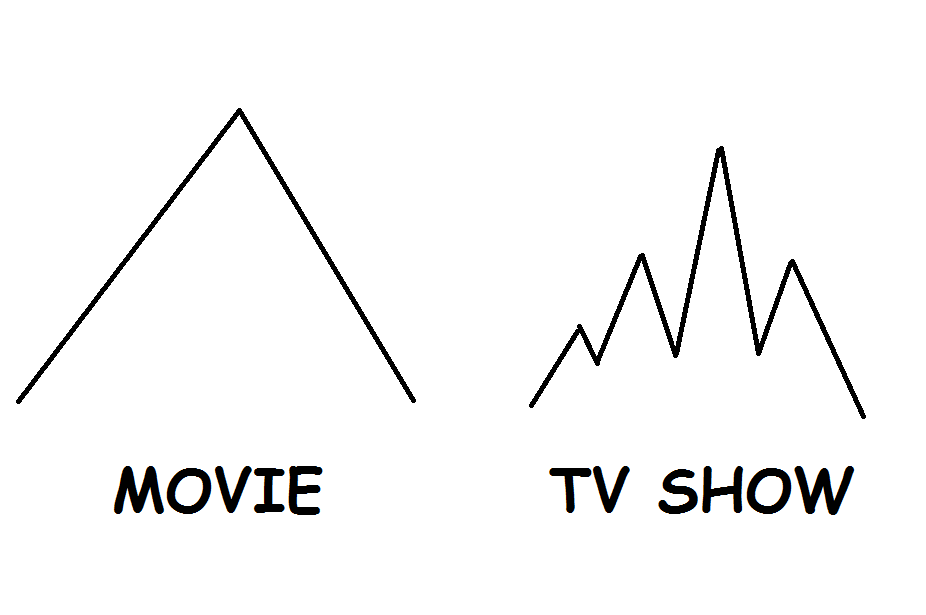
Television show plots are usually (not always) structured differently than films, with miniature arcs and developments over the course of individual episodes combining to create a greater arc of a season or a series. Movies typically have one, distinct arc. Here is a visual way to think about that:

graph1So, in order to turn a TV show plot into a movie, you have to do something to fill in the valleys. In the case of “The Last Airbender,” this was done with brief sequences of exposition acting as transitions, which was apparently the best way they could figure to stitch the story together in a cinematic way. Obviously, that didn’t work out so well.

So, back to paint drying. Part of the reason that the experience is so awful is the lack of a perceptible structure. Another way to look at this is by comparing it to distance driving. An 8 hour drive through flat territory with no landmarks is awful, because there is no perceptible demarcation to indicate progress, which helps us break down the experience. However, an 8 hour drive between, say, Cincinnati, Ohio and Birmingham, Alabama features a number of urban areas as landmarks: Louisville, Kentucky and Nashville, Tennessee, for instance. This helps us digest the whole experience better, just like we do with any experience: memorizing numbers, distance driving, watching movies, or watching paint dry.

As I mentioned before, there are two points I wanted to make about the parallel of movie watching and watching paint dry: the second is the similar importance of being an active observer in the experience. For sitting through the experience of watching paint dry, I had to dig around the details of what I was watching to keep myself entertained and focused on the task. That is pretty much the same thing I do with especially dull movies: close reading and analysis is a different experience than just watching something unfold before you: it is about minor details, and appreciating the entirety of the experience. In the case of watching paint dry, this meant noting the sounds in the background, paying attention to the shape the paint was taking on the wall, and even reading the obscured message on the ground and coming up with a bullshit theory. With a movie (particularly a shitty movie), this might be noting the positioning of the actors in a shot, paying attention to the repeated use of colors and specific objects, keeping track of the continuity of scenes, and coming up with bullshit theories to cover up gaping plot holes and errors. Honestly, I think it is easier to do close readings of bad movies, because there is rarely anything else worth paying attention to on screen (y’know, kind of like paint drying). It is a good skill to have, and it is something that most people are taught to do on some level in literature or English classes in primary school. Watching films as visual literature and art in addition to entertainment is part of what makes it so cool for so many people. It can also theoretically help you watch paint dry, so there’s that.

All in all: yes, there are significant similarities between watching paint dry and watching bad movies. However, I think bad movies can be a little more constructive: in many ways, you can reverse engineer a lot of the elements of what makes a good movie by diagnosing how bad ones ultimately fail. With watching paint dry, you aren’t going to get a whole lot out of the experience, apart from really odd bragging rights.

If you want to make me do a review of literally whatever you want (even watching paint dry), make a donation to this page (of any amount) by June 17, 2015. I will cover any request you have for as low as a $1 donation. Really. Also, enjoy my (God)Awful Movies BibleMan franchise marathon as part of Secular Students Week, and check out the excellent work of the Secular Student Alliance.

Blood Diner

Blood Diner

blooddiner1

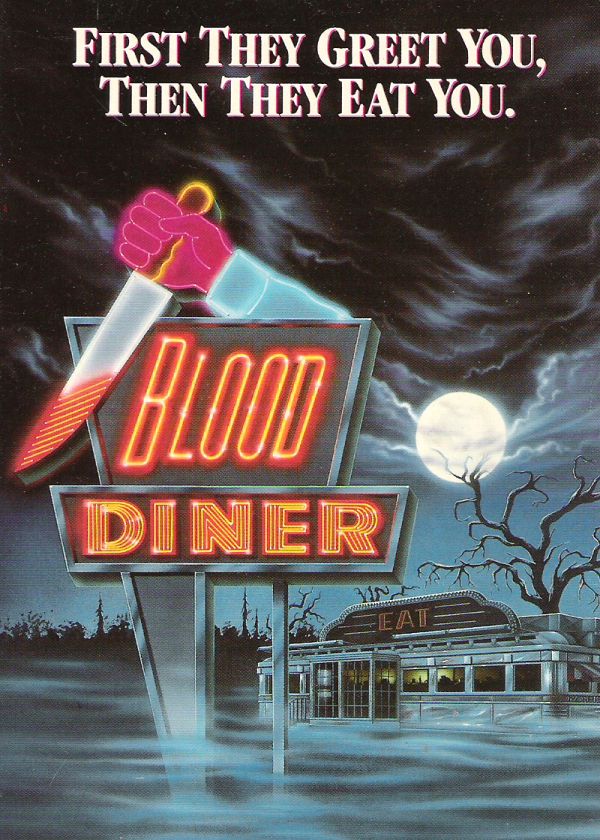
Today’s feature is “Blood Diner,” a peculiar little horror-comedy from the late 1980s that involves cannibalism, blood sacrifice, and veggie burgers.

“Blood Diner” was written by Michael Sonye. Sonye was primarily an actor, appearing in films such as “Surf Nazis Must Die,” but wrote a handful of b-movie screenplays, including “Cold Steel” and “Star Slammer.”

“Blood Diner” was directed and produced by Jackie Kong, who only had a handful of credits in the 1980s. She was also involved in the schlocky films “Night Patrol” and “The Being.”

The cinematography for “Blood Diner” was done by Jurg V. Walther, who has worked on such (not-so) esteemed films as “Daniel Der Zauberer,” “Zombie Nation,” “Joysticks,” and “Hot Dog: The Movie.”

The music for “Blood Diner” was composed by Don Preston, who did the music for most of Jackie Kong’s films, as well as “Eye of the Tiger” and “Android.” He also interestingly provided the synthesizer work for the score to “Apocalypse Now.”

The editor on “Blood Diner” was Thomas Meshelski, who also cut such horror films as “Puppetmaster” and “TerrorVision.”

The “Blood Diner” effects team included Larry Arpin (“Maniac Cop,” “Maniac Cop 2,” “Maniac Cop 3,” “The Dentist”), Loraiana Drucker (“Friday the 13th Part VII,” “The Blob”), Bruce Zahlava (“Dead Heat”), Michael Hyatt (“Leprechaun”), and Aaron Sims (“From Beyond,” “The Spirit,” “Baby’s Day Out”).

One of the executive producers for “Blood Diner” was Lawrence Kasanoff, who is best known for producing movies like “Mortal Kombat” and “Class of 1999,” but also infamously directed the animated disaster that is “Foodfight!”

Most of the cast of “Blood Diner” is made up of actors who have appeared in no other films, or at most just a handful of other similarly low-budget horror movies. Usually movies like this seem to have one or two players who eventually found some form of success, but that isn’t the case here.

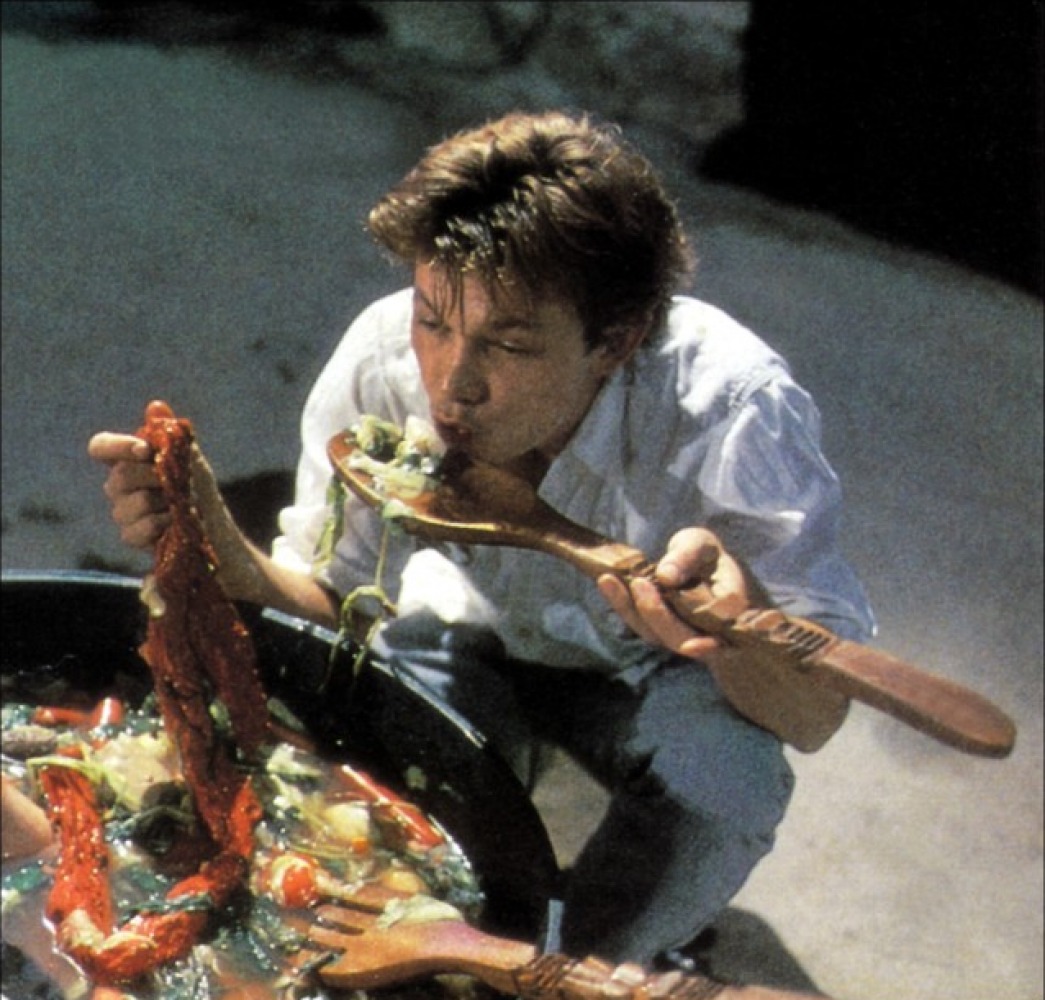
blooddiner3The story of “Blood Diner” centers around two cannibal brothers who co-own and operate a diner. They plan to resurrect an ancient God with a massive blood sacrifice, under the guidance of their newly resurrected undead uncle. Their preparations (namely the mass killings) attract attention from the police, who race against the clock to foil their plans.

The reception for “Blood Diner” was unsurprisingly negative, though not as poor as one might expect. It currently holds a rating of 5.0 on IMDb, along with a 53% audience score on Rotten Tomatoes.

“Blood Diner” was apparently initially intended as a sequel to Herschell Gordon Lewis’s “Blood Feast,” but the idea was scrapped before filming commenced. However, the plot similarities certainly remain for the sake of homage and parody.

A few parts of “Blood Diner” play for genuine laughs, such as the opening radio interruption warning listeners about an escaped killer in the area. However, most of the comedy feels added in after the fact, like this was meant to be serious horror, but half way through they realized how ridiculous it all was and tried to laugh off their incompetence. The result is a quasi-parody that rides the line between mocking and truly becoming the thing it is trying to make fun of. The humor is also pretty lazy on the whole, like it was concocted on the fly by people who don’t make a living in comedy.

Something else that can’t be ignored about “Blood Diner” is the musical score, which is the deadly combination of being both really terrible and extremely loud. The sound editing is straight horrendous, to the point that the music manages to overpower the outlandish acting on screen at times (or at least that was the case on my copy).

Speaking of which, ‘hammy’ doesn’t even begin to describe the acting in “Blood Diner.” Everyone seems to be over the top in one way or another, like all of the characters are trying to out-weird or act over each other. There is also some god-awful child acting in the introduction sequence that ranks up there with some of the worst that I have ever seen.

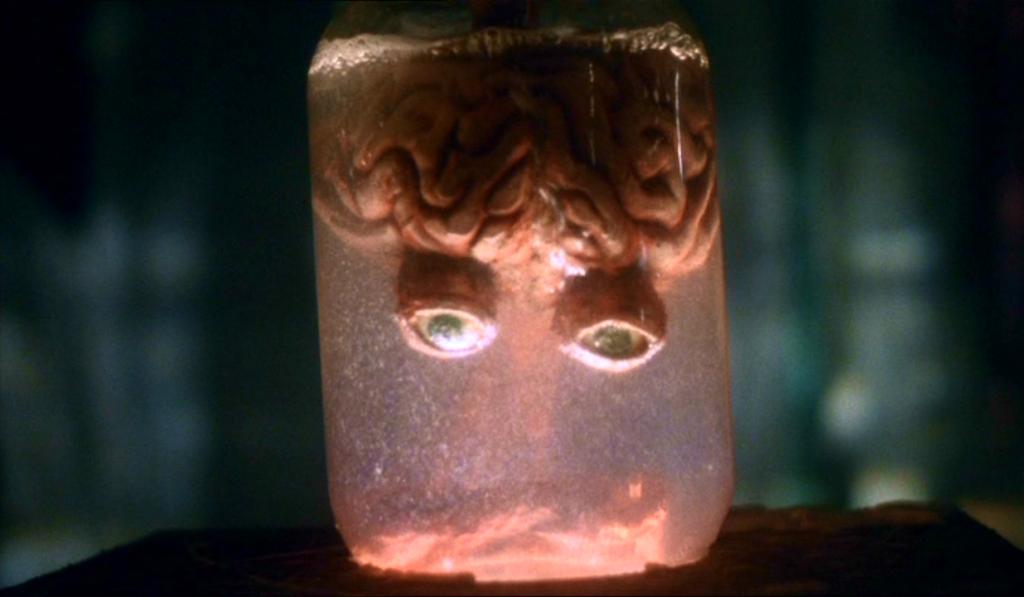
If there is anything positive to say about “Blood Diner,” it is that the cast of characters is certainly colorful, and makes for an odd and surreal world for the story to take place in. One of the key accessory characters, for instance, is a rival diner owner who is also a compulsive ventriloquist. There is also a group of explicitly vegetarian cheerleaders, a Hitler-themed professional wrestler, a talking undead brain, and a popular craze of nude aerobics.

blooddiner2One thing I still don’t understand about the plot is why the brothers pretend that their cannibalistic product is vegetarian, apart from the fact that it seems to be a popular fad in the world of the movie. It just strikes me as a little too easy of a ruse to spot, and they couldn’t possibly keep it up for too long for logistical reasons alone.

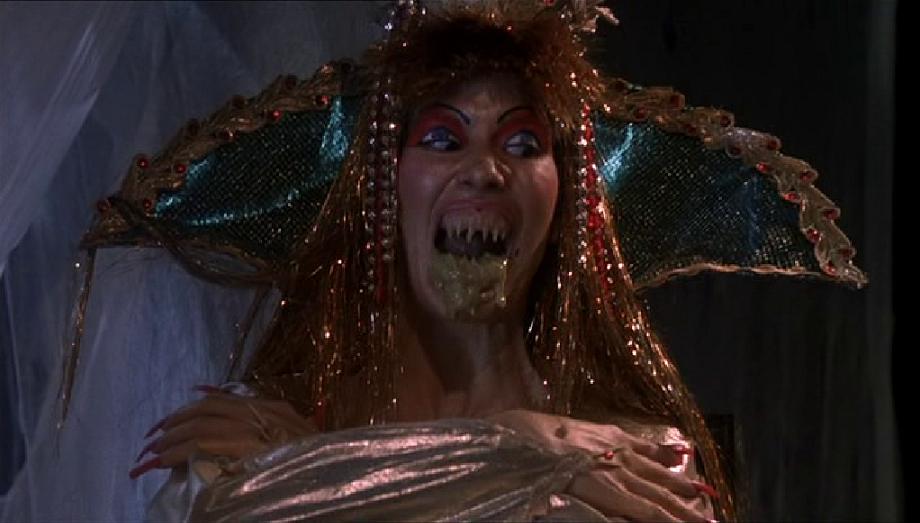
The God-raising ritual itself (the “blood buffet”) is the most bizarre section of the film by far. The Frankenstein-ish patchwork vessel for the deity is genuinely unsettling and bizarre, and the entire sequence plays like an intense fever dream. The nightclub setting is pretty much perfect for the finale, and the awful music is up to 11 throughout the whole sequence. The film is probably worth watching for that alone, because it is a spectacle of awfulness.

blooddiner4Overall, “Blood Diner” is a damn strange movie. As I said before, it rides a line between being parody and an earnestly terrible film, which makes it all the more intriguing to watch. How many of these moments were meant to be funny? Were they meant to be funny in the way that they are funny? The finale sequence alone makes it worth the watch for bad movie lovers, but I’m not totally sure how casual movie goers would react to it. It certainly isn’t dull, and has a lot of gore and ridiculousness to go around, but it also doesn’t quite have the same charm of the bad movie “classics” that everyone loves, which I think is because of the elements of intentional humor within it. If you are looking for a deep cut for a bad movie night, this could make an interesting pick. Better yet, it is entirely available on YouTube.

The Singing Detective

The Singing Detective

singingdetective1

Today’s feature is the surreal musical “The Singing Detective,” starring Robert Downey Jr. and Mel Gibson.

“The Singing Detective” was initially written as a BBC series by Dennis Potter, who also wrote the screenplay which ultimately led to this movie adaptation. Potter actually did suffer from extreme psoriasis, just like the lead character in “The Singing Detective.” Unfortunately, he died of cancer almost ten years before this film of his work was made.

“The Singing Detective” was directed by Keith Gordon, an actor who has directed a handful of pictures, such as “Mother Night,” “Waking the Dead,” and “A Midnight Clear.”

The cinematographer for “The Singing Detective” was Tom Richmond, who also shot such films as “Chopping Mall,” “Killing Zoe,” “Stand and Deliver,” “Mother Night,” and “House of 1000 Corpses.”

The editor on “The Singing Detective” was Jeff Wishengrad, who had worked with Keith Gordon on “Waking the Dead” and “The Chocolate War,” and also cut the horror film “Sorority House Massacre.”

The significant makeup effects team for “The Singing Detective” was composed of members of Captive Audience Productions, which is best known for doing movies like “The Passion of the Christ,” “Bicentennial Man,” “A Beautiful Mind,” and “Van Helsing.” The team included Anita Brabec (“The Hunger Games,” “Confessions of a Dangerous Mind”), Tom Killeen (“Red Planet,” “Spider Man 3”), Keith VanderLaan (“Son of the Mask,” “Van Helsing,” “Kull The Conqueror”), Greg Cannom (“The Pit and The Pendulum,” “Space Truckers,” “Jingle All The Way,” “Captain America,” “Highlander II,” “It Lives Again”), Corey Czekaj (“The Master of Disguise,” “Avatar”), Mark Nieman (“Foxcatcher,” “Big Momma’s House”), Pam Phillips (“Sideways,” “Bones”), Sam Sainz (“Toys,” “RoboCop 3”), and Patty York (“From Hell,” “Secret Window”).

singingdetective2The visual effects for “The Singing Detective” were provided by WhoDoo EFX, a company which also worked on such films as “Charlie Wilson’s War,” “The Stepford Wives,” and “X2.” The specific credited workers were Helena Packer (“The Last of the Mohicans,” “Tank Girl,” “Twin Peaks”) and Mark Ritcheson (“The Tuxedo,” “Anamorph”).

The special effects team for “The Singing Detective” was made up of Scott Blackwell (“24”), Jeremy Hays (“League of Extraordinary Gentlemen,” “State of Play,” “Tiptoes”), and David Peterson (“8MM,” “The X Files,” “Monkeybone,” “The Adventures of Ford Fairlane”).

The cast for “The Singing Detective” is headed by Robert Downey Jr. (“Iron Man,” “Kiss Kiss, Bang Bang”), Mel Gibson (“Lethal Weapon,” “Signs,” “Braveheart,” “Mad Max”), and Robin Wright (“House of Cards,” “State of Play,” “Unbreakable”), with the accessory players filled out by Adrien Brody (“The Pianist,” “Predators”), Jon Polito (“Miller’s Crossing,” “The Man Who Wasn’t There”), Katie Holmes (“Phone Booth”), Carla Gugino (“Sucker Punch,” “Watchmen”), and Jeremy Northam (“Mimic,” “The Net”).

singingdetective3The story of “The Singing Detective” takes place primarily inside the mind of a troubled, bedridden author with a debilitating skin condition, who increasingly lives inside a hallucination of one of his stories, where he lives as a dashing detective who also sings at a local night club.

Robert Downey, Jr. and Keith Gordon apparently met while they were both filming the Rodney Dangerfield comedy film “Back to School,” in which they both portrayed young characters.

The screenplay for “The Singing Detective” spent years rotating from studio to studio, with directors such as Robert Altman and David Cronenberg at one point or another expressing interest. Rumor has it that Altman was set to cast Dustin Hoffman as the lead, whereas Cronenberg had his eyes set on Al Pacino.

“The Singing Detective” was made on a budget of nearly $8 million, but grossed less than 350,000 in its limited theatrical run, making it a significant financial flop. The reception wasn’t much better: it currently has a 5.6 rating on IMDb, along with Rotten Tomatoes scores of 39% (critics) and 41% (audience).

“The Singing Detective” has a number of similarities to another Keith Gordon movie that I really like: “Mother Night,” adapted from the Kurt Vonnegut novel. Both stories center on an awful but oddly sympathetic protagonist being put through the ringer of life’s harshest struggles. However, “The Singing Detective” doesn’t pull off the same gravity as “Mother Night,” which benefits greatly from being shot starkly and in uniform shadows. Campbell from “Mother Night” is also a little more realistically portrayed as a human in deep pain, and isn’t constantly thrown into surreal hallucinations and manic musical numbers (which is not a fault to be leveled at Downey).

Speaking of which, Robert Downey Jr. is a particular highlight to “The Singing Detective,” and uses his typical sarcastic, frenetic charm to great effect. However, it is also combined with a pained bitterness and instability to create an incisive and paranoid character.

“The Singing Detective” is a little too incoherent to work effectively, but it is also oddly not quite surreal enough, either. I would have been fascinated to have seen Cronenberg’s or Altman’s takes on the story, because I think either of their styles would have fit it fantastically. Altman would have relied on character interactions, whereas Cronenberg could have turned it into something like “Videodrome” with a film noir twist.

This story just isn’t suited for casual moviegoers at all, and the advertising seemed to be done in a way that would trick people into the theater, which is a clear recipe for a disaster reception. The campaign certainly didn’t portray the movie as what it is: a depressing, cynical hallucination. It seemed like the advertising team just saw the title, and tried to sell the movie on that alone. Honestly, who wouldn’t have expected a jukebox musical noir from something called “The Singing Detective?”

Translation from television to film is always a bit tricky, as television shows are typically structured to follow a much longer arc than movie. In this case, the story of “The Singing Detective” specifically doesn’t lend itself well to the act structure of a film (at least for mass audiences). I was reminded a lot of Anthony Hopkins’s “Slipstream,” in that it lost itself in being profound, drifting right off into incoherence, and the slow pacing certainly didn’t do that any favors.

The production of “The Singing Detective” probably should have done new renditions of the songs featured in the film, as the lip syncing just doesn’t come off right, and isn’t particularly consistent either. The old tracks also keep the sequences from being truly distinct or charming, which they really could have been. The writer, Dennis Potter, was apparently adamant that the actors not sing the songs, so the lip syncing was actually specifically written into the script. This brings up another issue, in that the writer (or in this case, his will) may have had too much influence on the production (usually they have almost none), and thus muddled the vision. In any case, I guess what they did here is still better than “Viva Laughlin,” the failed musical television show (which was also adapted from an acclaimed BBC series) in which the actors bizarrely sang over the original tracks. It could always be worse, right?

Mel Gibson, to my shock, is actually pretty good here, and is nearly unrecognizable with the makeup effects. He doesn’t usually step outside of his comfort zone, so this was interesting to see. This was also a few years before he went completely off the rails, while he still had some real talent before sliding into self-parody. Robin Wright is also pretty great, as she always seems to be. She might be one of the most under-appreciated consistent performers in the business, even when in mediocre-to-awful movies.

Overall, “The Singing Detective” is a thoroughly flawed but interesting watch. The performances and direction are good, but the writing seems to be missing something to push it over the edge. Given the resurgence of both Robert Downey Jr. and Robin Wright in recent years, it is interesting to go back to. However, if you are just looking for pre-“Iron Man” RDJ performances, go to “Less Than Zero,” “Kiss Kiss, Bang Bang,” or “True Believer” before this one.

S. Darko

S. Darko

sdarko1

Today’s feature is yet another in a long tradition of unnecessary and reviled sequels: 2009’s “S. Darko.”

The director of “S. Darko” was Chris Fisher, who has primarily done work on television shows like “Warehouse 13” and “Person of Interest” as a producer and director.

The writer for “S. Darko” was Nathan Atkins, who has worked as an assistant editor on shows like “Masters of Horror” and “24,” but has also written a handful of TV movies like “Abominable Snowman.”

The cinematographer on “S. Darko” was Marvin V. Rush, who is a veteran director of photography on television shows such as “Hell on Wheels,” “Star Trek: Enterprise,” “Star Trek: Voyager,” “Star Trek: The Next Generation,” and “Star Trek: Deep Space Nine.”

The editor and co-producer for “S. Darko” was Kent Beyda, who also cut films such as  “Jonah Hex,” “Jingle All The Way,” “Fright Night,” “Humanoids of the Deep,” and “Gremlins 2.”

The producers on “S. Darko” included Sundip Shah (“Double Dragon,” “Sudden Death”), Jim Busfield (“Bad Ass,” “Bad Ass 2”), Ash Shah (“Frankenfish,” “Space Chimps 2”), and one of the producers of “Donnie Darko” in Adam Fields.

The music for “S. Darko” was composed by Ed Harcourt, who has also scored the documentary “For No Good Reason” and the 2007 film “New York City Serenade,” but it best known as a mildly popular British indie musician.

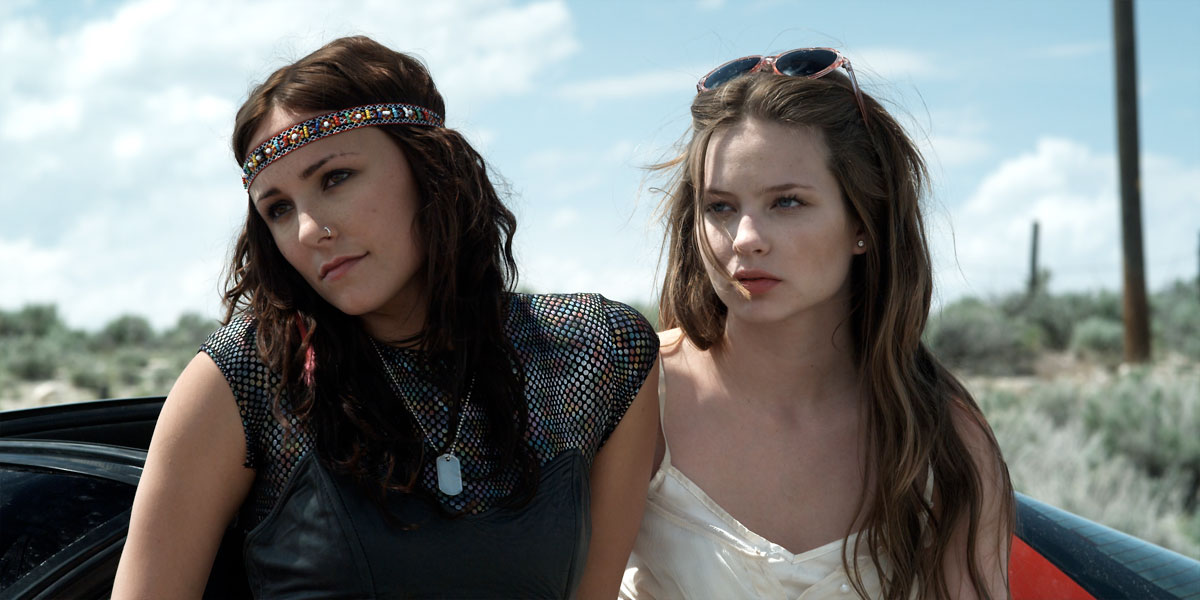
The cast of “S. Darko” is headlined by Daveigh Chase, one of the few returning elements from “Donnie Darko.” The rest of the cast includes Ed Westwick (“Gossip Girl”), Briana Evigan (“Step Up 2: The Streets,” “Sorority Row”), James Lafferty (“Oculus,” “One Tree Hill”), John Hawkes (“Congo”), and Jackson Rathbone (“Twilight,” “The Last Airbender”).

sdarko3Richard Kelly, the writer and director of “Donnie Darko,” dismissed the creation of “S. Darko” before it was ever even released, saying:

“To set the record straight, here’s a few facts I’d like to share with you all—I haven’t read this script. I have absolutely no involvement with this production, nor will I ever be involved.”

The creation of “S. Darko” was apparently made possible due to the dissolution of Newmarket films, which produced the original “Donnie Darko.” This apparently left the rights up for grabs, which the company Silver Nitrate jumped on to create “S. Darko.”

“S. Darko” wound up getting an abysmal reception from critics and audiences alike, earning Rotten Tomatoes scores of 0% (critics) and 18% (audience). The film currently holds a slightly higher IMDb rating of 3.7, which is still very much negative.

“S. Darko” was made on a budget of just under $4 million, and only received a limited theatrical release in Europe, earning a minimal gross. However, the movie apparently wound up at least making back its budget due to DVD and on demand sales.

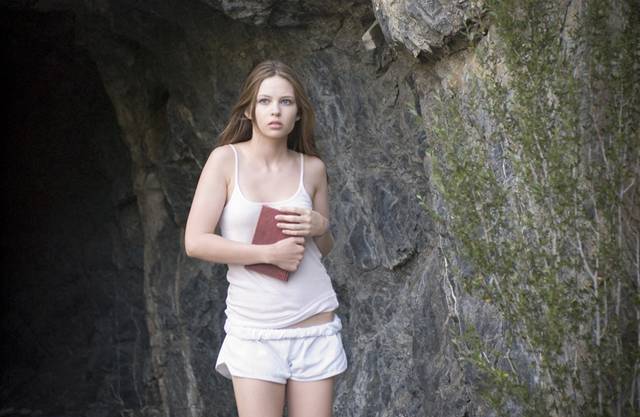
Samantha Darko StillsOne of the first things I noticed about “S. Darko” was that the soundtrack is notably weak, which was a key strength of the original from the very first scene. I’m sure this was partially because they didn’t want to spend money to license anything, but the music in “Donnie Darko” was more important than just providing background noise: it helped set the time period and the style, things that “S. Darko” seems totally tone deaf to.

Likewise, I thought that the cinematography and general tone was just off for this film. “S. Darko” lacks the surreal touch of “Donnie Darko,” and wound up looking more like a cheesy ghost story than a trippy time travel mind-bender. Even the writing on the characters and their portrayals failed to build the same level of intrigue as the original film, which managed to create an interesting cast of characters despite not spending much time on any particular person outside of Donnie. “S. Darko,” on the other hand, presents a veritable parade of cardboard cutouts, lacking in any distinct depth or emotion.

“Donnie Darko” has a dedicated cult fan base, as most people know. This sequel was surely made because someone thought that more money could be squeezed out of the dedicated “Donnie Darko” loyalists, which of course backfired on them terribly. The whole feel of the production reminded me of “American Psycho 2,” in that it is only tangentially tied to the original, and desperately tries to imitate the quirks of its predecessor like a child awkwardly fumbling with the new found power of speech. The whole movie feels like a clueless mockingbird imitation of “Donnie Darko,” trying to hit the essential beats that make up the tune. From watching scene to scene, you can practically see the writer’s line of thinking:

“Donnie Darko” had a rabbit mask, so we need a rabbit mask.
“Donnie Darko” has a book about time travel, so we need a book about time travel.
“Donnie Darko” had a car crash, so we need a car crash.
“Donnie Darko” had an arson, so we need an arson.
“Donnie Darko” had CGI chest-worms, so we need chest-worms.
“Donnie Darko” had television portals, so we need television portals.
“Donnie Darko” has an object falling from the sky, so we need an object falling from the sky.

sdarko5Every little detail feels like a parallel imitation from the previous movie, to the point that this list could just go on forever. I would challenge readers to a drinking game based on these observations, but I don’t want to be held liable for any untimely deaths.

I liked “Donnie Darko” well enough, but the movie does not make any sense, despite what some die-hard fans might claim. Likewise, “S. Darko” doesn’t have a shred of coherence, but it lacks the style and performances that were key to “Donnie Darko” to make up for the layers of nonsense.

“S. Darko” is one of the most boring movies I have ever sat through, and I am including ancient exploitation movies, Coleman Francis flicks, and the dullest of parody films in that count. It is excruciatingly dull and painfully derivative, to the point that you will try to manifest a nonsense form of time travel to erase it from existence. I can’t recommend it as a good-bad watch, because there are just so many better ways to spend just under 2 hours of a day.

Legend of the Dragon

Legend of the Dragon

legendofthedragon3

Today’s flick is an obscure martial arts / snooker comedy starring Stephen Chow: “Legend of the Dragon.”

“Legend of the Dragon” was produced and directed by the actor Danny Lee, who appeared in such films as “City on Fire” and John Woo’s “The Killer.” As a director, Lee primarily made action movies like “Dr. Lamb,” but drifted into the realm of comedy with “Legend of the Dragon” and “The Eight Immortals Restaurant: The Untold Story.”

“Legend of the Dragon” was written by Kam Fai-Law, a frequent collaborator with Danny Lee (“Dr. Lamb,” “The Eight Immortals Restaurant: The Untold Story”), and a man named James Fung, who received story credit.

The editor for “Legend of the Dragon” was Chung Yiu Ma, who also cut such films as “From Beijing With Love,” “Butterfly & Sword,” and “Flying Dagger.”

The two stunt coordinators for “Legend of the Dragon” were Corey Yuen, who provided stunts for “Drunken Master,” “The Expendables,” and “Transporter 3” (and even directed “The Transporter” and “No Retreat, No Surrender”), and Wah Yuen, who worked on “The Way of the Dragon,” “The Chinese Connection,” and “Enter the Dragon.”

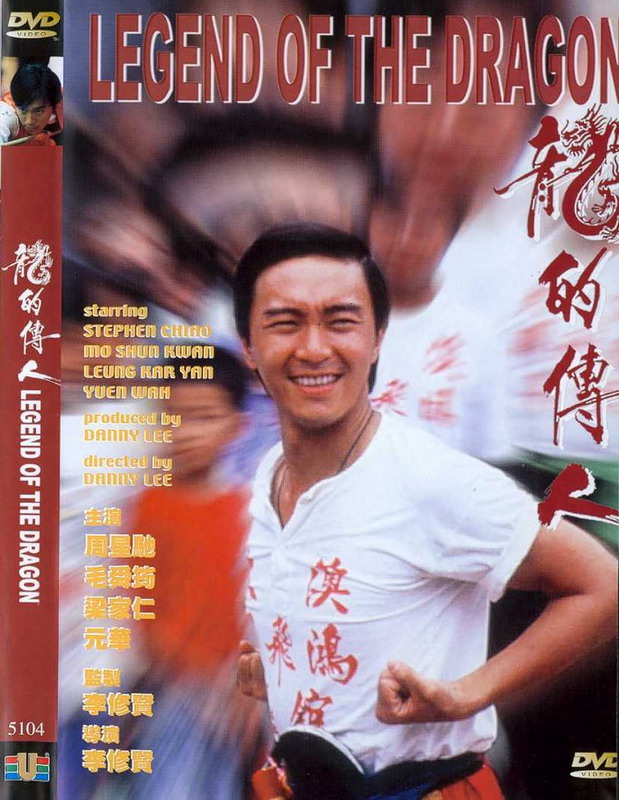
legendofthedragonThe other credited producer on “Legend of the Dragon,” aside from Danny Lee, was fellow actor Parkman Wong, who co-starred with Lee in “City on Fire” and “The Killer.”

The cast of “Legend of the Dragon” is headlined by Stephen Chow (“Shaolin Soccer,” “Kung Fu Hustle,” “The God of Cookery,” “From Beijing With Love,” “Sixty Million Dollar Man,” “Fight Back To School”), and also features Teresa Mo (“Hard Boiled,” “Men Suddenly In Black”), Chi Ling Chiu (“Kung Fu Hustle,” “Journey to the West”), Ka-Yan Leung (“The Man With The Iron Fists”), and Wah Yuen (“City Under Siege,” “Australia,” “Game of Death”).

legendofthedragon2The story of “Legend of the Dragon” follows a young snooker player and martial artist who has to win a large snooker tournament in Hong Kong to save his home.

The plot of “Legend of the Dragon” centers around the popular game of ‘snooker,’ which isn’t particularly well-known in the United States. For those curious, here is the summary of the game from Wikipedia:

Snooker is a cue sport played on a table covered with a green cloth or baize, with pockets at each of the four corners and in the middle of each of the long side cushions. A full-size table measures 11 ft 812 in × 5 ft 10 in (3569 mm x 1778 mm), commonly referred to as 12 × 6 ft.

The game is played using a cue and 22 snooker balls: one white cue ball, 15 red balls worth one point each, and six balls of different colours: yellow (2 points), green (3), brown (4), blue (5), pink (6) and black (7).[4] The red balls are initially placed in a triangular formation, and the other coloured balls on marked positions on the table known as “spots”. Players execute shots by striking the cue ball with the cue, causing the cue ball to hit a red or coloured ball. Points are scored by sinking the red and coloured balls (knocking them into the pockets, called “potting”) in the correct sequence. A player receives additional points if the opponent commits a foul. A player (or team) wins a frame (individual game) of snooker by scoring more points than the opponent(s). A player wins a match when a predetermined number of frames have been won.

Snooker, generally regarded as having been invented in India by British Army officers, is popular in many of the English-speaking and Commonwealth countries,[5] with top professional players attaining multi-million-pound career earnings from the game.[6] The sport is now increasingly popular in China.[7] Touring professional players compete regularly around the world, the premier tournament being the World Championship, held annually in Sheffield, England.

As mentioned in the Wikipedia summary, “Legend of the Dragon” was made in the midst of the growing popularity of snooker in China, which has continued in the years since the movie’s release.

“Legend of the Dragon” features a cameo from Jimmy White, a world champion snooker player and dominant force in the game throughout the 1980s, who acts as the final challenger Stephen Chow must defeat to win the tournament.

“Legend of the Dragon” is a pretty obscure flick, and doesn’t have a whole lot of reviews because of it. However, the ones that are out there are relatively positive: it currently has a 58% audience score on Rotten Tomatoes and a 6.5 rating on IMDb.

“Legend of the Dragon” is primarily a slapstick physical comedy, but Stephen Chow sells the humor with boundless enthusiasm as his man-child character. What would be painfully hack-y with a different cast comes off as mildly charming with Stephen Chow at the head.

Given the experience of the director and the cast, it is no surprise that “Legend of the Dragon” features good fight choreography and action sequences. Even the snooker sequences are shot with a fair amount of tension, making something that is generally mundane anything but.

There is an interesting undertone of anti-capitalism throughout “Legend of the Dragon,” with much of the plot centering on the condemnation of gambling and profiteering. However, the ending is less clear on the point, with gambling ultimately saving the day, and compromises of traditional values being reached. There is definitely a message in the story about the cultural divide between mainland China and Hong Kong, particularly as the once-distant year of 1997 began coming closer, which would bring the highly independent and westernized island back under the fold of Chinese authority. The tensions between the comically traditional Master Chow and his material-obsessed brother plays to this divide, and their ultimate reconciliation and compromise give the conflict a peaceful resolution in the end.

“Legend of the Dragon” features a couple of really funny moments. For instance, after the climactic kiss, both characters instantly think they are pregnant. It is a great little stab at the sheltered, naive characters that always seem to feature in kung fu flicks. There are also a number of good jokes pointed at the fact that no one knows the rules to snooker, most memorably after the protagonist and his friends celebrate their victory in the final tournament before the match is actually over.

Overall, “Legend of the Dragon” is a strange but fun little movie, with some deep undertones beneath a veneer of childish physical humor. It isn’t particularly easy to find, but it is worth checking out for kung fu fans if you happen to come across it.

Given the film’s obscurity, you might be a little as to how I came across this oddball little flick. Video Central, the local video store that provides my Clerk’s Picks, was recently clearing out some excess inventory, and I picked it up from them for a couple of bucks based on the distinctive cover art on the DVD. I assumed that there had to be something worth watching inside, and thankfully I was right.