Tag Archives: worst movies

Watching Paint Dry: A Review

This post is based on a viewer request, which is being filled due to a donation to the Secular Student Alliance via my fundraising page during Secular Students Week (June 10-17, 2015).

paintdry

I don’t think there is any idiom more often used in the discussion of bad films than the classic simile, “like watching paint dry.” There is no other universal image that so perfectly captures the frivolousness, agony, and boredom that many people experience while watching a sub-par movie. It really describes everything a conventional movie shouldn’t be: static, passive, un-engaging, and without thought.

Sure, there are some exceptions to this rule: some art films have been made with the expressed purpose of inciting the feeling of boredom, But as far as the general public consciousness goes, if a movie is “like watching paint dry,” it is because something has gone horribly wrong.

I consider myself a sort of specialist at watching bad movies. Given how often this experience is compared to “watching paint dry,” I assume I will be able to handle the task of, basically, watching paint dry on a surface. But how similar are the two activities, really?

It takes a fair amount of willpower and determination to suffer through a movie like “The Maize” or “Daniel Der Zauberer,” but is that the same kind of endurance necessary for the classically menial task of watching paint dry? I will say this: I have watched a pot boil. I don’t know why I did it, apart from the fact that I wanted to prove that I could. That brings up a whole different question of how similar watching pots boil and watching paint dry are, but my point is this: I have challenged the traditional wisdom of idioms in the past, and I have been victorious.

paintdry1

Now, there are a lot of ways that I could theoretically watch paint dry. In fact, there are more than you might expect: there are numerous YouTube videos varying in lengths of a few minutes to 10 hours, a live webcam of paint drying, and even a flash game created around the concept that gives you achievements for how long you continue, ranging from a few minutes to an entire day. Alternatively, of course, I could go buy some paint and put it on something.

For the sake of time, I decided to go with a 10 minute YouTube video, done by the channel “10minutesofyourlife,” which you can see below.

First off, I appreciate that they decided to use an eye catching color. Can you imagine if that were gray or beige? On to a negative: what are they doing with that tripod? There is an awful lot of camera movement for a video whose expressed purpose is *watching paint dry.* You don’t need to operate the damn thing, we’re not looking for creative angles, here. On the flip side, it does provide a little bit of welcome variety for a monotonous activity.

One thing that becomes clear very quickly while watching paint dry is that you become acutely aware of your other senses. Not only am I focusing on the background noises in my apartment (various mechanical hums, electronic buzzes, and cat sounds), but also on the curious background of the video itself. For whatever reason, I initially assumed that the setting of this video was indoors, but the details start becoming clear quickly: the stained wood at the bottom of the frame must be a deck, and the amount of background noise leads me to assume that there must be nearby traffic. That does beg the question, though: is this person planning to paint their house in this vivid green color? I’m not sure if that would be more weird or awesome.

Around minute five, I started thinking more about the form of the piece. The consistency of the paint is a bit odd, in my opinion: somehow thicker, and more plastic-like than I expected. It looks a little like “Gak,” for those of you who remember what that is. Also, the shape of the paint’s pattern is bizarre: there’s clearly no reason to it, but it also clearly wasn’t done haphazardly. Note, there are no splatters, so it wasn’t just slung against the wall. However, there is also no sign of orderly brush work, and the edges and smooth and pristine. Honestly, I’m not entirely sure how they managed to do this. Even the pooling at the base seems surreal, as the quantity seems oddly high, and it has clearly already been allowed time to creep its way across the horizon between the wall and the deck. I feel a little cheated, as if someone tore the first chapter out of a book. How did the paint get this way? I am missing some crucial developmental information about the paint and its relationship / experience with the wall. I understand the realistic style of telling a story in medias res, but I feel like the purpose of watching paint dry is to get the completest  possible view of the experience, from beginning to end. I’m not here for a highlight reel, I’m here for a full ride.

There is a message on the ground, partially obscured by the pool of wayward paint (which oddly does not seem to perceptibly expand over the course of the video). “_________ _______ MUST BE INSTALLED.” It is clearly the sort of industrial message one would find on a work in progress, and isn’t something you would ever see on the exterior of a finished product. This is something that we, as casual observers, are not supposed to see beneath the surface of our surroundings. But these messages, surely, are in buildings we enter every day: internally facing, and invisible to pedestrians. The paint serves to hide these messages from us, both in this video, and in our everyday lives. What “must be installed,” I wonder? We may never know, not without chipping away at the dried paint. And then, what was the process all really for? Maybe it was too late to install this mysterious object/program all along, and it is for the best to just leave it alone.

The video ends abruptly, and I was honestly jarred by it. You can’t help but sink into the process of watching paint dry, because it is so difficult to perceive the progress. With watching water in a pot boil, there are definite stages: you feel the heat rising, the bubbles begin forming at the bottom of the pot, there is a brief simmering pre-boil. Watching paint dry lacks any of this structure, so you are left completely on your own. In my case, my mind was desperate to find something to focus on, and I was able to find it in analysis of the minor details.

So, how does this tie back to movies? Well, there are two points worth making.

First: structure is vastly important to maintaining an audience of any kind. It doesn’t have to be traditional, but it needs to be present in some way to keep people engaged. This is one of the worst ways a movie can collapse, and it typically happens in either the editing or the initial screenwriting. We, as audience members, are conditioned to expect a certain kind of structure in a film, to the point that it is unconscious within us. When looking at screenplays, many people use a shorthand of “expecting x event by y page” to gauge whether it will play with audiences, because that is what we expect. When a movie is written without those important beats to keep us all on pace, the result is that, generally, people get bored.

Inexperienced writing and non-creative editing are usually the key things to blame when these structural things go wrong. For cases of the latter, give a watch to movies like “They Saved Hitler’s Brain” or “Monster A Go Go”: both incomplete films that were finished long after the fact and stitched together with minimal thought or care for the editing process. For some examples of the first, I would point out any popularly failed attempts to adapt television shows to the big screen: “The Singing Detective” and “The Last Airbender,” for instance.

Television show plots are usually (not always) structured differently than films, with miniature arcs and developments over the course of individual episodes combining to create a greater arc of a season or a series. Movies typically have one, distinct arc. Here is a visual way to think about that:
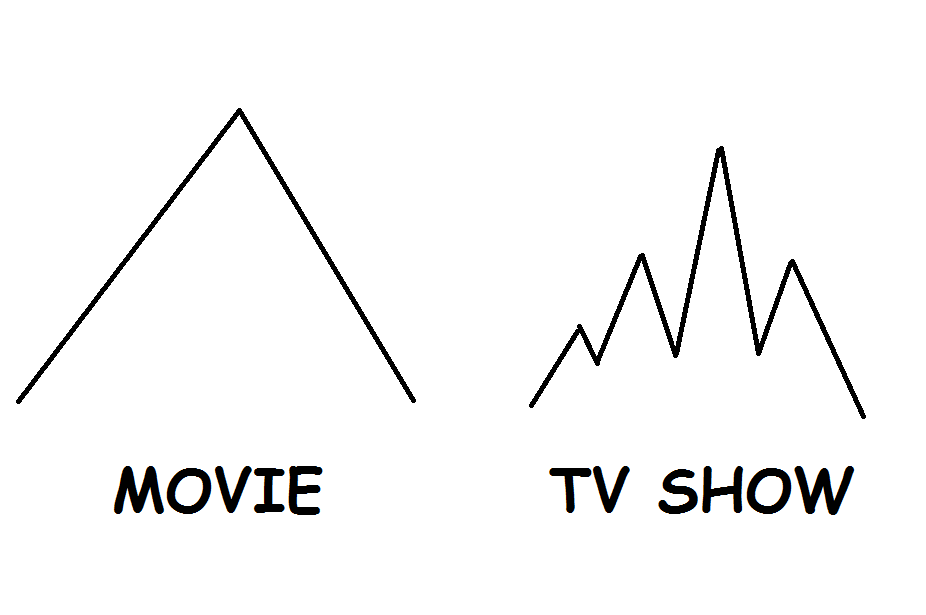
graph1So, in order to turn a TV show plot into a movie, you have to do something to fill in the valleys. In the case of “The Last Airbender,” this was done with brief sequences of exposition acting as transitions, which was apparently the best way they could figure to stitch the story together in a cinematic way. Obviously, that didn’t work out so well.

So, back to paint drying. Part of the reason that the experience is so awful is the lack of a perceptible structure. Another way to look at this is by comparing it to distance driving. An 8 hour drive through flat territory with no landmarks is awful, because there is no perceptible demarcation to indicate progress, which helps us break down the experience. However, an 8 hour drive between, say, Cincinnati, Ohio and Birmingham, Alabama features a number of urban areas as landmarks: Louisville, Kentucky and Nashville, Tennessee, for instance. This helps us digest the whole experience better, just like we do with any experience: memorizing numbers, distance driving, watching movies, or watching paint dry.

As I mentioned before, there are two points I wanted to make about the parallel of movie watching and watching paint dry: the second is the similar importance of being an active observer in the experience. For sitting through the experience of watching paint dry, I had to dig around the details of what I was watching to keep myself entertained and focused on the task. That is pretty much the same thing I do with especially dull movies: close reading and analysis is a different experience than just watching something unfold before you: it is about minor details, and appreciating the entirety of the experience. In the case of watching paint dry, this meant noting the sounds in the background, paying attention to the shape the paint was taking on the wall, and even reading the obscured message on the ground and coming up with a bullshit theory. With a movie (particularly a shitty movie), this might be noting the positioning of the actors in a shot, paying attention to the repeated use of colors and specific objects, keeping track of the continuity of scenes, and coming up with bullshit theories to cover up gaping plot holes and errors. Honestly, I think it is easier to do close readings of bad movies, because there is rarely anything else worth paying attention to on screen (y’know, kind of like paint drying). It is a good skill to have, and it is something that most people are taught to do on some level in literature or English classes in primary school. Watching films as visual literature and art in addition to entertainment is part of what makes it so cool for so many people. It can also theoretically help you watch paint dry, so there’s that.

All in all: yes, there are significant similarities between watching paint dry and watching bad movies. However, I think bad movies can be a little more constructive: in many ways, you can reverse engineer a lot of the elements of what makes a good movie by diagnosing how bad ones ultimately fail. With watching paint dry, you aren’t going to get a whole lot out of the experience, apart from really odd bragging rights.

If you want to make me do a review of literally whatever you want (even watching paint dry), make a donation to this page (of any amount) by June 17, 2015. I will cover any request you have for as low as a $1 donation. Really. Also, enjoy my (God)Awful Movies BibleMan franchise marathon as part of Secular Students Week, and check out the excellent work of the Secular Student Alliance.

BibleMan: Conquering the Wrath of Rage

BibleMan: Conquering the Wrath of Rage

wrathofrage3

Today, I’m continuing my week-long marathon of the Bibleman franchise as part of Secular Students Week. If you make a donation to the Secular Student Alliance this week, and I’ll cover a movie of your choice.

“Conquering the Wrath of Rage” marks the fourth entry into “The Bibleman Adventure,” which is the second incarnation of the franchise.

“Conquering the Wrath of Rage” was directed, produced, and co-written by Willie Aames, who once again stars as Bibleman. The other credited writer is one Greg Perkins, who I wasn’t able to dig up any information on.

The villain of “Conquering the Wrath of Rage” is El Furioso, who is yet another antagonist portrayed by Brian Lemmons, marking his fourth straight appearance on the show. He is once again accompanied by his self-aware, possibly stoned henchman, Ludicrous. The evil computer, L.U.C.I., also pops up again as a supporting villain.

Bibleman has a new partner for “Conquering the Wrath of Rage” in the rookie Cypher, who is introduced as a bit of a tech wizard, and is credited with designing the new Bibleman armor. He winds up hanging around for a long time in the series as I recall, becoming a bit of a staple.  I’m not really sure what happens to Coats, the previous sidekick, as the point is glossed over pretty quickly. It is actually somewhat implied that the split wasn’t exactly pleasant, which might allude to some tensions behind the scenes.

wrathofrage2

The story of “Conquering the Wrath of Rage” focuses on a new villain named El Furioso, who comes up with a chemical that causes uncontrollable fits of rage. This is used both on local children and on Bibleman to disastrous effect. Bibleman must confront his own anger and learn to trust the people around him in order to win the day and defeat El Furioso.

The episode begins with Bibleman fighting a group of really racist caricature villains, whose lines are subtitled despite the fact that they are speaking clear English. If the exaggerated, generic Asian accents don’t get the point across, the reference to Jackie Chan certainly does. Bibleman also, in keeping with tradition, straight murders one of them in a fit of rage after they corner Cypher. However, this time his actions are actually addressed, as the theme of the episode deals with rage and violence.

“Violence never got anyone anywhere”

-Bibleman, noted vigilante murderer


“Conquering the Wrath of Rage” features another notable upgrade for the Bibleman outfit, and introduces what is probably the most recognizable version of the cowl. This version is far more musclebound than the previous versions, and sets the precedent for future changes to the outfit as the series goes on.

wrathofrage1

“A man in spandex is no laughing matter”

-Bibleman

“Conquering the Wrath of Rage” also introduces the use of lower third text gags, which continues throughout the rest of the series. These are usually a bit funnier than the comedy in the dialogue, because they don’t rely on the actors having any kind of comedic timing.

wrathofrage4

El Furioso is probably the most amusing performance from Brian Lemmons so far in the show. He feels like he must be offensive somehow, but I’m not really sure to who? His name would make you think of some sort of Mexican stereotype, but it doesn’t really play that way, apart from using the occasional Spanish phrase. He is somewhat effeminate, but also occasionally drifts into what sounds like a bad imitation of a Jewish person, making for a really perplexing mixture of stereotypes.

As is tradition for the series, El Furioso suffers an awful demise in the conclusion. Bibleman uses some sort of divine force field that forces Furioso’s beam weapon to backfire, which leaves him dissolved into a nasty, green, gooey mess. In keeping with the theme of the episode, Bibleman doesn’t directly strike him down, but he certainly gets very dead. Bibleman’s reaction to this horrific loss of life is, quote:

“Jeepers, what a mess.”

wrathofrage5
human remains

Overall, “Conquering the Wrath of Rage” is a solid recommendation from me as an entertainingly awful entry into the saga of Bibleman. It makes for a pretty good introduction into the series: the cheese factor is to the max, and the comedic writing is actually entertaining at times, and completely baffling and tone deaf at others.

BibleMan: The Fiendish Works of Dr. Fear

BibleMan: The Fiendish Works of Dr. Fear

drfear1

Today, I’m continuing my week-long marathon of the Bibleman franchise as part of Secular Students Week. If you make a donation to the Secular Student Alliance this week, and I’ll cover a movie of your choice.

“The Fiendish Works of Dr. Fear” marks the third entry into “The Bibleman Adventure,” which is the second incarnation of the franchise.

“The Fiendish Works of Dr. Fear” is once again directed by Eric J. Smith, who also took the reins on the previous episode, “The Incredible Force of Joy.” Willie Aames, who also plays Bibleman, co-directs, and the writing for the episode is credited to Marion Rose Wells.

The central villain of “The Fiendish Works of Dr. Fear” is, of course, Dr. Fear. However, the character is once again played by the same actor, Brian Lemmons, who portrayed the previous two villains: The Master of Misery and The Shadow of Doubt, a fact that is pointed out once again by his self-aware sidekick, Ludicrous. This time, Dr. Fear appears to be partially cybernetic, which gives him a little more interesting appearance. The evil computer program, “L.U.C.I.,” who appeared in the live version of “The Incredible Force of Joy,” also shows up as an accessory villain.
drfear4

Both the intelligent computer, U.N.I.C.E., and a sidekick, Coats, appear alongside Bibleman in “The Fiendish Works of Dr. Fear,” just as they did in the previous two “Bibleman Adventure” installments.

The story of “The Fiendish Works of Dr. Fear” follows Bibleman as he leads the “Clean is Cool” campaign to keep kids off of drugs (or something like that). Meanwhile, a new villain named Dr. Fear plots to fill people with anxieties and destroy their self confidence, even taking aim at Bibleman himself. I assume that also has something to do with drugs, but I wasn’t entirely clear on that point. Bibleman, as per usual, has to figure out the villain’s plan and overcome his own fears to win the day.

“The Fiendish Works of Dr. Fear” shockingly kicks off with Bibleman dancing to a swing number with lyrics about saying ‘no’ to drugs. I can’t even make this kind of ridiculous thing up, that is actually how the episode starts.

drfear2

This episode also features the first (but not the last) time that Bibleman appears on a televised talk show. Of course, Dr. Fear uses this opportunity to strike Bibleman with some sort of fear ray, which sets off his anxieties about appearing on camera, leading him to briefly botch the interview.

drfear3

For once, Bibleman actually takes a fair amount of damage in the combat sequences, particularly thanks to Dr. Fear’s ranged attack. Speaking of which, why exactly doesn’t Bibleman have a way of fighting from a distance? You would think that with the amount of technology at his disposal, he would have some sort of plan for this kind of thing. He ultimately figures out a way around it, but it wouldn’t have been as much of an issue if he just had some sort of bible-themed projectile for combat.

drfear5

The humor here is still cringe-inducingly awful, and bows to a number of lazy stereotypes for no discernible reason. The plot also isn’t as entertainingly cheesy as other episodes, which, combined with yet another lackluster villain, makes for a pretty dull watch on the whole. The most amusingly terrible thing in the episode is the swing dance in the opening sequence, which passes pretty quickly. “The Fiendish Works of Dr. Fear” definitely isn’t on the top of my list for Bibleman episodes, but it is also far from the worst. It also features a brutal villain death for Dr. Fear, but it generally pales in comparison to most of the other episodes.

BibleMan: The Incredible Force of Joy

BibleMan: The Incredible Force of Joy

forceofjoy1

Today, I’m continuing my week-long marathon of the Bibleman franchise as part of Secular Students Week. If you make a donation to the Secular Student Alliance this week, and I’ll cover a movie of your choice.

“Incredible Force of Joy” is the second installment in “The Bibleman Adventure,” which is itself the second incarnation of the show.

“The Incredible Force of Joy” was directed by Eric J. Smith, and written by Albert Upton and Cory Edwards. This marks the first time that star Willie Aames was not involved in either the writing or direction of the episode, at least as far as the listed credits go.

The villain in “The Incredible Force of Joy” is basically just the return of Shadow of Doubt from the previous episode, but now under the name of Master of Misery. His henchman, Ludicrous, is also back, and a second supporter is introduced in the form of an evil computer named L.U.C.I.. L.U.C.I. is essentially the counter-balance to Bibleman’s computer, U.N.I.C.E., and continues to appear throughout the series. This practice of re-using villains under new monikers also continues throughout the rest of the Bibleman franchise.

forceofjoy3

Bibleman once again has a couple of allies present in the form of Coats and U.N.I.C.E., who were both introduced in the previous episode, “Defeating the Shadow of Doubt.”

The story of “The Incredible Force of Joy” centers on this new villain called the Master of Misery, who has developed some sort of weapon and computer program that can make people sad. He manages to infiltrate Bibleman’s lair, and corrupts his computer with the program, creating chaos for the team. Meanwhile, the Master of Misery launches his evil plan to corrupt children by making a young child miss a science fair. Bibleman, as always, has to figure out a way to foil the villain’s plans, and help the young boy make the science fair. This also marks perhaps the only time that Bibleman has supported science in any way.

“The Incredible Force of Joy” marks some notable improvements to the Bibleman costume. The appearance is more streamlined than the previous incarnation, and the cowl is pretty dramatically altered as well, with a gradient of purple and yellow.

forceofjoy2

Once again, the villain knows the location of Bibleman’s lair for no stated reason, which raises some questions for me as to whether theere might be a mole within Bibleman’s inner circle. However, Bibleman doesn’t seem particularly alarmed by that fact, which struck me as kind of odd.

“The Incredible Force of Joy” features the first iconic full armor sequence for Bibleman, and is also the first episode to have a live performance incarnation. The audio of the full armor sequence takes over for the old “The Bibleman Show” theme song in the introductory credits, completing the transition into “The Bibleman Adventure” series.

The plot of “The Incredible Force of Joy” features an awful lot of jargon-packed computer hacking magic that doesn’t make even a shred of sense, particularly on the part of the bad guys. The astounding misunderstanding of technology pops up a few more times in the series going forward, at least in some of the episodes that I have already seen.

The episode starts with the murder via laser evaporation of an unnamed villain (who resembles The Fibbler) by Coats, which isn’t treated with much seriousness by either character. Bibleman even offers a classic one-liner for the situation:

“Don’t you hate it when guys smoke?”

forceofjoy4
The smoking remain of a human being

Once again, this shows just how callous, unforgiving, and violent Bibleman and his crew can be, making him more like a comic book antihero (The Punisher) than a traditional superhero (Superman, Captain America). Interestingly, U.N.I.C.E., Bibleman’s computer, is the one who ultimately kills the Mastery of Misery, which sets a dangerous precedent in my mind about artificial intelligence committing murder.

Overall, “The Incredible Force of Joy” is another middling episode in the series, but the quality of the show from a production standpoint is clearly steadily improving. The villain here is once again a bit forgettable, but the techno-magic provides some entertainment value to the episode. The attempts at humor of course still fall flat, but there are some unintentional laughs to be had here.

BibleMan: Defeating the Shadow of Doubt

BibleMan: Defeating the Shadow of Doubt

shadowofdoubt1

Today, I’m continuing my week-long marathon of the Bibleman franchise as part of Secular Students Week. If you make a donation to the Secular Student Alliance this week, and I’ll cover a movie of your choice.

In 1998, two years after the conclusion of “The Bibleman Show,” “Defeating the Shadow of Doubt” marked the first episode of “The Bibleman Adventure,” the second and longest-running incarnation of the show.

For “Defeating the Shadow of Doubt,” Willie Aames takes sole writing and directing credits, and continues to star as the crusading eponymous hero, Bibleman. Chris Fann, who was previously co-director on “The Bibleman Show,” is now relegated to director of photography, I assume for the purpose of giving Aames sole credit. Notably, Tony Salerno’s creation credit for the Bibleman character is absent from both the ending and opening, which makes me wonder how much internal turbulence there was over the change of direction for the show.

shadowofdoubt4

The villain of the episode is Shadow of Doubt, who is overall a pretty generic antagonist for Bibleman. He uses a sort of chemical to inspire doubt in people, which reminded me a bit of the mind control used by previous villains. His performance is certainly over the top, but the character still comes off as pretty dull on the whole. He does have a fourth wall breaking henchman named Ludicrous, who is somewhat self-aware about his position, and steals the show from Shadow of Doubt in most of the villain scenes. However, Shadow does get his time to shine with his frenetic dancing musical number.

“Who is both a verb and a noun!”

“Shadow of Doubt!”

For the first time in the franchise, Bibleman has allies in the form U.N.I.C.E. and Coats. U.N.I.C.E. is an intelligent, speaking computer that runs the Bibleman headquarters, and continues to appear throughout the rest of the series. Coats is a pretty generic assistant / sidekick, who has a vague sort of military aesthetic to him.

The story of “Defeating the Shadow of Doubt” centers on a young girl, Kyla, who has lost her faith, which is initially assumed to be due to her parents arguing. However, there are also sinister forces at play in the form of a Pandora’s box of doubt, planted by a new villain called Shadow of Doubt. Bibleman has to overcome his own insecurities and find a way to defeat the shadow, and help restore Kyla’s faith.

Kyla: “You don’t know how I feel! Nobody does! Not even God!”

Bibleman: “Kyla, that’s just not true. God does care…I mean, he must?”

“Defeating the Shadow of Doubt” features a new introduction that focuses more on action, and also introduces the more familiar BibleMan logo. The old theme song is still around, but it plays over the credits as opposed to the introduction sequence. Honestly, it is a bit strange tone-wise to have both styles present, but I am guessing that will only be the case for a few of these transition episodes.
shadowofdoubt3

There is still a children’s musical number at the beginning of the episode, but it is cut into semi-digestible small chunks. I’m curious if this was initially intended as part of an episode of “The Bibleman Show,” and was repurposed for “Defeating the Shadow of Doubt.”

“Defeating the Shadow of Doubt” features more deliberate attempts at humor than previous episodes, most of which awkwardly fall flat. As the series goes on, the amount of tongue in cheek self-awareness seems to increase, which adds a whole new dimension of cringe-inducing awkwardness to the show.

The entire episode of “Defeating the Shadow of Doubt” reinforces a stereotype that the only reason people leave religion is due to some trauma or sinister influence, which just isn’t true by a long shot. The Bibleman version of questioning faith is also kind of hilarious in its lack of sincerity.

“In my mind I know all the right scriptures. I just don’t feel like they are real. One thing is for certain: whoever this [villain] is, he has affected my ability to reason.”

-Bibleman

I was a little surprised when Shadow of Doubt survived the episode, especially given the show’s pattern for giving villains violent and tortuous ends. I assume this was done to make a statement about how doubt never totally goes away, or something to that effect.

shadowofdoubt5

“Defeating the Shadow of Doubt” is more or less middle-of-the-road as far as entertainment value for Bibleman goes. The villain could certainly have been better, but there are still some entertainingly awful child acting and dialogue moments that help it out. It is certainly easier to sit through than the first two episodes of “The Bibleman Show,” and features a lot more cheesy action and fighting, if that is what you are looking for.

BibleMan: Big Big Book

BibleMan: Big Big Book

bigbigbook2

Today, I’m continuing my week-long marathon of the Bibleman franchise as part of Secular Students Week. If you make a donation to the Secular Student Alliance this week, and I’ll cover a movie of your choice.
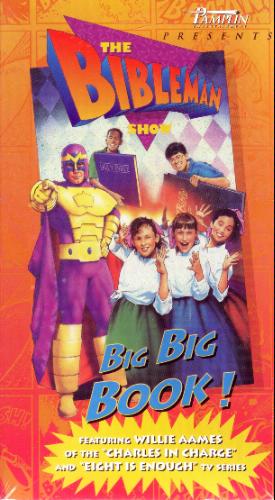
In 1995, the first ever installment of the Bibleman franchise came to be. “Big Big Book” kicked off the short lived initial incarnation of the series, called “The Bibleman Show,” and launched an evangelical quasi-phenomenon.

Willie Aames, who is best known for television shows like “Charles in Charge” and “Eight is Enough,” co-wrote, co-directed, and stars here as Bibleman, and is the person most publicly recognized as being associated with the show.

The character’s creation is credited to Tony Salerno, who also has writing and producing credits on this initial episode. The other two writers on the episode were Milt Schaffer and C. Scott Votaw, the latter of which worked in a variety of capacities on b-movies like “2001 Maniacs,” “Bikini Drive-In,” and Jim Wynorski’s “Dinosaur Island.”

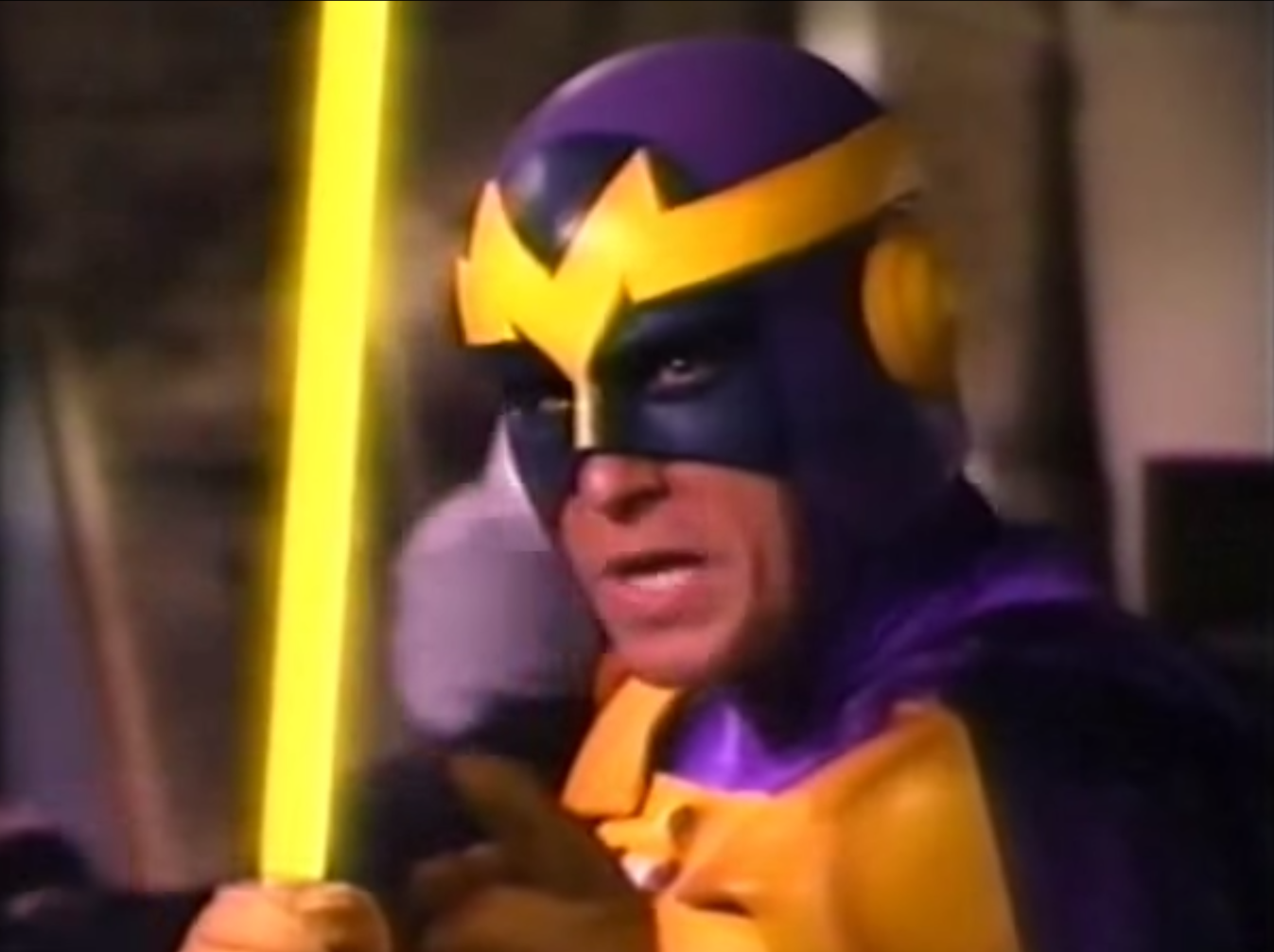
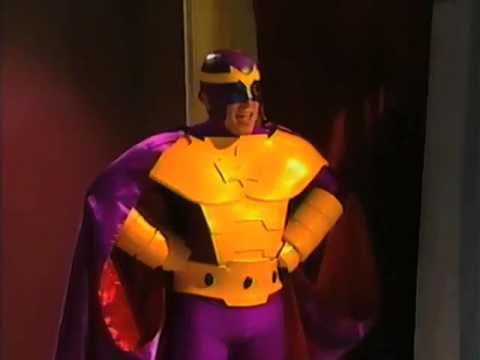
The initial Bibleman costume used in “The Bibleman Show” episodes is pretty laughable, and was clearly constructed on a minimal budget. Compared to the shiny, chrome/plastic uniform that would show up in later episodes, it is amazing to see how far the show and the character came over the course of its run.

bigbigbook1

“Big Big Book” doesn’t feature any sidekicks for Bibleman, who I assume start showing up in the later series. The villain is a pretty generic evil scientist with green skin, named Dr. Decepto, which is certainly a pattern for Bibleman villains as the show goes on. He isn’t quite as elaborate or offensive as many of the later antagonist, but the performance is plenty hammy enough to be entertaining.  He also has a great high-pitched evil laugh, which is always a plus.

The story of “Big Big Book” follows a group of children who are working on a bible-themed musical for their church. The planning isn’t going well, and a number of the kids want to quit, in order to not be embarrassed by a sub-par result. Bibleman shows up at a rehearsal, and tells the kids a story about a previous exploit where he prayed his way out of a hairy situation with Dr. Decepto. The story gives them the confidence to go forward with the show, which theoretically goes off without a hitch. Except, of course, for the fact that it sounds awful, but no one seems to care all that much. They are just happy that they went through with it.

“God’s probably sitting up there thinking: ‘Nice lame-o show, kids.'”

The content of the musical is of course ridiculous, and takes a handful of potshots at science education and evolution. It is pretty much exactly what you would expect from a Bibleman musical, honestly. Some of the kids straight-up cannot sing, which makes parts of it nearly unwatchable. The whole thing is kind of like a worse version of “Kidz Bop” for fake Christian music, if you can imagine such a thing. The musical section also takes up a huge chunk of the episode, which unfortunately (?) doesn’t have a lot of Bibleman in it.

The one fight sequence in “Big Big Book” is a blurry mess, and is almost as hard to watch as the musical. Bibleman notably doesn’t have the laser sword of the later episodes, instead using a traditional sword and shield.

If there is anything positive to say about “Big Big Book,” it is that it actually has some charm to it compared to the later episodes of the seriess, which attempt to be comedic and self-aware. It is still completely awful and beyond cheesy, cut it is at least an honestly made mess.

The theme song is also much different than what I am accustomed to hearing with the later episodes, which drift into a sort of pseudo-rock style. This initial theme song is pretty generic and forgettable, but certainly contributes to the heavy 1990s style of the episode.

bigbigbook3

Speaking of which, the 1990s bleeds out of every pore of this video. The fashion, the hair, the music, the colors: all of it makes for an astounding flashback. The nostalgia factor of it all is actually pretty amusing, and might make the whole thing worth sitting through for some folks.

As you would expect, “Big Big Book” features awful acting from all involved,  and horrendous writing to boot.  However, the added ‘benefit’ of the musical is what makes this episode stand out from the pack that I had previously seen. Lots of Bibleman episodes feature a song, but this episode being centered around a children’s church musical makes it so much worse than any of the music offered with other episodes. It is nearly unbearable.

Brad Jones, better known as The Cinema Snob, took a look at this episode on his show “DVD-R Hell.” If you don’t want to stomach actually watching this, his overview hits the key points and highlights with his typical sardonic wit.

This is the first of the initial run of “The Bibleman Show” episodes that I have sat through, and I’m mostly just hoping (praying?) that the rest of these early episodes don’t feature as much cringe-inducing singing.

Blood Diner

Blood Diner

blooddiner1

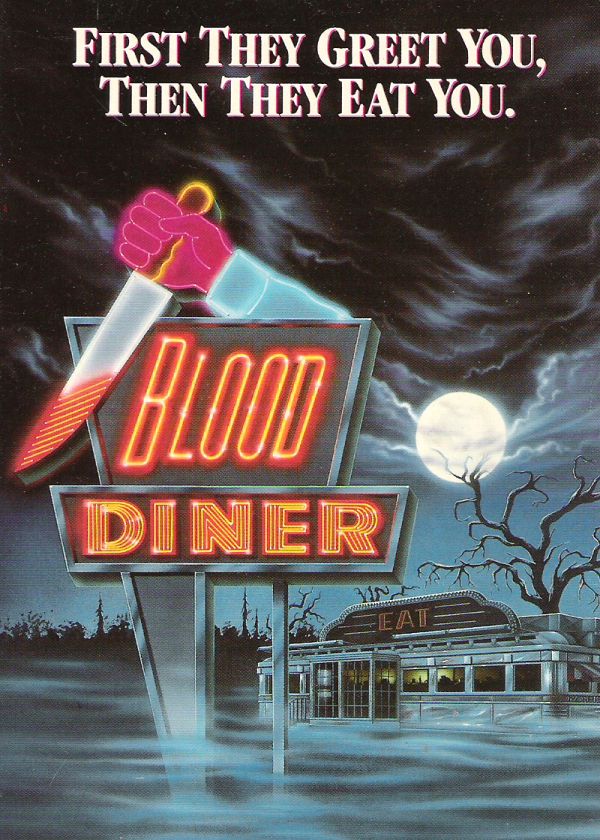
Today’s feature is “Blood Diner,” a peculiar little horror-comedy from the late 1980s that involves cannibalism, blood sacrifice, and veggie burgers.

“Blood Diner” was written by Michael Sonye. Sonye was primarily an actor, appearing in films such as “Surf Nazis Must Die,” but wrote a handful of b-movie screenplays, including “Cold Steel” and “Star Slammer.”

“Blood Diner” was directed and produced by Jackie Kong, who only had a handful of credits in the 1980s. She was also involved in the schlocky films “Night Patrol” and “The Being.”

The cinematography for “Blood Diner” was done by Jurg V. Walther, who has worked on such (not-so) esteemed films as “Daniel Der Zauberer,” “Zombie Nation,” “Joysticks,” and “Hot Dog: The Movie.”

The music for “Blood Diner” was composed by Don Preston, who did the music for most of Jackie Kong’s films, as well as “Eye of the Tiger” and “Android.” He also interestingly provided the synthesizer work for the score to “Apocalypse Now.”

The editor on “Blood Diner” was Thomas Meshelski, who also cut such horror films as “Puppetmaster” and “TerrorVision.”

The “Blood Diner” effects team included Larry Arpin (“Maniac Cop,” “Maniac Cop 2,” “Maniac Cop 3,” “The Dentist”), Loraiana Drucker (“Friday the 13th Part VII,” “The Blob”), Bruce Zahlava (“Dead Heat”), Michael Hyatt (“Leprechaun”), and Aaron Sims (“From Beyond,” “The Spirit,” “Baby’s Day Out”).

One of the executive producers for “Blood Diner” was Lawrence Kasanoff, who is best known for producing movies like “Mortal Kombat” and “Class of 1999,” but also infamously directed the animated disaster that is “Foodfight!”

Most of the cast of “Blood Diner” is made up of actors who have appeared in no other films, or at most just a handful of other similarly low-budget horror movies. Usually movies like this seem to have one or two players who eventually found some form of success, but that isn’t the case here.

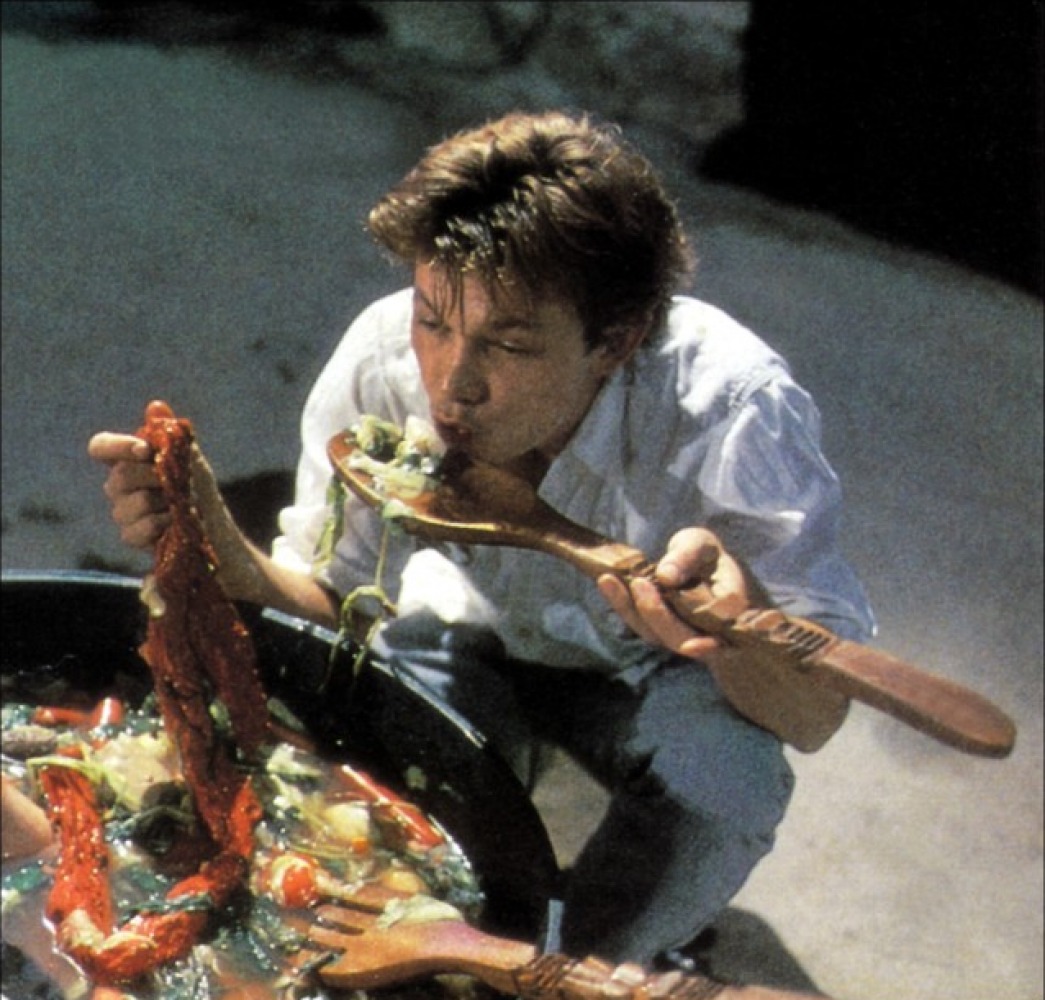
blooddiner3The story of “Blood Diner” centers around two cannibal brothers who co-own and operate a diner. They plan to resurrect an ancient God with a massive blood sacrifice, under the guidance of their newly resurrected undead uncle. Their preparations (namely the mass killings) attract attention from the police, who race against the clock to foil their plans.

The reception for “Blood Diner” was unsurprisingly negative, though not as poor as one might expect. It currently holds a rating of 5.0 on IMDb, along with a 53% audience score on Rotten Tomatoes.

“Blood Diner” was apparently initially intended as a sequel to Herschell Gordon Lewis’s “Blood Feast,” but the idea was scrapped before filming commenced. However, the plot similarities certainly remain for the sake of homage and parody.

A few parts of “Blood Diner” play for genuine laughs, such as the opening radio interruption warning listeners about an escaped killer in the area. However, most of the comedy feels added in after the fact, like this was meant to be serious horror, but half way through they realized how ridiculous it all was and tried to laugh off their incompetence. The result is a quasi-parody that rides the line between mocking and truly becoming the thing it is trying to make fun of. The humor is also pretty lazy on the whole, like it was concocted on the fly by people who don’t make a living in comedy.

Something else that can’t be ignored about “Blood Diner” is the musical score, which is the deadly combination of being both really terrible and extremely loud. The sound editing is straight horrendous, to the point that the music manages to overpower the outlandish acting on screen at times (or at least that was the case on my copy).

Speaking of which, ‘hammy’ doesn’t even begin to describe the acting in “Blood Diner.” Everyone seems to be over the top in one way or another, like all of the characters are trying to out-weird or act over each other. There is also some god-awful child acting in the introduction sequence that ranks up there with some of the worst that I have ever seen.

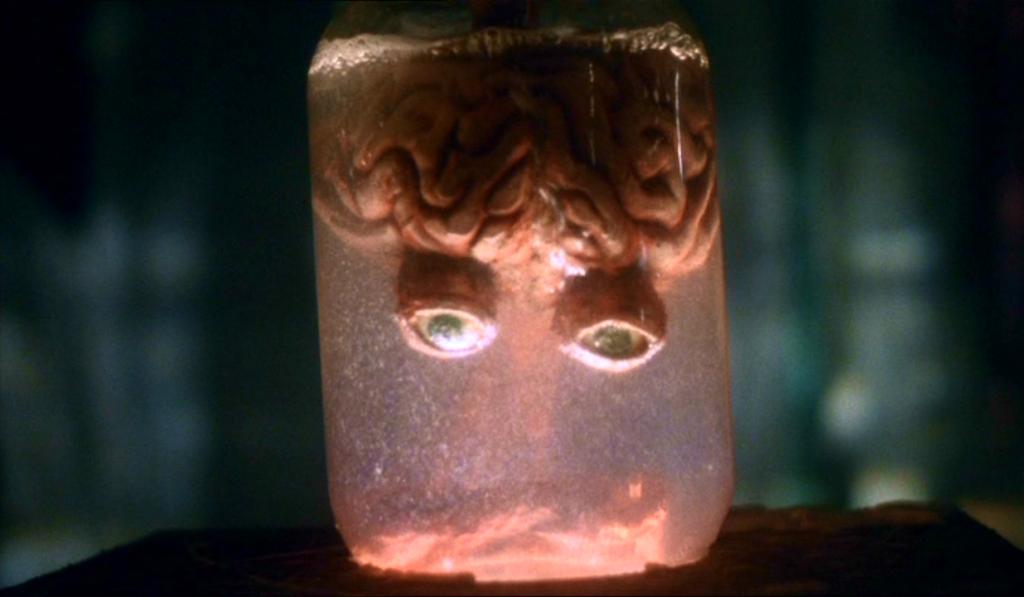
If there is anything positive to say about “Blood Diner,” it is that the cast of characters is certainly colorful, and makes for an odd and surreal world for the story to take place in. One of the key accessory characters, for instance, is a rival diner owner who is also a compulsive ventriloquist. There is also a group of explicitly vegetarian cheerleaders, a Hitler-themed professional wrestler, a talking undead brain, and a popular craze of nude aerobics.

blooddiner2One thing I still don’t understand about the plot is why the brothers pretend that their cannibalistic product is vegetarian, apart from the fact that it seems to be a popular fad in the world of the movie. It just strikes me as a little too easy of a ruse to spot, and they couldn’t possibly keep it up for too long for logistical reasons alone.

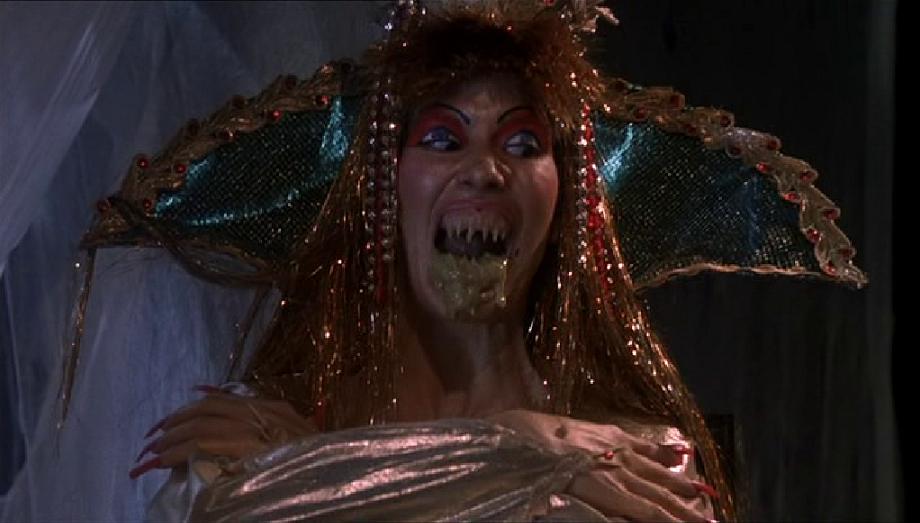
The God-raising ritual itself (the “blood buffet”) is the most bizarre section of the film by far. The Frankenstein-ish patchwork vessel for the deity is genuinely unsettling and bizarre, and the entire sequence plays like an intense fever dream. The nightclub setting is pretty much perfect for the finale, and the awful music is up to 11 throughout the whole sequence. The film is probably worth watching for that alone, because it is a spectacle of awfulness.

blooddiner4Overall, “Blood Diner” is a damn strange movie. As I said before, it rides a line between being parody and an earnestly terrible film, which makes it all the more intriguing to watch. How many of these moments were meant to be funny? Were they meant to be funny in the way that they are funny? The finale sequence alone makes it worth the watch for bad movie lovers, but I’m not totally sure how casual movie goers would react to it. It certainly isn’t dull, and has a lot of gore and ridiculousness to go around, but it also doesn’t quite have the same charm of the bad movie “classics” that everyone loves, which I think is because of the elements of intentional humor within it. If you are looking for a deep cut for a bad movie night, this could make an interesting pick. Better yet, it is entirely available on YouTube.

The Singing Detective

The Singing Detective

singingdetective1

Today’s feature is the surreal musical “The Singing Detective,” starring Robert Downey Jr. and Mel Gibson.

“The Singing Detective” was initially written as a BBC series by Dennis Potter, who also wrote the screenplay which ultimately led to this movie adaptation. Potter actually did suffer from extreme psoriasis, just like the lead character in “The Singing Detective.” Unfortunately, he died of cancer almost ten years before this film of his work was made.

“The Singing Detective” was directed by Keith Gordon, an actor who has directed a handful of pictures, such as “Mother Night,” “Waking the Dead,” and “A Midnight Clear.”

The cinematographer for “The Singing Detective” was Tom Richmond, who also shot such films as “Chopping Mall,” “Killing Zoe,” “Stand and Deliver,” “Mother Night,” and “House of 1000 Corpses.”

The editor on “The Singing Detective” was Jeff Wishengrad, who had worked with Keith Gordon on “Waking the Dead” and “The Chocolate War,” and also cut the horror film “Sorority House Massacre.”

The significant makeup effects team for “The Singing Detective” was composed of members of Captive Audience Productions, which is best known for doing movies like “The Passion of the Christ,” “Bicentennial Man,” “A Beautiful Mind,” and “Van Helsing.” The team included Anita Brabec (“The Hunger Games,” “Confessions of a Dangerous Mind”), Tom Killeen (“Red Planet,” “Spider Man 3”), Keith VanderLaan (“Son of the Mask,” “Van Helsing,” “Kull The Conqueror”), Greg Cannom (“The Pit and The Pendulum,” “Space Truckers,” “Jingle All The Way,” “Captain America,” “Highlander II,” “It Lives Again”), Corey Czekaj (“The Master of Disguise,” “Avatar”), Mark Nieman (“Foxcatcher,” “Big Momma’s House”), Pam Phillips (“Sideways,” “Bones”), Sam Sainz (“Toys,” “RoboCop 3”), and Patty York (“From Hell,” “Secret Window”).

singingdetective2The visual effects for “The Singing Detective” were provided by WhoDoo EFX, a company which also worked on such films as “Charlie Wilson’s War,” “The Stepford Wives,” and “X2.” The specific credited workers were Helena Packer (“The Last of the Mohicans,” “Tank Girl,” “Twin Peaks”) and Mark Ritcheson (“The Tuxedo,” “Anamorph”).

The special effects team for “The Singing Detective” was made up of Scott Blackwell (“24”), Jeremy Hays (“League of Extraordinary Gentlemen,” “State of Play,” “Tiptoes”), and David Peterson (“8MM,” “The X Files,” “Monkeybone,” “The Adventures of Ford Fairlane”).

The cast for “The Singing Detective” is headed by Robert Downey Jr. (“Iron Man,” “Kiss Kiss, Bang Bang”), Mel Gibson (“Lethal Weapon,” “Signs,” “Braveheart,” “Mad Max”), and Robin Wright (“House of Cards,” “State of Play,” “Unbreakable”), with the accessory players filled out by Adrien Brody (“The Pianist,” “Predators”), Jon Polito (“Miller’s Crossing,” “The Man Who Wasn’t There”), Katie Holmes (“Phone Booth”), Carla Gugino (“Sucker Punch,” “Watchmen”), and Jeremy Northam (“Mimic,” “The Net”).

singingdetective3The story of “The Singing Detective” takes place primarily inside the mind of a troubled, bedridden author with a debilitating skin condition, who increasingly lives inside a hallucination of one of his stories, where he lives as a dashing detective who also sings at a local night club.

Robert Downey, Jr. and Keith Gordon apparently met while they were both filming the Rodney Dangerfield comedy film “Back to School,” in which they both portrayed young characters.

The screenplay for “The Singing Detective” spent years rotating from studio to studio, with directors such as Robert Altman and David Cronenberg at one point or another expressing interest. Rumor has it that Altman was set to cast Dustin Hoffman as the lead, whereas Cronenberg had his eyes set on Al Pacino.

“The Singing Detective” was made on a budget of nearly $8 million, but grossed less than 350,000 in its limited theatrical run, making it a significant financial flop. The reception wasn’t much better: it currently has a 5.6 rating on IMDb, along with Rotten Tomatoes scores of 39% (critics) and 41% (audience).

“The Singing Detective” has a number of similarities to another Keith Gordon movie that I really like: “Mother Night,” adapted from the Kurt Vonnegut novel. Both stories center on an awful but oddly sympathetic protagonist being put through the ringer of life’s harshest struggles. However, “The Singing Detective” doesn’t pull off the same gravity as “Mother Night,” which benefits greatly from being shot starkly and in uniform shadows. Campbell from “Mother Night” is also a little more realistically portrayed as a human in deep pain, and isn’t constantly thrown into surreal hallucinations and manic musical numbers (which is not a fault to be leveled at Downey).

Speaking of which, Robert Downey Jr. is a particular highlight to “The Singing Detective,” and uses his typical sarcastic, frenetic charm to great effect. However, it is also combined with a pained bitterness and instability to create an incisive and paranoid character.

“The Singing Detective” is a little too incoherent to work effectively, but it is also oddly not quite surreal enough, either. I would have been fascinated to have seen Cronenberg’s or Altman’s takes on the story, because I think either of their styles would have fit it fantastically. Altman would have relied on character interactions, whereas Cronenberg could have turned it into something like “Videodrome” with a film noir twist.

This story just isn’t suited for casual moviegoers at all, and the advertising seemed to be done in a way that would trick people into the theater, which is a clear recipe for a disaster reception. The campaign certainly didn’t portray the movie as what it is: a depressing, cynical hallucination. It seemed like the advertising team just saw the title, and tried to sell the movie on that alone. Honestly, who wouldn’t have expected a jukebox musical noir from something called “The Singing Detective?”

Translation from television to film is always a bit tricky, as television shows are typically structured to follow a much longer arc than movie. In this case, the story of “The Singing Detective” specifically doesn’t lend itself well to the act structure of a film (at least for mass audiences). I was reminded a lot of Anthony Hopkins’s “Slipstream,” in that it lost itself in being profound, drifting right off into incoherence, and the slow pacing certainly didn’t do that any favors.

The production of “The Singing Detective” probably should have done new renditions of the songs featured in the film, as the lip syncing just doesn’t come off right, and isn’t particularly consistent either. The old tracks also keep the sequences from being truly distinct or charming, which they really could have been. The writer, Dennis Potter, was apparently adamant that the actors not sing the songs, so the lip syncing was actually specifically written into the script. This brings up another issue, in that the writer (or in this case, his will) may have had too much influence on the production (usually they have almost none), and thus muddled the vision. In any case, I guess what they did here is still better than “Viva Laughlin,” the failed musical television show (which was also adapted from an acclaimed BBC series) in which the actors bizarrely sang over the original tracks. It could always be worse, right?

Mel Gibson, to my shock, is actually pretty good here, and is nearly unrecognizable with the makeup effects. He doesn’t usually step outside of his comfort zone, so this was interesting to see. This was also a few years before he went completely off the rails, while he still had some real talent before sliding into self-parody. Robin Wright is also pretty great, as she always seems to be. She might be one of the most under-appreciated consistent performers in the business, even when in mediocre-to-awful movies.

Overall, “The Singing Detective” is a thoroughly flawed but interesting watch. The performances and direction are good, but the writing seems to be missing something to push it over the edge. Given the resurgence of both Robert Downey Jr. and Robin Wright in recent years, it is interesting to go back to. However, if you are just looking for pre-“Iron Man” RDJ performances, go to “Less Than Zero,” “Kiss Kiss, Bang Bang,” or “True Believer” before this one.

S. Darko

S. Darko

sdarko1

Today’s feature is yet another in a long tradition of unnecessary and reviled sequels: 2009’s “S. Darko.”

The director of “S. Darko” was Chris Fisher, who has primarily done work on television shows like “Warehouse 13” and “Person of Interest” as a producer and director.

The writer for “S. Darko” was Nathan Atkins, who has worked as an assistant editor on shows like “Masters of Horror” and “24,” but has also written a handful of TV movies like “Abominable Snowman.”

The cinematographer on “S. Darko” was Marvin V. Rush, who is a veteran director of photography on television shows such as “Hell on Wheels,” “Star Trek: Enterprise,” “Star Trek: Voyager,” “Star Trek: The Next Generation,” and “Star Trek: Deep Space Nine.”

The editor and co-producer for “S. Darko” was Kent Beyda, who also cut films such as  “Jonah Hex,” “Jingle All The Way,” “Fright Night,” “Humanoids of the Deep,” and “Gremlins 2.”

The producers on “S. Darko” included Sundip Shah (“Double Dragon,” “Sudden Death”), Jim Busfield (“Bad Ass,” “Bad Ass 2”), Ash Shah (“Frankenfish,” “Space Chimps 2”), and one of the producers of “Donnie Darko” in Adam Fields.

The music for “S. Darko” was composed by Ed Harcourt, who has also scored the documentary “For No Good Reason” and the 2007 film “New York City Serenade,” but it best known as a mildly popular British indie musician.

The cast of “S. Darko” is headlined by Daveigh Chase, one of the few returning elements from “Donnie Darko.” The rest of the cast includes Ed Westwick (“Gossip Girl”), Briana Evigan (“Step Up 2: The Streets,” “Sorority Row”), James Lafferty (“Oculus,” “One Tree Hill”), John Hawkes (“Congo”), and Jackson Rathbone (“Twilight,” “The Last Airbender”).

sdarko3Richard Kelly, the writer and director of “Donnie Darko,” dismissed the creation of “S. Darko” before it was ever even released, saying:

“To set the record straight, here’s a few facts I’d like to share with you all—I haven’t read this script. I have absolutely no involvement with this production, nor will I ever be involved.”

The creation of “S. Darko” was apparently made possible due to the dissolution of Newmarket films, which produced the original “Donnie Darko.” This apparently left the rights up for grabs, which the company Silver Nitrate jumped on to create “S. Darko.”

“S. Darko” wound up getting an abysmal reception from critics and audiences alike, earning Rotten Tomatoes scores of 0% (critics) and 18% (audience). The film currently holds a slightly higher IMDb rating of 3.7, which is still very much negative.

“S. Darko” was made on a budget of just under $4 million, and only received a limited theatrical release in Europe, earning a minimal gross. However, the movie apparently wound up at least making back its budget due to DVD and on demand sales.

Samantha Darko StillsOne of the first things I noticed about “S. Darko” was that the soundtrack is notably weak, which was a key strength of the original from the very first scene. I’m sure this was partially because they didn’t want to spend money to license anything, but the music in “Donnie Darko” was more important than just providing background noise: it helped set the time period and the style, things that “S. Darko” seems totally tone deaf to.

Likewise, I thought that the cinematography and general tone was just off for this film. “S. Darko” lacks the surreal touch of “Donnie Darko,” and wound up looking more like a cheesy ghost story than a trippy time travel mind-bender. Even the writing on the characters and their portrayals failed to build the same level of intrigue as the original film, which managed to create an interesting cast of characters despite not spending much time on any particular person outside of Donnie. “S. Darko,” on the other hand, presents a veritable parade of cardboard cutouts, lacking in any distinct depth or emotion.

“Donnie Darko” has a dedicated cult fan base, as most people know. This sequel was surely made because someone thought that more money could be squeezed out of the dedicated “Donnie Darko” loyalists, which of course backfired on them terribly. The whole feel of the production reminded me of “American Psycho 2,” in that it is only tangentially tied to the original, and desperately tries to imitate the quirks of its predecessor like a child awkwardly fumbling with the new found power of speech. The whole movie feels like a clueless mockingbird imitation of “Donnie Darko,” trying to hit the essential beats that make up the tune. From watching scene to scene, you can practically see the writer’s line of thinking:

“Donnie Darko” had a rabbit mask, so we need a rabbit mask.
“Donnie Darko” has a book about time travel, so we need a book about time travel.
“Donnie Darko” had a car crash, so we need a car crash.
“Donnie Darko” had an arson, so we need an arson.
“Donnie Darko” had CGI chest-worms, so we need chest-worms.
“Donnie Darko” had television portals, so we need television portals.
“Donnie Darko” has an object falling from the sky, so we need an object falling from the sky.

sdarko5Every little detail feels like a parallel imitation from the previous movie, to the point that this list could just go on forever. I would challenge readers to a drinking game based on these observations, but I don’t want to be held liable for any untimely deaths.

I liked “Donnie Darko” well enough, but the movie does not make any sense, despite what some die-hard fans might claim. Likewise, “S. Darko” doesn’t have a shred of coherence, but it lacks the style and performances that were key to “Donnie Darko” to make up for the layers of nonsense.

“S. Darko” is one of the most boring movies I have ever sat through, and I am including ancient exploitation movies, Coleman Francis flicks, and the dullest of parody films in that count. It is excruciatingly dull and painfully derivative, to the point that you will try to manifest a nonsense form of time travel to erase it from existence. I can’t recommend it as a good-bad watch, because there are just so many better ways to spend just under 2 hours of a day.

The Corpse Grinders

The Corpse Grinders

corpsegrinders2

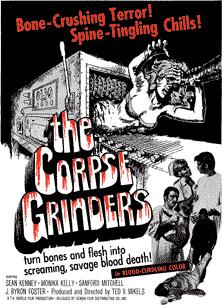
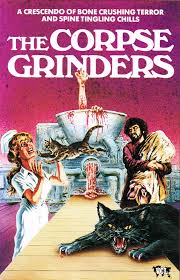
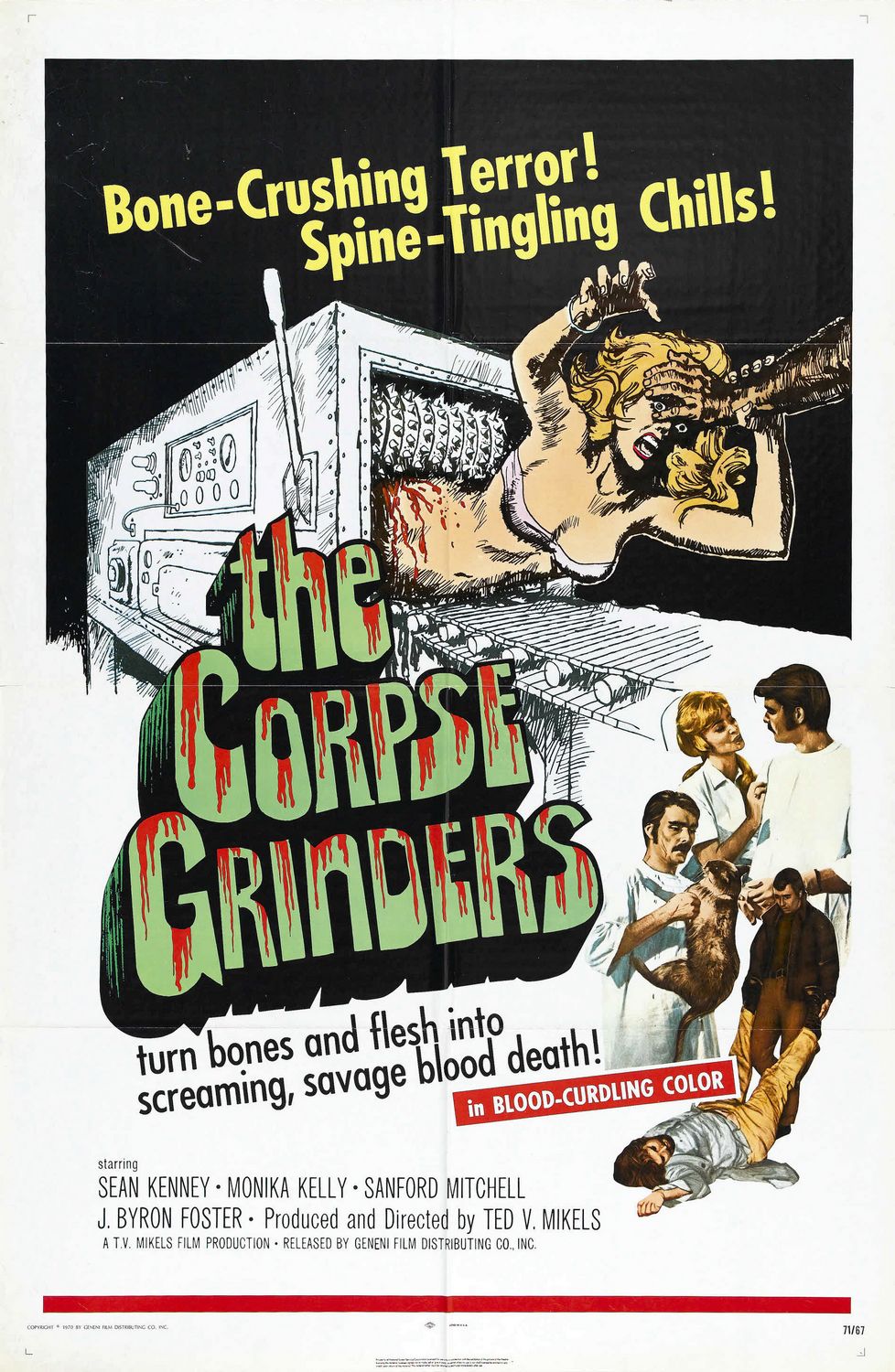
Today’s movie is a little story that answers the age-old mystery of what cat food is made of: “The Corpse Grinders.”

“The Corpse Grinders” was directed, produced, edited, scored, and co-written by Ted V. Mikels, a b-movie legend who also created “Girl In Gold Boots,” “The Astro-Zombies,” “The Black Klansman,” and “The Doll Squad.” The other credited writers were Arch Hall Sr., best known for “Eegah,” and Joseph Cranston (“The Crawling Hand”).

corpsegrinders1The effects for “The Corpse Grinders” were provided by Sherri Vernon (“Blood Orgy of the She-Devils”) and Gary Heacock (“The Astro-Zombies”).

The executive producer on the film was Peter James, who was also behind “Head in the Clouds,” “The Merchant of Venice” starring Al Pacino, and a 2005 adaptation of “Beowulf & Grendel.”

The cast of “The Corpse Grinders” is made up mostly of inexperienced exploitation actors, like Sean Kenney (“Star Trek,” “The Toy Box”), Sanford Mitchell (“The Scavengers”), Warren Ball (“The Harem Bunch”), Ann Noble (“Sins of Rachel”), Vincent Barbi (“Dolemite,” “The Astro-Zombies,” “The Blob”), and Drucilla Hoy (“Sinner’s Blood”).

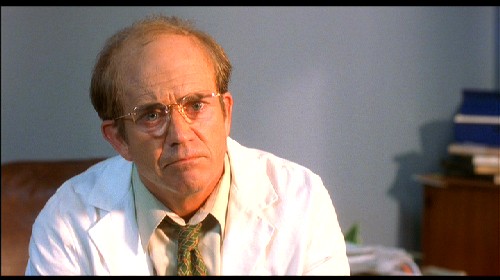
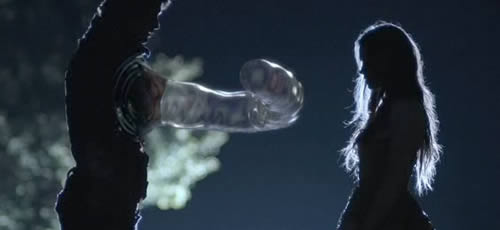
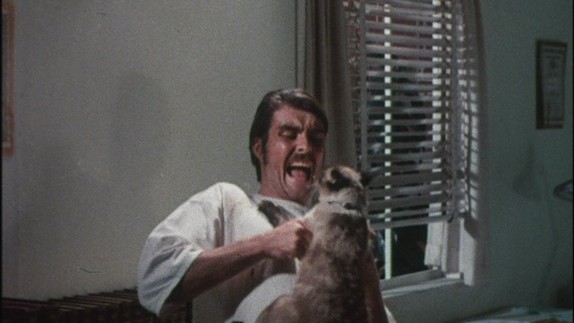
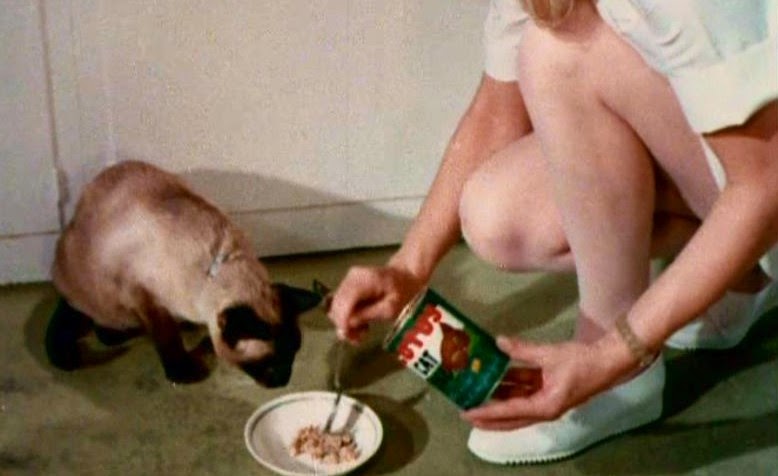
corpsegrinders4The story of “The Corpse Grinders” centers on a cat food company that is grinding up human corpses to make their product. The result is, of course, that domestic cats begin going wild and attacking their owners.

“The Corpse Grinders” spawned two sequels many years after the fact: “The Corpse Grinders 2” in 2000, and “The Corpse Grinders 3” in 2012.

In 2013, the Las Vegas Review Journal did a spotlight feature on Ted V. Mikels that covers many of his eccentric life experiences, as well as how the digital revolution affected his film making. Apparently, he at one point lived in a castle with a veritable harem, has a distinctive mustache, and is generally a bit of a creepy oddball. However, he also provided some interesting insights into his film-making process, particularly why he almost always worked with amateurs, and how that rounded him as a director:

“I found that the people I could use, the only ones I could afford, were people who didn’t have the type of experience that I required. So I had to put some tutoring into them to get what I wanted.”

The cat food company featured in “The Corpse Grinders” is called Lotus Cat Food Company. As luck would have it, there is now an actual pet food company that uses the name Lotus: Lotus Pet Foods. Much like the recent popularity of “Soylent,” based on the infamous product from “Soylent Green,” perhaps using the name “Lotus” has given the company a slight boost.

corpsegrinders5A 2008 documentary was made about the long career of Ted V. Mikels, called, appropriately, “The Wild World of Ted V. Mikels.” The movie was made by documentary maker Kevin Sean Michaels, who also created a feature about the infamous horror host and “Plan 9 From Outer Space” star Vampira.

The infamous corpse grinding machine, according to Ted V. Mikels, was constructed out of plywood and a series of bicycle parts, contradicting the myth that it was made precariously of cardboard.

corpsegrindersJustifiably, the reception to “The Corpse Grinders” wasn’t exactly glowing. It currently has an IMDb rating of 3.4, along with Rotten Tomatoes scores of 17% (critic) and 28% (audience). That said, the outlandish plot has cemented the film as a cult classic of the good-bad quasi-genre.

The budget for “The Corpse Grinders” was reportedly less than $50,000, which is astoundingly low even for low-budget flicks.

“The Corpse Grinders” obviously suffers from being as cheap as it is: the actors aren’t good, the effects are iffy, and, most notable of all, the sound quality is just awful. However, considering all of this, the film really isn’t all that bad. The biggest issue is probably how slow it is, as the plot plods around a bit too long.

corpsegrinders3If there is anything to say positive about “The Corpse Grinders,” it is that it is imaginative. The film came out the same year as “Willard,” which popularized the use of otherwise innocuous creatures as the subjects of monster movies, which led to films like “Night of the Lepus” and “Frogs.” However, “The Corpse Grinders” does a better job of explaining why the cats are attacking, something that most of the others gloss over. “The Corpse Grinders” also makes some interesting use of colored lighting during certain scenes, which creates a bizarre ambiance for the corpse grinding room.

Ted V. Mikels is, of course, an exploitation director. As you would expect from the genre, there’s a lot of inexplicable lack of clothing throughout the film, but it could certainly have been more flagrant. From what I have seen of Ted V. Mikels, “The Corpse Grinders” is actually pretty low-key among his films.

Overall, “The Corpse Grinders” is an imaginative little cheap flick with an interesting concept, but it suffers immensely from having an extremely low budget and being paced awfully. The experience of sitting through it is unfortunately pretty boring, and the highlights are rare and fleeting. That said, a supercut of them is probably worth checking out.