Category Archives: Themed Reviews

Water Foul: Creature From The Haunted Sea

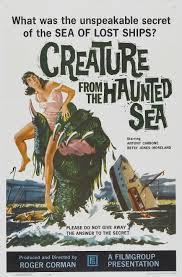
Creature From The Haunted Sea

hauntedsea2

Today’s movie is another low-budget classic from Roger Corman: Creature From The Haunted Sea.

Creature From The Haunted Sea was written by Charles Griffith, a frequent Corman collaborator who penned such memorable flicks as Death Race 2000, Attack of the Crab Monsters, A Bucket of Blood, and The Little Shop of Horrors.

The director and producer of Creature From The Haunted Sea was, of course, Roger Corman, who is widely known as the king of the b-movies. Though he has primarily worked as a producer over the years, he also has over 50 directing credits, including The Wild Angels, Attack of the Crab Monsters, A Bucket of Blood, and The Little Shop of Horrors.

The cinematographer for Creature From The Haunted Sea was Jacques R. Marquette, who shot multiple episodes of television shows like The Greatest American Hero, Hawaii Five-O, McHale’s Navy, The Patty Duke Show, and The Streets of San Francisco over his career.
hauntedsea1The score for Creature From The Haunted Sea was provided by Fred Katz, who worked on a number of other Corman movies like A Bucket of Blood, The Little Shop of Horrors, and The Wasp Woman.

The associate producer for Creature From The Haunted Sea was Charles Hannawalt, who has worked with Roger Corman in a number of different capacities over his career, including producing The Beast with A Million Eyes, acting as cinematographer on Dementia 13, and serving as a grip on movies like The Trip and She Gods of Shark Reef.

Creature From The Haunted Sea stars Beach Dickerson (Attack of the Crab Monsters), Robert Bean (The Wild Ride), Betsy Jones-Moreland (Last Woman on Earth), Antony Carbone (A Bucket of Blood), and famed screenwriter Robert Towne, who later penned such movies as Chinatown, Bonnie & Clyde, Days of Thunder, Shampoo, and Mission: Impossible.

hauntedsea3The plot of Creature From The Haunted Sea takes place during a Cuban revolution, where a mobster seeks to profit on the social unrest by smuggling loyalists out of the country with the government’s treasury. However, he plans on killing and robbing the exiled stowaways under the guise of an elaborate fake monster attack. Complications arise in the form of an embedded CIA agent and the appearance of a real sea monster, both of whom threaten the entire operation.

Creature From The Haunted Sea was shot back to back with Last Woman on Earth, using the same crew, cast, and locations in Puerto Rico.

Unlike many of Corman’s more famous b-movies, Creature From The Haunted Sea is an intentionally comedic parody movie, lampooning everything from spy films to gangster flicks to Corman’s own prolific creature features.

Robert Towne is credited under a pseudonym for his role in the movie, taking on the fake name ‘Edward Wain’ in the cast listing.

The reception to Creature From The Haunted Sea wasn’t particularly positive, certainly due in part to the unusual comedic tone. It currently holds a 21% audience score on Rotten Tomatoes, along with a 3.3 user rating on IMDb.

hauntedsea4The plot of Creature From The Haunted Sea is impossible to fully understand without a familiarity with the context of the time. The movie released in June of 1961,  which placed it right in the middle of the most heated diplomatic era between Cuba and the United States in the long history between the two neighboring countries. In April of 1961, two months prior to the film’s release, the United States launched the counter-revolutionary campaign known as The Bay of Pigs, which ultimately failed to depose Fidel Castro, whose communist forces had been controlling the country since 1959. Sixteen months following the release of the film, the Cuban Missile Crisis took place, in which Cuba agreed to house Soviet nuclear weapons within eyesight of the Florida coast. This is remembered as the pinnacle of tensions in the Cold War, and the defining moment in John F. Kennedy’s presidency.

What is important to note about all of this is that at the time, Communism’s hold in Cuba was still new, and most believed that it would be ousted by some sort of United States scheme before too long. Not only was there the Bay of Pigs invasion, but the CIA even built up a bit of a reputation surrounding their failed assassination attempts on Fidel Castro, which were frequent enough to justify a wikipedia page. So, the idea that the Communist revolutionaries would need to flee the country on short notice was far from unrealistic in the minds of the American public, particularly given the US Government’s adherence to domino theory, and its proficiency in meddling in foreign governments during the era.

The other aspect of the time that may not be engrained in the public consciousness, but is of note to the film’s story, is the involvement of the mafia in Cuba. For film buffs, you probably recall a famous sequence from The Godfather Part 2 that depicted the 1959 Cuban Revolution foiling a backroom mafia plot to divide the country. In fact, organized crime had a field day with Cuba during the reign of Batista, which was effectively ruined by the Communist revolution and Batista’s fall from power. However, as depicted in Creature From The Haunted Sea, the organized crime elements didn’t entirely disappear overnight, particularly if they had money wrapped up in businesses in the country. Thus, that’s why there are so many wayward American criminals and mobster-types hanging out in Cuba at the beginning of Creature From The Haunted Sea.

On to the nuts and bolts of the film, this movie is actually pretty funny, particularly in how it skewers the spy genre. The film is interestingly more of a spy movie than a monster movie at its core, which certainly isn’t what it appears to be at first glance, and wasn’t how it was marketed.

The storyline is incredibly culturally relevant and political, particularly for a b-movie creature feature. It is still goofy without any doubt, and a lot of jokes fall flat, but there is more to it than just simple comedy, which it had every right to limit itself to. More than anything, the movie provides a fascinating window into the time period, and how the American public viewed Cuba and communism in the country. I was reminded a little bit of an episode of The Twilight Zone that also dealt with a veiled version of Cuba called “The Mirror,” which also released in the latter half of 1961, and is worth checking out.

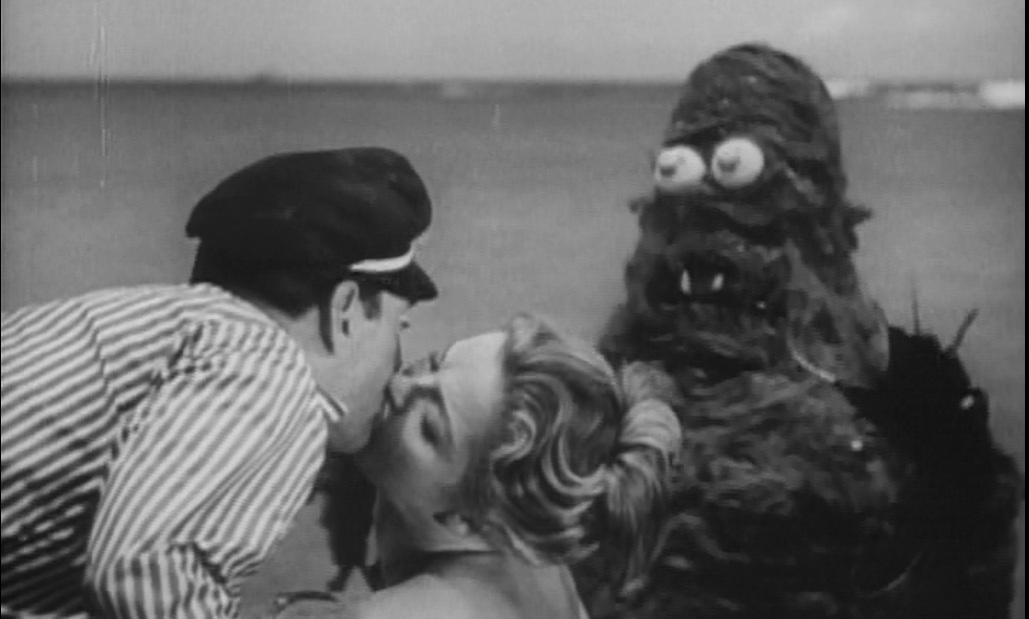
I can’t very well not talk about the ridiculous monster in this movie, which makes The Creeping Terror look like something Stan Winston or Rick Baker cooked up in a workshop. If you ask me, the goofy eyes are really what ties the whole thing together, and gives the monster its life-like quality. It is actually admirable in my opinion that Corman could laugh at himself and the reputation of his movies with this flick. For a modern example, this movie is comparable to what it would be like if Michael Bay had directed Hot Fuzz, if you could imagine such a thing.

While this wasn’t Corman’s only foray into the realm of comedy, it is certainly the least acclaimed of his three famous ventures into the genre. Both A Bucket of Blood and The Little Shop of Horrors are better polished, more memorable, and more fondly treasured as b-movie comedies than Creature From The Haunted Sea, and I can’t help but think that is partially due to the ad hoc nature of the production, as Joe Dante describes in the video above. When you are literally cobbling together a movie from the screenplay up with spare time while making another movie, there is no way you can give it the attention and care that the feature merits, even if it is in the hands of Corman’s notoriously quick movie-making machine. Even with similar back-to-back situations, like with Dolls and From Beyond, both screenplays were at least fully formed at the outset, whereas Creature From The Haunted Sea was a mere concept when the cast and crew was setting out for Puerto Rico.

Overall, Creature From The Haunted Sea is an uneven comedy with plenty of dead spots, and it was obviously cobbled together and padded out with extra footage. That said, it still has a peculiar charm to it and some solid comedic moments. This is a movie that I would say requires some research ahead of going into it, because it certainly isn’t a conventional Corman creature feature, and shouldn’t be viewed as such. If nothing else, this film is a curiosity worth checking out for its novelty value, if not for its cultural value as a window into a bygone era and into Corman’s own opinion of his movies.
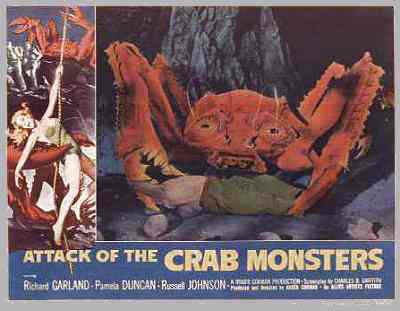
Water Foul: Attack of the Crab Monsters

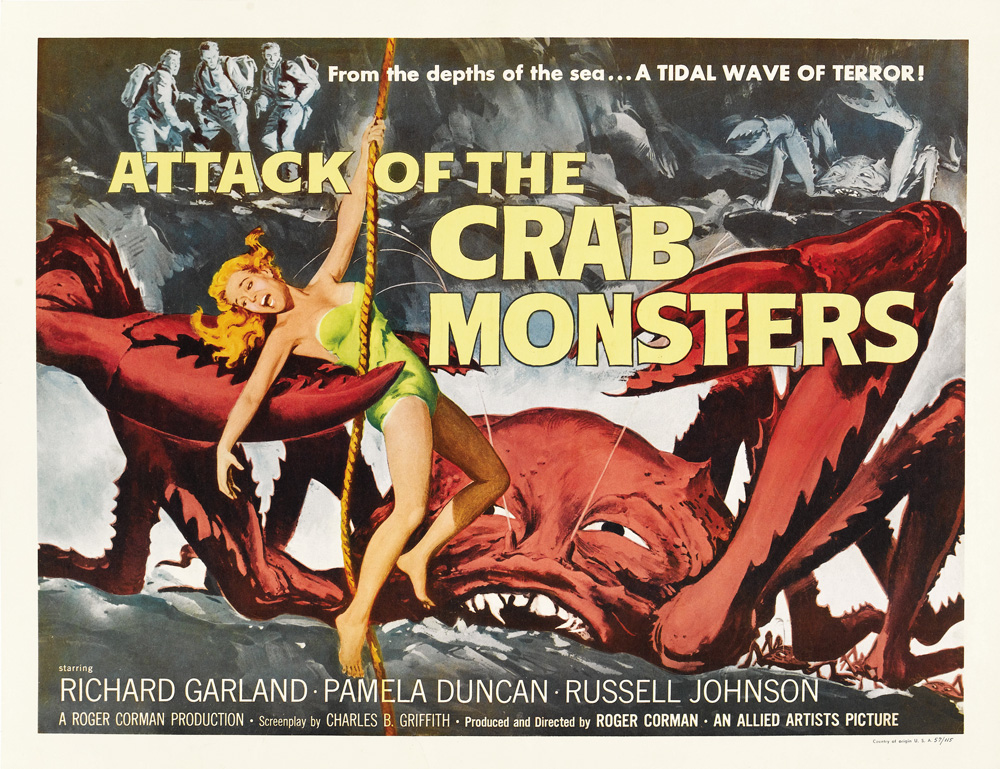
Attack of the Crab Monsters

crabmonsters1

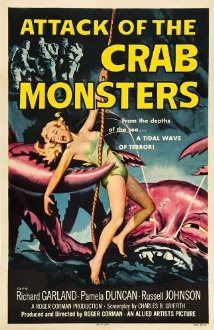
Today’s flick is Roger Corman’s famous creature feature b-movie, Attack of the Crab Monsters.

Attack of the Crab Monsters was written and co-produced by Charles Griffith, a frequent Corman collaborator who penned such memorable flicks as Death Race 2000, A Bucket of Blood, and The Little Shop of Horrors.

The director and producer of Attack of The Crab Monsters was, of course, Roger Corman, who is widely known as the king of the b-movies. Though he has primarily worked as a producer over the years, he also has over 50 directing credits, including The Wild Angels, The Creature From The Haunted Sea, A Bucket of Blood, and The Little Shop of Horrors.

The cinematographer for Attack of the Crab Monsters was Floyd Crosby, who also shot movies like House of Usher, The Raven, and X: The Man With X-Ray Eyes for Roger Corman.

crabmonsters2The editor for the film was Charles Gross, who cut a handful of other b-movies like Invasion of the Saucer Men and It Conquered The World.

The musical score for Attack of the Crab Monsters was provided by Ronald Stein, who composed music for other Roger Corman flicks like The Terror, Attack of the 50 Foot Woman, and Francis Ford Coppolla’s debut film, Dementia 13.

The cast of Attack of the Crab Monsters included Ed Nelson (A Bucket of Blood), Richard Garland (Mutiny in Outer Space), Beach Dickerson (The Trip, Creature From The Haunted Sea), Richard Cutting (South Pacific), Mel Welles (The Little Shop Of Horrors), Leslie Bradley (The Conqueror), and Russell Johnson (Gilligan’s Island).

crabmonsters3The plot of Attack of the Crab Monsters follows a group of scientists who are researching into the after effects of the Bikini Atoll nuclear tests on local wildlife. To their shock, they discover that a couple of ornery giant crabs that have mutated dramatically, to the point of acquiring telepathic powers.

The eponymous crab monsters were portrayed via a two-person suit, with one person filling the body and another operating the claws. Instead of having designated effects workers to operate the effects, actors who weren’t in the specific scene were assigned to run the crab.

Attack of the Crab Monsters initially released on a drive-in double bill with Not of This Earth, another Roger Corman directed creature feature from 1957.

Attack of the Crab Monsters is one of the most iconic of the Roger Corman monster movies, and has appeared in the background of many other films as a form of homage. For instance, sharp eyes might spot the poster or clips of the film in movies like Chopping Mall or Found.

Writer/producer Charles Griffith directed all of the underwater sequences in the movie, supposedly because he was inspired by documentary filming done by Jacques Cousteau.

Jim Wynorski, a cohort of Roger Corman’s who has directed such flicks as Chopping Mall, Piranhaconda, and 976-EVIL II, has expressed interest in helming a remake of Attack of the Crab Monsters. However, Corman is reportedly against the idea, despite Wynorski having previously remade a number of his other movies, most notably Not of This Earth and The Wasp Woman.

In an interview with Dennis Fischer, writer and producer Charles Griffith said the following about the inception of Attack of the Crab Monsters:

“Roger came to me and said, ‘I want to make a picture called ‘Attack of the Giant Crabs,’ and I asked, ‘Does it have to be atomic radiation?’ He responded, ‘Yes.’ He said it was an experiment. ‘I want suspense or action in every scene. No kind of scene without suspense or action.’ His trick was saying it was an experiment, which it wasn’t. He just didn’t want to bother cutting out the other scenes, which he would do.”

The reception to Attack of the Crab Monsters wasn’t particularly great at the time, however, it is undoubtedly a classic Roger Corman movie today. It currently holds a 4.8 rating on IMDb, and Rotten Tomatoes scores of 29% (audience) and 67% (critics).

In true Corman fashion, it is estimated that the budget for Attack of the Crab Monsters was an astounding $70,000, on which it certainly managed to turn a profit.

Attack of the Crab Monsters certainly doesn’t waste any time getting started: before any character names are even introduced, a crab is on screen and decapitating an extra. This is particularly interesting, given how slowly paced many of these older monster flicks are (The Horror of Party Beach comes to mind). As mentioned previously, this constant action was part of Corman’s plan for the film from the onset, which pays off pretty well for what this movie is. The downside of this, however, is that the audience isn’t given any time to relate to the cast of characters, because they aren’t given any breathing room to be human, and die off quicker than you can get through ice breakers.

crabmonsters4The plot of Attack of the Crab Monsters could be accurately described as infamously outlandish. The premise that irradiated crabs with superhuman intelligence and telepathic powers are looking to conquer the world is a few steps beyond the mere bizarre, even for a 1950s b-movie. The fact that the crabs actually have dialogue puts this flick in a league of its own if you ask me.

The underwater footage in the movie actually looks pretty good, and if the claim from writer Charles Griffith is true, I’m actually pretty impressed that the production actually did it themselves. Underwater sequences seem to beg for stock footage, and I wouldn’t have put it past them to use whatever was laying around or handy to plug the hole in the movie.

The ending of Attack of the Crab Monsters is appropriately abrupt and baffling given the rest of the film, with a character collapsing an electrical tower onto the last surviving crab, killing both dramatically. However, this climax occurs almost entirely off-screen, being portrayed primarily via an electric sound effect over a reaction shot of the last two survivors. This shot lasts approximately 10 seconds before a fade into the ending card, with the following concluding lines summing up the movie:

“He gave his life…”

“I know.”

*THE END*

There is something particularly appropriate about the movie interrupting and cutting off the character’s final thoughts, like it was trying to hurry people out the door and didn’t actually care what the actors had to say about the situation anyway.  The entire movie clocks in at barely over an hour, and shuffles its way quickly through that entire run time. I’m willing to bet that the aim was to get the film to an even 60 minutes, but the team just barely missed the mark. Still, it is almost refreshing to see a movie that races too fast from beginning to end, especially given how many slow movies I have had to sit through. It doesn’t make the movie good (pacing that is too fast is still a problem), but it is certainly harder for me to complain about.

Overall, Attack of the Crab Monsters is a rightfully legendary b-movie. You can’t help but giggle when a goofy giant crab claw materializes from off screen without the character seeing it, or when a giant crustacean sets up an elaborate plot by mimicking human speech patterns, throwing its voice, and sabotaging complex communications equipment. The fact that the film takes itself seriously at all is astounding, particularly with the crabs roaring like pissed off gorillas for half of the movie, and speaking in German accents for the other half. The sheer wackiness of the story elevates the feature over a lot of similar flicks from the era without any doubt. It still holds onto the expected bad acting and goofy effects that are hallmarks of the genre, but having nefarious, psychic sea-life hanging about puts Attack of the Crab Monsters a rank or two above its peers in the realm of entertainment value. If you are looking for a b-movie classic to check out, this should be on your list.

Water Foul: The Last Shark

The Last Shark

lastshark1

Today’s entry into the “Water Foul” spotlight on awful aquatic monster flicks is The Last Shark, likely the most notorious of the Jaws knock-offs.

The Last Shark had three credited writers: Vincenzo Mannino (Hallucination Strip, Murder-Rock: Dancing Death, The New York Ripper), Marc Princi (The Squeeze, Terror Stalks The Class Reunion), and producer Ugo Tucci (Zombie, Once Upon A Time In The West).

The director of The Last Shark was Enzo Castellari, who also directed 1990: The Bronx Warriors, The Inglorious Bastards, Keoma, and The Shark Hunter.

The cinematographer for the film was Alberto Spagnoli, who shot such films as the Italian Lou Ferrigno Hercules movies and Peter Bogdanovich’s Daisy Miller.

The editor for the movie was Gianfranco Amicucci, who also cut a number of Castellari’s other films, including Keoma, The Inglorious Bastards, and 1990: The Bronx Warriors. He also went on to edit a number of Ruggero Deodato (Cannibal Holocaust) movies, including The Washing Machine and Mom I Can Do It.

The music for The Last Shark was composed by Guido and Maurizio De Angelis, who contributed scores to a number of other low-budget features like The Shark Hunter, Keoma, and Alien 2: On Earth.

Aside from co-writer Ugo Tucci, the producers for The Last Shark were Maurizio Amati (Cannibal Apocalypse), Sandro Amati (The New Gladiators), and Edward Montoro (Pieces, Pod People, Anthropophagus, Grizzly).

The makeup and special effects for The Last Shark were done by Giovanni Morosi (Inglorious Bastards, Escape From The Bronx) and Antonio Corridori (Mission Impossible III, Piranha II, U-571, The Italian Job).

The cast of The Last Shark included James Franciscus (Beneath The Planet Of The Apes), Joshua Sinclair (Judgment in Berlin, 1990: The Bronx Warriors, Keoma), Vic Morrow (1990: The Bronx Warriors, Twilight Zone: The Movie), Giancarlo Prete (Bad Cop Chronicles, Escape From The Bronx), and Stefania Goodwin (1990: The Bronx Warriors, Super Mario Bros.).

The plot of The Last Shark surrounds a string of shark attack deaths off the coast of a tourist town, but an ambitious local politician refuses to close the beaches due to an upcoming wind-surfing event. After the event turns into a tragedy, the whole town goes into a frenzy trying to catch and kill the crazed, monstrous shark.

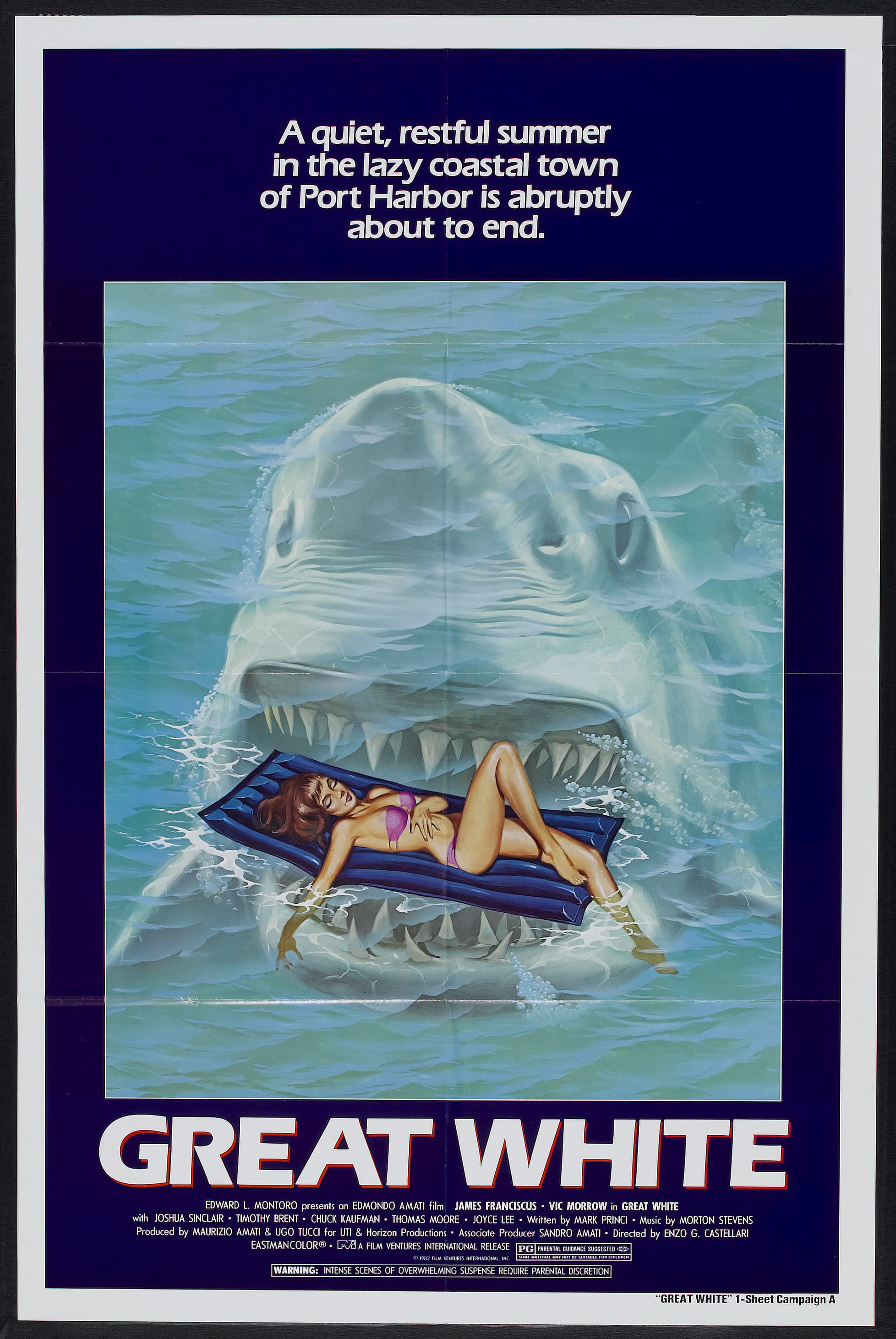
As you might suspect from that plot synopsis, The Last Shark was marketed as a Jaws sequel in a handful of foreign markets, while being titled Great White for its release in the United States. Regardless, Universal Pictures filed a lawsuit against the production for being too similar to Jaws, which led to an injunction and the film being pulled from theaters.

lastshark2 lastshark4

A sequel to The Last Shark was at one point planned, but the shark was too heavily damaged during the production to re-use, and it was decided that it wasn’t worth the trouble to create a new one.

The reception to The Last Shark was roundly negative: it currently holds a 4.6 rating on IMDb, alongside a 35% audience score on Rotten Tomatoes.

I wasn’t able to dig up a number for the budget on The Last Shark, but I assume it was pretty low. Primarily due to piggy-backing on the popularity of Jaws, the film grossed 18 million in its United States theatrical run (despite being pulled from theaters), making it significantly profitable on the whole.

lastshark3To the credit of the politician character in this movie, he at least does more than the mayor in Jaws. Instead of outright refusing to acknowledge the shark attacks, he surrounds the beach with shark-proof netting to provide a sense of security for the locals participating in the wind-surfing event. Of course, this doesn’t wind up working, but it is certainly more effort than doing nothing.

The music for this movie is all over the place, and even opens with an upbeat and pop-inspired number. It just doesn’t fit with what should be a thriller or adventurous soundtrack, and is a huge departure from the classic Jaws score.

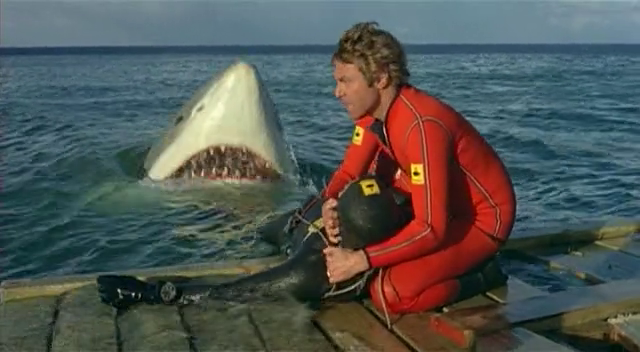
Most of times the shark is shown on screen in The Last Shark, it is done with stock footage. However, a mechanical shark is used occasionally, and looks absolutely terrible. They would have been better off just not bothering with underwater footage of the replicated shark at all.

All of that said, there is some extensive miniature work in this movie that, in my opinion, doesn’t look excessively terrible, particularly when compared to the CGI shark nonsense we get today. At one point the shark takes out a helicopter, which is simultaneously awesome and hilarious. However, nothing stands out quite as much as the ultimate shark death at the end of the movie.

Overall, The Last Shark is a pretty entertaining watch, particularly for fans of Jaws. The film is so not-subtle about being a knockoff that sequences are basically lifted straight out of Jaws and thrown into this movie. It is certainly understandable why Universal wasn’t thrilled about this movie, because it takes more than a few steps too far. As far as entertainment value goes, the shark and miniature effects are hilarious, and the actor playing not-Quint is pretty entertaining. This is a movie worth digging up if you want to watch an old school cheap shark movie that wasn’t made by Syfy and The Asylum.

Water Foul: Octaman

Octaman

octaman2

Today’s movie is Octaman, which features a human-octopus hybrid suit designed by repeat Academy Award winner Rick Baker.

Octaman was written, directed, and produced by Harry Essex, who was also behind such films as It Came From Outer Space and Creature From The Black Lagoon.

The cinematographer on the film was Robert Caramico, who also shot numerous episodes of the television shows Just Shoot Me and Dallas, the Fred Williamson blaxploitation western Boss (that’s, uh, not the original title), and Ted V. Mikels’s The Black Klansman.

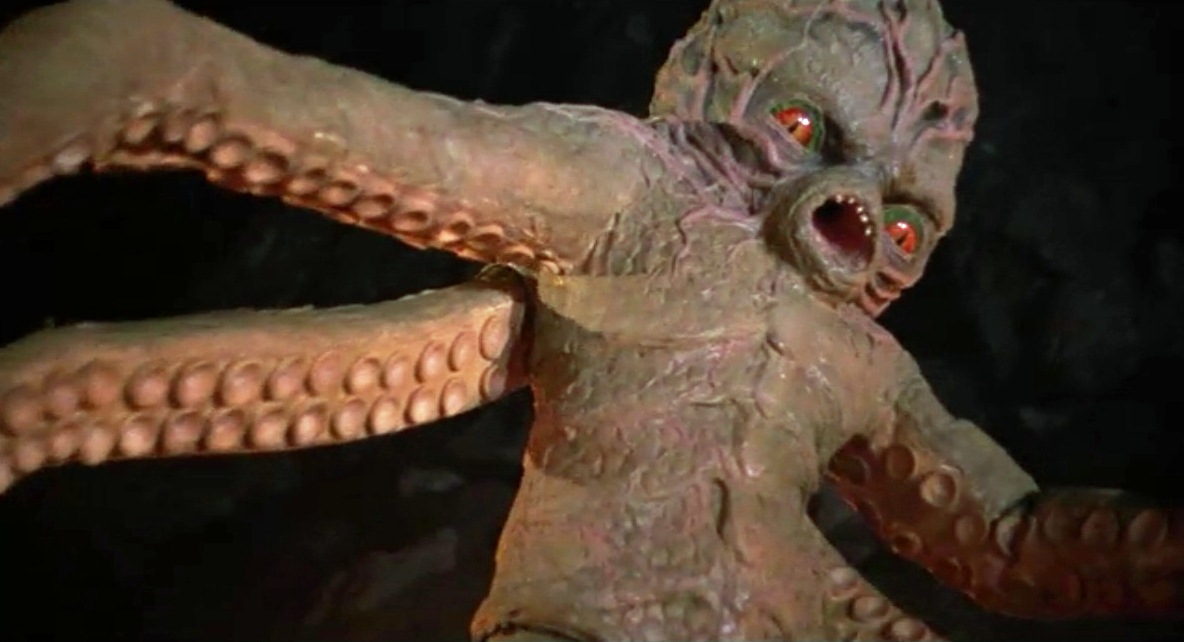
The effects team for the movie included Academy Award winner Rick Baker (An American Werewolf in London, Men in Black, Ed Wood, Wolf, Videodrome, It’s Alive, It Lives Again, Black Caesar), Doug Beswick (Aliens, The Terminator, Evil Dead II, Ghostbusters), and Ron Kinney (Wild Riders, The Cremators). Beswick and Baker specifically designed the Octaman suit, under the belief that it would be kept in shadows and obscured for most of the film. Unfortunately, that wasn’t the case.

octaman4The cast of Octaman included Pier Angeli (Battle of the Bulge, The Angry Silence), Jeff Morrow (This Island Earth, The Giant Claw, The Creature Walks Among Us), and Kerwin Mathews (Jack The Giant Killer, The 7th Voyage of Sinbad).

The story of Octaman is delightfully straightforward: a team of scientists stumbles upon a mysterious mutated hybrid of an octopus and a human, and the creature proceeds to make all of their lives miserable and significantly shorter.

Footage of Octaman shows up under a variety of different titles in movies like Gremlins 2 and Fright Night, as an homage both to the influence of Rick Baker as an effects master, and as a throwback to traditional, b-level horror and monster movies.
octaman1The reception to Octaman was unsurprisingly negative, and it currently holds a 3.5 rating on IMDb, alongside a 23% audience score on Rotten Tomatoes.

The budget for the movie was reportedly $250,000, which is a pretty astounding microbudget. However, the product on screen holds true to the saying “you get what you pay for.”

Octaman is a movie that feels, looks, and sounds misplaced in time. The movie could have been made any time from the tail end of the 1950s to (particularly cheaply) in the 1980s, and I don’t think it would look or sound all that different. It is a curiosity of a film that rides the line between being an homage and legitimately being the thing that it is trying to send up (honestly, I’m still not 100% sure which this is).

octaman3The suit itself is probably the most impressive aspect of the movie given the budget, but the way it is shot and used is just hilariously awful. It is a real testament to the importance of cinematography and editing when it comes to movies with practical monsters, because the way it is shown on screen makes all the difference between it being intimidating and it being impossibly goofy.

Speaking of which, the lighting throughout the movie is astoundingly terrible, and most of it comes off looking like incomprehensible blackness (except for the monster, the one thing that should be kept a bit obscured). For most of the film, it is a chore to parse out what the hell is supposed to be happening on screen, because all of the colors used are on a scale of pitch black to relatively dark blue.

Octaman uses a few moments of monster point-of-view shots, which popped up here and there throughout the history of b-movies. However, it became particular famous for its use in highly-acclaimed, b-movie influenced films like Jaws, Predator, and Halloween.

The only real highlight to the film comes when a plot is executed to capture the monster by confusing it with strobe lights and encircling it with fire, in order to “burn up the oxygen all around him.” Astoundingly, this works, and the team throws a net over the monster and calls it a day. That part of the plan, however, doesn’t turn out so well.

octaman5Overall, Octaman is a pretty run-of-the-mill, cheaply made b-movie. If not for Rick Baker’s involvement, it would probably only amount to a footnote in the history of bad movies. However, Baker’s participation and future success adds an element of trivia to the movie, which makes it moderately more worth checking out. Personally, I think the movie is pretty dull, but I’d recommend looking up some clips and photos of the suit in action to get an idea of where a 12-time Academy Award nominated (and 7-time winner) effects guru comes from.

Water Foul: Godzilla vs. The Sea Monster

Godzilla vs. The Sea Monster

seamonster2

Today’s entry into the “Water Foul” spotlight on the worst aquatic monsters in movie history is 1966’s Godzilla vs. The Sea Monster.

Godzilla vs The Sea Monster was written by Shinichi Sekizawa, the primary writer of the Showa era of Godzilla. His credits include the MST3K-infamous Godzilla vs. Megalon, Godzilla vs. Gigan, Godzilla’s Revenge, King Kong vs. Godzilla, Godzilla vs. Monster Zero, Ghidorah: The Three Headed Monster, Godzilla vs. Mothra, and Godzilla vs. Mechagodzilla.

The director for Godzilla vs The Sea Monster was Jun Fukuda. This was his first Godzilla movie, and afterwards he would direct four more in the Showa era of the franchise: Son of Godzilla, Godzilla vs Gigan, Godzilla vs. Megalon, and Godzilla vs. Mechagodzilla.

The cinematographer on the film was Kazuo Yamada, who also shot Son Of Godzilla, Samurai III, and Samurai Rebellion, as well as Key of Keys, which was used as the source material for Woody Allen’s What’s Up, Tiger Lily?

The editor for Godzilla vs The Sea Monster was Ryohel Fujii, who was yet another Toho regular, cutting such films as Ghidorah: The Three Headed Monster, King Kong Escapes, Frankenstein Conquers The World, and Godzilla vs. Monster Zero.

Executive Producer Tomoyuki Tanaka was a producer of the Godzilla franchise from the original Godzilla all the way through the conclusion of the Hesei era, 1995’s Godzilla vs. Destroyah. He also frequently produced movies for Akira Kurosawa, such as Yojimbo, Kagemusha, and Sanjuro.

The music on Godzilla vs. The Sea Monster was done by Masaru Sato, who accrued 236 score composition credits over his illustrious career, including Yojimbo, Throne of Blood, Sanjuro, Godzilla Raids Again, and The Hidden Fortress.

The Godzilla vs. The Sea Monster effects team included Sadamasa Arikawa (Godzilla, Destroy All Monsters, Mothra, Rodan), Sokei Tomioka (Terror of Mechagodzilla, King Kong Escapes, Frankenstein Conquers the World), Taka Yuki (Godzilla, Ghidorah: The Three Headed Monster), Fumio Nakadai (Son of Godzilla, Godzilla’s Revenge), Eiji Tsuburaya (Godzilla, Godzilla Raids Again, Throne of Blood, Rodan, Mothra), Teruyoshi Nakano (Godzilla vs. Mothra, Godzilla 1985), and Akira Watanabe (The Green Slime, Godzilla, Godzilla Raids Again, Destroy All Monsters).

The cast of the movie included a number of recognizable faces from other Toho films: Akira Takarada (Godzilla, Godzilla vs. Mothra, King Kong Escapes, Godzilla vs. Monster Zero), Kumi Mizuno (Godzilla: Final Wars, Godzilla vs. Monster Zero, Frankenstein Conquers the World), Chôtarô Tôgin (Destroy All Monsters), and Tôru Ibuki (Terror of Mechagodzilla, Godzilla vs. Monster Zero).

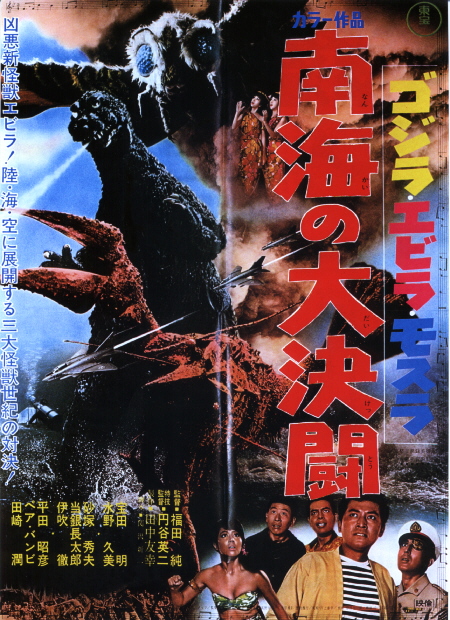
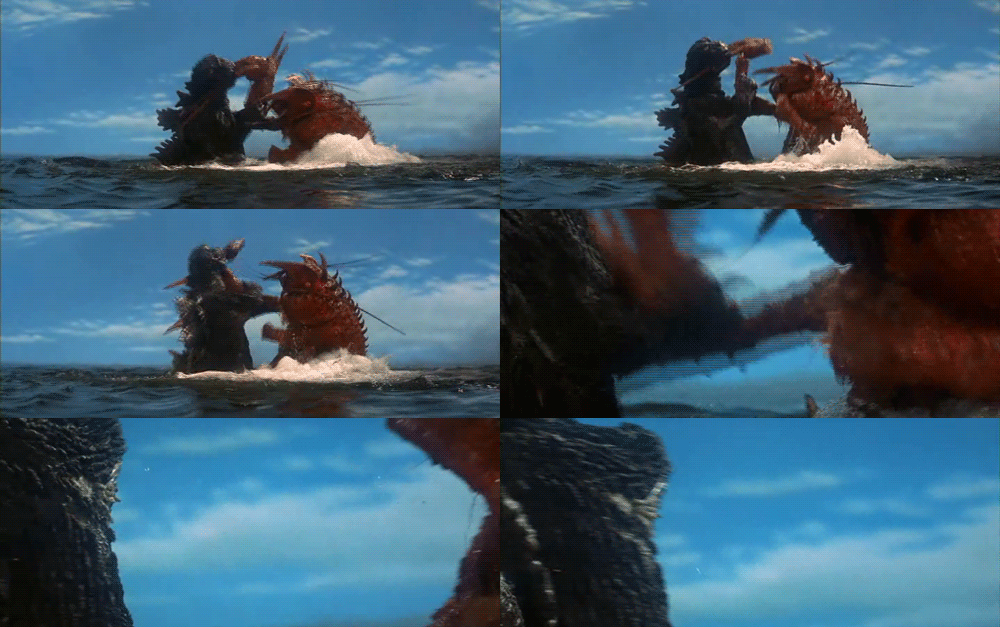
The plot of Godzilla vs. The Sea Monster has very little to do with the monsters themselves. A terrorist organization has taken over a small island, and is secretly developing nuclear weapons there. They use a giant shrimp, named Ebirah, to defend the island and prevent any of their captured slaves from escaping. However, they ultimately capture a Japanese citizen, and his family goes hunting after him, ultimately leading to the discovery of the secret base. Serendipitously, Godzilla is found sleeping in a cave nearby, and is awakened to fight Ebirah. Also, Mothra is hanging around on a nearby island (where the slaves were mostly kidnapped from), and eventually shows up to help towards the end of the story.

seamonster1Godzilla vs. The Sea Monster was initially planned to be a King Kong movie, and many of that monster’s trademarks and characteristics remain in the movie. Godzilla’s uncharacteristic obsession with a woman and his awakening via lightning were both associated with King Kong as opposed to the King of the Monsters. The lightning revival came from King Kong vs. Godzilla, which was also due to a last minute monster replacement (King Kong for Frankenstein’s Monster), making the trait all the more confusing.

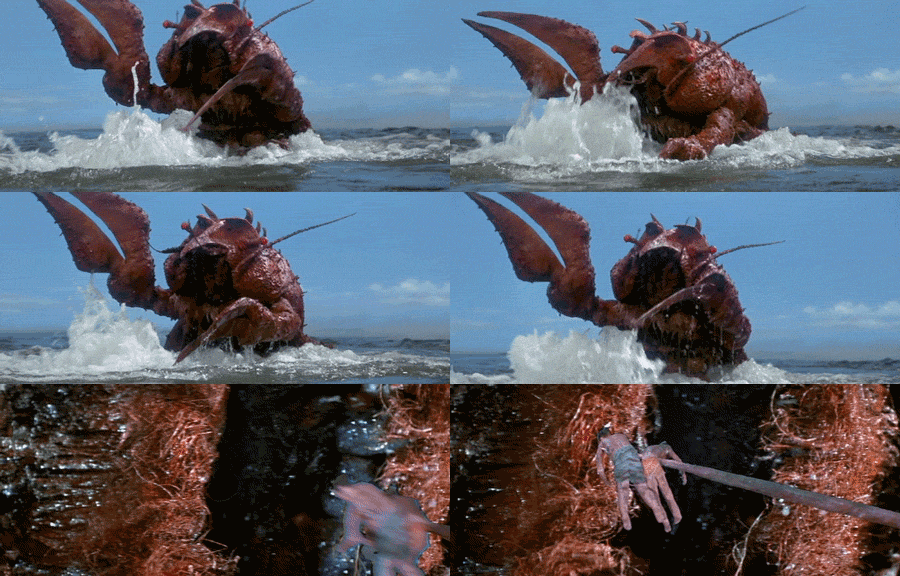
The Sea Monster itself, Ebirah, is named after the japanese word for shrimp, ‘ebi.’ This essentially confirms that Ebirah is supposed to be a shrimp, though it looks a bit more like a lobster.

Godzilla vs. The Sea Monster interestingly marks the last appearance of a full-grown Mothra in the Showa era of Godzilla, though the larval form pops up again in Destroy All Monsters in 1968.

Mystery Science Theater 3000, the popular bad movie television show, had an episode dedicated to Godzilla vs. The Sea Monster in its second season. The episode immediately followed the more recognizable and terrible Godzilla vs. Megalon, which famously features the robot Jet Jaguar.

The reception to Godzilla vs. The Sea Monster was generally negative, and is regarded as one of the weaker entries into the series. It currently holds a rating of 5.1 on IMDb, along with a 39% audience score on Rotten Tomatoes.

First off, Godzilla vs. The Sea Monster definitely focuses far more on the human plot than the monsters, which is bound to be part of why it is so unpopular. Godzilla doesn’t even appear on screen until an hour into the picture. However, the story isn’t super-awful as far as the Showa era of Godzilla is concerned. The terrorist organization isn’t as memorable as sound-prone aliens from Planet X or angry cockroach people, but they serve well enough here.

The monster fighting that does appear in the movie is really lackluster. Ebirah isn’t particularly powerful, and doesn’t have any way to effectively compete with Godzilla, eand ventually gets his claws torn off without much fanfare. There are a couple of other minor battles, such as a skirmish between Godzilla and Mothra and the appearance of a Rodan-like bird monster, but they are both pretty brief and unmemorable. The movie does feature an infamous volleyball fight between Ebirah and Godzilla, which I believe pops up again re-purposed in the even more terrible Godzilla’s Revenge.

seamonster3My favorite part of the film by far is when Ebirah spears two people on one of his claws like a shish kebab, which both looks ridiculous and is kind of jarring. You don’t see the Toho monsters directly kill people very often, though death is heavily implied by their stomping and blasting. It definitely stands out as a highlight moment in the movie, and is one of the few clips worth checking out.

seamonster4Overall, Godzilla vs. The Sea Monster is a pretty mediocre entry in the Showa era of Godzilla. It isn’t particularly over-the-top or entertaining in comparison to the rest of the series, but also isn’t quite amusingly abysmal enough to make sitting through it much fun. The MST3K episode is pretty solid and the background trivia is interesting, so if you want to watch it, I’d recommend going that route with it.

Water Foul: DeepStar Six

DeepStar Six

deepstar1

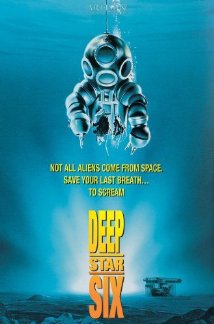
Today’s movie is one of the numerous 1989 deep ocean science fiction flicks: DeepStar Six.

DeepStar Six was written by two people: Geof Miller (House IV) and Lewis Abernathy (Terminal Invasion, House IV), neither of whom have many other writing credits of note.

DeepStar Six was directed and produced by Sean Cunningham, who was also behind Friday the 13th, The New Kids, and Spring Break, and also acted as a producer on Jason X and House.

The cinematographer on the film was Mac Ahlberg, who also shot such films as Re-Animator, King of the Ants, Evil Bong, Good Burger, Space Truckers, From Beyond, Dolls, Trancers, Ghoulies, and House.

The editor for DeepStar Six was David Handman, who also cut Jason X and Wishmaster, and served as assistant editor on Footloose and Staying Alive.

The music for the film was provided by Harry Manfredini, who also provided scores for House, Swamp Thing, Friday the 13th, Wishmaster, Jason X, and The Omega Code.

Aside from Sean Cunningham, the producers for DeepStar Six were Mario Kassar (Showgirls, Angel Heart, Red Heat, Total Recall, Jacob’s Ladder, Terminator 2), Patrick Markey (The Quick and The Dead, Joy Ride, House), and Andrew Vajna (Judge Dredd, The 13th Warrior, First Blood).

The special effects team included Steve Wang (Hell Comes To Frogtown), Mike Trcic (Leviathan), Doyle Smiley (Slipstream (2007)), Mark Shostrom (From Beyond), Robert Olmstead (Best Seller, Cellular, Predator 2), Steve Patino (From Beyond, Hell Comes To Frogtown), Greg Nicotero (Maniac Cop 3, The Black Cat, Dreams In The Witch House), James McLoughlin (Wolf, Son Of The Mask), Karen Mason (Leviathan, Congo, Lake Placid), Robert Kurtzman (Maniac Cop 3, From Beyond), David Kindlon (Leprechaun, Hell Comes to Frogtown, From Beyond, Wolf), Mike Edmonson (Daredevil, Wild Wild West), James Cummins (Jaws 3-D), Gino Crognale (Texas Chainsaw Massacre 2, Troll, From Beyond), Francis Coates (Leonard Part 6), Everett Burrell (Re-Animator, Troll, Castle Freak), Al Broussard (Speed 2: Cruise Control), and John Blake (From Beyond, Leviathan),

The cast of DeepStar Six includes Taurean Blacque (Hill Street Blues), Nancy Everhard (The Punisher), Greg Evigan (TekWar), Miguel Ferrer (RoboCop, Twin Peaks, Hot Shots Part Deux), Nia Peeples (Blues Brothers 2000), and Cindy Pickett (Evolver, Ferris Bueller’s Day Off).

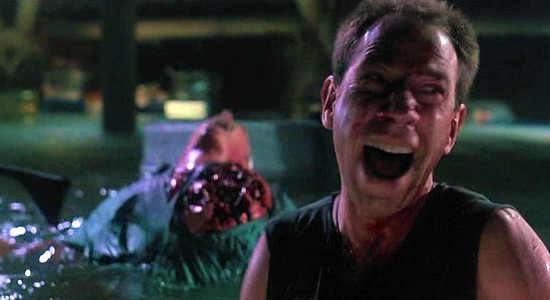
deepstar3The plot to DeepStar Six follows the population of an experimental deep water military colony that comes under attack by a mysterious sea monster.

DeepStar Six kicked off the 1989 deep sea sci-fi boom, which also featured Leviathan, The Abyss, The Rift, Lords of the Deep, and The Evil Below. However, the early bird failed to get the worm on this occasion: the film just barely broke even on its theatrical run.

Robert Harmon (best known for The Hitcher) was initially going to direct the film, but left the production before filming. Cunningham, who was set to produce, took on the directing role as well.

The reception to DeepStar Six was pretty negative, likely due to unfavorable comparisons to the similar, more impressive films The Abyss and Leviathan. It currently holds a 5.1 rating on IMDb, along with Rotten Tomatoes scores of 0% (critics) and 22% (audience).

I noticed from reading around that some more recent reviews of DeepStar Six compare it to 1998’s Sphere, which strikes me as a genuinely more similar movie to DeepStar Six than both of its major contemporaries, The Abyss and Leviathan.

The monster isn’t nearly as impressive as the bizarre concoction in Leviathan or the creatures from The Abyss, and that makes for a pretty significant comparative weakness. Personally, I thought it just looked like a Graboid from Tremors. The cast also isn’t nearly as deep for DeepStar Six as the other two movies, though I absolutely love Miguel Ferrer going increasingly off his rocker in this film.

deepstar2deepstar4Overall, DeepStar Six isn’t an awful flick, it just pales in comparison to its peers. If this had come out a year or more earlier, people probably would have been less harsh to it. That said, it is also far from fantastic: the pacing is certainly not great, and most of the components of the film are mediocre from top to bottom. It doesn’t deserve the abysmal reputation that it has accrued, and I think the more recent reviews and ratings of the film reflect that. This movie isn’t garbage, it is just middling, and to a certain degree a victim of its historical context.

As far as a recommendation goes, the only thing I loved about this movie was Miguel Ferrer’s over-the-top performance. The story plods along, and feels like the broad-strokes plot of Deep Blue Sea stretched to its absolute limit. The movie works fine as background noise if you just want to have something on Netflix, but it isn’t something people should particularly seek out.

Water Foul: Devil Fish

Devil Fish

bottom25devil

Today’s installment into the “Water Foul” spotlight on the worst aquatic monster movies ever made is one of the illustrious members of IMDb’s Bottom 100: 1984’s Devil Fish.

Devil Fish was directed and co-written by Lamberto Bava, the son of the legendary giallo director Mario Bava (Black Sunday, Black Sabbath). He directed the film under the pseudonym of John Old, Jr., which was a frequent practice for Italian directors making knock-off films. Lamberto Bava also worked with noted Italian horror icon Dario Argento on the films Demons and Demons II.

The other credited writers on the film included Dardano Sacchetti (The Beyond, 1990: The Bronx Warriors, Manhattan Baby), Gianfranco Clerici (Cannibal Holocaust, The New York Ripper), Luigi Cozzi (Starcrash, Hercules, The Adventures of Hercules 2), and Sergio Martino (The Mountain of the Cannibal God, The Great Alligator, Torso).

The cinematographer for Devil Fish was Giancarlo Ferrando, who also shot movies like Troll 2, Hands of Steel, Warrior of the Lost World, The Great Alligator, and Torso.

The editor on Devil Fish was one Roberto Sterbini, who has also performed editing duties on films like Zombi 3, Hands of Steel, and Beyond the Door II.

The music for Devil Fish was provided by Fabio Frizzi, who also provided scores to Zombie, The Beyond, and the outlandish 1977 colorized, Italian version of Godzilla by Devil Fish co-writer Luigi Cozzi.

The ‘shark’ for the movie was created by one Ovidio Taito, who astoundingly has no other listed special effects credits on IMDb. The rest of the special effects are credited to Germano Natali, who also worked on movies like Starcrash, Suspira, The Beyond, Hercules, and King Solomon’s Mines.

The plot of Devil Fish is pretty straightforward: it follows a hunt for a mysterious, unidentified creature that is attacking swimmers off the coast of Florida.

As the dialogue loves to remind the audience throughout the film, the monster featured in the movie is clearly not a shark. Despite this, one of the most common alternate titles of this movie is simply Shark. Other alternate titles included Red Ocean, Devouring Waves, Monster Shark, and Shark: Red On The Ocean.

The reception to Devil Fish online is incredibly negative, and its IMDb rating of 2.4 places it in the Bottom 100 of the website. However, this is mostly due to the fact that the movie was featured on the hit show Mystery Science Theater 3000, which tends to dramatically skew votes into the negative range.

Devil Fish was obviously a Jaws knockoff in concept, but it clearly went very wrong somewhere in the creation process. The plot moves almost unbearably slowly in the movie, and the plot lines are barely interesting enough to follow in the first place. There is also, of course, tons of bad science loosely thrown around to try to explain the squid-shark antagonist of the film. I particularly like that it is supposedly capable of breaking down into individual cells and reforming into countless copies of itself, provided they don’t completely destroy it within a set amount of time. As you could probably predict, the evil shark-beast was created by sinister scientists for a vague military purpose, which explains some of its more outlandish qualities.

As bad creature movies often do, the monster was shown far too early on in this movie, and is given too much exposure throughout the film. On top of that, it looks really damn goofy, because the design is pretty much a sharktopus. While it looks good as far as quality goes, particularly for a movie as cheap as this one, it is damn near impossible to take a sharktopus seriously as the central monster of a movie.

Aside from the monster, the blood effects used in this film are really shoddy. There is a point where a character is shot and instantaneously has clearly fake blood dried on his shirt, which is pointed out to great comedic effect by the MST3k crew.

Overall, Devil Fish is a shockingly dull movie, given what it is. Despite fleeting moments of amazingness, like when the monster is killed by a mass of flamethrowers, the pacing of the film is so awful that it is a chore to sit through the whole thing. Even the handful of attacks are boring and routine, whereas they should be highlights of the flick. Unless you are used to watching through movies with Mystery Science Theater 3000, this is a movie that you should absolutely skip. There just isn’t enough going on here to be entertaining.

Water Foul: The Shark Hunter

The Shark Hunter

OLYMPUS DIGITAL CAMERA

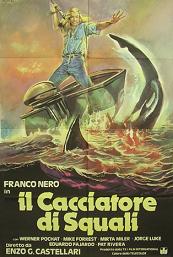
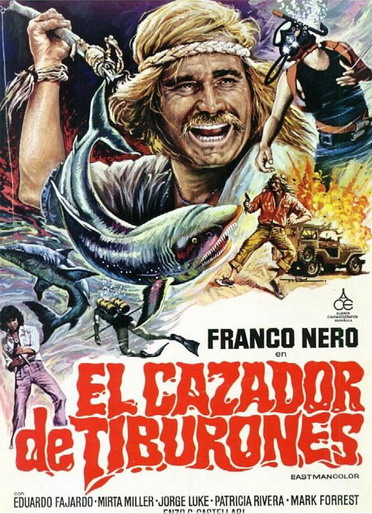
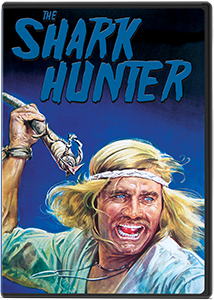
Today’s feature is a little-known Franco Nero movie from 1979: The Shark Hunter.

The Shark Hunter was written by a team that included Alfredo Gianetti (The Blue Eyed Bandit, Divorce Italian Style), co-producer Jaime Comas Gil (A Fistful of Dollars, Cabo Blanco), Tito Carpi (Escape from the Bronx), Jesus Folgar (Watch Out, We’re Mad) and Gisella Longo (Adam and Eve).

The director of The Shark Hunter, Enzo Castellari, was also behind a number of other low-budget Italian productions like The Last Shark, 1990: The Bronx Warriors, Keoma, and The Inglorious Bastards.

The editor for the film was Gianfranco Amicucci, who also cut Keoma, 1990: The Bronx Warriors, and The Inglorious Barstards for Castellari.

The cinematographer on The Shark Hunter was Raul Perez Cubero, who accrued nearly 100 cinematography and director of photography film credits over his career.

The special effects in The Shark Hunter are credited to Alvaro Passeri, which is, according to IMDb, a pseudonym for producer and director Massimiliano Cerchi, who went on to create such films as Satan Claus and Hellbilly.

sharkhunter8The music for The Shark Hunter was composed by Guido and Maurizio De Angelis, who contributed scores to a number of other low-budget features like The Last Shark, Keoma, and Alien 2: On Earth.

The cast of The Shark Hunter includes Franco Nero (Django, Massacre Time, Die Hard II, Omega Code 2), Werner Pochath (Flatfoot in Africa), Jorge Luke (Clear and Present Danger), and Michael Forest (Body of Evidence, Macross Plus, Big O, Mobile Suit Gundam F91).

The reception to The Shark Hunter online is mixed: it currently has a 5.0 rating on IMDb and a 67% audience score on Rotten Tomatoes. However, it is certainly not well known, and both of those numbers come off of very small sample sizes.

I usually don’t cover movies that I can’t understand. However, I decided to give this a shot at this one with translated YouTube subtitles. The results were less than stellar.

sharkhunter2 sharkhunter3 sharkhunter4 sharkhunter5 sharkhunter6In spite of the language barrier, I was still able to piece together the gist of the story. Franco Nero stars as a mysterious professional shark hunter with a hidden criminal past, who has taken up on a remote island after the death of his wife. He becomes engulfed in a wild treasure hunt when word starts to spread about a downed aircraft just off shore with a massive load of cash. All of the forces need his input because of his expertise as a shark hunter (the waters around the wreck are infested with sharks), and for his criminal prowess. This places him in the middle of a dangerous web of violent and greedy individuals that start to appear on the island.

The Shark Hunter takes a while to get going, but the last third of the movie is pretty much non-stop. Once all of the invested parties are established and the treasure heist is planned, everything heats up pretty well: there’s a pretty decent boat/plane chase, a bunch of alarmingly realistic shark wrestling. and Franco Nero wearing what I assume is the most ridiculous wigs ever to grace a film. As badass as Nero is throughout the film, that wig of blonde, flowing locks still looks absolutely ludicrous, and steals the show most of the time.

sharkhunter7As I mentioned previously, there are a number of sequences in this movie where Franco Nero’s stunt double (I assume) actually wrestles a goddamn shark in the water. I was worried that the movie was about to turn into an unintentional remake of Lucio Fulci’s Zombie, and I’m actually curious as to how they pulled all of the shark wrestling off. Some years earlier, Samuel Fuller had similar stunts in his film Shark! that utilized live, sedated sharks, which tragically resulted in the death of one of the film’s stuntmen. I’d like to think that they didn’t do the same thing here.

sharkhunter1I kind of like the plot to this movie (at least the bits that I could understand), and appreciated the way that the crime and heist aspects played into the adventure setting. It made for an interesting sort of genre-bender that took notes from all across the board, synthesizing into something that felt unique.

Overall, this isn’t a particularly awful film, but it certainly isn’t high quality, and suffers from an obviously shoe-string budget. The beginning is far too slow, but the conclusion pretty much makes up for the weaknesses of the first act. The shark wrestling is kind of nerve-wracking because you have to assume that the stunt people were actually in significant danger, which adds an extra element to the movie (for better or worse). I would love to find a legitimately subtitled or dubbed copy of The Shark Hunter, because it was kind of a struggle to get through with the nonsense translations, but it was still compelling enough to get me through it.

Water Foul: Piranha II

Piranha II: The Spawning

piranhaii1

Today, I’m going to be continuing my spotlight of the worst aquatic horror movies with yet another infamous sequel: Piranha II: The Spawning.

Piranha II has three credited screenplay writers: James Cameron (The Terminator, Aliens, The Abyss, Avatar, Titanic), Ovidio Assonitis (The Visitor, Tentacles), and Charles H. Eglee (Dark Angel, Dexter, The Shield). James Cameron is also the sole credited director, however, he reportedly was dismissed and had no control over the editing process, which was dictated by producer and co-writer Ovidio Assonitis. Because of this, there is some question of how much of Cameron’s work actually made it to the screen.

The cinematographer for Piranha II was Roberto Plazzoli, who also shot such films as Starcrash, Midnight Ride, and Tentacles. The editor on Piranha II was Roberto Silvi, who also cut the films Tombstone, Leviathan, and The Ninth Configuration.

piranhaii2The musical score for Piranha II was composed by Stelvio Cipriani, who also created music for the Mario Bava movies Baron Blood and A Bay of Blood, as well as a number of other killer animal flicks like The Great Alligator and Beaks.

Aside from Ovidio Assonitis, the other producers on Piranha II were Chako van Leeuwen (Piranha, Piranha 3D, Piranha 3DD) and Jeff Schechtman (Piranha, Invasion of the Bee Girls, Enter the Dragon, Killing Zoe).

The effects team for Piranha II included Brain Wade (Van Helsing, Wild Wild West, Galaxy of Terror, Jaws 3D), Maurizio Trani (Troll 2, 1990: The Bronx Warriors), Gilberto Carbonaro (Keoma), Mario Cassar (Leviathan, Cutthroat Island, Final Justice), Antonio Corridori (The Italian Job, The Last Shark), Gino De Rossi (Hudson Hawk, Casino Royale, The Inglorious Bastards), and Glannetto De Rossi (Kull The Conqueror, Dune, The Beyond, Zombie).

piranhaii3The cast for Piranha II is primarily made up of Lance Henriksen (The Last Samurai, Aliens, Hard Target, The Terminator), Ricky Paull Goldin (The Blob, All My Children), Carole Davis (Mannequin, The Flamingo Kid), and Steve Marachuk (Eyes of Laura Mars).

The plot of Piranha II follows an investigation into a series of bizarre deaths in the waters around a Caribbean island. While it is at first suspected of being the work of sharks or barracudas, it is eventually discovered that the genetically modified monsters from Piranha have unexpectedly returned, and mutated into having the ability to fly.

James Cameron is outspoken about how much he deeply dislikes the final product of Piranha II, saying the following:

I was replaced after two-and-a-half weeks by the Italian producer. He just fired me and took over, which is what he wanted to do when he hired me. It wasn’t until much later that I even figured out what had happened. It was like, “Oh, man, I thought I was doing a good job.” But when I saw what they were cutting together, it was horrible. In actual fact, I did some directing on the film, but I don’t feel it was my first movie.

Not only was Cameron dismissed before the film was completed and locked out of the editing room, but Miller Drake, who was a trailer cutter alongside Piranha director Joe Dante at Roger Corman’s New World Pictures, was briefly attached to direct before him, and was quickly fired by Assonitis before filming. This is particularly unfortunate, as his idea for the movie sounds pretty cool:

Miller’s intention was that Piranha II should hinge upon Kevin McCarthy’s scientist from Piranha, even though he had seemingly perished in the first movie. “I pitched this idea of bringing Kevin McCarthy back, all chewed up and mutilated from the previous movie,” says Drake. “He was on an abandoned oil rig and he was developing these flying piranhas out there to get revenge, or whatever. I think we were going to bring Barbara Steele back and have him kill her by smashing her head through a fish tank.”

The idea for James Cameron’s hit The Terminator came from the time period when Piranha II was releasing in Italy. Cameron got significantly ill while powerlessly fretting over the movie overseas in the United States, and had a vivid fever dream about a skeletal, killer robot, which became the primary inspiration for The Terminator’s central machine.

Regardless of the unusual situation behind the scenes, Piranha II is still officially James Cameron’s directorial debut, at least on paper. His name remaining on the picture after being fired is apparently due to a contractual stipulation which required that an American had to be credited as the director on the film, or else he would likely have been taken off the movie’s credits, as he initially requested.

piranhaii5James Cameron’s b-movie roots interestingly go deeper than just Piranha II. Before his ill-fated directorial debut, he worked on such films as Galaxy of Terror, Battle Beyond the Stars, and Escape From New York as a visual effects artist, production designer, and art director.

The budget for Piranha II was astoundingly reported as less than $150,000, which it managed to make back with a marginal profit on a limited theatrical release in Europe.

Piranha II has been widely loathed by audiences and critics ever since its release. It currently holds a rating of 3.5 on IMDb, alongside amazingly low Rotten Tomatoes scores of 7% (critics) and 10% (audiences).

The fish in Piranha II just look terrible, even in comparison to the less than impressive monstrous stars of the original Piranha. The addition of wings on the creatures just comes off as comical rather than menacing, in spite of how hard the movie tries to make them terrifying. Fortunately, the film wisely tries to keep the fish off screen and out of focus as much as possible, but there is just no getting around how goofy they look when they do show up.

piranhaii4Worse than anything else is the fact that Piranha II is astoundingly slowly paced, and doesn’t do much to keep the audience’s attention. Honestly, this is one of the most boring movies I have watched since I finished the IMDb Bottom 100, and that is saying a lot. I was able to focus on an Italian Franco Nero movie with no subtitles better than I could stay tuned into Piranha II.

Overall, Piranha II is a train wreck of a movie with little to no redeeming value. However, the behind the scenes stories are really fascinating and interesting, enough so that it is almost worth watching through the movie to get some context. If you aren’t planning to do some reading for the sake of trivia, though, you should avoid Piranha II at all costs. However, the clips of the flying piranhas are worth checking out, because those are hilarious.