Tag Archives: b-movies

Water Foul: Jaws In Japan

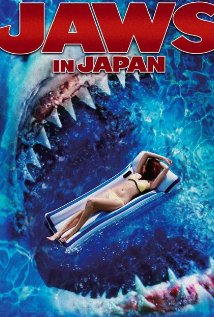
Jaws In Japan

jawsinjapan2

Today’s feature is a 2009 Japanese “sequel” to the 1975 super-smash, Jaws. Appropriately, it is commonly known as Jaws in Japan.

Jaws in Japan was written by Yasutoshi Murakawa, who also penned a movie called Iron Girl: The Ultimate Weapon, which I kind of assume is a Japanese Iron Man sexploitation knockoff (but I’m not planning to find out if that is true or not.)

The director for Jaws in Japan was John Hijiri, whose only other major credit is a Japanese TV series called Girls Be Ambitious.

The Jaws in Japan cinematographer is the most experienced member of the crew that I came across, Yasutaka Nagano. He has shot such films as The Machine Girl, a segment in The ABCs of Death, and something called RoboGeisha.

The editor for the flick was one Masakazu Ohashi, whose credits include X Game and the TV show Girls Be Ambitious under director John Hijiri.

The producers on Jaws in Japan were Kyosuke Uen (Grotesque, Geisha Assassin) and Rie Mikami, who only has two other listed credits on IMDb, neither of which have five votes as of yet.
jawsinjapan1The visual effects for Jaws in Japan were provided by Tsuyoshi Shôji, who recently provided effects for an undeniably Japanese movie called Schoolgirl Apocalypse.

Jaws in Japan stars one Nonami Takizawa, who, according to wikipedia:

is a Japanese gravure idol, and a female talent. She is best known for her voluptuous figure. She is from Saitama, and her nickname is ‘Nonamin’.[2] She retired from modeling as of 2011.

You might notice that ‘acting’ isn’t specifically mentioned in that blurb, which I don’t think was a mistake on the writer’s part.

The plot of Jaws in Japan follows two young college students on vacation at a resort island. However, not all is well in the apparent paradise, as both a serial killer and a murderous shark may be hunting in the area.

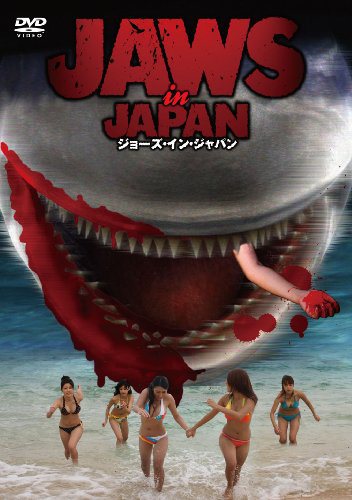
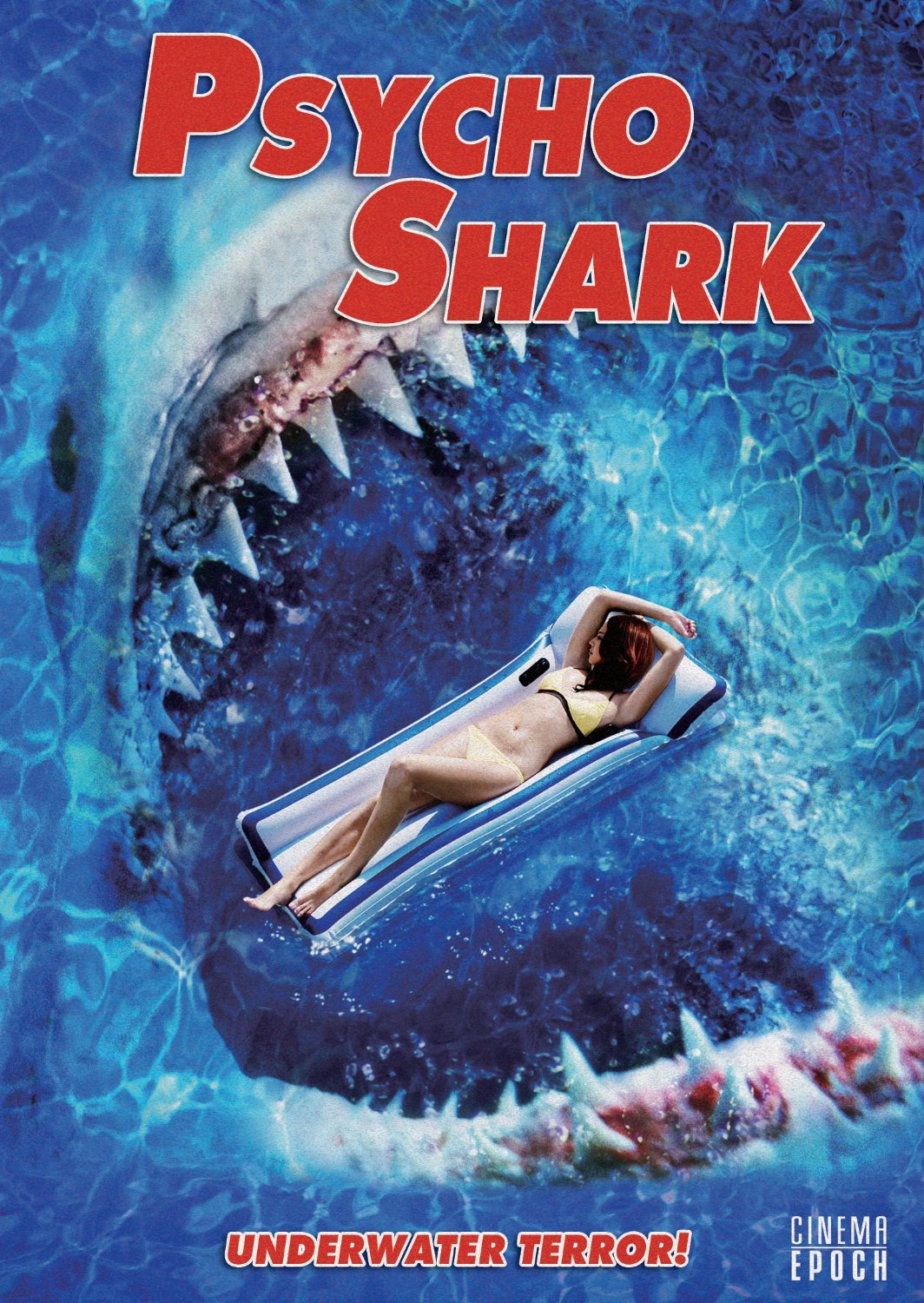
Jaws in Japan is also known by the alternate title of Psycho Shark, which was used for its United States home video release. For its release in Japan, it was actually marketed as a direct sequel to Jaws, though I somehow doubt that fooled anyone.
jawsinjapan4The reception for Jaws in Japan was overwhelmingly poor. The movie currently holds a 1.7 rating on IMDb, alongside a 1.2/5 average audience score on the review aggregator Rotten Tomatoes.

First off, Jaws in Japan is clearly a work of amateurs (or immensely untalented people, but I’ll be optimistic), because it is pretty much garbage film-making across the board. As I’ll get into in a minute, there are brief flashes of promise in the concept of the movie, but pretty much every aspect of the execution of it is abysmal. The acting is nonexistent, and I would wager that there wasn’t a screenplay of any kind for this film. Most of the movie is either repeated camcorder footage of nonsense, shots of girls watching that camcorder footage, shots of girls on beaches, shots of girls in showers, or shots of girls in bed doing and saying nothing. With the exception of the finale sequence, pretty much nothing happens throughout this entire movie. In short: it is paced poorly, shot poorly, looks terrible, sounds terrible, and might be the most boring movie I have ever seen.

Adding a whole extra layer to the film is the fact that this is an exploitation flick in just about every conceivable way. Not only are bikini shots constant (there is more dialogue about bikinis in this movie than about sharks or serial killers), but there are also random sequences ripping off everything from Psycho to The Ring.

The idea behind the story of Jaws in Japan has at least some promise if you ask me. The concept of a remote beach resort being terrorized by a serial killer, and the only clues left behind being guests’ camcorder tapes, could have made for an interesting thriller flick (a few decades ago). However, totally wastes that concept with its ineptitude.

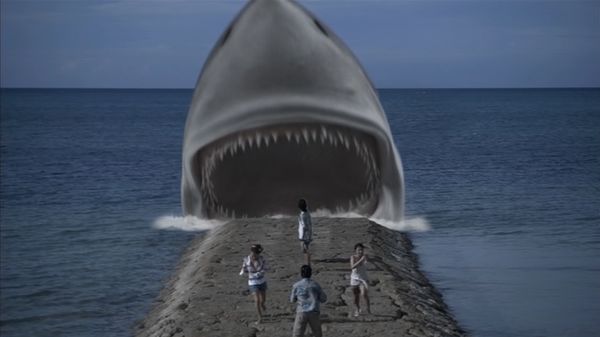
I honestly think the shark was added into this movie after the fact. This is a shitty thriller found footage flick about a serial killer stalking around a remote beach resort, and the producers must have realized it was too boring for anyone to possibly watch it. So, they threw a CGI shark in two scenes and labeled it a Jaws movie. I can sort of understand the parallel of the serial killer picking off beach-goers like a shark, and that might have promise in a different context, but that clearly isn’t how this movie was pitched. I kind of wish more information was out there about this movie, because I honestly want to understand how on Earth this film came to be, like an investigator trying to piece together the scraps after an airplane crash at sea.
jawsinjapan3If there is anything that I can say confidently about this film, it is that it is boring. In a movie that is barely over one hour, there is a nearly endless amount of unnecessary footage in it. The footage isn’t even extraneous plot: it is just nothing. It is primarily home video footage of a shitty vacation, often times played multiple times. Other sequences just drag on for seemingly minutes too long without anything of note happening or being said. Because of this, Jaws In Japan is one of the most boring and incompetent movies I have ever sat through, up there with IMDb Bottom 100 flicks like The Maize.

Overall, this feels like an amateur art movie that was “spiced up” with the addition of a CGI shark, and was marketed as a silly Jaws knockoff. However, it is actually an unwatchably slow thriller composed of handheld camera footage of women in bikinis doing nothing. If you have enemies that you want to hurt with a movie, this is one that you can consider as a weapon. Just tell them that it is a shark movie, and watch them wait the entire run time for something (anything) to happen.

All of that said, the finale sequence is pretty hilariously terrible.
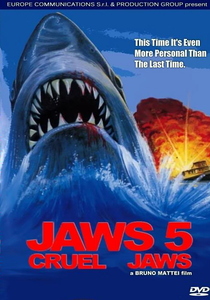
Water Foul: Cruel Jaws

Cruel Jaws

crueljaws1

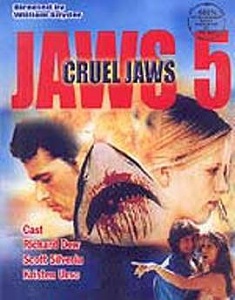
Today’s feature is a knockoff movie sometimes referred to as Jaws 5: Bruno Mattei’s Cruel Jaws.

Cruel Jaws was directed, edited, and co-written by Bruno Mattei, an infamous b-movie creator who has been behind movies like Strike Commando, Hell of the Living Dead, Zombi 3, and Robowar. Interestingly, he used more than one pseudonym for Cruel Jaws: ‘Andy Lamar’ for the editing credit, and ‘William Snyder’ for the writing and directing credits.

Nearly the entire cast and crew of Cruel Jaws outside of Mattei have little to no other film credits, which isn’t particularly surprising given the ultimate product of this movie.

crueljaws3The plot of Cruel Jaws follows the formula of Jaws pretty closely: a tourist town is terrorized by a killer shark during peak season, and is pushed to the brink of financial ruin due to the negative press. The local sheriff has to team up with a shark expert to try and stop the murderous carcharodon.

Cruel Jaws extensively uses stock footage from other shark movies, including Jaws, Jaws 2, and even the Italian Jaws knockoff The Last Shark, which makes Cruel Jaws a rare ripoff of a ripoff.

Cruel Jaws is a pretty obscure knockoff flick, but the people who have come across it certainly haven’t liked it: it currently boasts an IMDb rating of 3.0 from just over 400 users.

crueljaws2The extensive use of stock footage and shots ripped from other films means that the shark attacks themselves play pretty awkwardly in Cruel Jaws. Obviously, you can’t show a shark from a different movie attacking characters in your movie, because you don’t have the shark. The result, as you would expect, is far less than ideal.

There is an odd subplot in Cruel Jaws about a theme park, which I think only exists as an attempt to knock-off Jaws 3-D, which isn’t particularly beloved to start with. This side plot also features a precocious child actor, who might be the most terrible and annoying performance in a film packed to the gills with terrible and annoying performances.

There is a ton of dialogue that feels completely ripped out of the original Jaws, making this maybe the most blatant knockoff of the classic movie I have ever seen. It goes beyond just lifting the broad strokes of the plot (like The Last Shark), and goes so far as to feature entire conversations are almost identical to Jaws, particularly from the Hooper analogue.

The musical score for Cruel Jaws is absolutely all over the place. You would probably assume that it would knock-off Jaws with the score, given how iconic and recognizable it is. However, perplexingly, that isn’t the case. There is one memorable moment as the intrepid heroes are setting out to sea for their shark hunt when the music is almost a direct ripoff of, believe it or not, Star Wars.  I suppose the filmmakers deserve partial credit for at least ripping off John Williams?

Overall, this is a pretty dull flick in my opinion. However, it has moments of genuine entertainment thanks to the awful acting an awkward use of stock footage. For die hard Jaws fans, hopefully this movie is as close as we will ever come to seeing an honest remake of the classic film. If you know the movie by heart, Cruel Jaws might be a wee bit more fun for you, particularly if you make a drinking game out of all of the times something is lifted from the original.

Water Foul: Creature From The Haunted Sea

Creature From The Haunted Sea

hauntedsea2

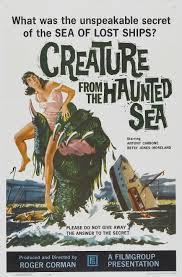
Today’s movie is another low-budget classic from Roger Corman: Creature From The Haunted Sea.

Creature From The Haunted Sea was written by Charles Griffith, a frequent Corman collaborator who penned such memorable flicks as Death Race 2000, Attack of the Crab Monsters, A Bucket of Blood, and The Little Shop of Horrors.

The director and producer of Creature From The Haunted Sea was, of course, Roger Corman, who is widely known as the king of the b-movies. Though he has primarily worked as a producer over the years, he also has over 50 directing credits, including The Wild Angels, Attack of the Crab Monsters, A Bucket of Blood, and The Little Shop of Horrors.

The cinematographer for Creature From The Haunted Sea was Jacques R. Marquette, who shot multiple episodes of television shows like The Greatest American Hero, Hawaii Five-O, McHale’s Navy, The Patty Duke Show, and The Streets of San Francisco over his career.

hauntedsea1The score for Creature From The Haunted Sea was provided by Fred Katz, who worked on a number of other Corman movies like A Bucket of Blood, The Little Shop of Horrors, and The Wasp Woman.

The associate producer for Creature From The Haunted Sea was Charles Hannawalt, who has worked with Roger Corman in a number of different capacities over his career, including producing The Beast with A Million Eyes, acting as cinematographer on Dementia 13, and serving as a grip on movies like The Trip and She Gods of Shark Reef.

Creature From The Haunted Sea stars Beach Dickerson (Attack of the Crab Monsters), Robert Bean (The Wild Ride), Betsy Jones-Moreland (Last Woman on Earth), Antony Carbone (A Bucket of Blood), and famed screenwriter Robert Towne, who later penned such movies as Chinatown, Bonnie & Clyde, Days of Thunder, Shampoo, and Mission: Impossible.

hauntedsea3The plot of Creature From The Haunted Sea takes place during a Cuban revolution, where a mobster seeks to profit on the social unrest by smuggling loyalists out of the country with the government’s treasury. However, he plans on killing and robbing the exiled stowaways under the guise of an elaborate fake monster attack. Complications arise in the form of an embedded CIA agent and the appearance of a real sea monster, both of whom threaten the entire operation.

Creature From The Haunted Sea was shot back to back with Last Woman on Earth, using the same crew, cast, and locations in Puerto Rico.

Unlike many of Corman’s more famous b-movies, Creature From The Haunted Sea is an intentionally comedic parody movie, lampooning everything from spy films to gangster flicks to Corman’s own prolific creature features.

Robert Towne is credited under a pseudonym for his role in the movie, taking on the fake name ‘Edward Wain’ in the cast listing.

The reception to Creature From The Haunted Sea wasn’t particularly positive, certainly due in part to the unusual comedic tone. It currently holds a 21% audience score on Rotten Tomatoes, along with a 3.3 user rating on IMDb.

hauntedsea4The plot of Creature From The Haunted Sea is impossible to fully understand without a familiarity with the context of the time. The movie released in June of 1961,  which placed it right in the middle of the most heated diplomatic era between Cuba and the United States in the long history between the two neighboring countries. In April of 1961, two months prior to the film’s release, the United States launched the counter-revolutionary campaign known as The Bay of Pigs, which ultimately failed to depose Fidel Castro, whose communist forces had been controlling the country since 1959. Sixteen months following the release of the film, the Cuban Missile Crisis took place, in which Cuba agreed to house Soviet nuclear weapons within eyesight of the Florida coast. This is remembered as the pinnacle of tensions in the Cold War, and the defining moment in John F. Kennedy’s presidency.

What is important to note about all of this is that at the time, Communism’s hold in Cuba was still new, and most believed that it would be ousted by some sort of United States scheme before too long. Not only was there the Bay of Pigs invasion, but the CIA even built up a bit of a reputation surrounding their failed assassination attempts on Fidel Castro, which were frequent enough to justify a wikipedia page. So, the idea that the Communist revolutionaries would need to flee the country on short notice was far from unrealistic in the minds of the American public, particularly given the US Government’s adherence to domino theory, and its proficiency in meddling in foreign governments during the era.

The other aspect of the time that may not be engrained in the public consciousness, but is of note to the film’s story, is the involvement of the mafia in Cuba. For film buffs, you probably recall a famous sequence from The Godfather Part 2 that depicted the 1959 Cuban Revolution foiling a backroom mafia plot to divide the country. In fact, organized crime had a field day with Cuba during the reign of Batista, which was effectively ruined by the Communist revolution and Batista’s fall from power. However, as depicted in Creature From The Haunted Sea, the organized crime elements didn’t entirely disappear overnight, particularly if they had money wrapped up in businesses in the country. Thus, that’s why there are so many wayward American criminals and mobster-types hanging out in Cuba at the beginning of Creature From The Haunted Sea.

On to the nuts and bolts of the film, this movie is actually pretty funny, particularly in how it skewers the spy genre. The film is interestingly more of a spy movie than a monster movie at its core, which certainly isn’t what it appears to be at first glance, and wasn’t how it was marketed.

The storyline is incredibly culturally relevant and political, particularly for a b-movie creature feature. It is still goofy without any doubt, and a lot of jokes fall flat, but there is more to it than just simple comedy, which it had every right to limit itself to. More than anything, the movie provides a fascinating window into the time period, and how the American public viewed Cuba and communism in the country. I was reminded a little bit of an episode of The Twilight Zone that also dealt with a veiled version of Cuba called “The Mirror,” which also released in the latter half of 1961, and is worth checking out.

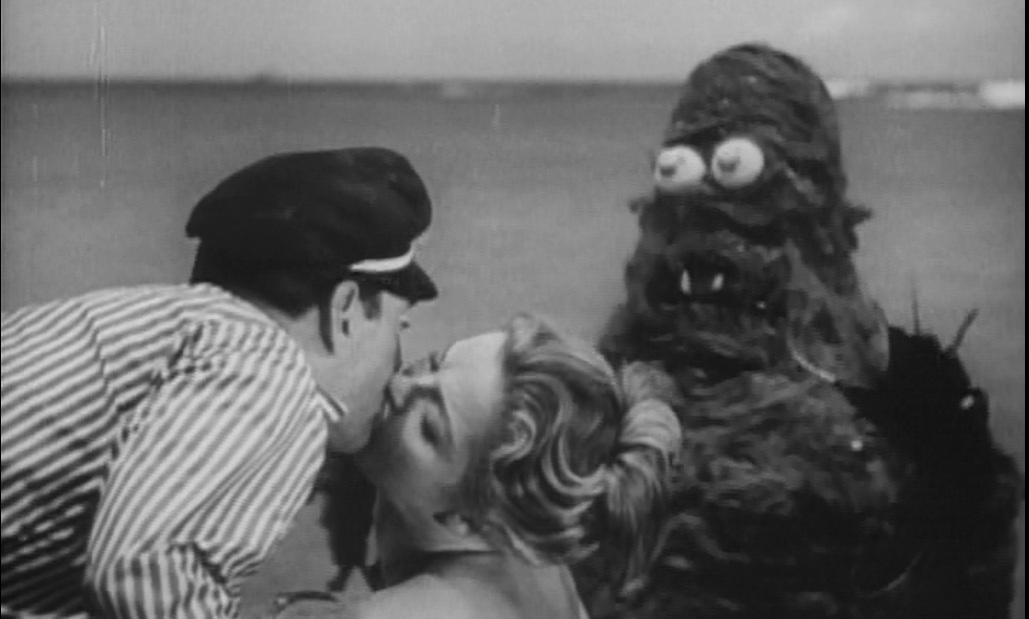
I can’t very well not talk about the ridiculous monster in this movie, which makes The Creeping Terror look like something Stan Winston or Rick Baker cooked up in a workshop. If you ask me, the goofy eyes are really what ties the whole thing together, and gives the monster its life-like quality. It is actually admirable in my opinion that Corman could laugh at himself and the reputation of his movies with this flick. For a modern example, this movie is comparable to what it would be like if Michael Bay had directed Hot Fuzz, if you could imagine such a thing.

While this wasn’t Corman’s only foray into the realm of comedy, it is certainly the least acclaimed of his three famous ventures into the genre. Both A Bucket of Blood and The Little Shop of Horrors are better polished, more memorable, and more fondly treasured as b-movie comedies than Creature From The Haunted Sea, and I can’t help but think that is partially due to the ad hoc nature of the production, as Joe Dante describes in the video above. When you are literally cobbling together a movie from the screenplay up with spare time while making another movie, there is no way you can give it the attention and care that the feature merits, even if it is in the hands of Corman’s notoriously quick movie-making machine. Even with similar back-to-back situations, like with Dolls and From Beyond, both screenplays were at least fully formed at the outset, whereas Creature From The Haunted Sea was a mere concept when the cast and crew was setting out for Puerto Rico.

Overall, Creature From The Haunted Sea is an uneven comedy with plenty of dead spots, and it was obviously cobbled together and padded out with extra footage. That said, it still has a peculiar charm to it and some solid comedic moments. This is a movie that I would say requires some research ahead of going into it, because it certainly isn’t a conventional Corman creature feature, and shouldn’t be viewed as such. If nothing else, this film is a curiosity worth checking out for its novelty value, if not for its cultural value as a window into a bygone era and into Corman’s own opinion of his movies.

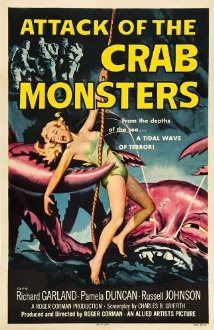
Water Foul: Attack of the Crab Monsters

Attack of the Crab Monsters

crabmonsters1

Today’s flick is Roger Corman’s famous creature feature b-movie, Attack of the Crab Monsters.

Attack of the Crab Monsters was written and co-produced by Charles Griffith, a frequent Corman collaborator who penned such memorable flicks as Death Race 2000, A Bucket of Blood, and The Little Shop of Horrors.

The director and producer of Attack of The Crab Monsters was, of course, Roger Corman, who is widely known as the king of the b-movies. Though he has primarily worked as a producer over the years, he also has over 50 directing credits, including The Wild Angels, The Creature From The Haunted Sea, A Bucket of Blood, and The Little Shop of Horrors.

The cinematographer for Attack of the Crab Monsters was Floyd Crosby, who also shot movies like House of Usher, The Raven, and X: The Man With X-Ray Eyes for Roger Corman.

crabmonsters2The editor for the film was Charles Gross, who cut a handful of other b-movies like Invasion of the Saucer Men and It Conquered The World.

The musical score for Attack of the Crab Monsters was provided by Ronald Stein, who composed music for other Roger Corman flicks like The Terror, Attack of the 50 Foot Woman, and Francis Ford Coppolla’s debut film, Dementia 13.

The cast of Attack of the Crab Monsters included Ed Nelson (A Bucket of Blood), Richard Garland (Mutiny in Outer Space), Beach Dickerson (The Trip, Creature From The Haunted Sea), Richard Cutting (South Pacific), Mel Welles (The Little Shop Of Horrors), Leslie Bradley (The Conqueror), and Russell Johnson (Gilligan’s Island).

crabmonsters3The plot of Attack of the Crab Monsters follows a group of scientists who are researching into the after effects of the Bikini Atoll nuclear tests on local wildlife. To their shock, they discover that a couple of ornery giant crabs that have mutated dramatically, to the point of acquiring telepathic powers.

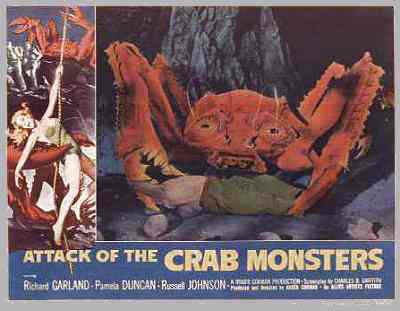
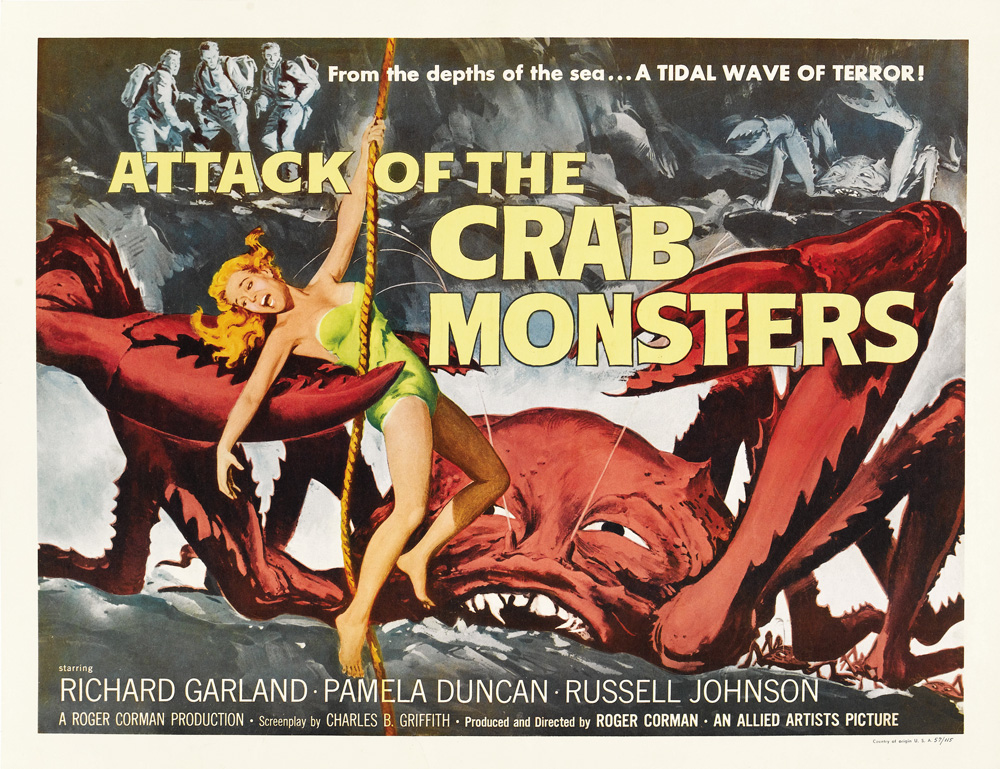
The eponymous crab monsters were portrayed via a two-person suit, with one person filling the body and another operating the claws. Instead of having designated effects workers to operate the effects, actors who weren’t in the specific scene were assigned to run the crab.

Attack of the Crab Monsters initially released on a drive-in double bill with Not of This Earth, another Roger Corman directed creature feature from 1957.

Attack of the Crab Monsters is one of the most iconic of the Roger Corman monster movies, and has appeared in the background of many other films as a form of homage. For instance, sharp eyes might spot the poster or clips of the film in movies like Chopping Mall or Found.

Writer/producer Charles Griffith directed all of the underwater sequences in the movie, supposedly because he was inspired by documentary filming done by Jacques Cousteau.

Jim Wynorski, a cohort of Roger Corman’s who has directed such flicks as Chopping Mall, Piranhaconda, and 976-EVIL II, has expressed interest in helming a remake of Attack of the Crab Monsters. However, Corman is reportedly against the idea, despite Wynorski having previously remade a number of his other movies, most notably Not of This Earth and The Wasp Woman.

In an interview with Dennis Fischer, writer and producer Charles Griffith said the following about the inception of Attack of the Crab Monsters:

“Roger came to me and said, ‘I want to make a picture called ‘Attack of the Giant Crabs,’ and I asked, ‘Does it have to be atomic radiation?’ He responded, ‘Yes.’ He said it was an experiment. ‘I want suspense or action in every scene. No kind of scene without suspense or action.’ His trick was saying it was an experiment, which it wasn’t. He just didn’t want to bother cutting out the other scenes, which he would do.”

The reception to Attack of the Crab Monsters wasn’t particularly great at the time, however, it is undoubtedly a classic Roger Corman movie today. It currently holds a 4.8 rating on IMDb, and Rotten Tomatoes scores of 29% (audience) and 67% (critics).

In true Corman fashion, it is estimated that the budget for Attack of the Crab Monsters was an astounding $70,000, on which it certainly managed to turn a profit.

Attack of the Crab Monsters certainly doesn’t waste any time getting started: before any character names are even introduced, a crab is on screen and decapitating an extra. This is particularly interesting, given how slowly paced many of these older monster flicks are (The Horror of Party Beach comes to mind). As mentioned previously, this constant action was part of Corman’s plan for the film from the onset, which pays off pretty well for what this movie is. The downside of this, however, is that the audience isn’t given any time to relate to the cast of characters, because they aren’t given any breathing room to be human, and die off quicker than you can get through ice breakers.

crabmonsters4The plot of Attack of the Crab Monsters could be accurately described as infamously outlandish. The premise that irradiated crabs with superhuman intelligence and telepathic powers are looking to conquer the world is a few steps beyond the mere bizarre, even for a 1950s b-movie. The fact that the crabs actually have dialogue puts this flick in a league of its own if you ask me.

The underwater footage in the movie actually looks pretty good, and if the claim from writer Charles Griffith is true, I’m actually pretty impressed that the production actually did it themselves. Underwater sequences seem to beg for stock footage, and I wouldn’t have put it past them to use whatever was laying around or handy to plug the hole in the movie.

The ending of Attack of the Crab Monsters is appropriately abrupt and baffling given the rest of the film, with a character collapsing an electrical tower onto the last surviving crab, killing both dramatically. However, this climax occurs almost entirely off-screen, being portrayed primarily via an electric sound effect over a reaction shot of the last two survivors. This shot lasts approximately 10 seconds before a fade into the ending card, with the following concluding lines summing up the movie:

“He gave his life…”

“I know.”

*THE END*

There is something particularly appropriate about the movie interrupting and cutting off the character’s final thoughts, like it was trying to hurry people out the door and didn’t actually care what the actors had to say about the situation anyway.  The entire movie clocks in at barely over an hour, and shuffles its way quickly through that entire run time. I’m willing to bet that the aim was to get the film to an even 60 minutes, but the team just barely missed the mark. Still, it is almost refreshing to see a movie that races too fast from beginning to end, especially given how many slow movies I have had to sit through. It doesn’t make the movie good (pacing that is too fast is still a problem), but it is certainly harder for me to complain about.

Overall, Attack of the Crab Monsters is a rightfully legendary b-movie. You can’t help but giggle when a goofy giant crab claw materializes from off screen without the character seeing it, or when a giant crustacean sets up an elaborate plot by mimicking human speech patterns, throwing its voice, and sabotaging complex communications equipment. The fact that the film takes itself seriously at all is astounding, particularly with the crabs roaring like pissed off gorillas for half of the movie, and speaking in German accents for the other half. The sheer wackiness of the story elevates the feature over a lot of similar flicks from the era without any doubt. It still holds onto the expected bad acting and goofy effects that are hallmarks of the genre, but having nefarious, psychic sea-life hanging about puts Attack of the Crab Monsters a rank or two above its peers in the realm of entertainment value. If you are looking for a b-movie classic to check out, this should be on your list.

The Creep Behind The Camera

The Creep Behind The Camera

creepbehind1

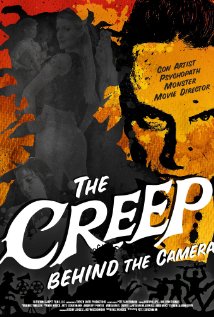
Today’s flick is the newly-released docu-drama, The Creep Behind The Camera, which tells the astounding story behind the legendarily awful b-movie The Creeping Terror.

The Creep Behind The Camera was directed and written by Pete Schuermann, who has been behind a number of low-budget flicks since his debut in 1999. The Creep Behind The Camera was specifically funded via a crowdfunding campaign on Kickstarter, raising over $70,000 dollars from a horde of supporters.

The Creeping Terror, the inspiration and subject of The Creep Behind The Camera, is widely regarded as one of the worst monster movies of all time. The monster itself is particularly memorable, and could be accurately described as a carpet from outer space.

Further, the film is filled with bad acting, terrible narration, nonexistent sound work, and an earworm of a theme song, which have all combined to make it a sort of ironic classic. It gained even more of a following after being featured on a season 6 episode of the show Mystery Science Theater 3000, which was dedicated to digging up the worst movies of all time.

As bad as the movie itself is, the stories that have circulated about the film’s production have added an extra mythos to the flick. The Creep Behind the Camera is dedicated to digging into that swirl of outlandish rumors: that the director was a con-artist working under a false identity, that no one in the production had film experience, and that it was financed by having actors pay for the privilege of playing a part in the movie, and countless more. As it turns out, it appears that many of these legends about The Creeping Terror may be true (or at least partially so).

The Creep Behind The Camera is composed of a series of interviews and testaments from people involved with the production of The Creeping Terror, interspersed with dramatic recreations of the events. While most of the film is dedicated to The Creeping Terror, a fair portion of it is also spent on the miscellaneous misdeeds and antics of the film’s star and director, Vic Savage/AJ Nelson.

While the actual content of the information is the primary draw for this movie (and is certainly fascinating), the performances in the dramatic sequences are really what tie it together. Particularly, Josh Phillips portrays AJ Nelson with a mix of charisma, insecurity, violence, self-delusion, and conniving that helps build the larger than life persona of the eccentric swindler behind The Creeping Terror.

The Creep Behind The Camera interestingly doesn’t take place in chronological order, and bounces around throughout the pre-production, post-production, and filming of The Creeping Terror without any particularly coherence. However, I felt like this worked pretty well, particularly in the parts focusing specifically on Nelson. The audience should be just as flabbergasted and perplexed by this figure as his crew was, and that feeling definitely gets across in the movie. The fact that he is initially introduced naked in front of a mirror, wearing a fake Hitler mustache, and repeating “I am God” to himself is about the best way to sum up Nelson in a nutshell, regardless of when that event occurred in his timeline.

For bad movie fans, The Creep Behind The Camera is necessary viewing, and helps fill in the gaps and questions that were left in the wake of the train wreck that is The Creeping Terror. The flick is currently available on most Video On Demand mediums, and The Creeping Terror is fairly easy to dig up on YouTube.

Arena

Arena

arena4

Today’s movie is Empire Pictures’s mostly forgotten sci-fi boxing flick from 1989: Arena.

Arena was written by Danny Bilson, who also penned Trancers, Trancers II, The Flash, and The Rocketeer, and Paul De Meo, who wrote flicks like The Vipers, Eliminators, and The Sentinel.

The director on Arena was Peter Manoogian, who was also behind movies like Demonic Toys, Eliminators, and Seedpeople, among others.

The cinematographer on the film was the veteran Mac Ahlberg, a frequent Stuart Gordon collaborator who has shot such films as Evil Bong, Re-Animator, Space Truckers, Good Burger, The Wonderful Ice Cream Suit, DeepStar Six, Robot Jox, King of the Ants, Dolls, and From Beyond.

The editor on Arena was Andy Horvitch, another Stuart Gordon cohort who also cut films like Stuck, Edmond, The Pit and The Pendulum, The Wonderful Ice Cream Suit, Beeper, and Demonic Toys.

The producers on Arena included Empire Pictures head Charles Band, Debra Dion (Dolls, Trancers, Troll, Ghoulies), Irwin Yablans (Men at Work, Halloween, Halloween III), and J. Larry Carroll (Laserblast, Diagnosis: Murder).

arena2The music on the film was provided by Richard Band, the brother of Charles Band and noted music composer who has worked on such films as Re-Animator, From Beyond, Dreams In The Witch House, Castle Freak, Troll, and Laserblast.

The makeup effects team for Arena included Scott Coulter (It’s Alive (2008), Shark Attack 3: Megalodon, The Garbage Pail Kids Movie, Friday the 13th Part VIII), Bruce Barlow (From Beyond, Leviathan, Ghoulies II, Dinocroc), Adam Hill (On Deadly Ground, Leonard Part 6, The Abyss, Masters of the Universe), and Alessandro Jacoponi (Troll).

John Carl Beuchler (Troll, Carnosaur, Dolls, From Beyond) was in charge of the creature effects for Arena. The rest of the special effects team included Michael Deak (Pick Me Up, The Lawnmower Man, From Beyond, The Dentist), Mike Elizalde (Lady In The Water, The Frighteners, Total Recall, The Happening), Jeffrey Farley (Wolf, Carnosaur, Robot Jox, Shocker, Evil Bong), Steve Wang (Hell Comes To Frogtown, DeepStar Six), A.J. Workman (Moonwalker, Look Who’s Talking, Mac and Me), Renato Agostini (The Core, Leviathan), and ‘Screaming Mad’ George (Space Truckers, Jack Frost, The Dentist 2).

arena1The visual effects team for Arena was made up of David Stipes (The Lawnmower Man, The Stuff, Creepshow) and Jeff Pyle (Waterworld, On Deadly Ground, Volcano), who primarily did miniature work for the movie.

The cast for the movie included Claudia Christian (Babylon 5), Marc Alaimo (Total Recall, Tango & Cash), Paul Satterfield (Bruce Almighty, Creepshow 2), Hamilton Camp (Joe Dirt, Almost Heroes), Armin Shimmerman (Star Trek: Deep Space Nine), and Shari Shattuck (On Deadly Ground, Death Spa).

The plot of Arena takes place in a distant future, where a number of alien races from throughout the galaxy interact. This society includes a popular form of entertainment: a modified version of boxing.  The story follows a human as he becomes an unlikely star in the arena, and challenges the defending champion. Basically, it is Rocky in space.

Arena currently holds a 5.2 rating on IMDb, along with a 34% audience score on the Rotten Tomatoes review aggregator. However, these both come from pretty small sample sizes, as Arena definitely qualifies as a forgotten feature.

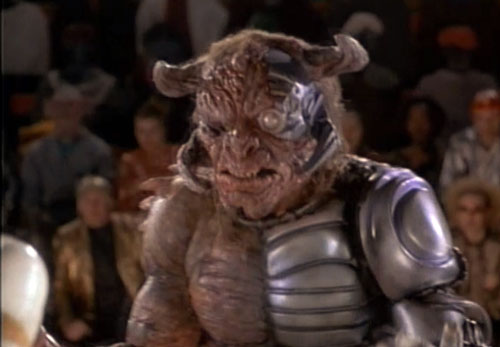
Personally, I was impressed with the creativity and the vision behind the monster designs in Arena, particularly given the fact that there was an extremely limited budget for the team to work with. Most of the aliens are just humans with some makeup effects, but a handful of them are more insect-like or otherwise complicated puppets or rubber suits.

arena3That said, the voice over work (for the monsters that required it) was absolutely atrocious. Horn, the primary antagonist, sounds absolutely ridiculous when he is supposed to come off as intimidating, and comes off as incredibly cartoon-y rather than menacing.

Late in the movie, there is a femme fatale who is introduced over the course of what is supposed to be a seductive musical number. However, just like the monster voice over work, it is absolutely awful. Honestly, he song is almost unbearable to listen to, with or without the lackluster singing, and it plays in the background of an entire scene. It is pretty surreal to watch, given the lead character is absolutely enamored with the impossibly terrible performance, and is distracted by it throughout the scene. Even worse, he acts like he is totally unaware that the singer is affiliated with his enemies, despite the fact that they were introduced by his primary antagonist. Just like Rocky, the hero of Arena (appropriately named “Armstrong”) isn’t the brightest of bulbs.

Overall, there are definitely some highlights to Arena that make it worth watching through, but I think the real value of the movie is in the outlandish premise. A run-of-the-mill sports movie set in outer space against the backdrop of a dystopian society turns a flick that is otherwise pretty basic into something incredibly bizarre. I feel like this is the most true sequel to Rocky IV, as the only way for a boxing match to have greater consequence than ending The Cold War is for a match to literally save the universe.

For bad movie fans, Arena is a good deep cut to check out. I think it would make a pretty good pairing with Robot Jox given the similar sports-movie styles, though Robot Jox is definitely the better movie of the two.

Jungleground

Jungleground

jungleground1

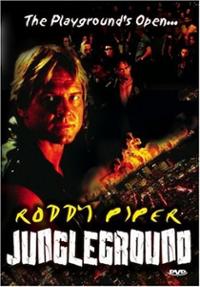
Today, I am going to take a look at one of the lesser-known movies starring the late “Rowdy” Roddy Piper: 1995’s Jungleground.

Jungleground was written by Michael Stokes, who also penned the movies Iron Eagle IV, The Marsh, Exit Speed, and a number of episodes of children’s television shows, including Rolie Polie Olie, Totally Spies, and Miss Spider’s Sunny Patch Friends.

Jungleground was directed by a fellow named Don Allan, who never had any other directing gigs on feature motion pictures, but worked on a couple of documentaries.

The cinematographer for Jungleground was Gilles Corbeil, who also shot the action movies Back in Action and Balance of Power, and has worked as a camera operator on such films as Mimic, Shoot Em Up, 16 Blocks, Pixels, Pacific Rim, and the upcoming Crimson Peak.

The musical score for Jungleground was provided by Varouje, who has also done scores for low budget movies like The Circuit, G.O.D., Tiger Claws, and Expect No Mercy.

The effects team for Jungleground included Liz Gruszka (Devil, Kick-Ass), Ron Craig (Abraxas: Guardian of the Universe, Death Wish V), Antony Stone (Generation Kill, Lord of War), Jeff Skochko (Silent Hill, Cube 2: Hypercube, Repo! The Genetic Opera), and Stan Zuwala (The Adjuster, Iron Eagle IV),

The producers of Jungleground were Peter K. Simpson (Prom Night, Prom Night II), George Flak (The Marsh, Striking Poses), and Ilana Frank (Prom Night II, Prom Night III).

The cast of Jungleground is composed of the late wrestling star and cult icon Roddy Piper (Hell Comes To Frogtown, They Live), Torri Higginson (Stargate: Atlantis), JR Bourne (Teen Wolf, The Butterfly Effect 2), Rachel Wilson (Breaker High, The Glass House), Nicholas Campbell (Goon),  and Nicole de Boer (Cube, The Dead Zone, Star Trek: Deep Space Nine).

The story of Jungleground takes place in a mostly abandoned, lawless city (“the jungleground”) run by ruthless gangs. An undercover policeman is outed and captured after a sting gone bad, and is given one night to escape the jungleground, or else his fiancee will be executed by his captors.

JUNGLEGROUND, Roddy Piper, 1995. ©Norstar Releasing

Jungleground is a pretty obscure movie, with just over 1000 user reviews between IMDb and Rotten Tomatoes combined. Of the two, it currently holds a 5.1 rating on IMDb, and a 44% audience score on Rotten Tomatoes, which are hardly glowing numbers.

The plot to Jungleground gets pretty complicated as it moves along, but it clearly takes a lot of inspiration from Escape From New York and The Warriors, much like 1990: The Bronx Warriors. There is a notable side plot about the interior workings of the “Ragnarockers” gang that operates in the jungleground, but the fact that it rarely actually connects to the main plot with Piper drags the story down a bit, which is a definite weakness of the film.

While Roddy Piper gets a handful of one-liners in the movie, he doesn’t seem to be having as much fun as he did in They Live and Hell Comes to Frogtown. His charisma still comes through here and there, and he makes the movie entertaining more than any other single element in it, but he certainly isn’t on the top of his game. It strikes me as though he is taking the movie far more seriously than it merits, which is ultimately a disservice to what is definitely campy material.

Jungleground strikes me as a movie lost in time. I am still kind of shocked that this is from 1995, because it looks like it could easily have come from anywhere between 1982 and 1989. If not for Roddy Piper looking just a tad older than he did in They Live, I would have sworn that this was made back to back with something like Class of 1999.

jungleground3Overall, Jungleground probably qualifies as middle-of-the-road as far as b-movies go. I picked this up on a whim from a video store some time ago, and the untimely death of Piper gave me the motivation to actually pop it in and review it. I had higher hopes for it being a forgotten gem, but it certainly isn’t a painful movie to sit through. It isn’t as good as similar movies like Escape From New York or The Warriors, or as good-bad as knockoffs like 1990: The Bronx Warriors, but it is a totally serviceable b-level action movie if that is what you are craving. Piper might not be at the top of his game here, but he is still definitely Rowdy Roddy Piper, and has fleeting moments of true badassdom (such as the ending, in which he leaves the film’s villain quadriplegic, but alive).

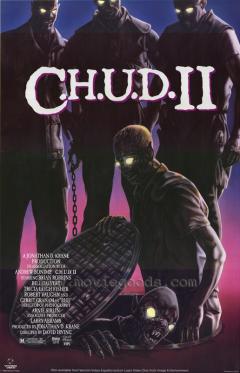
C.H.U.D. II: Bud the Chud

C.H.U.D. II: Bud the Chud

chudii1

Today’s feature is truly one of the most unnecessary and strange sequels of all time: C.H.U.D. II: Bud the Chud.

C.H.U.D. II was written by Ed Naha, who also penned such movies as Troll and Dolls. However, he did so under a pseudonym: M. Kane Jeeves. The fact that a man who was willing to have his name on Dolls and Troll declined credit for C.H.U.D. II should say a lot about the sort of movie we are dealing with here.

The film was directed David Irving, who has directed such films as (Night of the Cyclone, Rumpelstiltskin, Sleeping Beauty). However, he had no previous experience with directing horror movies.

The cinematographer for C.H.U.D. II was Arnie Smith, who has primarily worked on biographical documentaries like Aldous Huxley: Darkness and Light, Bogart: The Untold Story, and The Unknown Peter Sellers.

The film’s editor was Barbara Pokras, who cut such memorable films as The Giant Spider Invasion and The Return of The Living Dead.

The producers for C.H.U.D. II included Lawrence Kasanoff (Mortal Kombat, Foodfight!, Class of 1999, Blood Diner), Jonathan Krane (Face/Off, Battlefield Earth, Swordfish), Simon Lewis (Look Who’s Talking), and Anthony Santa Croce (Monk, Tales From The Darkside)

The music for C.H.U.D. II was composed by Nicholas Pike, who worked on scores for a number of episodes of Masters of Horror (including Pick Me Up), Freddy’s Nightmares, It’s Alive (2008), and Critters 2.

The C.H.U.D. II effects team included Allan Apone (Evilspeak, Galaxy of Terror, Going Overboard, Deep Blue Sea), Douglas White (Merlin’s Shop of Mystical Wonders, UHF), Michael Spatola (Iron Man 3, Going Overboard), Bryan Moore (Dolls, Tremors II), Tim Huchthausen (Blind Fury, 1941), and John Fifer (Return to Horror High, Cyber Tracker).

The cast for C.H.U.D. II includes Gerrit Graham (Child’s Play 2, Chopping Mall), Brian Robbins (Head of the Class), Tricia Leigh Fisher (Book of Love), Robert Vaughn (Bullitt, The Magnificent Seven, Battle Beyond The Stars), Larry Cedar (The Gingerdead Man), Larry Linville (M*A*S*H), and June Lockhart (Troll, Deadly Games, Lost In Space).

chudii3The plot of C.H.U.D. II centers around a sole surviving experimental C.H.U.D., which was synthesized by the military from the original race of Cannibalistic Humanoid Underground Dwellers in an attempt to create a super-soldier. However, the project was scrapped, and “Bud” was left in the care of a Center for Disease Control. At the beginning of the story, Bud is accidentally freed by some teenagers, after which he begins creating a new army of C.H.U.D.s, and generally causes havoc for the local townsfolk.

The reception to C.H.U.D. II: Bud the Chud was definitively negative at the time, though it has a bit of a cult following now. Currently, it holds an IMDb rating of 3.6, which is still impressively low.

chudii4This flick astoundingly takes place in a totally different genre from C.H.U.D., and the monsters don’t look remotely like CHUDs as they were previously depicted. There is just no way that this movie was originally written as a sequel to C.H.U.D., because there are just too many dramatic differences. To be generous, CHUD II is to CHUD what Return of the Living Dead is to Night of the Living Dead: the movies are not really related, though the previous film is nodded at here and there in the story of the “sequel”.

Speaking of which, what value was there to the C.H.U.D. name that it made sense to brand this random zombie comedy? It was a bit of a cult classic, but it was never a cash cow or particularly beloved to the point of being worth a sequel. Honestly, this makes more sense as a Weekend at Bernie’s sequel, and would probably be funnier that way. The protagonists in this movie spend a lot of time trying to use Bud to get a good grade in a science class, which fits way better in a silly comedy franchise than the sequel to grimy cannibal movie.

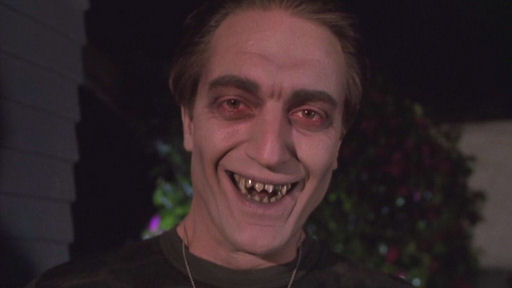
chudii2Regarding the monsters themselves, the CHUDs in C.H.U.D. II are really unimpressive. The zombie makeup here is mostly just pale foundation, eye pits, and messed up teeth. The original CHUDs are still cheap, but they are at least a bit eerie with their contorted faces and lantern eyes. There isn’t even an attempt to recreate them here.

I couldn’t very well forget to talk about the music in this movie, which is absolutely ridiculous. Bud, the Alpha CHUD, gets his own theme song, which plays constantly throughout the movie whenever the character is on screen.

Speaking of Bud, the character is far more intelligent and thoughtful than it was ever implied that CHUDs could be. This may be due to him being a synthesized, experimental super-soldier rather than a natural CHUD, but I personally think that was just a plot convenience used to explain away any inconsistencies with the first film. However, it is pretty funny to think of Bud the super-soldier CHUD dressed up as Captain America.

This isn’t an easy flick to recommend. It isn’t particularly fun as a comedy or as a b-movie, and clearly didn’t have a whole lot of care put into it. That said, it is certainly cheesy and hammy, and is probably worth giving a shot for bad movie fans. I just wouldn’t go in with any kind of high expectations, because this isn’t anywhere close to being a good-bad elite flick. Just in the realm of zombie comedies, there are far better options out there to dig up.

Going Overboard

Going Overboard

goingoverboard1

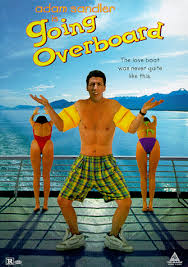
Today’s feature is the often-forgotten early Adam Sandler vehicle, Going Overboard.

Going Overboard was directed and co-written by Valerie Breiman, who went on to direct Bikini Squad and Love & Sex. Her co-writers were stars Adam Sandler and Scott LaRose, as well as the uncredited Adam Rifkin (Small Soldiers, Mousehunt, The Invisible Maniac), who also produced the film and appears in the movie.

The cinematographer on Going Overboard was Ron Jacobs, who, since 2000, has only worked in film as a driver and transportation manager. The editor for the film, Randy D. Wiles, has primarily worked on television shows over the years, like Quantum Leap, JAG, NCIS, and Tequila & Bonetti.

The music for Going Overboard was composed by Steven Scott Smalley, who has primarily worked as an orchestrator on films like Iron Eagle, RoboCop, Tommy Boy, Starship Troopers, Tiptoes, and Paul Blart: Mall Cop.

The special effects makeup for Going Overboard was done by a team that included Michael Spatola (Iron Man 3, Little Monsters, Never Too Young To Die), Allan Apone (CHUD II: Bud the Chud, UHF, Deep Blue Sea, The Avengers), and Mary Brando (Bachelor Party).

The cast of Going Overboard includes Adam Sandler (Jack & Jill, Grown Ups, Billy Madison), Billy Zane (Titanic, The Phantom, Critters, The Brotherhood of Justice), Billy Bob Thornton (The Ice Harvest, Sling Blade, The Man Who Wasn’t There), Scott LaRose (The Sixth Man, Booty Call), Ricky Paull Goldin (Piranha II), and Peter Berg (Battleship, Aspen Extreme, Shocker, Hancock).

The plot of Going Overboard follows an aspiring comedian working on a commercial cruise ship, who desperate tries to figure out the secrets to effect stand up comedy and self confidence.

Adam Sandler to this day doesn’t acknowledge the existence of this film, and doesn’t list it among the credits on his website. Considering the quality of movies that he is willing to claim, that speaks volumes about how bad Going Overboard really is.

Going Overboard is widely loathed by audiences and critics alike, and currently holds a rating of 1.9 on IMDb, landing it in the website’s Bottom 100 films. The Rotten Tomatoes audience score isn’t any better: an abysmal 11%.

First off, the cinematography on the film is just horrible, though part of that is justifiably due to the production trying to film the movie in the cramped confines of a cruise ship, which certainly isn’t conducive to it. However, there are long shots and bad angles that go much deeper than just the difficulties of the environment. The fact that the cinematographer didn’t wind up with any other credits is no surprise given the product here.

Going Overboard does a lot of unnecessary fourth wall breaking, with most of the instances acting as transitions or outright apologies for the poor quality of the film. The film literally starts with Adam Sandler breaking character to explain that the movie had no budget, and tries to lower audience expectations out of the gate. The fourth wall is later broken in desperate attempts for laughs throughout the film, but it never really works.

goingoverboard4It is interesting to see a pre-Saturday Night Live Sandler trying to take on a leading role. He is just as bad as he always is, but in a different sort of way. He clearly isn’t used to the spotlight in Going Overboard, and looks obviously uncomfortable with the camera on him. He also hasn’t worked out his trademark comedic cadence, though flashes of it pop up here and there throughout the story.If there is any trivial worth to the movie, it is to see how Sandler has managed to develop into his modern persona.

It doesn’t seem like anyone in the cast or crew of Going Overboard was putting in any real effort here. While the film was obviously filmed in a rush, it generally feels as if the motivation behind this movie is that the team wanted to go on a cruise together, and film along the way when they could.

goingoverboard2For being as despised as it is, I actually found Going Overboard to be mostly watchable. It isn’t funny, and it definitely has plenty of technical and writing issues, but the team behind the film clearly wasn’t working with anything to start with, and didn’t much care about putting out a quality product at the end of the day. So, it is hard to have any kind of expectations for this flick: it is basically a home movie. I’m not sure if the self-aware aspect of the film helps it or hurts it, but I do know that this is a film I would still take over anything in Uwe Boll’s or Uli Lommel’s filmographies. Basically, there are far worse movies out there.

I actually think that there is a potentially funny movie hidden inside of this film somewhere. I could imagine this plot with someone like Louis CK, a genuinely talented self-loathing comedian, as a cruise ship waiter who is down on his luck, with dreams of doing stand up comedy. I could see an effectively brash comedian like Dennis Leary or Dennis Miller as the washed up antagonist comic, relegated from his banner years to doing a cruise ship show. Seriously, there is a potential movie there.

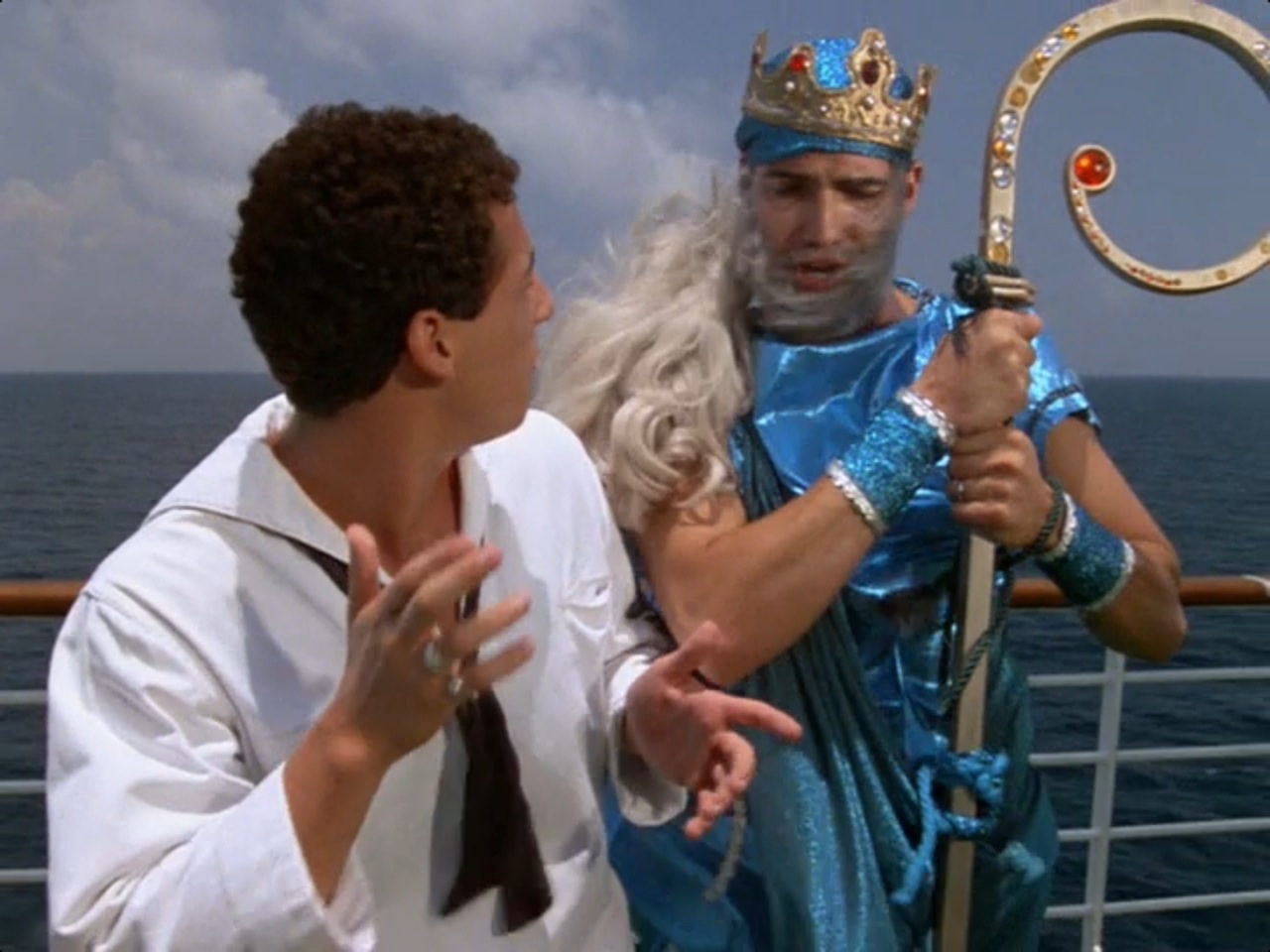
The thing that makes this movie stand out, over anything else, is the inclusion of countless unnecessary characters. For instance, the Greek God Poseidon and infamous dictator General Noriega both feature prominently as characters in the movie. The plot also manages to go completely off the rails, eventually featuring a Panamanian hit squad that has a deep love of stand-up comedy. The movie ends with Adam Sandler hooking up with the demigod daughter of Poseidon, and the rival comic
drowning after being tossed overboard in what is essentially a mutiny. That sounds more like the way you would end some sort of Greco-Roman epic, not an Adam Sandler comedy vehicle.

goingoverboard3The bizarreness of the ending to this film, coupled with the unique incompetence behind the scenes, actually makes this whole mess relatively interesting to watch, in the same way that dissecting a mutated squirrel from Chernobyl might be.

I certainly can’t heavily recommend this movie, but it is one of the few bad comedy movies that I have ever gone back to rewatch. Most bad comedies try too hard to be funny, whereas this mess suffers from the exact opposite problem. It is certainly a unique movie, and I would at least recommend watching it for no other reason than that Adam Sandler doesn’t want you to.