Tag Archives: movie

The Identical

The Identical

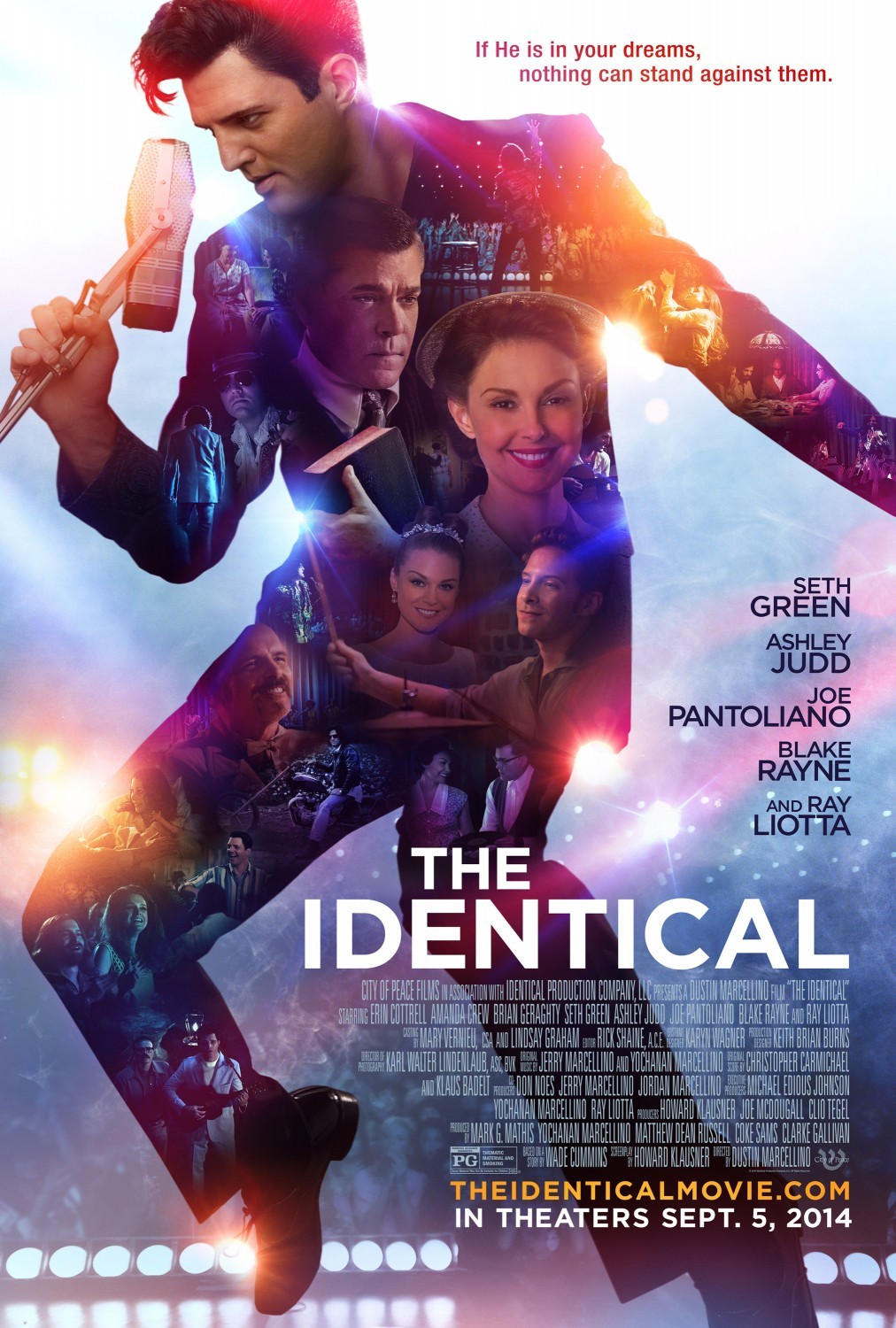
Today, I’m taking a look at a bizarre alternate history film about identical twins who are, in turn, identical to Elvis Presley: 2014’s The Identical.

The plot of The Identical is summarized on IMDb as follows:

Twin brothers are unknowingly separated at birth; one of them becomes an iconic rock ‘n’ roll star, while the other struggles to balance his love for music and pleasing his father.

The screenplay for The Identical was written by Howard Klausner, whose other writing credits include Hoovey, Space Cowboys, Grace Card, and The Last Ride.

The Identical was directed by a man named Dustin Marcellino, who has no other directorial credits listed on IMDb. His only documented experience is shooting and editing a short film in 2011, called The Last Train.

The cast of the film includes the likes of Seth Green (Austin Powers, Idle Hands, The Italian Job, Rat Race), Ray Liotta (Goodfellas, Smokin Aces, Revolver, The Iceman), Ashley Judd (Heat, Bug, Frida), Joe Pantoliano (Memento, The Matrix, Daredevil, Pluto Nash), and Erin Cottrell (Love’s Abiding Joy). The lead of The Identical, Blake Rayne, is a well known Elvis Presley impersonator. He was cast in the dual lead role after one of his performances was seen by the film’s casting director, despite his lack of acting experience.

The cinematographer on The Identical was Karl Walter Lindenlaub, whose shooting credits include Independence Day, Stargate, Nine Lives, Universal Soldier, and Moon 44.

The editor for the film was Rick Shaine, who also cut Pitch Black, The Incredible Hulk, Theodore Rex, Loverboy, and the horror classic A Nightmare On Elm Street.

Four people are credited with composing music for The Identical, including Klaus Badelt (Ultraviolet, Equilibrium, Catwoman, Constantine, 16 Blocks, Rescue Dawn, Poseidon), Christopher Carmichael (The Howling: Reborn), and producers Yochanan and Jerry Marcellino, the latter of whom composed Michael Jackson’s hit single “Music & Me”.

After the film’s critical and financial failure, the production’s twitter account launched a campaign for fans to flood Rotten Tomatoes with positive reviews, claiming that the popular review aggregator has an anti-Christian bias. Even with that directed campaign, however, the audience score on Rotten Tomatoes for The Identical sits at an unenviable 62%.

The Identical only played in theaters for three weeks before getting pulled for low grosses. In that time, it took in only $2.8 million of its $16 million budget, making it a significant loss for a small production.

The reception to the film was arguably even more disastrous: Linda Cook, film critic for the Quad City Times, summarized it as “Showgirls bad: a vision that slowly goes wrong, then terribly wrong, then hits disaster levels.” Likewise, Randy Cordova of The Arizona Republic wrote that “Elvis Presley made some bad movies, but…He never made anything as outright awful as The Identical.” Currently, The Identical holds an IMDb user rating of 5.1/10, along with a Rotten Tomatoes critics’ score of a measly 6%.

As far as positives go, I have to say that some of the music featured in the film is kind of catchy, even if the lyrics aren’t exactly deep. That said, this was definitely a music movie first, and everything else second. Unfortunately, that definitely shows once you delve beyond the soundtrack.

It would be easy to poke at first time actor Blake Rayne as a key issue with this movie. After all, he had no acting experience previously, so he’s an easy target. However, I thought he was actually pretty decent here. Given that his character is basically Elvis, it shouldn’t be too shocking that a professional Elvis impersonator could pull the role off well. Likewise, most of the cast is pretty decent: Liotta in particular deserves props for a performance that far exceeds the needs for this film.

The area where The Identical really suffers is in the screenplay writing. Not only is there a ton of unnecessary narration that drifts in and out of the film, but the very structure of story is bizarre: notably, it flashes back and forward numerous times, making it unclear when certain events are happening, and glosses over years at a time.

On top of that, there are some serious historical issues with the screenplay. For instance, it dodges the Civil Rights Movement and racism in any way that it can. Even more glaringly, the film doesn’t address that Elvis is an established figure within the film’s acknowledged historical canon. Basically, in the film’s version of history, both Elvis and an identical Elvis look-alike are celebrities at the same time, doing the same kind of music. On top of that, the Elvis look-alike’s identical twin winds up with an enviable music career, which is inexplicably never compared to Elvis’s. Despite establishing Elvis’s existence as a popular figure, at no point does anyone in the film note similarities between Elvis and his fictional identical(s), which is beyond mind-boggling. I assume this is the result of the screenplay originally having Elvis as a character (instead of Drexel), and being changed at some point to avoid issues. However, to leave in references to Elvis is a glaring flaw in the story’s world and internal logic, that both the screenwriter and director should have caught and omitted.

It may be a minor gripe, but one of the most egregious issues with The Identical is the costuming. There are countless bad wigs scattered throughout the film, in an attempt to convey ages of characters and time periods, but they all ultimately distract the eye because of how unconvincing they are. Costuming, ideally, should blend into the background, and only catch the audience’s eye if it is meant to establish something about a character or the setting. In this movie, wigs and outlandish outfits constantly stand out without cause or need, which takes away from the audience’s immersion and investment in the story.

Similar to the costuming, another pair of unusual issues with The Identical are the casting and makeup. Given the story spans over multiple decades, there were going to be some inevitable difficulties with portraying characters over time. Some productions elect to re-cast characters in order to convey different points in time, like Barry Jenkins’s Moonlight. This can create a slight disconnect, but audiences are usually a bit forgiving if the actors look plausibly related. The other popular way to show that characters have aged is the use of makeup, such as in Citizen Kane, which allows the same actor to portray an older version of their character. While some movies have been innovative in terms of prosthetic use or digital enhancements to achieve similar aging and de-aging effects, these two methods remain the most effective and cheapest ways to deal with having the same characters portrayed across long spans of time in a story.

In the case of The Identical, however, the production chose to do nothing at all. Seth Green and Blake Rayne, outside of changing goofy wigs occasionally, look the same when their characters are in high school and when they are grown adults. Particularly in the early sections of the film, this decision makes their scenes straight comical. In one sequence, the two clearly adult men are in a bar, and are supposed to be playing minors. Then, the “teens” are scolded by their also-adult parents. “Surreal” might not be the right descriptor, but it is pretty close.

If I didn’t know from the marketing that The Identical was a Christian movie, I’m not sure if I would have figured it out otherwise, and that is pretty noteworthy to itself these days. While religion does play somewhat prominently in the story, it is hardly the focal point. That is not even to mention that the version of Christianity lauded is not nearly as conservative as one might expect, particularly when comparing the film to its contemporary Christian features like God’s Not Dead or The War Room. Theoretically, this is what a Christian movie should be: a story that involves Christianity, insofar as it impacts the characters. The crux of the story isn’t that Christianity is rad: there is a (mostly) coherent narrative with tangible characters, who are often guided by their religion. It may seem like a minor distinction, but when a movie’s transparent purpose is to preach and convert, it automatically gets the tone of hokey propaganda, and it undercuts any character motivations or story investment that the audience might develop.

I don’t think there’s much to recommend with The Identical, but I did find it to be a bit thought-provoking. If you are curious, Ray Liotta and the music may justify your time, but there isn’t much entertainment to be had beyond that. I do think that, with some work on the screenplay and a little more attention to detail on screen, there might have been the makings of an interesting alternate history film here. Hell, if Bubba Ho-Tep can work, I’m not writing off any outlandish Elvis movie ideas.

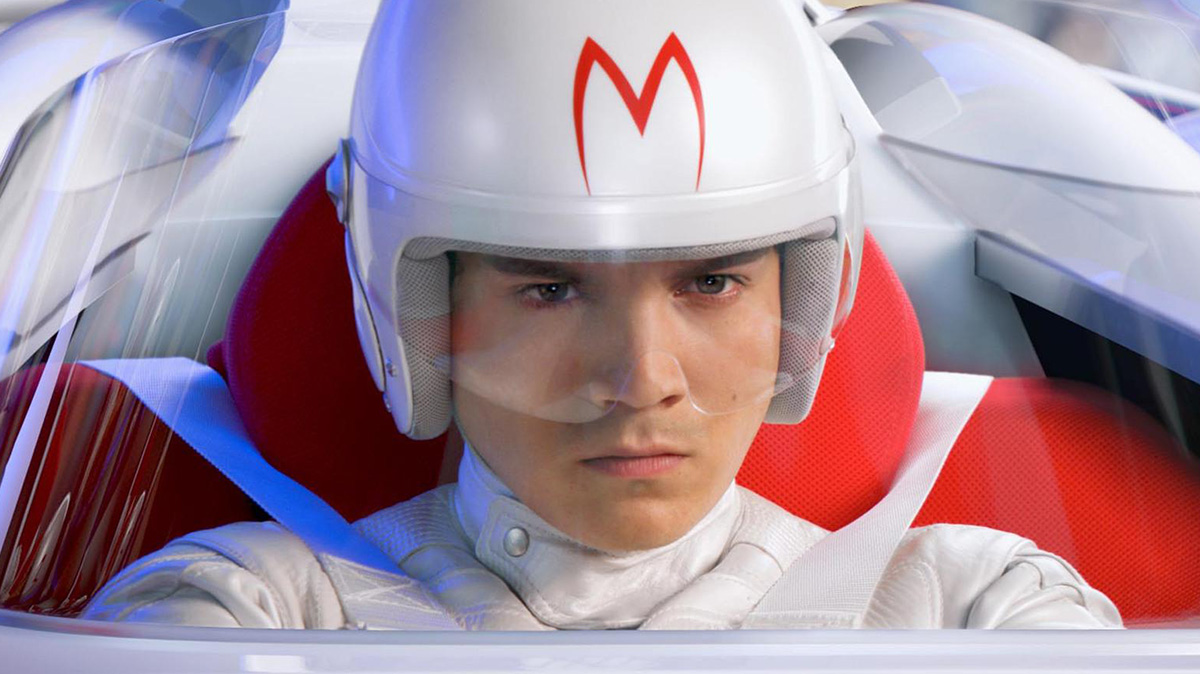
Speed Racer

Speed Racer

Today, I’m going to take a look at 2008’s divisive, live action film adaptation of Speed Racer.

The plot of Speed Racer is summarized on IMDb as follows:

A young driver, Speed Racer, aspires to be champion of the racing world with the help of his family and his high-tech Mach 5 automobile.

Speed Racer was written and directed by the duo of Lana and Lilly Wachowski, who are best known for The Matrix trilogy, Jupiter Ascending, Cloud Atlas, and the television series Sense8.

The central cast of Speed Racer includes Emile Hirsch (Into The Wild, Milk, Killer Joe), Susan Sarandon (Thelma & Louise, Igby Goes Down, The Rocky Horror Picture Show, Bull Durham), John Goodman (10 Cloverfield Lane, The Big Lebowski, Blues Brothers 2000, Barton Fink, Matinee, King Ralph, The Flintstones), Christina Ricci (Monster, Black Snake Moan, Casper, The Addams Family), Matthew Fox (Bone Tomahawk, Lost, Alex Cross), and Rain (I’m A Cyborg, But That’s OK).

The cinematographer for the film was David Tattersall, whose other credits include Tooth Fairy, Next, The Green Mile, Soldier, Con Air, The Matador, Die Another Day, and Theodore Rex, among others.

Speed Racer employed the work of two primary editors: Zach Staenberg (Bunraku, Ender’s Game, Lord of War, Police Academy, The Matrix) and Roger Barton (The Grey, The A-Team, Bad Boys II, Ghost Ship, Pearl Harbor).

The musical score for Speed Racer was composed by Michael Giacchino, who also provided music for Doctor Strange, Rogue One, Jurassic World, Super 8, Ratatouille, Up, and John Carter.

The designer for the production was Owen Paterson, who has done work on such visually distinct films as The Matrix, Gods of Egypt, The Green Hornet, Red Planet, and V For Vendetta.

Keanu Reeves, whose career was resurrected by the Wachowskis’ The Matrix, turned down the role of Racer X in Speed Racer. Other alternative casting rumors about the production include that Kate Mara was at one point considered for Trixie, and the lead role of Speed could well have gone to Joseph Gordon-Levitt, Zac Efron, or Shia LaBeouf.

There were multiple attempts to make a film adaptation of Speed Racer over the years prior to the Wachowskis’, dating back to the early 1990s. Various planned incarnations were set to feature Nicolas Cage, Johnny Depp, and Vince Vaughn over that time period, with Alfonso Cuaron, Hype Williams, and Julien Temple all being attached to direct the film at one point or another.

PETA, the contentious animal rights organization, claimed that the production of Speed Racer engaged in animal cruelty. This was confirmed by the American Humane Association Animal Safety Representative who worked on the set: specifically, there was an incident where the animal trainer hit a chimpanzee in retaliation for biting an actor.

Speed Racer has the unenviable claim of receiving a Golden Raspberry nomination, which are given out to the worst films and performances of a given year. In this case, it was nominated in the category of Worst Prequel, Remake, Ripoff, or Sequel, but lost out to Indiana Jones and The Kingdom of the Crystal Skull.

The reception to Speed Racer was fairly mixed: it currently holds Rotten Tomatoes scores of 39% from critics and 60% from audiences, along with an IMDb user rating of 6.0/10. Financially, however, it did not far well at all: on a production budget of $120 million, it took in an international lifetime box office gross of just $93.9 million.

On April 1, 2017, Jon Humbert of The Hollywood Reporter published a defense of Speed Racer, which included the following:

An editing and compositing master class, each shot of Speed Racer lingers for mere flashes, with overlaid background and foreground action. It’s clear the directors are playing up the manga and animated style — and translating that to film as best as possible…Admittedly, outlandish costumes and absurd colors clash with “so expensive it’s bad CGI” — creating a visual mess at times…which isn’t entirely a bad thing. It’s just its own thing.

In general, I agree with Humbert’s assessment of Speed Racer. I think that the Wachowskis did one of the better jobs of translating the style of manga and anime to the screen in a live action format. While the CGI isn’t perfect by any means, and some sequences suffer from visual overload, the movie is all uniform enough that even the rougher sequences hold together adequately. Also, when compared to something like Transformers, the visuals actually compare pretty well: in general, it is clear to the audience what is happening at any given moment, unlike in the other franchise.

The reason that I decided to take a look back at Speed Racer to begin with was because of a video essay by Patrick H. Willems, a YouTuber who generally makes some insightful and interesting stuff. In his essay, he compares and contrasts the styles and color palettes of Speed Racer with traditional superhero movies like Civil War and The Dark Knight, and talks at length about the modern trend of realism in non-realistic movies. He makes a number of good points: namely, that Speed Racer‘s colors and vibrancy don’t detract from its emotional core. Basically, it doesn’t have to be realistic to be identifiable. Speed Racer is unique and interesting as a result of shirking the accepted norms of realism, which is why it still stands out from the pack of blockbusters visually and stylistically nearly a decade later.

Something that definitely stood out more on a re-watch were the smooth and creative transitions that are used throughout the film. A lot of the techniques that are used in Speed Racer are lauded when employed by someone like Edgar Wright. In fact, I think a direct line can be traced between Speed Racer and Scott Pilgrim vs The World. While that doesn’t make up for some of Speed Racer‘s drawbacks, such as its terrible comic relief, shallow characterizations, and less-than-thrilling story, I think the visual craft of the film makes it worth a second look and reassessment on its own.

In regards to those stated drawbacks, they are a bit tricky in their own right. It can be argued that the comic relief is accurate to the source material: the same goes for the weak characters and plot. I suppose it is a matter of perspective: if something is bad in the source material, should it be changed for an adaptation, or kept in tact for the sake of accuracy? Personally, I could have done with a whole lot less of the kid and monkey shenanigans, but the plot and characters make sense to me to keep as they are.

When it comes down to it, Speed Racer is (and should be) all about the races: to the movie’s credit, that is exactly what the Wachowskis executed. The track set pieces are absolutely electric, and the races are gripping, which is what the movie should have always been about. All of the issues that I hear pointed out about it, outside of the complaints about the occasional moments of visual clutter, are about the fringes of the film. As annoying as the kid and monkey are, they are never front and center. Likewise, the plot is far secondary to the spectacle.

Speed Racer is not a great movie. It may not even be a good movie. However, it is a creative and interesting movie, that may be the best example we have of what the Wachowskis’ innovative concepts in high gear look like when things generally go right. At the very least, I think it is worth another look, particularly in our current era of drab blockbusters. I think that, similar to Batman & Robin, Speed Racer probably came along at the wrong time: it may have been a successfully executed vision, but it isn’t a vision that people wanted.

The Guyver

The Guyver

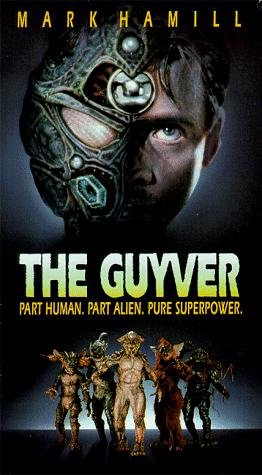
Today, I’m going to take a look at the bizarre live action manga adaptation, The Guyver.

The plot of The Guyver is described on IMDb as follows:

A young man discovers a mechanical device that merges with his own body, turning him into a cyborg superhero. When strange creatures start appearing, trying to take the device back, he begins to uncover a secret plot to genetically engineer terrifying monsters.

The source material for The Guyver is the manga series Bio Booster Armor Guyver, which was created by Yoshiki Takaya. The series first debuted in a serialized format in 1985, as part of the magazine Shonen Captain.

The Guyver had two directors, who both had extensive careers as special effects and makeup artists: Screaming Mad George, whose credits include Predator, Space Truckers, Children of the Corn III, The Dentist 2, Jack Frost, and A Nightmare On Elm Street 3,  and Steve Wang, who worked on DeepStar Six, Harry and the Hendersons, The Monster Squad, Arena, and Hell Comes To Frogtown. However, neither man had any significant directing experience at the time. Years later, Wang directed 1997’s Drive and one episode of Power Rangers: Lost Galaxy, but neither man has done much in the way of directing outside of that.

The cast for the film included Mark Hamill (Slipstream, The Big Red One, The Flash, Batman: The Animated Series, Star Wars), Jeffrey Combs (Re-Animator, The Frighteners, From Beyond, Doctor Mordred, Castle Freak, Fortress), David Gale (Re-Animator, Bride of Re-Animator), Michael Berryman (The Hills Have Eyes), Linnea Quigley (Witchtrap, Night of the Demons, Return of the Living Dead), Vivian Wu (The Last Emperor, Teenage Mutant Ninja Turtles III), and Jack Armstrong (Days of Our Lives, The Bold and The Beautiful, All My Children).

The cinematographer for The Guyver was Levie Isaacks, whose other shooting credits include The Dentist, Texas Chainsaw Massacre: The Next Generation, Leprechaun, and Children of the Corn II.

The Guyver had two primary editors: Andy Horvitch (The Wonderful Ice Cream Suit, Stuck, Arena, American Ninja, The Pit and The Pendulum, Beeper, Demonic Toys, Edmond) and Joe Woo Jr., who was an assistant editor on The Fog, The Abyss, The Beastmaster, First Knight, Tuff Turf, and The New Adventures of Pippi Longstocking.

One of the producers for the film was Brian Yuzna, a renowned horror director and producer who is known for working on films like Re-Animator, From Beyond, Dolls, Dagon, The Dentist, and The Dentist 2, among others.

The Guyver received a sequel in 1994, titled Guyver 2: Dark Hero. This iteration was directed solely by Steve Wang, and had a markedly darker tone than the first film. It was also far better received than its predecessor, and is a bit of a cult movie in its own right.

The source manga, Bio Booster Armor Guyver, has been adapted a number of times over the years. On top of this live action film and its sequel, it was turned into a 2005 26-episode anime series, a 1989 12-episode OVA series, and a short 1986 OVA titled Guyver: Out of Control.

If there is anything that can be said about The Guyver, it is that it is a movie filled with unique and ambitious effects. Honestly, the effects work here looks like stuff that you would find a much higher budget feature: these guys clearly knew what they were doing when they made these suits, and they look pretty impressive, particularly for a cheap movie.

One of my favorite aspects of The Guyver is that it is populated with lots of recognizable b-movie character actors, likely due to the directors’ connections from other productions, and the influence of Brian Yuzna. Guys like Jeffrey Combs and David Gale just know how to ham up a performance, and can add a lot to depth roles in a cast.

Live action movies with manga or anime source materials face distinct issues of tone and style, and The Guyver is no exception. It is by no means as weird and awkwardly done as Ricki-O: The Story of Ricki, but there are definitely some characters and dialogue moments that probably fit right in on the page, but didn’t translate quite right to live-action. Exaggerated motions and behaviors come off as particularly slapstick when acted out, as opposed to when they are drawn, which causes more tonal whiplash than when sequences are animated. For The Guyver, those comedic elements offset a style that should be more purely horrific, and the contrast creates a lot of jarring discord that just doesn’t belong on screen, even if it flowed well on the page. The best example of this is the first Guyver transformation, in which a goofy street gang harasses and cracks jokes at the protagonist, before they are quickly dispatched. Their antics belong in a Saturday morning cartoon, rather than a body horror superhero flick, and they cheapen the impact of the initial transformation sequence.

Overall, I think The Guyver is worth checking out, if only for the effects. Particularly for b-movie fans, the cast here is kind of a delight as well, even if the screenplay is a bit lacking. As I understand, the sequel is actually quite a bit better, and deals with a lot of the tonal issues that bothered me with this one, so I may check that out soon and cover it here.

Samurai Cop

Samurai Cop

Today, I am going to take a look at a cult favorite in the realm of bad movies: 1991’s Samurai Cop.

The plot of Samurai Cop is summarized on IMDb as follows:

Joe Marshall and Frank Washington are two police detectives who must stop the ruthless activities of the Katana, a renegade Yakuza gang composed of violent and sadistic killers who want to lead the drug trade in Los Angeles.

Samurai Cop was directed, written, produced, and co-edited by Amir Shervan, whose other features include the similarly low-budgeted Hollywood Cop, Killing American Style, and Young Rebels.

The cast of the film includes Robert Z’Dar (Maniac Cop, Maniac Cop 2, Maniac Cop 3, Tango & Cash, Soultaker), Mark Frazer (Samurai Cop 2), Mathew Karedas (Samurai Cop 2, American Revenge), Melissa Moore (Sorority House Massacre II), Gerald Okamura (Big Trouble In Little China), and Cranston Komuro (Samurai Cop 2).

The ridiculously catchy music for Samurai Cop was provided by Alan DerMarderosian, who also composed music for the equally infamous Hobgoblins, as well as Killing American Style, Mind Trap, Terror In Beverly Hills, and Vice Academy.

In 2015, due to the film’s raised profile and cult status, Samurai Cop received a fan-funded sequel in the form of Samurai Cop 2: Deadly Vengeance, which featured a number of the cast members from the original movie.

Initially, Samurai Cop did not receive any kind of theatrical release. However, Rifftrax simulcasted a screening of the movie to numerous movie theaters for a live show in April of 2017.

Matt Hannon, who plays the titular character, cut his distinctly long hair as soon as he wrapped shooting for Samurai Cop. However, the production ultimately required reshoots, for which he had to wear an ill-fitting and not-at-all convincing wig, which stands out notably in the few sequences where it appears.

Samurai Cop received its initial DVD release in 2004, but gained a significantly higher profile after an additional DVD release in 2013 by Cinema Epoch, which was followed up by a blu-ray release in the subsequent year.

As with many cheap productions, the team behind Samurai Cop didn’t record any sound on set. Thus, nearly all of the dialogue was recorded after the fact as ADR (automated dialogue replacement). This is at times jarring, thanks to the lack of any ambient noise or music beneath many of the vocal tracks, as well as the awkward line readings from the actors. On top of that, a number of the actors didn’t return to record lines, leading to their characters being dubbed by other voices, or exact lines of dialogue being used multiple times.

It is hard to conjure up any positive traits of Samurai Cop, given it is one of the most incompetently crafted movies of all time. However, I will say that the music, when it decides to show up, it pretty damn catchy. Unfortunately, the baffling editing leaves the majority of the movie in silence.

Speaking of which, this may be the worst edited movie I have ever seen. Not only are there plenty of jarring cuts, but events don’t cohesively tie together, dialogue doesn’t line up with mouth movements or on-screen actions, reaction shots pop up at random in the middle of sentences, and trying to figure out what exactly is going wrong in any given scene is a lost cause.

That is not to say that all of the problems of Samurai Cop boil down to editing. These are, without any doubt, bad performances from the top of the cast to the bottom. However, what really makes the performances in Samurai Cop uniquely bad is the awkward ADR recording: the line reads are stilted and weirdly emphasized, and when that is combined with the bad syncing, the result is down-right comedic.

That said, it is hard to put all of the blame on the actors: they have to have something to work with, after all. In the case of Samurai Cop, I would be fascinated to see a copy of the screenplay, if one ever existed. If the editing comes off as confusing, I can’t imagine how perplexing it was to read this material on the page.

Overall, Samurai Cop is a sort of perfect storm of “doing it wrong.” Most bad movies have redeeming qualities: Samurai Cop is a rare flick that is bottom-of-the-barrel in every perceivable category of storytelling and filmmaking, and that makes it something unique. However, somehow, the result isn’t painful in the slightest. Samurai Cop is an absolute delight, and never fails to entertain me on a re-watch. It manages to really get cooking in the action sequences, and the weird performances manage to keep even the lulls in the screenplay oddly captivating.

For bad movie fans, I think Samurai Cop is a staple of the genre. For even casual audiences, I think this is a movie worth checking out, just for how surreal its awfulness is.

Sphere

Sphere

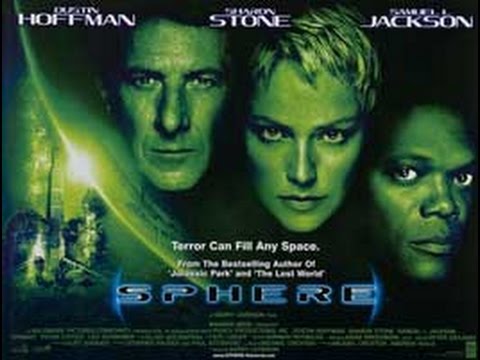
Today, I’m going to cover the 1998 Michael Crichton adaptation, Sphere.

The setup for Sphere is summarized on IMDb as follows:

A spaceship is discovered under three hundred years’ worth of coral growth at the bottom of the ocean.

The director for Sphere was Barry Levinson, who is known for movies like Wag the Dog, Sleepers, Toys, Rain Man, The Natural, Good Morning, Vietnam, and Bugsy.

Sphere is based on a novel of the same name by Michael Crichton, who was a well-known producer and director on top of being a best-selling author. Westworld, Jurassic Park, E.R., Congo, Twister, The 13th Warrior, Timeline, The Andromeda Strain, and many other prominent television shows and movies were either adaptations of his works, or were directly created for the screen by him.

While Crichton did occasionally provide screen treatments for his own novels, in the case of Sphere the adaptation work was done by Kurt Wimmer, who is best known for writing and directing the movies Equilibrium and Ultraviolet.

Additional screenplay credits were also given to Paul Attanasio, who has also written for films like The Good German, Donnie Brasco, Disclosure, Quiz Show, and The Sum of All Fears, and Barry Levinson’s former assistant, Stephen Hauser.

The cast for Sphere includes Dustin Hoffman (The Graduate, Rain Man, Marathon Man, Straw Dogs), Sharon Stone (Casino, The Quick and The Dead, Total Recall, Basic Instinct), Samuel L. Jackson (The Hateful Eight, Pulp Fiction, Jackie Brown, Django Unchained), Liev Schreiber (Spotlight, X-Men Origins: Wolverine, Goon), and Queen Latifah (Taxi, Chicago, Bringing Down The House, Stranger Than Fiction).

The cinematographer for the film was Adam Greenberg, who also shot movies like Rush Hour, North, Eraser, Ghost, Three Men And A Baby, Terminator 2: Judgment Day, Iron Eagle, and Near Dark.

The editor for Sphere was Stu Linder, whose other credits include cutting Quiz Show, Rain Man, Sleepers, Wag The Dog, and Toys, among others.

The musical score for the movie was composed by Elliot Goldenthal, who also provided music for the films Heat, Frida, Batman & Robin, Demolition Man, Alien 3, Pet Sematary, Batman Forever, Titus, Public Enemies, and Across the Universe, among others.

Sphere‘s production designer was Norman Reynolds, who also designed movies like Raiders of the Lost Ark, Return of the Jedi, The Empire Strikes Back, Alien 3, Mission: Impossible, and Return to Oz, and additionally served as art director for Star Wars – A New Hope, Superman, and Superman II.

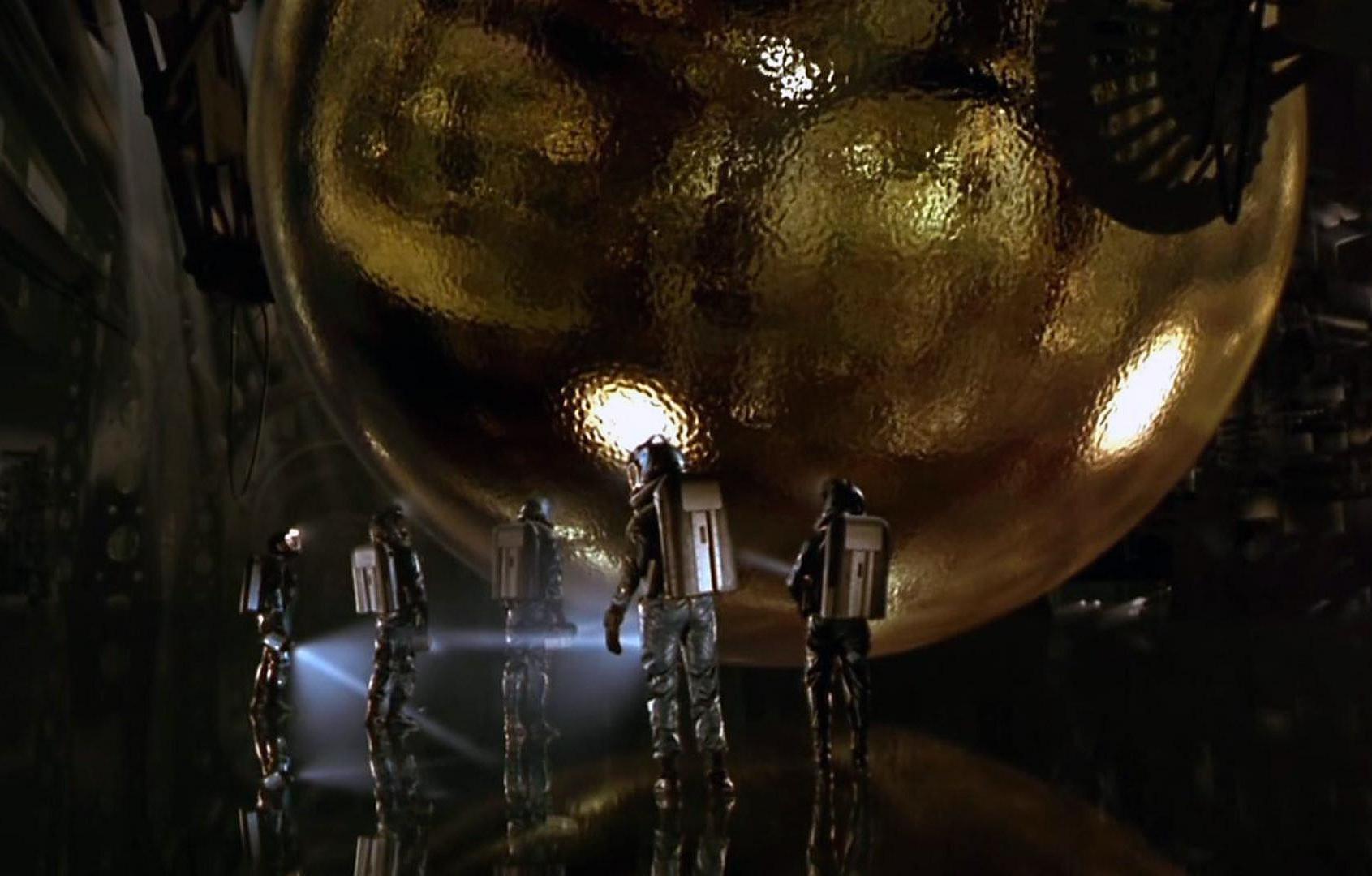
As with any adaptation, there are a number of details from the Sphere book that were changed for the film. Aside from the elimination of a few characters, the most interesting of these changes is actually the eponymous sphere’s coloration. In the book, it is silvery and chrome-like in appearance. Apparently, this was initially supposed to be the case on screen as well, but the decision was made for the sphere to be gold in the middle of the production, apparently for aesthetic reasons.

Interestingly, the ending of the movie was re-shot due to complaints from test audiences. While these sorts of changes are typically in response to petty complaints from fickle or shallow audience members, in this case, the change made the move more sensible. The initial cut failed to account for the decompression needed for the characters to acclimate from being in the far depths of the ocean, and test audiences didn’t buy it when the survivors made it to the surface.

Sphere grossed just over $50 million in its worldwide theatrical release. However, the production budget alone has been recorded as anywhere from $73 million to $80 million, making it a significant financial failure.

Unfortunately, the critical reception to the movie wasn’t any better: it currently holds Rotten Tomatoes scores of 12% from critics and 38% from audiences, along with an IMDb user rating of 6.0/10.

Personally, I think there are definitely some things to like about Sphere. For instance, Samuel L. Jackson is pretty damn good here, and is about as restrained, menacing, and cerebral as you’ll see him in anything. In general, the small cast puts out some solid performances. Aside from Jackson, Liev Schreiber is always a great supporter, and Stone does a serviceable job with her role. However, I think Hoffman doesn’t quite fit with the rest of the cast, and wasn’t the best choice to lead the film. I suspect that Levinson just likes working with him, and he was the most bankable name that was available to the production.

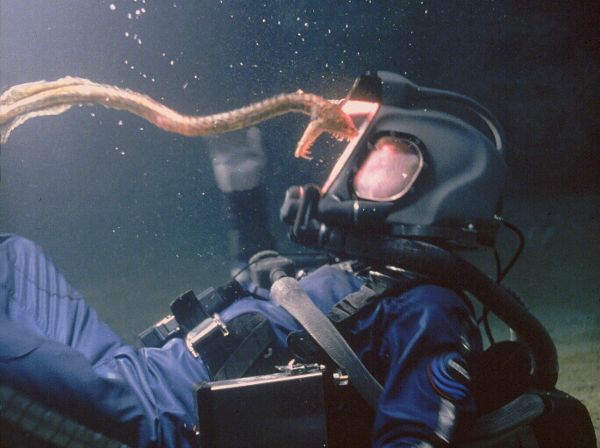
The biggest positive for the movie, however, it its design. The underwater facility just looks cool, and does a lot for the atmosphere of the film. Everything has a compelling science-fiction appearance, and it gets across the concept of the deep sea as a foreign world.

Likewise, I really like the concept for the story. I remember reading the book many years ago, and liking it quite a bit. The story is a bit surreal and highly psychological, which could have made for something compelling on screen. The book uses the high tension, claustrophobic setting to great effect, so there was certainly something for the film to work with. In the right hands, Sphere could be an effective science-fiction whodunnit, not unlike The Thing. At least, the blueprint was certainly there.

Unfortunately, in spite of the performances, the design, and a decent source, this movie is incredibly boring and forgettable. Honestly, it is a bit difficult to nail down exactly why. The whole movie feels a bit rushed, which makes it particularly difficult to get invested in the characters. At the same time, it is far from action-packed, so it is hard to say where all of the time goes. The movie certainly could have benefited from some character building sequences, as well as some better moments of sustained tension.

I think the biggest issue with the movie is that it was just put in the wrong hands. There’s nothing about Barry Levinson’s works that would indicate that he’d be a good fit for a psychological science fiction thriller. On top of that, the screenplay sounds like it was bounced around quite a bit, and probably suffered from that.

Overall, as I stated previously, Sphere is pretty forgettable. I do think that the source could make for a good sci-fi thriller someday, but this certainly isn’t it. With the recent television success of Westworld, I’m hopeful that people will start digging back through Crichton’s works, and will see the potential that was squandered with this iteration of Sphere.

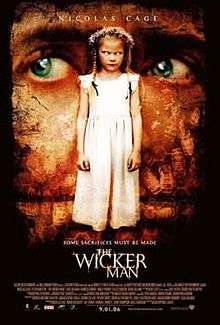
The Wicker Man (2006)

The Wicker Man

To continue my jaunt through the cinematic realm of Nicolas Cage, today I am going to look at the infamous 2006 remake of The Wicker Man.

The plot of The Wicker Man is summarized on IMDb as follows:

A sheriff investigating the disappearance of a young girl from a small island discovers there’s a larger mystery to solve among the island’s secretive, neo-pagan community.

The Wicker Man is based on an acclaimed 1973 film of the same name starring Christopher Lee. That film was in turn a loose adaptation of the 1967 novel Ritual by David Pinner, though it was not initially formally credited as such. The 1973 film is widely regarded as a horror classic, and stands in sharp contrast to its 2006 remake.

The 2006 version of The Wicker Man was both written and directed by Neil LaBute, who has directed movies like Lakeview Terrace, Nurse Betty, the remake of Death At A Funeral, Possession, and a number of episodes of Hell On Wheels.

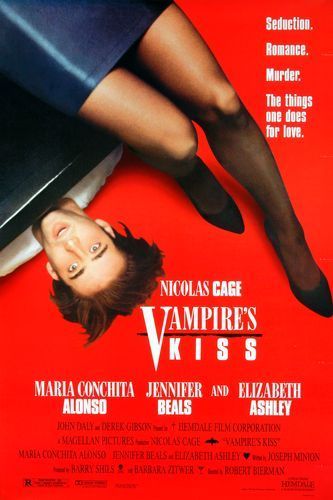
The cast of The Wicker Man includes Nicolas Cage (Con Air, Ghost Rider, Face/Off, The Rock, Drive Angry, Leaving Las Vegas, Stolen, National Treasure, Adaptation., Vampire’s Kiss, Snake Eyes), Ellen Burstyn (Requiem For A Dream, The Fountain, Interstellar, The Exorcist, The Last Picture Show), Kate Beahan (The Crocodile Hunter: Collision Course, Flightplan), Frances Conroy (Scent of a Woman, The Crucible, Six Feet Under), and Molly Parker (House of Cards, Deadwood, Hollywoodland).

The cinematographer for The Wicker Man was Paul Sarossy, whose other shooting credits include Charlie Bartlett, The Sweet Hereafter, Chloe, and notable television series like The Borgias and Copper.

The music for the film was composed by Angelo Badalamenti, who is notably a frequent collaborator with David Lynch, scoring such works as Twin Peaks, Twin Peaks: Fire Walk With Me, Blue Velvet, Wild at Heart, Lost Highway, and Mulholland Drive. On top of his Lynch credits, Badalamenti provided music for movies like Auto Focus, Christmas Vacation, Cabin Fever, Secretary, The Beach, and A Nightmare On Elm Street 3.

Both Robin Hardy, director of the 1973 The Wicker Man, and Christopher Lee, the film’s star, denounced the poor quality of the film’s remake. In 2011, Robin Hardy directed a sequel to his original film, called The Wicker Tree, which met with a reception almost as bad as the remake he denounced.

The original cut of The Wicker Man got an R-rating from the MPAA. Neil LaBute decided to make some minor changes to get a PG-13 for the theatrical release, in hopes that it would reach a wider audience. Interestingly, when the movie eventually released on DVD as an unrated version, not all of the footage was put back in: roughly four minutes from the original cut didn’t get re-inserted.

Nicolas Cage has claimed that the movie was intentionally made as an absurdist comedy, based on both his and LaBute’s vision. Some critics have agreed that it is a sort of black comedy, though very few who regard it as such think that the comedic elements were done well.

One of the key changes to the screenplay for this remake of The Wicker Man was the addition of the gender dynamic. The island is Summersisle is portrayed as a strict matriarchal system, where men are essentially used solely for breeding and labor.

Also, in the original iteration of The Wicker Man, the island is called “Summerisle”. Apparently, the change of the name to “Summersisle” for the remake was done because it was believed that Americans would have an easier time pronouncing it.

The Wicker Man was made on a production budget of $40 million, on which it took in a lifetime theatrical gross of just under $39 million. The reception to the film, however, was damning. Currently, it holds an IMDb user rating of 3.7/10, and has Rotten Tomatoes scores of 15% from critics and 17% from audiences. It ultimately wound up with a number of Golden Raspberry Award nominations, including for Worst Picture and Worst Actor, but didn’t wind up winning any.

In 2016, Brian Collins of Birth.Movies.Death. wrote an elaborate defense of The Wicker Man, which makes some interesting points:

[The Wicker Man is] unfairly maligned and curiously lambasted for its remake status when the original has its own share of offbeat choices… this was one of the more inspired [remake] choices for a major studio to throw a lot of money at…

the original Wicker Man was a realtively (sic) obscure British film that barely saw release in the US…Warner Bros. wasn’t giving Neil LaBute and Nicolas Cage 40 million dollars to remake a horror movie because they knew fans would show up – they saw potential in this strange tale being retold by these unique talents, regardless of the fact that it had been done before.

Is it a masterpiece? Heavens no.  But I wouldn’t offer the original that high of a compliment, either…I don’t think it’s fair to dismiss the remake outright simply because it’s a big budget movie that played on 2,000 screens instead of this weird little British movie you saw on TV on a late night broadcast.

Collins hits on something in this piece that I noticed a lot when reading through contemporaneous reviews of the film. Over and over again, reviews harped on the movie being an “unnecessary” remake, as if the original was an untouchable fixture that couldn’t be improved. While I understand that the oversaturation of remakes is frustrating, remakes are not inherently bad: sometimes, they bring fresh, new visions to stories. On top of that, I would argue that a remake of The Wicker Man was necessary: it has brought the original movie back into the public consciousness in a big way, and raised it out of obscurity.

All of that said, a bias against remakes combined with rose-tinted nostalgia glasses don’t totally account for the negative reaction to The Wicker Man. Make no mistake, this is a bad movie, and for a litany of reasons.

As mentioned previously, Nicolas Cage has claimed that the vision for the film was always comedic, though absurdist. If that’s the case, something went wrong, and the humor doesn’t come across. People don’t laugh at this because it is inherently comedic, but because it is nonsensical, and punctuated by Cage’s outlandish performance. One critical response to the film (by MaryAnn Johansen of Flick Filosopher) put my feelings on this issue well:

I’d look more kindly on Neil LaBute’s profoundly silly movie… if I thought he meant any of it in jest, if any of it were winking at us even a little.

As much as Cage may claim that the production had comedic intentions from the outset, there are just no signs of those intentions on screen. The tone, the music, the supporting performances, the cinematography: pretty much every element of the film (outside of Cage) is played absolutely straight. While that would certainly be absurd if done with intention, Occam’s razor dictates that it is far more likely that Cage was off the rails on his own tangent with his quasi-comedic performance.

For those same reasons, it is impossible for me to write off the transparently misogynistic themes and portrays in The Wicker Man as satiric or comedic. The thesis of this film is essentially that a matriarchal society is inherently oppressive, and devoid of critical thought. You can almost read LaBute’s thoughts: “Of course a society led women is going to be irrational, right?” It is hard not to imagine Neil LaBute filming sequences of Nic Cage punching women without experiencing an element of catharsis, given the amount of disdain laced through this screenplay. The fact that LaBute alone made the decision to alter the island society from the original film to be a matriarchy is more than a little telling as to his feelings towards women and feminism, and the look isn’t good.

As far as positives go, I have to say that The Wicker Man does look good: if you weren’t paying attention, you might mistake it for an artfully crafted film. Likewise, I like the setting of Summersisle: there is a sense of tension and foreboding to it, which contrasts interestingly with the bright, natural images that make it up. In that way, it isn’t unlike the bees that inhabit it: they are aesthetically pleasing, but dangerous.

While it may be true that critics were harsher to this movie based on its status as a remake, there are more than a handful of problems with it. It bows to countless genre cliches, promotes a misogynistic narrative, and has a bafflingly unfocused tone, and that’s without even touching on the perplexing, erratic performance from Nicolas Cage. It ultimately deserves the derision and ridicule that has been levied at it over the years, despite a few redeeming elements.

Much like Death Bed: The Bed That Eats, The Wicker Man falls in the rare category of bad movies that fancy themselves as art pieces, which carries a uniquely off-kilter tone. It is the sort of movie that you can truly marvel at, and get lost wrapping your brain around just how ill-conceived it was.

As far as a recommendation goes, I think this film’s reputation precedes it. If you think you might enjoy watching this movie, you probably will. Nicolas Cage fanatics are sure to enjoy his zany antics, to say the least, and absolutely have to give it a watch.

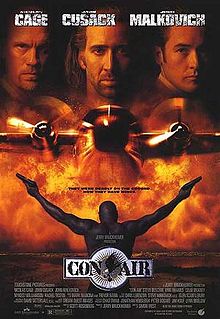
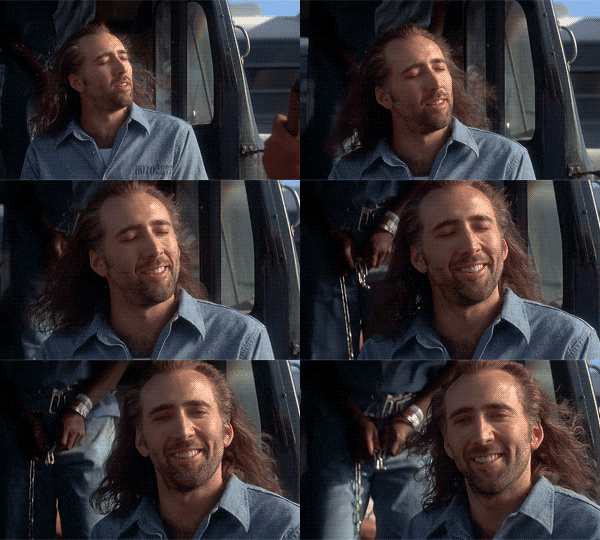
Con Air

Con Air

Today, I’m going to take a look at the notorious Nicolas Cage action flick, Con Air.

The plot of Con Air is summarized on IMDb as follows:

Newly paroled ex-con and former U.S. Ranger Cameron Poe finds himself trapped in a prisoner transport plane when the passengers seize control.

The screenplay for Con Air is credited to Scott Rosenberg, whose other credits include Kangaroo Jack, High Fidelity, Disturbing Behavior, and Gone In Sixty Seconds, among others.

The director for the film was rookie helmer Simon West, who has gone on to direct movies like Stolen, When A Stranger Calls, The Mechanic, The Expendables 2, and Lara Croft: Tomb Raider. However, perhaps his best known credit is directing the infamous 1987 music video for Rick Astley’s “Never Gonna Give You Up.”

The huge cast of character actors that makes up Con Air includes the likes of Nicolas Cage (Vampire’s Kiss, The Wicker Man, Left Behind, Leaving Las Vegas, Ghost Rider, Snake Eyes, Bringing Out The Dead, Adaptation.), John Cusack (Grosse Pointe BlankHigh Fidelity, 1408, The Raven, Being John Malkovich, 2012, War, Inc.), John Malkovich (Rounders, Eragon, Burn After Reading), Ving Rhaimes (Pulp Fiction, Mission: Impossible, Mission: Impossible II, Mission: Impossible III), Steve Buscemi (Boardwalk Empire, Reservoir Dogs, Fargo, The Big Lebowski, Armageddon), Colm Meaney (Star Trek: Deep Space Nine, Star Trek: The Next Generation, Hell On Wheels), Danny Trejo (Machete, Machete Kills, Anaconda, From Dusk Till Dawn, Desperado), and Dave Chappelle (Half-Baked, Chappelle’s Show).

The cinematographer for Con Air was David Tattersall, who also shot such films as The Green Mile, Speed Racer, Next, Die Another Day, Theodore Rex, Soldier, and The Majestic, among others.

Con Air ultimately had three credited editors: Glen Scantlebury (Stolen, Teenage Mutant Ninja Turtles, Twixt, Armageddon), Steve Mirkovich (Hardcore Henry, 16 Blocks, Broken Arrow, Big Trouble In Little China, Prince of Darkness, Cool World, The Astronaut’s Wife), and Chris Lebenzon (Eragon, Big Fish, Enemy of the State, Mars Attacks, Ed Wood, Hudson Hawk, Wolfen, Top Gun, Days of Thunder).

The musical score for Con Air is credited to both Mark Mancina (Moana, Shooter, Training Day, Twister, Speed, Speed 2: Cruise Control) and Trevor Rabin (12 Rounds, Snakes On A Plane, Torque, National Treasure, Kangaroo Jack, Deep Blue Sea). Apparently, due to his commitment to Speed 2: Cruise Control, Mancina didn’t have time to complete his work on Con Air, and Rabin filled in to complete the project.

Con Air was produced by Jerry Bruckheimer, one of the most prolific and popular film and television producers of the past few decades. His television shows include CSI, CSI: Miami, Cold Case, CSI: NY, and The Amazing Race, and just a handful of his film credits are The Rock, National Treasure, Armageddon, Pirates of the Caribbean. Top Gun, Bad Boys, and Days of Thunder.

In a 2007 interview with The Guardian, John Cusack justified his decision to take part in Con Air, despite not actually liking the movie:

I use those kinds of films to get leverage…you wouldn’t think Con Air had anything to do with Max, but in my career it does. It’s doing Con Air, or doing romantic comedies, that makes Max possible. The bad stuff you just try to make as good as you can.

In an appearance on Inside The Actor’s Studio, comedian Dave Chappelle claimed that he improvised nearly all of the dialogue for his minor part in Con Air.

In the credits, Con Air is dedicated to Phil Swartz. Swartz was an effects worker for the production who was killed in an on-set accident, in which a plane fell off of its rigging.

The song “How Do I Live,” which is featured prominently in Con Air, had the rare claim of being nominated for both Best Original Song at the Academy Awards and Worst Original Song at the Razzie Awards. However, it wound up winning neither distinction.

Con Air was made on a production budget of $75 million, on which it took in a lifetime theatrical gross of just over $224 million, making it significantly profitable. Critically, though, it was a bit of a mixed bag: it currently holds Rotten Tomatoes scores of 54% from critics and 75% from audiences, alongside an IMDb user score of 6.8.

One of Con Air‘s prominent advocates was Roger Ebert, who gave the film 3/4 stars in his review for the Chicago Sun-Times:

The movie is essentially a series of quick setups, brisk dialogue and elaborate action sequences…it moves smoothly and with visual style and verbal wit.

In this case, I’m not sure if I completely agree with Ebert’s opinion, particularly on the point of the “quick setups” and action sequences. I think that Con Air is one of the key action movies that is most guilty of action over-saturation. Essentially, there are so many set ups, explosions, and grandiose moments, that ultimately each of their impacts is diluted. If a movie is nothing but explosions and gunfire, then those moments will be less notable that a single dramatic explosion in a different film. At the same time, it can be said that the constant flashes can keep an audiences attention. However, I tend to think of Con Air as more like a strobe light: after a few minutes, the effect has worn off, and the moments that should be thrilling just feel normalized and repetitive.

As far as positives go, it is hard to get better than the rogue’s gallery of character actors that populate the eponymous plane. Led by John Malkovich, the whole cast of villains is eccentric, colorful, volatile, and beyond over-the-top. Between the lot of them, there is more scenery-chewing than we might ever see on screen again. On the flip side, however, is Nicolas Cage: perhaps the king of the cinematic freak-out. Unfortunately, however, his character here is polite to the point of near stoicism, and even when unleashed, never quite goes wide-eyed in Cage-y fury. If anything, he is the closest thing to a stable presence in the film, which doesn’t suit him in the slightest. Luckily, he does use an absolutely outrageous interpretation of an Alabama accent, which has cemented this as one of his worst performances regardless.

Thanks to its frequent appearances on cable, I assume that most people have caught Con Air before, or know of its reputation. I don’t have to mention that this is a big, silly action movie with the depth of a kiddie pool. I will say that it is anything but tasteful, and hasn’t aged terribly well in a multitude of ways. Most surprisingly, though, is that I found it to be not quite as exciting as I remembered on this particular re-watch. It is still a pretty fun ride as far as blockbuster fare goes, particularly in today’s market. However, I think this might be the rare movie that I think is better to experience in clips and highlights, or left relegated to fond memories.

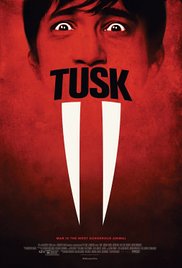
Tusk

Tusk

Today, I’m going to take a look at Kevin Smith’s 2014 creature feature, Tusk.

The plot of Tusk is summarized on IMDb as follows:

When podcaster Wallace Bryton goes missing in the backwoods of Manitoba while interviewing a mysterious seafarer named Howard Howe, his best friend Teddy and girlfriend Allison team with an ex-cop to look for him.

Tusk was written, directed, and edited by Kevin Smith, who is known for films like Chasing Amy, Clerks, Clerks 2, Mallrats, Jersey Girl, Red State, and Dogma, as well as his numerous successful podcasts, television shows, comic books, and live Q+A events.

The primary cast of Tusk is made up of Michael Parks (Red State, From Dusk Till Dawn, Kill Bill), Justin Long (Dodgeball, Drag Me To Hell, Accepted, Galaxy Quest), Haley Joel Osment (The Sixth Sense, A.I., The Spoils Before Dying, Secondhand Lions, Pay It Forward), Genesis Rodriguez (Big Hero 6, Run All Night), and Johnny Depp (Yoga Hosers, Pirates of the Caribbean, Ed Wood, Donnie Brasco, Black Mass, Sweeney Todd, Edward Scissorhands).

The cinematographer on Tusk was James Laxton, whose other credits include Moonlight (which netted him an Academy Award nomination), Yoga Hosers, Bad Milo, and Holidays.

The musical score for the film was composed by Christopher Drake, who also provided music for Yoga Hosers and Holidays, as well as a number of animated DC movies like Batman: Under The Red Hood and Batman: Year One.

Tusk was distributed theatrically by A24, which was at the time an eccentric independent distributor that was building a positive reputation. Today, it is a renowned brand in independent cinema: it boasted the Best Picture winner Moonlight, as well as acclaimed films like The Witch, Swiss Army Man, 20th Century Woman, Room, Green Room, The Lobster, Ex Machina, The Rover, Under the Skin, and Enemy.

The bizarre creature effects for Tusk were provided by Robert Kurtzman, whose other credits include It Follows, John Dies At The End, Bubba Ho-Tep, Vampires, Ghosts of Mars, Spawn, Scream, In The Mouth of Madness, Intruder, The People Under The Stairs, and From Dusk Till Dawn, among many others. He was recommended to Kevin Smith for the project by special effects guru Gregory Nicotero, who turned down the job due to schedule conflicts with other projects.

The idea for Tusk came to Kevin Smith after discussing a prank Gumtree advertisement on his flagship podcast, SModcast. The bizarre advertisement offered free board to a housemate in exchange for wearing a walrus suit for 2 hours a day, and fully performing the part during that time.

Tusk was the first entry in Kevin Smith’s proposed True North trilogy: three movies with similar horror themes and common characters set in Western Canada. The second of these was Yoga Hosers, which featured a number of returning elements from Tusk. The third film in the series, a Jaws parody called Moose Jaws, has still not begun filming as of May 2017, likely due to the overwhelmingly negative reception to Yoga Hosers.

In order to gauge his fanbase as to whether there was enough interest for him to make Tusk, Kevin Smith launched a hashtag campaign. Anyone could respond on Twitter with either #WalrusYes or #WalrusNo to indicate whether they thought he should take on the outlandish concept.

Tusk was made on an estimated production budget of $3 million, on which it managed to gross only $1.8 million in a limited theatrical run. Critically, the movie didn’t fare any better: it currently holds an IMDb user rating of 5.4/10, alongside Rotten Tomatoes scores of 41% from critics and 36% from audiences.

As you would certainly expect, Tusk is weird by design, on the virtue of its concept. Accordingly, it features some of the strangest makeup and creature effects in recent years, which is fortunately compellingly strange and unnerving. Designer Robert Kurtzman definitely outdid himself with this body horror execution of a humanoid walrus, and its presence is arguably the highlight of the film.

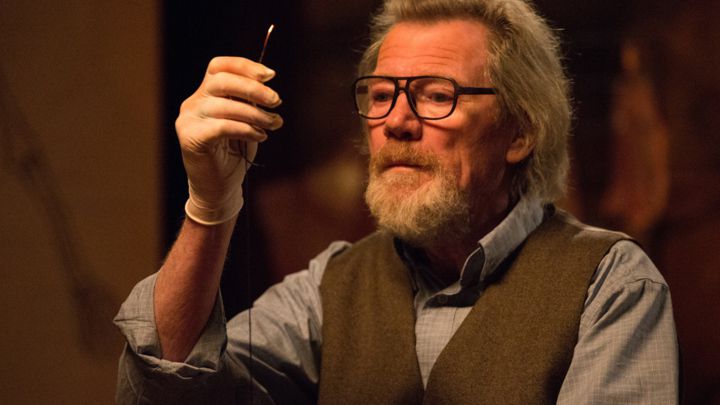
As far as other positives of the film go, I would be remiss not to mention the late Michael Parks. Parks, who previously starred in Smith’s religious thriller Red State, is firing on all cylinders for his unhinged role in Tusk. Not an ounce of scenery goes unchewed by Parks, who nearly makes the movie on his own. Particularly in the first act of the film, he manages to act circles around Justin Long, and builds an immense amount of tension through his storytelling and body language. However, a lot of the tension dissipates as the movie goes on, and changes focus to other characters. Unfortunately, by the film’s supposed climax, the movie has already peaked, and is significantly hindered by weaker elements that whittle on its effectiveness throughout.

Mark Jenkins, in his review of Tusk for NPR, had the following choice words for the film:

Tusk is an overextended, tonally incoherent joke that would make viewers squirm even if it didn’t involve a bloody and demented medical experiment.

While Parks is impressively suave as the absurd obsessive, the other performances range from unpersuasive to distracting. Long is off-pitch throughout, and a slumming, uncredited superstar functions only as a half-comprehensible in-joke.

That review hits on what are, by far, my two biggest issues with Tusk. The first of them is the “uncredited superstar,” Johnny Depp, who puts in what might be the worst performance of his career. In a word, his portrayal of a French Canadian detective is unbearable. His facial prosthesis look ridiculous, his accent is all over the place, and his presence and performance grind the movie to an unnecessary stop. Honestly, Tusk would have been a better overall feature if his point-of-view section had been excised altogether. For the life of me, I can’t fathom why it wasn’t left on the cutting room floor, outside of Depp’s supposed marketability.

The second issue that Jenkins brings up that I emphatically agree with is his assessment that the film is “overextended.” On top of the pacing troubles brought on by the aforementioned Johnny Depp segment, everything after the intriguing first act setup feels bloated and stretched, like Smith was having trouble making a full feature out of the concept. Progress happens slowly once the second act begins, and the shifts in perspective make it feel even slower. I honestly think, however, that there was enough promise and material for this idea to make a pretty kick-ass short film, but the necessary run time to hit feature-length brought about a lot of the problems that hinder Tusk. With some of the extended gags omitted, Johnny Depp’s part reduced, and the rescue attempt shortened, I think the total run-time could have been brought down to about an hour, and been a pretty intriguing flick to plug into HBO or Netflix. As it stands, however, the pacing leaves it a bit on the dull side.

Overall, I do think that Tusk is a fair bit better than the mess of Yoga Hosers, and had some initial promise. The effects are pretty decent, Parks puts in a chillingly strange performance, and there is certainly an intriguing setup for the story. However, the screenplay has some serious pacing issues, which are exacerbated by a mind-numbingly terrible performance from Johnny Depp, and a generally very unlikable lead character. I do think that the movie was written off prematurely by some based on its concept alone, but ultimately, I think that the failure of this flick is 100% on Smith’s screenplay and dual director/editor role. If he had someone else take on any number of those roles, he might have had a mitigating force to keep things in check. Alas, that’s not how it went down.

As far as recommendations go, Tusk is complicated. Kevin Smith fans certainly should check it out, as this was basically made for their benefit. Beyond that, body horror fans might as well check it out for the effects, but the rest of the film will probably leave a lot to be desired. As for everyone else, I think this is a toss-up. I have talked to people who have loved this movie that I didn’t expect, and people who passionately hated it that I thought might go the other way. If the concept intrigues you, I say dive in at your own risk.