Water Foul: Shark Attack 3

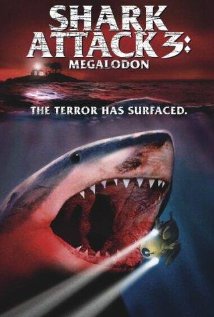
Shark Attack 3: Megalodon

sharkattack31

Today’s movie is Shark Attack 3: Megalodon, one of the most notoriously awful shark movies of all time.

Shark Attack 3 was written and produced by the duo of Scott Devine and William Hooke, who also penned the previous two Shark Attack movies. The film was directed and shot by David Worth, who has also been behind flicks like Kickboxer and Shark Attack 2, and has served as a cinematographer for films like Puppet Master vs Demonic Toys, Bloodsport, and Paper Dragons.

The editor for the film was Kristopher Leese, who worked on the editorial teams in a handful of episodes of television shows like E.R., Buffy The Vampire Slayer, and Heroes.
sharkattack33The effects team for Shark Attack 3 included Veselina Georgieva (The Expendables, The Wicker Man), Nikolay Gachev (Olympus Has Fallen, Legend of Hercules, Mansquito), Simeon Asenov (It’s Alive (2008), Drive Angry), Tinko Dimov (Kingsman: The Secret Service, Jurassic World, Jupiter Ascending), Anton Donchev (In Hell, Alien Hunter), Stanislav Dragiev (The Expendables 2, Automata), Jivko Ivanov (Jarhead 2, Lake Placid 3, Robocroc), Scott Coulter (Dogma, The Faculty, It’s Alive (2008)), and Radost Yonkova (Green Lantern, Men in Black 3).

The musical score for Shark Attack 3 was provided by Bill Wandel, who has also provided music for films like Crocodile 2: Death Swamp, Octopus 2: River of Fear, The Genesis Code, and some obscure gem called Blackmailing Santa.

The producers on Shark Attack 3 included Danny Dimbort (The Wolf of Wall Street, Shark in Venice), David Varod (300: Rise of an Empire, Octopus), Danny Lerner (War, Inc., Lethal Ninja (1992)), Avi Lerner (Alien From L.A., American Ninja 2), and Boaz Davidson (The Iceman, 16 Blocks).

The cast for Shark Attack 3 included John Barrowman (Doctor Who, Torchwood), Jenny McShane (Cyborg Cop III), Ryan Cutrona (Hot Shots!), and Bashar Mounzer Rahal (In The Name Of The King 3).

The plot of Shark Attack 3 surrounds the re-appearance of a thought-extinct species of enormous sharks, known as Megalodons. A handful of locals take it upon themselves to eliminate the gigantic shark before it can make it to a populated tourist beach where it can wreak significant havoc.

John Barrowman’s infamous propositioning line from Shark Attack 3 was improvised, and intended initially as a joke to make Jenny McShane break character. However, because she played it off with no reaction and the production was averse to doing multiple takes, it wound up in the final cut of the film.

The reception to Shark Attack 3 certainly wasn’t good, and it currently holds a 2.7 rating on IMDb. However, it has become a cult classic thanks to a number of clips of the shark effects (and Barrowman’s ‘cunning linguistics’) making the rounds on the internet.
sharkattack32First off, this movie is amazing, and I highly recommend it as a good-bad feature. For being as awful as it is, the film is actually not difficult to watch, and is paced better than most low-budget features, while still retaining its “terribad” features.

One of the most immediately notable aspects of this movie is the acting, which is generally abysmal across the board. The bizarre line readings come fast and furious throughout the film, which is usually a sign of bad directing. The odds of having honestly terrible actors from top to bottom is far less likely than the possibility that they were being instructed poorly. Given what John Barrowman has said about the movie over the years, I don’t think it is too much to assume that bad direction combined with the hesitancy to do multiple takes to create the memorable acting performances on display in this movie.

Something that has been done in countless shark movies since Jaws is the use of mammalian roars coming from sharks. Obviously this doesn’t make any sense, but it has gotten to be a bit of a tradition in shark movies in spite of all logic and sensibility. In the original Jaws it was a subtle big cat roar in the death sequence, but the noises have gotten increasingly blatant over the years. Shark Attack 3 is a bit unique in that it seems to use stock audio of bear attacks for the megalodon, which stands out from the pack of generic grunts and roars given to sharks in other films. Bears have a very specific sort of angry noise that is instantly recognizable, and hearing it come out of a shark is just…weird.

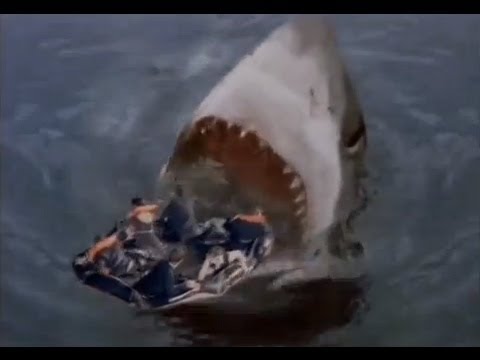
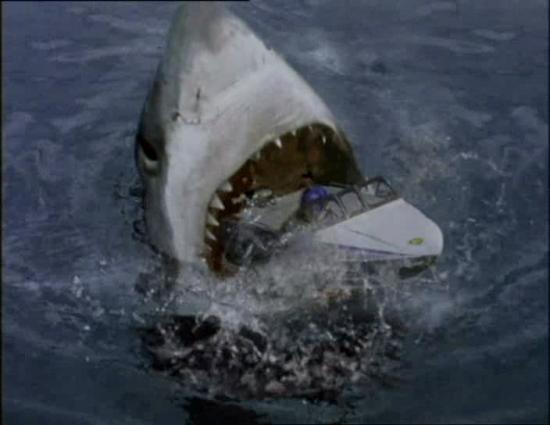
The shark itself is often made up of stock footage in Shark Attack 3, but there are a couple of creative moments worth noting. For instance, there is a camera hooked behind a shark fin in the water, giving a pseudo POV effect for a number of sequences. There is also some use of a fake shark head/torso for some of the attack sequences, though it seemed to be used pretty sparingly. The film is infamous for combining stock footage with original footage to create some of the worst attack sequences of all time, but those moments are pretty well compartmentalized to that section of the movie: through the lion’s share of the film, the effects aren’t awful. Given the budget the production was dealing with, they were pretty creative, particularly when compared with other Jaws knockoff shark movies.

I will also note that I found the use of practical effects intercut with stock footage, while cheesy, to be vastly superior in entertainment value when compared to the plethora of Asylum-produced monster flicks (Mega-Piranha, Sharknado, etc). For what it is worth, a rubber shark head looks more “real” than a cut-scene from a 2005 video game. As far as cost-effective CGI has come, it still can’t come close to comparing with actual, tangible effects (or appropriate stock footage), even when considering its creative benefits.

Overall, as I previously stated, Shark Attack 3 is an entertainingly bad movie worth checking out. I would take it over a Sharknado any day, and the popular clips of it circulating the internet amazingly don’t do it justice. It isn’t too difficult to find if you do some digging, and it is worth dredging up.
https://dailymotion.com/video/x28coe2

Water Foul: Jaws In Japan

Jaws In Japan

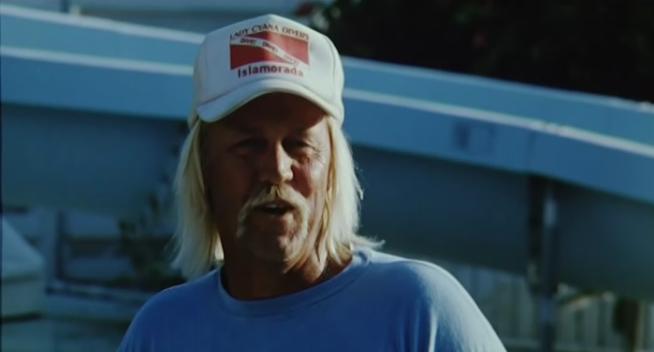
jawsinjapan2

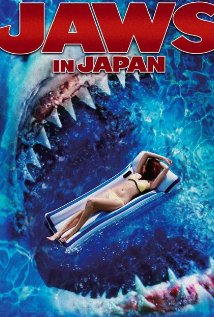
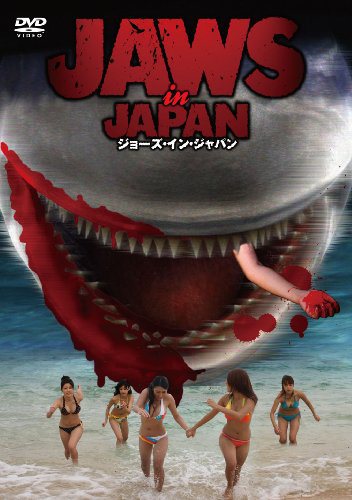
Today’s feature is a 2009 Japanese “sequel” to the 1975 super-smash, Jaws. Appropriately, it is commonly known as Jaws in Japan.

Jaws in Japan was written by Yasutoshi Murakawa, who also penned a movie called Iron Girl: The Ultimate Weapon, which I kind of assume is a Japanese Iron Man sexploitation knockoff (but I’m not planning to find out if that is true or not.)

The director for Jaws in Japan was John Hijiri, whose only other major credit is a Japanese TV series called Girls Be Ambitious.

The Jaws in Japan cinematographer is the most experienced member of the crew that I came across, Yasutaka Nagano. He has shot such films as The Machine Girl, a segment in The ABCs of Death, and something called RoboGeisha.

The editor for the flick was one Masakazu Ohashi, whose credits include X Game and the TV show Girls Be Ambitious under director John Hijiri.

The producers on Jaws in Japan were Kyosuke Uen (Grotesque, Geisha Assassin) and Rie Mikami, who only has two other listed credits on IMDb, neither of which have five votes as of yet.

jawsinjapan1The visual effects for Jaws in Japan were provided by Tsuyoshi Shôji, who recently provided effects for an undeniably Japanese movie called Schoolgirl Apocalypse.

Jaws in Japan stars one Nonami Takizawa, who, according to wikipedia:

is a Japanese gravure idol, and a female talent. She is best known for her voluptuous figure. She is from Saitama, and her nickname is ‘Nonamin’.[2] She retired from modeling as of 2011.

You might notice that ‘acting’ isn’t specifically mentioned in that blurb, which I don’t think was a mistake on the writer’s part.

The plot of Jaws in Japan follows two young college students on vacation at a resort island. However, not all is well in the apparent paradise, as both a serial killer and a murderous shark may be hunting in the area.

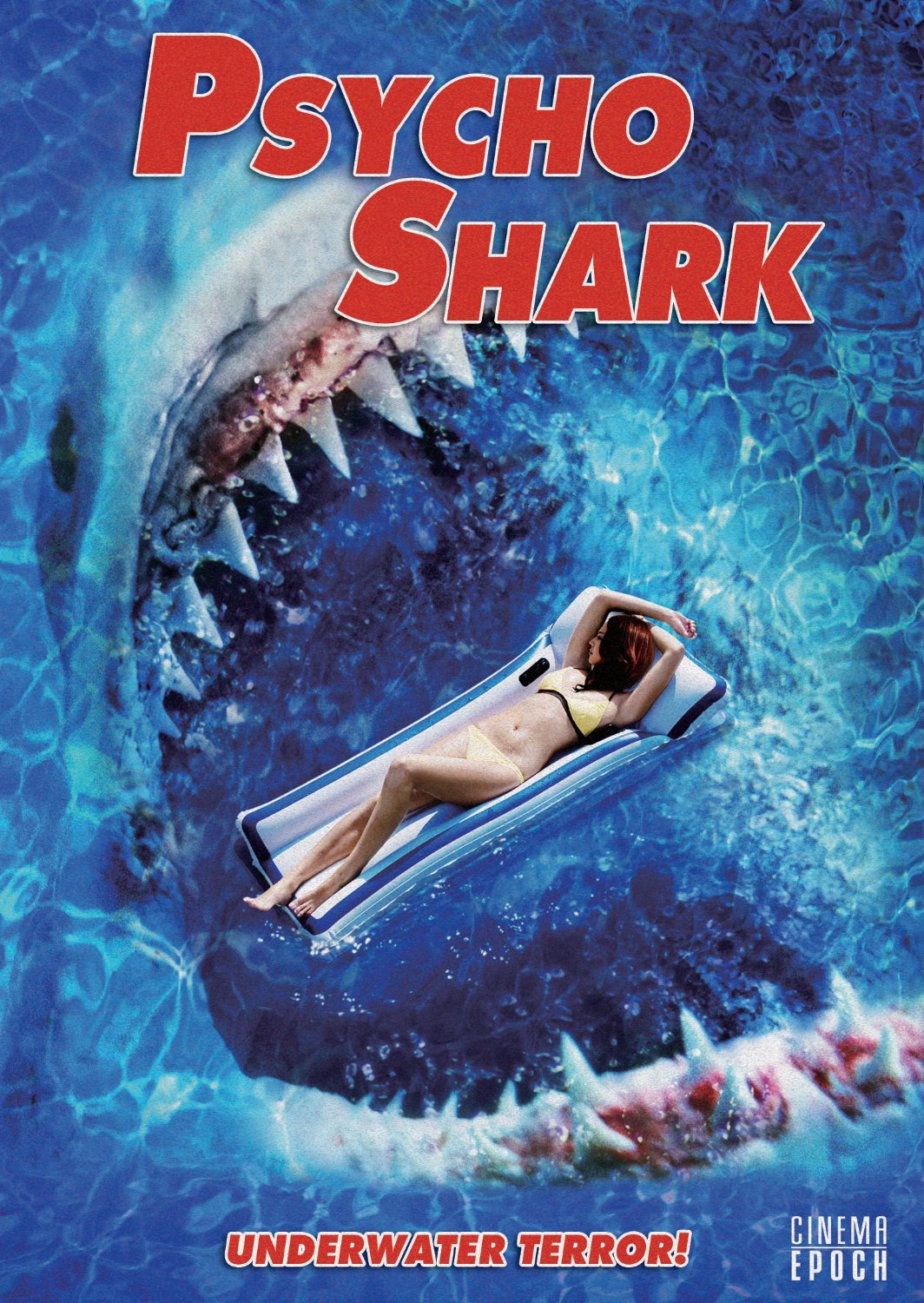
Jaws in Japan is also known by the alternate title of Psycho Shark, which was used for its United States home video release. For its release in Japan, it was actually marketed as a direct sequel to Jaws, though I somehow doubt that fooled anyone.

jawsinjapan4The reception for Jaws in Japan was overwhelmingly poor. The movie currently holds a 1.7 rating on IMDb, alongside a 1.2/5 average audience score on the review aggregator Rotten Tomatoes.

First off, Jaws in Japan is clearly a work of amateurs (or immensely untalented people, but I’ll be optimistic), because it is pretty much garbage film-making across the board. As I’ll get into in a minute, there are brief flashes of promise in the concept of the movie, but pretty much every aspect of the execution of it is abysmal. The acting is nonexistent, and I would wager that there wasn’t a screenplay of any kind for this film. Most of the movie is either repeated camcorder footage of nonsense, shots of girls watching that camcorder footage, shots of girls on beaches, shots of girls in showers, or shots of girls in bed doing and saying nothing. With the exception of the finale sequence, pretty much nothing happens throughout this entire movie. In short: it is paced poorly, shot poorly, looks terrible, sounds terrible, and might be the most boring movie I have ever seen.

Adding a whole extra layer to the film is the fact that this is an exploitation flick in just about every conceivable way. Not only are bikini shots constant (there is more dialogue about bikinis in this movie than about sharks or serial killers), but there are also random sequences ripping off everything from Psycho to The Ring.

The idea behind the story of Jaws in Japan has at least some promise if you ask me. The concept of a remote beach resort being terrorized by a serial killer, and the only clues left behind being guests’ camcorder tapes, could have made for an interesting thriller flick (a few decades ago). However, totally wastes that concept with its ineptitude.

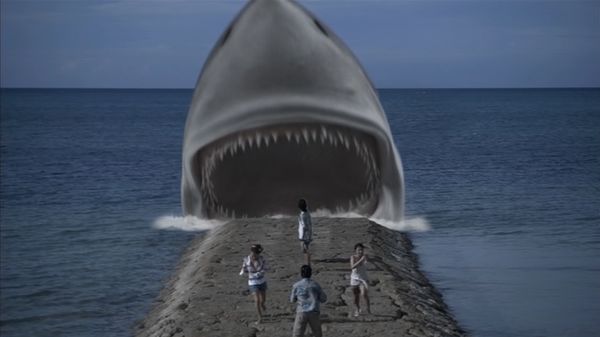
I honestly think the shark was added into this movie after the fact. This is a shitty thriller found footage flick about a serial killer stalking around a remote beach resort, and the producers must have realized it was too boring for anyone to possibly watch it. So, they threw a CGI shark in two scenes and labeled it a Jaws movie. I can sort of understand the parallel of the serial killer picking off beach-goers like a shark, and that might have promise in a different context, but that clearly isn’t how this movie was pitched. I kind of wish more information was out there about this movie, because I honestly want to understand how on Earth this film came to be, like an investigator trying to piece together the scraps after an airplane crash at sea.

jawsinjapan3If there is anything that I can say confidently about this film, it is that it is boring. In a movie that is barely over one hour, there is a nearly endless amount of unnecessary footage in it. The footage isn’t even extraneous plot: it is just nothing. It is primarily home video footage of a shitty vacation, often times played multiple times. Other sequences just drag on for seemingly minutes too long without anything of note happening or being said. Because of this, Jaws In Japan is one of the most boring and incompetent movies I have ever sat through, up there with IMDb Bottom 100 flicks like The Maize.

Overall, this feels like an amateur art movie that was “spiced up” with the addition of a CGI shark, and was marketed as a silly Jaws knockoff. However, it is actually an unwatchably slow thriller composed of handheld camera footage of women in bikinis doing nothing. If you have enemies that you want to hurt with a movie, this is one that you can consider as a weapon. Just tell them that it is a shark movie, and watch them wait the entire run time for something (anything) to happen.

All of that said, the finale sequence is pretty hilariously terrible.

Water Foul: Cruel Jaws

Cruel Jaws

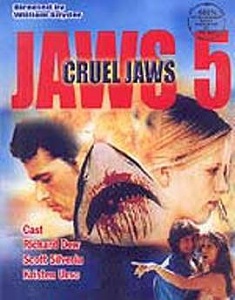
crueljaws1

Today’s feature is a knockoff movie sometimes referred to as Jaws 5: Bruno Mattei’s Cruel Jaws.

Cruel Jaws was directed, edited, and co-written by Bruno Mattei, an infamous b-movie creator who has been behind movies like Strike Commando, Hell of the Living Dead, Zombi 3, and Robowar. Interestingly, he used more than one pseudonym for Cruel Jaws: ‘Andy Lamar’ for the editing credit, and ‘William Snyder’ for the writing and directing credits.

Nearly the entire cast and crew of Cruel Jaws outside of Mattei have little to no other film credits, which isn’t particularly surprising given the ultimate product of this movie.

crueljaws3The plot of Cruel Jaws follows the formula of Jaws pretty closely: a tourist town is terrorized by a killer shark during peak season, and is pushed to the brink of financial ruin due to the negative press. The local sheriff has to team up with a shark expert to try and stop the murderous carcharodon.

Cruel Jaws extensively uses stock footage from other shark movies, including Jaws, Jaws 2, and even the Italian Jaws knockoff The Last Shark, which makes Cruel Jaws a rare ripoff of a ripoff.

Cruel Jaws is a pretty obscure knockoff flick, but the people who have come across it certainly haven’t liked it: it currently boasts an IMDb rating of 3.0 from just over 400 users.

crueljaws2The extensive use of stock footage and shots ripped from other films means that the shark attacks themselves play pretty awkwardly in Cruel Jaws. Obviously, you can’t show a shark from a different movie attacking characters in your movie, because you don’t have the shark. The result, as you would expect, is far less than ideal.

There is an odd subplot in Cruel Jaws about a theme park, which I think only exists as an attempt to knock-off Jaws 3-D, which isn’t particularly beloved to start with. This side plot also features a precocious child actor, who might be the most terrible and annoying performance in a film packed to the gills with terrible and annoying performances.

There is a ton of dialogue that feels completely ripped out of the original Jaws, making this maybe the most blatant knockoff of the classic movie I have ever seen. It goes beyond just lifting the broad strokes of the plot (like The Last Shark), and goes so far as to feature entire conversations are almost identical to Jaws, particularly from the Hooper analogue.

The musical score for Cruel Jaws is absolutely all over the place. You would probably assume that it would knock-off Jaws with the score, given how iconic and recognizable it is. However, perplexingly, that isn’t the case. There is one memorable moment as the intrepid heroes are setting out to sea for their shark hunt when the music is almost a direct ripoff of, believe it or not, Star Wars.  I suppose the filmmakers deserve partial credit for at least ripping off John Williams?

Overall, this is a pretty dull flick in my opinion. However, it has moments of genuine entertainment thanks to the awful acting an awkward use of stock footage. For die hard Jaws fans, hopefully this movie is as close as we will ever come to seeing an honest remake of the classic film. If you know the movie by heart, Cruel Jaws might be a wee bit more fun for you, particularly if you make a drinking game out of all of the times something is lifted from the original.

Water Foul: Creature From The Haunted Sea

Creature From The Haunted Sea

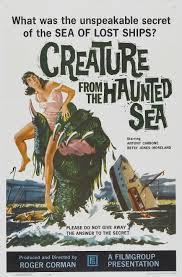
hauntedsea2

Today’s movie is another low-budget classic from Roger Corman: Creature From The Haunted Sea.

Creature From The Haunted Sea was written by Charles Griffith, a frequent Corman collaborator who penned such memorable flicks as Death Race 2000, Attack of the Crab Monsters, A Bucket of Blood, and The Little Shop of Horrors.

The director and producer of Creature From The Haunted Sea was, of course, Roger Corman, who is widely known as the king of the b-movies. Though he has primarily worked as a producer over the years, he also has over 50 directing credits, including The Wild Angels, Attack of the Crab Monsters, A Bucket of Blood, and The Little Shop of Horrors.

The cinematographer for Creature From The Haunted Sea was Jacques R. Marquette, who shot multiple episodes of television shows like The Greatest American Hero, Hawaii Five-O, McHale’s Navy, The Patty Duke Show, and The Streets of San Francisco over his career.

hauntedsea1The score for Creature From The Haunted Sea was provided by Fred Katz, who worked on a number of other Corman movies like A Bucket of Blood, The Little Shop of Horrors, and The Wasp Woman.

The associate producer for Creature From The Haunted Sea was Charles Hannawalt, who has worked with Roger Corman in a number of different capacities over his career, including producing The Beast with A Million Eyes, acting as cinematographer on Dementia 13, and serving as a grip on movies like The Trip and She Gods of Shark Reef.

Creature From The Haunted Sea stars Beach Dickerson (Attack of the Crab Monsters), Robert Bean (The Wild Ride), Betsy Jones-Moreland (Last Woman on Earth), Antony Carbone (A Bucket of Blood), and famed screenwriter Robert Towne, who later penned such movies as Chinatown, Bonnie & Clyde, Days of Thunder, Shampoo, and Mission: Impossible.

hauntedsea3The plot of Creature From The Haunted Sea takes place during a Cuban revolution, where a mobster seeks to profit on the social unrest by smuggling loyalists out of the country with the government’s treasury. However, he plans on killing and robbing the exiled stowaways under the guise of an elaborate fake monster attack. Complications arise in the form of an embedded CIA agent and the appearance of a real sea monster, both of whom threaten the entire operation.

Creature From The Haunted Sea was shot back to back with Last Woman on Earth, using the same crew, cast, and locations in Puerto Rico.

Unlike many of Corman’s more famous b-movies, Creature From The Haunted Sea is an intentionally comedic parody movie, lampooning everything from spy films to gangster flicks to Corman’s own prolific creature features.

Robert Towne is credited under a pseudonym for his role in the movie, taking on the fake name ‘Edward Wain’ in the cast listing.

The reception to Creature From The Haunted Sea wasn’t particularly positive, certainly due in part to the unusual comedic tone. It currently holds a 21% audience score on Rotten Tomatoes, along with a 3.3 user rating on IMDb.

hauntedsea4The plot of Creature From The Haunted Sea is impossible to fully understand without a familiarity with the context of the time. The movie released in June of 1961,  which placed it right in the middle of the most heated diplomatic era between Cuba and the United States in the long history between the two neighboring countries. In April of 1961, two months prior to the film’s release, the United States launched the counter-revolutionary campaign known as The Bay of Pigs, which ultimately failed to depose Fidel Castro, whose communist forces had been controlling the country since 1959. Sixteen months following the release of the film, the Cuban Missile Crisis took place, in which Cuba agreed to house Soviet nuclear weapons within eyesight of the Florida coast. This is remembered as the pinnacle of tensions in the Cold War, and the defining moment in John F. Kennedy’s presidency.

What is important to note about all of this is that at the time, Communism’s hold in Cuba was still new, and most believed that it would be ousted by some sort of United States scheme before too long. Not only was there the Bay of Pigs invasion, but the CIA even built up a bit of a reputation surrounding their failed assassination attempts on Fidel Castro, which were frequent enough to justify a wikipedia page. So, the idea that the Communist revolutionaries would need to flee the country on short notice was far from unrealistic in the minds of the American public, particularly given the US Government’s adherence to domino theory, and its proficiency in meddling in foreign governments during the era.

The other aspect of the time that may not be engrained in the public consciousness, but is of note to the film’s story, is the involvement of the mafia in Cuba. For film buffs, you probably recall a famous sequence from The Godfather Part 2 that depicted the 1959 Cuban Revolution foiling a backroom mafia plot to divide the country. In fact, organized crime had a field day with Cuba during the reign of Batista, which was effectively ruined by the Communist revolution and Batista’s fall from power. However, as depicted in Creature From The Haunted Sea, the organized crime elements didn’t entirely disappear overnight, particularly if they had money wrapped up in businesses in the country. Thus, that’s why there are so many wayward American criminals and mobster-types hanging out in Cuba at the beginning of Creature From The Haunted Sea.

On to the nuts and bolts of the film, this movie is actually pretty funny, particularly in how it skewers the spy genre. The film is interestingly more of a spy movie than a monster movie at its core, which certainly isn’t what it appears to be at first glance, and wasn’t how it was marketed.

The storyline is incredibly culturally relevant and political, particularly for a b-movie creature feature. It is still goofy without any doubt, and a lot of jokes fall flat, but there is more to it than just simple comedy, which it had every right to limit itself to. More than anything, the movie provides a fascinating window into the time period, and how the American public viewed Cuba and communism in the country. I was reminded a little bit of an episode of The Twilight Zone that also dealt with a veiled version of Cuba called “The Mirror,” which also released in the latter half of 1961, and is worth checking out.

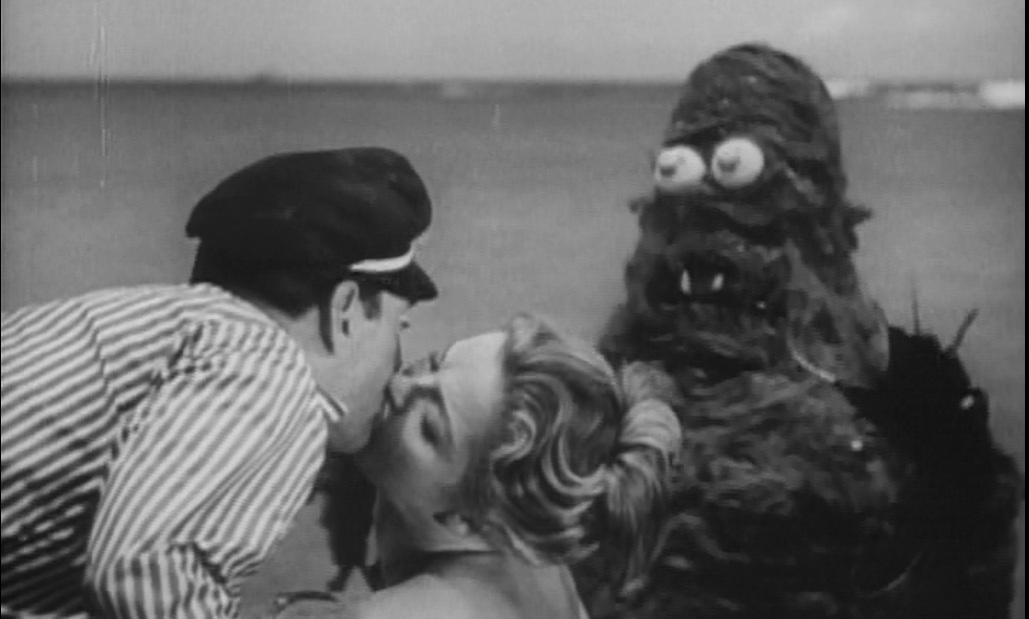
I can’t very well not talk about the ridiculous monster in this movie, which makes The Creeping Terror look like something Stan Winston or Rick Baker cooked up in a workshop. If you ask me, the goofy eyes are really what ties the whole thing together, and gives the monster its life-like quality. It is actually admirable in my opinion that Corman could laugh at himself and the reputation of his movies with this flick. For a modern example, this movie is comparable to what it would be like if Michael Bay had directed Hot Fuzz, if you could imagine such a thing.

While this wasn’t Corman’s only foray into the realm of comedy, it is certainly the least acclaimed of his three famous ventures into the genre. Both A Bucket of Blood and The Little Shop of Horrors are better polished, more memorable, and more fondly treasured as b-movie comedies than Creature From The Haunted Sea, and I can’t help but think that is partially due to the ad hoc nature of the production, as Joe Dante describes in the video above. When you are literally cobbling together a movie from the screenplay up with spare time while making another movie, there is no way you can give it the attention and care that the feature merits, even if it is in the hands of Corman’s notoriously quick movie-making machine. Even with similar back-to-back situations, like with Dolls and From Beyond, both screenplays were at least fully formed at the outset, whereas Creature From The Haunted Sea was a mere concept when the cast and crew was setting out for Puerto Rico.

Overall, Creature From The Haunted Sea is an uneven comedy with plenty of dead spots, and it was obviously cobbled together and padded out with extra footage. That said, it still has a peculiar charm to it and some solid comedic moments. This is a movie that I would say requires some research ahead of going into it, because it certainly isn’t a conventional Corman creature feature, and shouldn’t be viewed as such. If nothing else, this film is a curiosity worth checking out for its novelty value, if not for its cultural value as a window into a bygone era and into Corman’s own opinion of his movies.

Water Foul: Attack of the Crab Monsters

Attack of the Crab Monsters

crabmonsters1

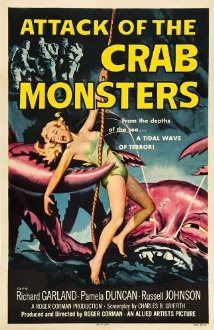
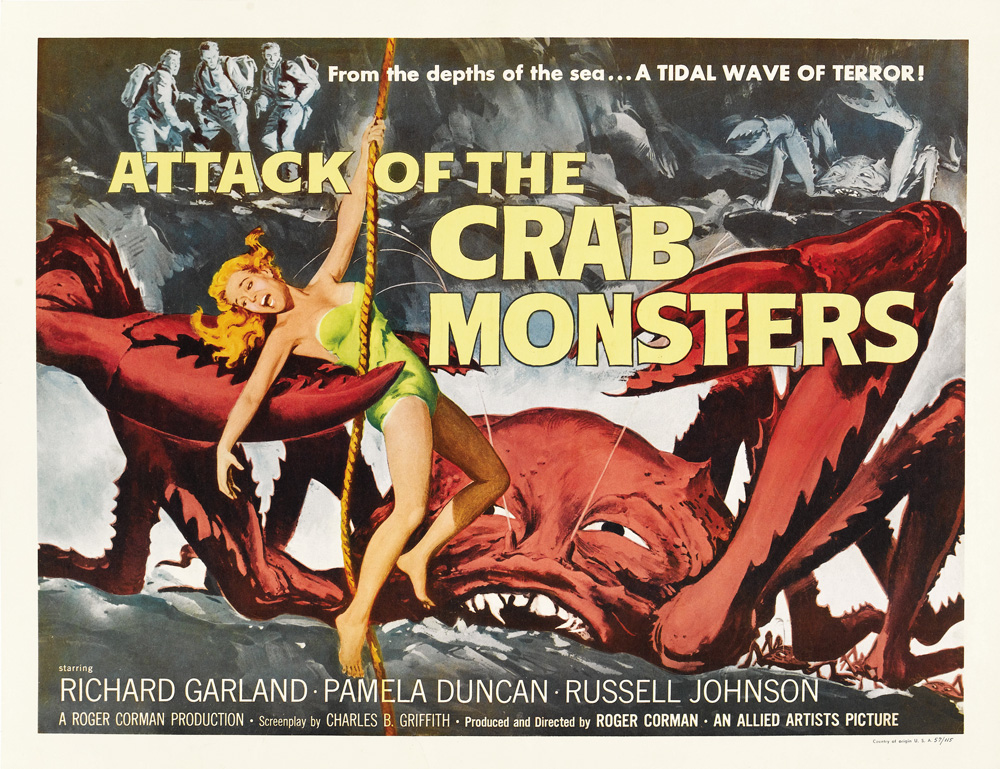
Today’s flick is Roger Corman’s famous creature feature b-movie, Attack of the Crab Monsters.

Attack of the Crab Monsters was written and co-produced by Charles Griffith, a frequent Corman collaborator who penned such memorable flicks as Death Race 2000, A Bucket of Blood, and The Little Shop of Horrors.

The director and producer of Attack of The Crab Monsters was, of course, Roger Corman, who is widely known as the king of the b-movies. Though he has primarily worked as a producer over the years, he also has over 50 directing credits, including The Wild Angels, The Creature From The Haunted Sea, A Bucket of Blood, and The Little Shop of Horrors.

The cinematographer for Attack of the Crab Monsters was Floyd Crosby, who also shot movies like House of Usher, The Raven, and X: The Man With X-Ray Eyes for Roger Corman.

crabmonsters2The editor for the film was Charles Gross, who cut a handful of other b-movies like Invasion of the Saucer Men and It Conquered The World.

The musical score for Attack of the Crab Monsters was provided by Ronald Stein, who composed music for other Roger Corman flicks like The Terror, Attack of the 50 Foot Woman, and Francis Ford Coppolla’s debut film, Dementia 13.

The cast of Attack of the Crab Monsters included Ed Nelson (A Bucket of Blood), Richard Garland (Mutiny in Outer Space), Beach Dickerson (The Trip, Creature From The Haunted Sea), Richard Cutting (South Pacific), Mel Welles (The Little Shop Of Horrors), Leslie Bradley (The Conqueror), and Russell Johnson (Gilligan’s Island).

crabmonsters3The plot of Attack of the Crab Monsters follows a group of scientists who are researching into the after effects of the Bikini Atoll nuclear tests on local wildlife. To their shock, they discover that a couple of ornery giant crabs that have mutated dramatically, to the point of acquiring telepathic powers.

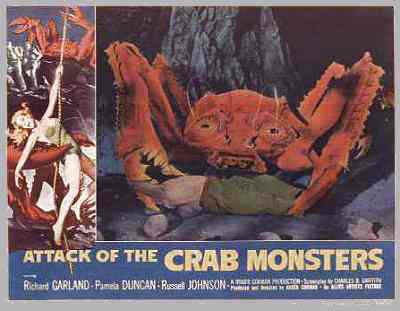
The eponymous crab monsters were portrayed via a two-person suit, with one person filling the body and another operating the claws. Instead of having designated effects workers to operate the effects, actors who weren’t in the specific scene were assigned to run the crab.

Attack of the Crab Monsters initially released on a drive-in double bill with Not of This Earth, another Roger Corman directed creature feature from 1957.

Attack of the Crab Monsters is one of the most iconic of the Roger Corman monster movies, and has appeared in the background of many other films as a form of homage. For instance, sharp eyes might spot the poster or clips of the film in movies like Chopping Mall or Found.

Writer/producer Charles Griffith directed all of the underwater sequences in the movie, supposedly because he was inspired by documentary filming done by Jacques Cousteau.

Jim Wynorski, a cohort of Roger Corman’s who has directed such flicks as Chopping Mall, Piranhaconda, and 976-EVIL II, has expressed interest in helming a remake of Attack of the Crab Monsters. However, Corman is reportedly against the idea, despite Wynorski having previously remade a number of his other movies, most notably Not of This Earth and The Wasp Woman.

In an interview with Dennis Fischer, writer and producer Charles Griffith said the following about the inception of Attack of the Crab Monsters:

“Roger came to me and said, ‘I want to make a picture called ‘Attack of the Giant Crabs,’ and I asked, ‘Does it have to be atomic radiation?’ He responded, ‘Yes.’ He said it was an experiment. ‘I want suspense or action in every scene. No kind of scene without suspense or action.’ His trick was saying it was an experiment, which it wasn’t. He just didn’t want to bother cutting out the other scenes, which he would do.”

The reception to Attack of the Crab Monsters wasn’t particularly great at the time, however, it is undoubtedly a classic Roger Corman movie today. It currently holds a 4.8 rating on IMDb, and Rotten Tomatoes scores of 29% (audience) and 67% (critics).

In true Corman fashion, it is estimated that the budget for Attack of the Crab Monsters was an astounding $70,000, on which it certainly managed to turn a profit.

Attack of the Crab Monsters certainly doesn’t waste any time getting started: before any character names are even introduced, a crab is on screen and decapitating an extra. This is particularly interesting, given how slowly paced many of these older monster flicks are (The Horror of Party Beach comes to mind). As mentioned previously, this constant action was part of Corman’s plan for the film from the onset, which pays off pretty well for what this movie is. The downside of this, however, is that the audience isn’t given any time to relate to the cast of characters, because they aren’t given any breathing room to be human, and die off quicker than you can get through ice breakers.

crabmonsters4The plot of Attack of the Crab Monsters could be accurately described as infamously outlandish. The premise that irradiated crabs with superhuman intelligence and telepathic powers are looking to conquer the world is a few steps beyond the mere bizarre, even for a 1950s b-movie. The fact that the crabs actually have dialogue puts this flick in a league of its own if you ask me.

The underwater footage in the movie actually looks pretty good, and if the claim from writer Charles Griffith is true, I’m actually pretty impressed that the production actually did it themselves. Underwater sequences seem to beg for stock footage, and I wouldn’t have put it past them to use whatever was laying around or handy to plug the hole in the movie.

The ending of Attack of the Crab Monsters is appropriately abrupt and baffling given the rest of the film, with a character collapsing an electrical tower onto the last surviving crab, killing both dramatically. However, this climax occurs almost entirely off-screen, being portrayed primarily via an electric sound effect over a reaction shot of the last two survivors. This shot lasts approximately 10 seconds before a fade into the ending card, with the following concluding lines summing up the movie:

“He gave his life…”

“I know.”

*THE END*

There is something particularly appropriate about the movie interrupting and cutting off the character’s final thoughts, like it was trying to hurry people out the door and didn’t actually care what the actors had to say about the situation anyway.  The entire movie clocks in at barely over an hour, and shuffles its way quickly through that entire run time. I’m willing to bet that the aim was to get the film to an even 60 minutes, but the team just barely missed the mark. Still, it is almost refreshing to see a movie that races too fast from beginning to end, especially given how many slow movies I have had to sit through. It doesn’t make the movie good (pacing that is too fast is still a problem), but it is certainly harder for me to complain about.

Overall, Attack of the Crab Monsters is a rightfully legendary b-movie. You can’t help but giggle when a goofy giant crab claw materializes from off screen without the character seeing it, or when a giant crustacean sets up an elaborate plot by mimicking human speech patterns, throwing its voice, and sabotaging complex communications equipment. The fact that the film takes itself seriously at all is astounding, particularly with the crabs roaring like pissed off gorillas for half of the movie, and speaking in German accents for the other half. The sheer wackiness of the story elevates the feature over a lot of similar flicks from the era without any doubt. It still holds onto the expected bad acting and goofy effects that are hallmarks of the genre, but having nefarious, psychic sea-life hanging about puts Attack of the Crab Monsters a rank or two above its peers in the realm of entertainment value. If you are looking for a b-movie classic to check out, this should be on your list.

The Creep Behind The Camera

The Creep Behind The Camera

creepbehind1

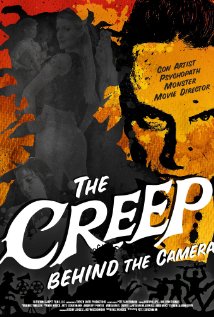
Today’s flick is the newly-released docu-drama, The Creep Behind The Camera, which tells the astounding story behind the legendarily awful b-movie The Creeping Terror.

The Creep Behind The Camera was directed and written by Pete Schuermann, who has been behind a number of low-budget flicks since his debut in 1999. The Creep Behind The Camera was specifically funded via a crowdfunding campaign on Kickstarter, raising over $70,000 dollars from a horde of supporters.

The Creeping Terror, the inspiration and subject of The Creep Behind The Camera, is widely regarded as one of the worst monster movies of all time. The monster itself is particularly memorable, and could be accurately described as a carpet from outer space.

Further, the film is filled with bad acting, terrible narration, nonexistent sound work, and an earworm of a theme song, which have all combined to make it a sort of ironic classic. It gained even more of a following after being featured on a season 6 episode of the show Mystery Science Theater 3000, which was dedicated to digging up the worst movies of all time.

As bad as the movie itself is, the stories that have circulated about the film’s production have added an extra mythos to the flick. The Creep Behind the Camera is dedicated to digging into that swirl of outlandish rumors: that the director was a con-artist working under a false identity, that no one in the production had film experience, and that it was financed by having actors pay for the privilege of playing a part in the movie, and countless more. As it turns out, it appears that many of these legends about The Creeping Terror may be true (or at least partially so).

The Creep Behind The Camera is composed of a series of interviews and testaments from people involved with the production of The Creeping Terror, interspersed with dramatic recreations of the events. While most of the film is dedicated to The Creeping Terror, a fair portion of it is also spent on the miscellaneous misdeeds and antics of the film’s star and director, Vic Savage/AJ Nelson.

While the actual content of the information is the primary draw for this movie (and is certainly fascinating), the performances in the dramatic sequences are really what tie it together. Particularly, Josh Phillips portrays AJ Nelson with a mix of charisma, insecurity, violence, self-delusion, and conniving that helps build the larger than life persona of the eccentric swindler behind The Creeping Terror.

The Creep Behind The Camera interestingly doesn’t take place in chronological order, and bounces around throughout the pre-production, post-production, and filming of The Creeping Terror without any particularly coherence. However, I felt like this worked pretty well, particularly in the parts focusing specifically on Nelson. The audience should be just as flabbergasted and perplexed by this figure as his crew was, and that feeling definitely gets across in the movie. The fact that he is initially introduced naked in front of a mirror, wearing a fake Hitler mustache, and repeating “I am God” to himself is about the best way to sum up Nelson in a nutshell, regardless of when that event occurred in his timeline.

For bad movie fans, The Creep Behind The Camera is necessary viewing, and helps fill in the gaps and questions that were left in the wake of the train wreck that is The Creeping Terror. The flick is currently available on most Video On Demand mediums, and The Creeping Terror is fairly easy to dig up on YouTube.

Miami Connection

Miami Connection

miamiconnection1

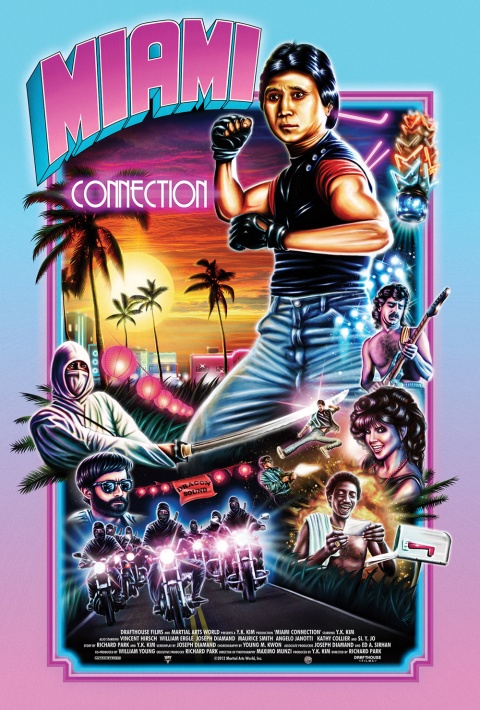
Today’s feature is Miami Connection, a once-lost movie that features all of the cocaine, ninjas, and 80s rock you could ever want.

Miami Connection was directed, produced, and co-written by Woo-Sang Park, who was also behind American Chinatown, Gang Justice, and LA Streetfighters. His co-writers were two of the film’s stars and co-producers, Joseph Diamand and Y.K. Kim.

The cinematographer for Miami Connection was Maximo Munzi, who also shot such films as Detonator, Scorcher, and American Chinatown.

Both the music and special effects makeup work for Miami Connection was provided by Jon McCallum, who also worked on films like Future Shock, Project Eliminator, Soultaker, and Surf Nazis Must Die.

miamiconnection2The plot of Miami Connection centers around a group of students at the University of Central Florida in Orlando, who share a passion for taekwondo and their family-friendly rock and roll band, Dragon Sound. When Dragon Sound bumps a local gang peddling cocaine from a night club venue, their adversaries go out for revenge, and the conflict rapidly escalates.

The star of Miami Connection is Y.K. Kim, who is a noted master of taekwondo, and a local celebrity in Orlando. Apparently, he arranged most of the filming locations and extras for the movie based on his good will with the greater community. For instance, the bikers featured in the background were reportedly real local bikers from the Orlando area, and were compensated for their time in beer.

miamiconnection3Most of Miami Connection was filmed on (or near) the University of Central Florida campus in the Orlando, FL area. Despite the title of the movie, no part of the filming took place in Miami.

For years, Miami Connection was lost to the ages. Its theatrical release in 1988 barely broke out of Florida, and most of the screenings were limited to the Orlando area. The Orlando Sentinel apparently even named it the worst film of the year. In 2009, a programmer at Alamo Drafthouse picked up a copy on ebay, and screened it at one of the theaters. This eventually led to Drafthouse Films picking up the film for redistribution, which has led to its rising status as a cult classic.

Former Mystery Science Theater 3000 hosts Mike Nelson, Bill Corbett, and Kevin Murphy have announced that Miami Connection will be the lampooned feature for their Rifftrax Live event on October 1, 2015, which is bound to increase the movie’s profile even further.

Thanks to its new-found cult status, Miami Connection currently has an IMDb rating of 6.1, alongside Rotten Tomatoes scores of 69% from critics and 70% from audiences. However, I don’t think anyone would claim that it is an objectively “good” movie by any means: most of those positive reviews are acknowledging that the movie is immensely entertaining for its “good-bad” qualities.

There is so much to talk about in Miami Connection that I honestly have no idea where to start. The musical numbers and rock sequences might be what sets it apart the most from the pack of b-movies out there, and those songs are guaranteed to get stuck in your head, but the movie goes so much further than just those amazing tunes:

The acting is astoundingly terrible across the board in Miami Connection, with Y.K. Kim leading the pack with his thick accent and indecipherable dialogue. The performances are at times beyond belief, like during either of the “letter” sequences, which are some of the most bafflingly awful showcases of acting I have ever seen.

If there is anything honestly good about Miami Connection, it is the aesthetic. The look of the movie is just delightful, and you can feel how charmingly low budget it was, and how much people enjoyed being involved with it. It still doesn’t make any sense and is amateurish from top to bottom, but it sure as hell has charm. Scott Tobias sums up the movie perfectly in his review for The A.V. Club:

Hits the sweet spot between stunning ineptitude, hilariously dated period touchstones, and a touching naïveté that gives it an odd distinction.

The ending of Miami Connection takes an unexpected and dramatically dark turn for a movie about man-children singing about fighting ninjas and “stupid cocaine.” The absolute slaughter that takes place in the last few minutes feels like it belongs in a totally differently film, which just adds to how endlessly bizarre Miami Connection is on the whole (there is apparently an even darker alternate ending to the movie as well). The ending title message about pacifism is also one of the most confusing and jarring conclusions to a film I have seen since Dracula 3000, but it is somehow amazing at the same time.

Something that is never addressed in the movie is the fact that all of the central characters appear to be far too old to be living together in a small house, let alone be typical college undergraduates. Speaking of which, the University of Central Florida could not be plastered on this movie any more than it already is: if one of the main characters is wearing a shirt, there’s a 90% UCF branding is on it. I think the wardrobe might have been provided by the college bookstore.

Miami Connection is one of the best good-bad movies out there: the acting is ridiculous, the writing is silly without being aware of itself, and the plot is out-of-this world strange. If you have the opportunity to catch this one, I can’t recommend it highly enough. For bad movie fans, I would go so far as to say that Miami Connection is a must-see movie, alongside movies like Troll 2, Manos: The Hands of Fate, Birdemic, and Samurai Cop.

Suspect Zero

Suspect Zero

suspectzero2

Today’s feature is the 2004 psychic serial killer thriller Suspect Zero, starring Aaron Eckhart and Ben Kingsley.

The screenplay for Suspect Zero was co-written by Billy Ray (Shattered Glass, Volcano, State of Play, Hart’s War, The Hunger Games) and Zak Penn (The Avengers, Last Action Hero, Elektra, Behind Enemy Lines), with the original story credit going to Penn.

The director on Suspect Zero was E. Elias Merhige, who was also behind films like Shadow of the Vampire and Begotten, but hasn’t made a full length feature since the release of Suspect Zero in 2004.

The cinematographer for Suspect Zero was Michael Chapman, whose shooting credits range from massively influential films like Raging Bull, Taxi Driver, and The Last Detail, to cult classics like Scrooged and The Lost Boys, to popcorn flicks like Kindergarten Cop, Space Jam, Ghostbusters II, and Evolution.

Suspect Zero had two primary editors: Robert K. Lambert (Red Planet, House of 1000 Corpses, Rollerball, Ed) and John Gilroy (Nightcrawler, Pacific Rim, Michael Clayton).

The score for Suspect Zero was composed by Clint Mansell, who is known for providing memorable music for films like Black Swan, Moon, The Wrestler, Requiem for A Dream, and Pi.

The effects work for the film was done by a team that included Thomas Burman (Frogs, Con Air, Hudson Hawk, Teen Wolf), Bari Dreiband-Burman (The Mask of Zorro, Howard The Duck), Stephan Dupuis (Ant-Man, Jason X, RoboCop 3), Todd McIntosh (Marmaduke, Torchwood, City Slickers II), Kenneth Van Order (Speed 2, The Hateful Eight), and Matt Kutcher (The Hottie and The Nottie, The Midnight Meat Train).

The team of producers on Suspect Zero included Paula Wagner (Vanilla Sky, Mission: Impossible), Nigel Sinclair (Rush, End of Watch, Mindhunters, The Life of David Gale), Tom Rosenberg (Crank, Million Dollar Baby, Gamer), Gary Lucchesi (The Midnight Meat Train, Aeon Flux, Virtuosity), Lester Berman (The Postman, Superman), Moritz Borman (World Trade Center, Alexander), and director E. Elias Merhige.

The cast of Suspect Zero is led by Aaron Eckhart (Thank You For Smoking, The Dark Knight), Ben Kingsley (Schindler’s List, Iron Man 3, Sexy Beast), Carrie-Anne Moss (Memento, The Matrix), and Harry Lennix (State of Play, Man of Steel, The Matrix Revolutions).

suspectzero3The plot of Suspect Zero follows a telepathic vigilante on the hunt for a theoretic undetectable serial killer, who he refers to as “Suspect Zero.” Meanwhile, a police officer is on the hunt for the renegade telepath, and is on the trail of bodies (all of serial killers) left in his wake.

Zak Penn’s initial screenplay for Suspect Zero reportedly started circling Hollywood in 1995. Over the years, notables such as Paul Schrader, Sylvester Stallone, Ben Affleck, and Tom Cruise all expressed interest in the project before it actually made it to the screen. Cruise even stayed on the film as a producer through his production company, though his name specifically doesn’t appear in the credits.

Suspect Zero was made on a budget of $27 million, though it only raked in $11.4 million in its worldwide theatrical release. The reception at the time was relatively negative: it accrued Rotten Tomatoes scores of 18% from critics and 38% from audiences. However, time has been kinder to the film, and the IMDb rating (which is updated more consistently frequently) has risen to a 5.9.

suspectzero1Suspect Zero definitely suffers from the inevitable comparisons to David Fincher’s Se7en, which is by all accounts a much better movie. Most of the criticisms I have read at least mention the stylistic similarities if nothing else. However, the movie deserves to be considered on its own merits, and I think the time and distance from Se7en has allowed that to happen. Still, the movie is far from flawless.

First off, a number of the surreal ‘vision’ sequences seemed way too forced to me, and I never got on board with the idea of using thermal ‘Predator-vision’ to indicate the psychic sequences. It just seemed to me that there had to be a better way to get across the idea of remote vision without resorting to what basically amounted to a night vision filter.

As much as I like both Aaron Eckhart and Ben Kingsley, neither of them put in consistently impressive performances in this flick. However, I think that has far more to do with the way that the characters are written over anything they could do. None of the characters have much in the way of personality in this movie, and there isn’t much to them beyond their explicitly-stated back stories, which is a real shame. There are flashes of interesting chemistry between the two actors, but it never totally clicks.

Likewise, the screenplay for Suspect Zero isn’t particularly effective at telling its story. It gets the point across, and the audience gets from A to B eventually, but there isn’t a whole lot of depth to it beyond the basic road map. Visually, the movie is pretty interesting, and it almost makes up for some of the weaknesses in the writing. However, even that goes overboard, as I mentioned with the ‘Predator-vision’.

As far as positives go, I’m a big fan of the score to this movie, and how it is used to create discomfort and tension throughout the film. Mansell always seems pretty good at that, and he really gets to show off his creepy composition skills here.

Overall, I think this film gets an unwarranted bad reputation. It isn’t great by any means, but I think people were particularly weary of Se7en imitators at the time. It is a bit slow and arty in its aesthetic for the casual movie-going crowd, but if you are interested in dark cop/serial killer films, this is definitely one worth checking out. I feel similarly about The Cell, which came out a handful of years earlier, though that film is far more surreal, and nearly unbearably pretentious. It also makes Suspect Zero look comparatively coherent.

If you are a big fan of The X-files and True Detective, Suspect Zero might hit the perfect middle ground for you in terms of both style and substance, just don’t go in expecting anything Earth-shattering.

Arena

Arena

arena4

Today’s movie is Empire Pictures’s mostly forgotten sci-fi boxing flick from 1989: Arena.

Arena was written by Danny Bilson, who also penned Trancers, Trancers II, The Flash, and The Rocketeer, and Paul De Meo, who wrote flicks like The Vipers, Eliminators, and The Sentinel.

The director on Arena was Peter Manoogian, who was also behind movies like Demonic Toys, Eliminators, and Seedpeople, among others.

The cinematographer on the film was the veteran Mac Ahlberg, a frequent Stuart Gordon collaborator who has shot such films as Evil Bong, Re-Animator, Space Truckers, Good Burger, The Wonderful Ice Cream Suit, DeepStar Six, Robot Jox, King of the Ants, Dolls, and From Beyond.

The editor on Arena was Andy Horvitch, another Stuart Gordon cohort who also cut films like Stuck, Edmond, The Pit and The Pendulum, The Wonderful Ice Cream Suit, Beeper, and Demonic Toys.

The producers on Arena included Empire Pictures head Charles Band, Debra Dion (Dolls, Trancers, Troll, Ghoulies), Irwin Yablans (Men at Work, Halloween, Halloween III), and J. Larry Carroll (Laserblast, Diagnosis: Murder).

arena2The music on the film was provided by Richard Band, the brother of Charles Band and noted music composer who has worked on such films as Re-Animator, From Beyond, Dreams In The Witch House, Castle Freak, Troll, and Laserblast.

The makeup effects team for Arena included Scott Coulter (It’s Alive (2008), Shark Attack 3: Megalodon, The Garbage Pail Kids Movie, Friday the 13th Part VIII), Bruce Barlow (From Beyond, Leviathan, Ghoulies II, Dinocroc), Adam Hill (On Deadly Ground, Leonard Part 6, The Abyss, Masters of the Universe), and Alessandro Jacoponi (Troll).

John Carl Beuchler (Troll, Carnosaur, Dolls, From Beyond) was in charge of the creature effects for Arena. The rest of the special effects team included Michael Deak (Pick Me Up, The Lawnmower Man, From Beyond, The Dentist), Mike Elizalde (Lady In The Water, The Frighteners, Total Recall, The Happening), Jeffrey Farley (Wolf, Carnosaur, Robot Jox, Shocker, Evil Bong), Steve Wang (Hell Comes To Frogtown, DeepStar Six), A.J. Workman (Moonwalker, Look Who’s Talking, Mac and Me), Renato Agostini (The Core, Leviathan), and ‘Screaming Mad’ George (Space Truckers, Jack Frost, The Dentist 2).

arena1The visual effects team for Arena was made up of David Stipes (The Lawnmower Man, The Stuff, Creepshow) and Jeff Pyle (Waterworld, On Deadly Ground, Volcano), who primarily did miniature work for the movie.

The cast for the movie included Claudia Christian (Babylon 5), Marc Alaimo (Total Recall, Tango & Cash), Paul Satterfield (Bruce Almighty, Creepshow 2), Hamilton Camp (Joe Dirt, Almost Heroes), Armin Shimmerman (Star Trek: Deep Space Nine), and Shari Shattuck (On Deadly Ground, Death Spa).

The plot of Arena takes place in a distant future, where a number of alien races from throughout the galaxy interact. This society includes a popular form of entertainment: a modified version of boxing.  The story follows a human as he becomes an unlikely star in the arena, and challenges the defending champion. Basically, it is Rocky in space.

Arena currently holds a 5.2 rating on IMDb, along with a 34% audience score on the Rotten Tomatoes review aggregator. However, these both come from pretty small sample sizes, as Arena definitely qualifies as a forgotten feature.

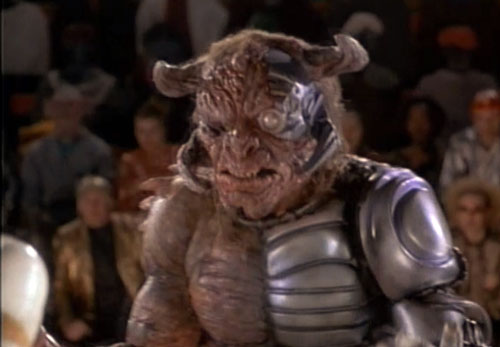
Personally, I was impressed with the creativity and the vision behind the monster designs in Arena, particularly given the fact that there was an extremely limited budget for the team to work with. Most of the aliens are just humans with some makeup effects, but a handful of them are more insect-like or otherwise complicated puppets or rubber suits.

arena3That said, the voice over work (for the monsters that required it) was absolutely atrocious. Horn, the primary antagonist, sounds absolutely ridiculous when he is supposed to come off as intimidating, and comes off as incredibly cartoon-y rather than menacing.

Late in the movie, there is a femme fatale who is introduced over the course of what is supposed to be a seductive musical number. However, just like the monster voice over work, it is absolutely awful. Honestly, he song is almost unbearable to listen to, with or without the lackluster singing, and it plays in the background of an entire scene. It is pretty surreal to watch, given the lead character is absolutely enamored with the impossibly terrible performance, and is distracted by it throughout the scene. Even worse, he acts like he is totally unaware that the singer is affiliated with his enemies, despite the fact that they were introduced by his primary antagonist. Just like Rocky, the hero of Arena (appropriately named “Armstrong”) isn’t the brightest of bulbs.

Overall, there are definitely some highlights to Arena that make it worth watching through, but I think the real value of the movie is in the outlandish premise. A run-of-the-mill sports movie set in outer space against the backdrop of a dystopian society turns a flick that is otherwise pretty basic into something incredibly bizarre. I feel like this is the most true sequel to Rocky IV, as the only way for a boxing match to have greater consequence than ending The Cold War is for a match to literally save the universe.

For bad movie fans, Arena is a good deep cut to check out. I think it would make a pretty good pairing with Robot Jox given the similar sports-movie styles, though Robot Jox is definitely the better movie of the two.