June 10-17 is Secular Students Week, a week dedicated to the stories and work of the awesome students served by the Secular Student Alliance. The week also marks a big fundraiser for the organization (which I proudly support and work for), with a $20,000 challenge on the line if we can bring in 500 donations (of any size) over the course of the week.
To do my part, I’m going to be resurrecting my (God)Awful Movies segment with a bang: by covering the entire infamous video series of “BibleMan” over the course of the week. Also, I’m pledging to honor any coverage requests for people who donate to the Secular Student Alliance (through my fundraising page) over the course of the week. If you want me to cover your favorite movie, a movie you made, a training video you found on YouTube, a cat video, a movie you think I will hate/love, a horror film about killer rabbits, whatever: I’ll honor whatever you point me to. That doesn’t mean I’ll like it, but I will certainly watch and write about it. Caveat emptor, as they say.
Now, if you aren’t familiar with BibleMan, here is the rundown: it was a long-running home video series that starred an evangelical superhero in a garish armored outfit. Each story followed a vague biblical lesson, and often featured musical numbers, awful special effects, inane plots, and over the top villains. It has achieved a bit of cult status, and has been referenced and parodied in shows like “The Venture Bros.” and films like “Super.”
“BibleMan” initially starred Willie Ames of “Charles in Charge,” who was eventually replaced in the later installments. It managed to spawn a number of touring live performances, a video game, and some licensed merchandise that is still floating around out there somewhere.
One of the things that I enjoyed during my time as a secular student at the University of Alabama was the occasional ironic viewing of “BibleMan.” A lot of people I knew grew up with the costumed crusader, who is a common presence in children’s programming in evangelical churches (which, as you might imagine, are numerous in the area). For many, college is the first time that they could look back and laugh a bit at some aspects of their religious upbringings, and BibleMan always made for a prime therapeutic target.
Of course, it isn’t all funny. Some of the lessons and content in “BibleMan” teach (explicitly or implicitly) xenophobic, anti-semitic, and anti-scientific rhetoric. I have made it a personal policy to buy any copies I find at buy/sell/trade stores (which doesn’t profit the BibleMan folks), in order to do my part to keep them out of the hands of kids.
In any case, the Secular Student Alliance helps build and sustain communities for young atheists, agnostics, humanists, etc. on college and high school campuses across the United States, much like the one that I was in at the University of Alabama. We also, as an organization, strongly support interfaith and progressive cooperation on campuses (LGBT orgs, Feminist groups, etc). If atheism isn’t your bag, that’s all cool by me! We aren’t out to destroy churches or shame the religious: we’re trying to be constructive, by building communities where they didn’t exist previously. I think many religious folks take for granted the advantages and benefits of having a natural community around their faith: it gives them a social network, a meeting spot, and a pool of people you can potentially lean on in times of need. That is the sort of thing we are building for the not-so-religious across the country, in cooperation with organizations like Openly Secular.
Regardless, enjoy the ride through BibleMan over the next week! If you can spare it, toss a couple of bucks to the Secular Student Alliance: it’ll help us (and more importantly, our students) out a ton. If you do, I’ll cover a movie of your choice. Again, here is my campaign page for donations. Just shoot me an email at mail@misantropey.com, and I’ll be sure to do your bad movie bidding.
Today’s feature is “Blood Diner,” a peculiar little horror-comedy from the late 1980s that involves cannibalism, blood sacrifice, and veggie burgers.
“Blood Diner” was written by Michael Sonye. Sonye was primarily an actor, appearing in films such as “Surf Nazis Must Die,” but wrote a handful of b-movie screenplays, including “Cold Steel” and “Star Slammer.”
“Blood Diner” was directed and produced by Jackie Kong, who only had a handful of credits in the 1980s. She was also involved in the schlocky films “Night Patrol” and “The Being.”
The cinematography for “Blood Diner” was done by Jurg V. Walther, who has worked on such (not-so) esteemed films as “Daniel Der Zauberer,”“Zombie Nation,” “Joysticks,” and “Hot Dog: The Movie.”
The music for “Blood Diner” was composed by Don Preston, who did the music for most of Jackie Kong’s films, as well as “Eye of the Tiger” and “Android.” He also interestingly provided the synthesizer work for the score to “Apocalypse Now.”
The editor on “Blood Diner” was Thomas Meshelski, who also cut such horror films as “Puppetmaster” and “TerrorVision.”
One of the executive producers for “Blood Diner” was Lawrence Kasanoff, who is best known for producing movies like “Mortal Kombat” and “Class of 1999,” but also infamously directed the animated disaster that is “Foodfight!”
Most of the cast of “Blood Diner” is made up of actors who have appeared in no other films, or at most just a handful of other similarly low-budget horror movies. Usually movies like this seem to have one or two players who eventually found some form of success, but that isn’t the case here.
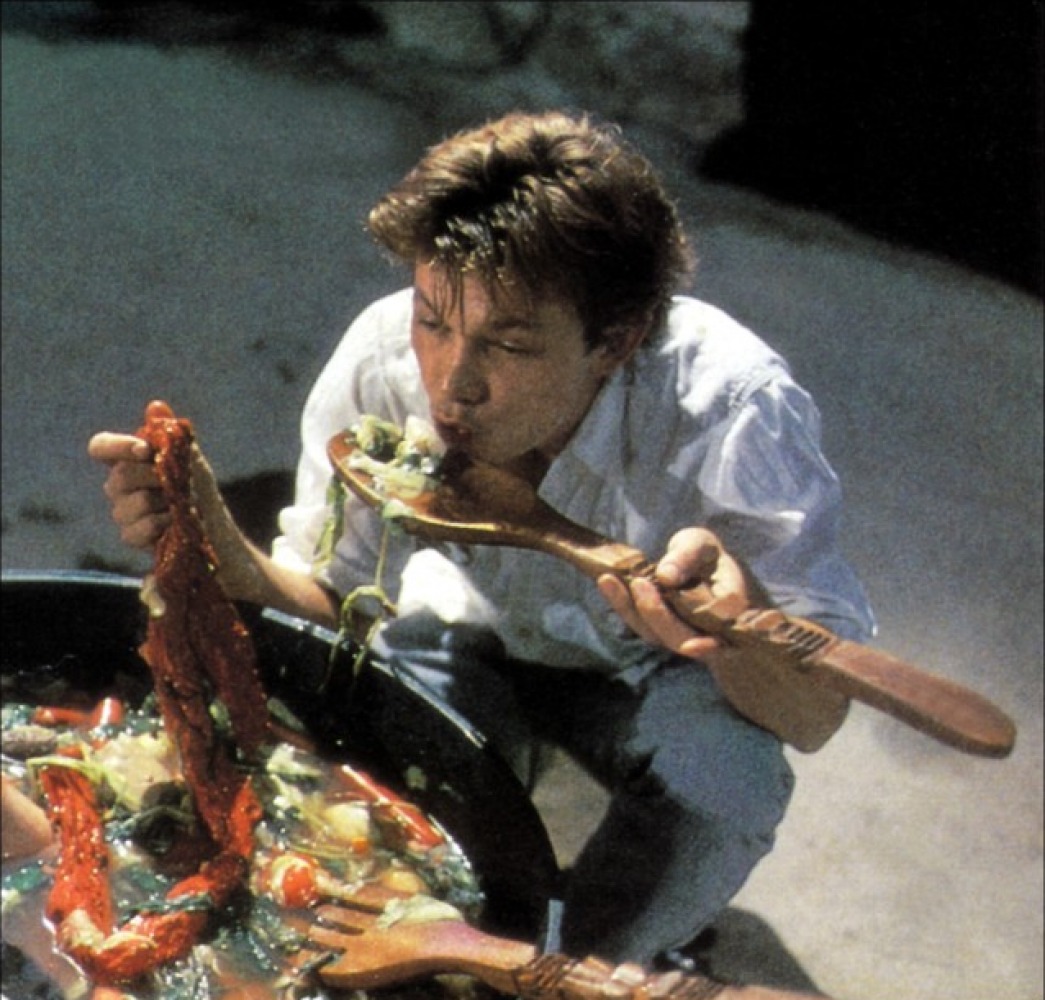
The story of “Blood Diner” centers around two cannibal brothers who co-own and operate a diner. They plan to resurrect an ancient God with a massive blood sacrifice, under the guidance of their newly resurrected undead uncle. Their preparations (namely the mass killings) attract attention from the police, who race against the clock to foil their plans.
The reception for “Blood Diner” was unsurprisingly negative, though not as poor as one might expect. It currently holds a rating of 5.0 on IMDb, along with a 53% audience score on Rotten Tomatoes.
“Blood Diner” was apparently initially intended as a sequel to Herschell Gordon Lewis’s “Blood Feast,” but the idea was scrapped before filming commenced. However, the plot similarities certainly remain for the sake of homage and parody.
A few parts of “Blood Diner” play for genuine laughs, such as the opening radio interruption warning listeners about an escaped killer in the area. However, most of the comedy feels added in after the fact, like this was meant to be serious horror, but half way through they realized how ridiculous it all was and tried to laugh off their incompetence. The result is a quasi-parody that rides the line between mocking and truly becoming the thing it is trying to make fun of. The humor is also pretty lazy on the whole, like it was concocted on the fly by people who don’t make a living in comedy.
Something else that can’t be ignored about “Blood Diner” is the musical score, which is the deadly combination of being both really terrible and extremely loud. The sound editing is straight horrendous, to the point that the music manages to overpower the outlandish acting on screen at times (or at least that was the case on my copy).
Speaking of which, ‘hammy’ doesn’t even begin to describe the acting in “Blood Diner.” Everyone seems to be over the top in one way or another, like all of the characters are trying to out-weird or act over each other. There is also some god-awful child acting in the introduction sequence that ranks up there with some of the worst that I have ever seen.
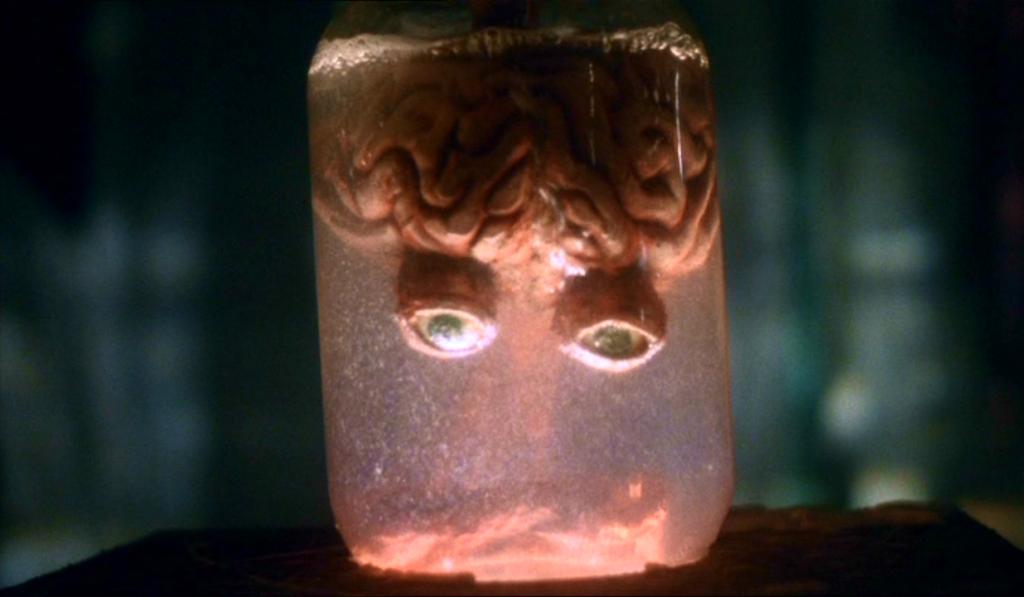
If there is anything positive to say about “Blood Diner,” it is that the cast of characters is certainly colorful, and makes for an odd and surreal world for the story to take place in. One of the key accessory characters, for instance, is a rival diner owner who is also a compulsive ventriloquist. There is also a group of explicitly vegetarian cheerleaders, a Hitler-themed professional wrestler, a talking undead brain, and a popular craze of nude aerobics.
One thing I still don’t understand about the plot is why the brothers pretend that their cannibalistic product is vegetarian, apart from the fact that it seems to be a popular fad in the world of the movie. It just strikes me as a little too easy of a ruse to spot, and they couldn’t possibly keep it up for too long for logistical reasons alone.
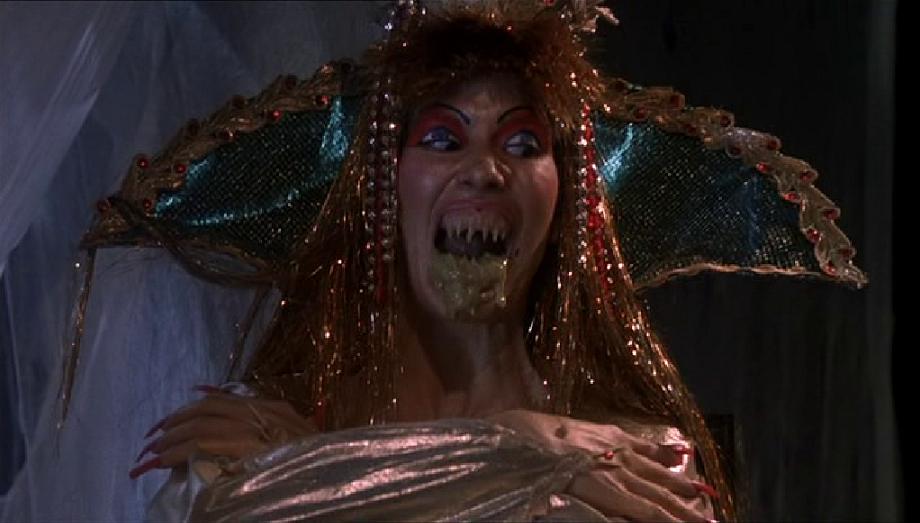
The God-raising ritual itself (the “blood buffet”) is the most bizarre section of the film by far. The Frankenstein-ish patchwork vessel for the deity is genuinely unsettling and bizarre, and the entire sequence plays like an intense fever dream. The nightclub setting is pretty much perfect for the finale, and the awful music is up to 11 throughout the whole sequence. The film is probably worth watching for that alone, because it is a spectacle of awfulness.
Overall, “Blood Diner” is a damn strange movie. As I said before, it rides a line between being parody and an earnestly terrible film, which makes it all the more intriguing to watch. How many of these moments were meant to be funny? Were they meant to be funny in the way that they are funny? The finale sequence alone makes it worth the watch for bad movie lovers, but I’m not totally sure how casual movie goers would react to it. It certainly isn’t dull, and has a lot of gore and ridiculousness to go around, but it also doesn’t quite have the same charm of the bad movie “classics” that everyone loves, which I think is because of the elements of intentional humor within it. If you are looking for a deep cut for a bad movie night, this could make an interesting pick. Better yet, it is entirely available on YouTube.
Today’s feature is the surreal musical “The Singing Detective,” starring Robert Downey Jr. and Mel Gibson.
“The Singing Detective” was initially written as a BBC series by Dennis Potter, who also wrote the screenplay which ultimately led to this movie adaptation. Potter actually did suffer from extreme psoriasis, just like the lead character in “The Singing Detective.” Unfortunately, he died of cancer almost ten years before this film of his work was made.
“The Singing Detective” was directed by Keith Gordon, an actor who has directed a handful of pictures, such as “Mother Night,” “Waking the Dead,” and “A Midnight Clear.”
The cinematographer for “The Singing Detective” was Tom Richmond, who also shot such films as “Chopping Mall,” “Killing Zoe,” “Stand and Deliver,” “Mother Night,” and “House of 1000 Corpses.”
The editor on “The Singing Detective” was Jeff Wishengrad, who had worked with Keith Gordon on “Waking the Dead” and “The Chocolate War,” and also cut the horror film “Sorority House Massacre.”
The significant makeup effects team for “The Singing Detective” was composed of members of Captive Audience Productions, which is best known for doing movies like “The Passion of the Christ,” “Bicentennial Man,” “A Beautiful Mind,” and “Van Helsing.” The team included Anita Brabec (“The Hunger Games,” “Confessions of a Dangerous Mind”), Tom Killeen (“Red Planet,” “Spider Man 3”), Keith VanderLaan (“Son of the Mask,”“Van Helsing,” “Kull The Conqueror”), Greg Cannom (“The Pit and The Pendulum,”“Space Truckers,” “Jingle All The Way,” “Captain America,”“Highlander II,”“It Lives Again”), Corey Czekaj (“The Master of Disguise,” “Avatar”), Mark Nieman (“Foxcatcher,” “Big Momma’s House”), Pam Phillips (“Sideways,” “Bones”), Sam Sainz (“Toys,” “RoboCop 3”), and Patty York (“From Hell,” “Secret Window”).
The visual effects for “The Singing Detective” were provided by WhoDoo EFX, a company which also worked on such films as “Charlie Wilson’s War,” “The Stepford Wives,” and “X2.” The specific credited workers were Helena Packer (“The Last of the Mohicans,” “Tank Girl,” “Twin Peaks”) and Mark Ritcheson (“The Tuxedo,” “Anamorph”).
The special effects team for “The Singing Detective” was made up of Scott Blackwell (“24”), Jeremy Hays (“League of Extraordinary Gentlemen,”“State of Play,” “Tiptoes”), and David Peterson (“8MM,” “The X Files,” “Monkeybone,” “The Adventures of Ford Fairlane”).
The cast for “The Singing Detective” is headed by Robert Downey Jr. (“Iron Man,” “Kiss Kiss, Bang Bang”), Mel Gibson (“Lethal Weapon,” “Signs,” “Braveheart,” “Mad Max”), and Robin Wright (“House of Cards,” “State of Play,” “Unbreakable”), with the accessory players filled out by Adrien Brody (“The Pianist,” “Predators”), Jon Polito (“Miller’s Crossing,” “The Man Who Wasn’t There”), Katie Holmes (“Phone Booth”), Carla Gugino (“Sucker Punch,” “Watchmen”), and Jeremy Northam (“Mimic,” “The Net”).
The story of “The Singing Detective” takes place primarily inside the mind of a troubled, bedridden author with a debilitating skin condition, who increasingly lives inside a hallucination of one of his stories, where he lives as a dashing detective who also sings at a local night club.
Robert Downey, Jr. and Keith Gordon apparently met while they were both filming the Rodney Dangerfield comedy film “Back to School,” in which they both portrayed young characters.
The screenplay for “The Singing Detective” spent years rotating from studio to studio, with directors such as Robert Altman and David Cronenberg at one point or another expressing interest. Rumor has it that Altman was set to cast Dustin Hoffman as the lead, whereas Cronenberg had his eyes set on Al Pacino.
“The Singing Detective” was made on a budget of nearly $8 million, but grossed less than 350,000 in its limited theatrical run, making it a significant financial flop. The reception wasn’t much better: it currently has a 5.6 rating on IMDb, along with Rotten Tomatoes scores of 39% (critics) and 41% (audience).
“The Singing Detective” has a number of similarities to another Keith Gordon movie that I really like: “Mother Night,” adapted from the Kurt Vonnegut novel. Both stories center on an awful but oddly sympathetic protagonist being put through the ringer of life’s harshest struggles. However, “The Singing Detective” doesn’t pull off the same gravity as “Mother Night,” which benefits greatly from being shot starkly and in uniform shadows. Campbell from “Mother Night” is also a little more realistically portrayed as a human in deep pain, and isn’t constantly thrown into surreal hallucinations and manic musical numbers (which is not a fault to be leveled at Downey).
Speaking of which, Robert Downey Jr. is a particular highlight to “The Singing Detective,” and uses his typical sarcastic, frenetic charm to great effect. However, it is also combined with a pained bitterness and instability to create an incisive and paranoid character.
“The Singing Detective” is a little too incoherent to work effectively, but it is also oddly not quite surreal enough, either. I would have been fascinated to have seen Cronenberg’s or Altman’s takes on the story, because I think either of their styles would have fit it fantastically. Altman would have relied on character interactions, whereas Cronenberg could have turned it into something like “Videodrome” with a film noir twist.
This story just isn’t suited for casual moviegoers at all, and the advertising seemed to be done in a way that would trick people into the theater, which is a clear recipe for a disaster reception. The campaign certainly didn’t portray the movie as what it is: a depressing, cynical hallucination. It seemed like the advertising team just saw the title, and tried to sell the movie on that alone. Honestly, who wouldn’t have expected a jukebox musical noir from something called “The Singing Detective?”
Translation from television to film is always a bit tricky, as television shows are typically structured to follow a much longer arc than movie. In this case, the story of “The Singing Detective” specifically doesn’t lend itself well to the act structure of a film (at least for mass audiences). I was reminded a lot of Anthony Hopkins’s “Slipstream,” in that it lost itself in being profound, drifting right off into incoherence, and the slow pacing certainly didn’t do that any favors.
The production of “The Singing Detective” probably should have done new renditions of the songs featured in the film, as the lip syncing just doesn’t come off right, and isn’t particularly consistent either. The old tracks also keep the sequences from being truly distinct or charming, which they really could have been. The writer, Dennis Potter, was apparently adamant that the actors not sing the songs, so the lip syncing was actually specifically written into the script. This brings up another issue, in that the writer (or in this case, his will) may have had too much influence on the production (usually they have almost none), and thus muddled the vision. In any case, I guess what they did here is still better than “Viva Laughlin,” the failed musical television show (which was also adapted from an acclaimed BBC series) in which the actors bizarrely sang over the original tracks. It could always be worse, right?
Mel Gibson, to my shock, is actually pretty good here, and is nearly unrecognizable with the makeup effects. He doesn’t usually step outside of his comfort zone, so this was interesting to see. This was also a few years before he went completely off the rails, while he still had some real talent before sliding into self-parody. Robin Wright is also pretty great, as she always seems to be. She might be one of the most under-appreciated consistent performers in the business, even when in mediocre-to-awful movies.
Overall, “The Singing Detective” is a thoroughly flawed but interesting watch. The performances and direction are good, but the writing seems to be missing something to push it over the edge. Given the resurgence of both Robert Downey Jr. and Robin Wright in recent years, it is interesting to go back to. However, if you are just looking for pre-“Iron Man” RDJ performances, go to “Less Than Zero,” “Kiss Kiss, Bang Bang,” or “True Believer” before this one.
Today’s feature is yet another in a long tradition of unnecessary and reviled sequels: 2009’s “S. Darko.”
The director of “S. Darko” was Chris Fisher, who has primarily done work on television shows like “Warehouse 13” and “Person of Interest” as a producer and director.
The writer for “S. Darko” was Nathan Atkins, who has worked as an assistant editor on shows like “Masters of Horror” and “24,” but has also written a handful of TV movies like “Abominable Snowman.”
The cinematographer on “S. Darko” was Marvin V. Rush, who is a veteran director of photography on television shows such as “Hell on Wheels,” “Star Trek: Enterprise,” “Star Trek: Voyager,” “Star Trek: The Next Generation,” and “Star Trek: Deep Space Nine.”
The editor and co-producer for “S. Darko” was Kent Beyda, who also cut films such as “Jonah Hex,” “Jingle All The Way,” “Fright Night,” “Humanoids of the Deep,” and “Gremlins 2.”
The producers on “S. Darko” included Sundip Shah (“Double Dragon,” “Sudden Death”), Jim Busfield (“Bad Ass,” “Bad Ass 2”), Ash Shah (“Frankenfish,” “Space Chimps 2”), and one of the producers of “Donnie Darko” in Adam Fields.
The music for “S. Darko” was composed by Ed Harcourt, who has also scored the documentary “For No Good Reason” and the 2007 film “New York City Serenade,” but it best known as a mildly popular British indie musician.
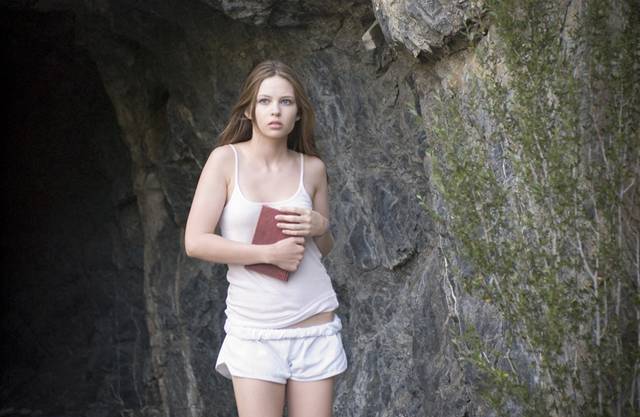
The cast of “S. Darko” is headlined by Daveigh Chase, one of the few returning elements from “Donnie Darko.” The rest of the cast includes Ed Westwick (“Gossip Girl”), Briana Evigan (“Step Up 2: The Streets,” “Sorority Row”), James Lafferty (“Oculus,” “One Tree Hill”), John Hawkes (“Congo”), and Jackson Rathbone (“Twilight,” “The Last Airbender”).
Richard Kelly, the writer and director of “Donnie Darko,” dismissed the creation of “S. Darko” before it was ever even released, saying:
“To set the record straight, here’s a few facts I’d like to share with you all—I haven’t read this script. I have absolutely no involvement with this production, nor will I ever be involved.”
The creation of “S. Darko” was apparently made possible due to the dissolution of Newmarket films, which produced the original “Donnie Darko.” This apparently left the rights up for grabs, which the company Silver Nitrate jumped on to create “S. Darko.”
“S. Darko” wound up getting an abysmal reception from critics and audiences alike, earning Rotten Tomatoes scores of 0% (critics) and 18% (audience). The film currently holds a slightly higher IMDb rating of 3.7, which is still very much negative.
“S. Darko” was made on a budget of just under $4 million, and only received a limited theatrical release in Europe, earning a minimal gross. However, the movie apparently wound up at least making back its budget due to DVD and on demand sales.
One of the first things I noticed about “S. Darko” was that the soundtrack is notably weak, which was a key strength of the original from the very first scene. I’m sure this was partially because they didn’t want to spend money to license anything, but the music in “Donnie Darko” was more important than just providing background noise: it helped set the time period and the style, things that “S. Darko” seems totally tone deaf to.
Likewise, I thought that the cinematography and general tone was just off for this film. “S. Darko” lacks the surreal touch of “Donnie Darko,” and wound up looking more like a cheesy ghost story than a trippy time travel mind-bender. Even the writing on the characters and their portrayals failed to build the same level of intrigue as the original film, which managed to create an interesting cast of characters despite not spending much time on any particular person outside of Donnie. “S. Darko,” on the other hand, presents a veritable parade of cardboard cutouts, lacking in any distinct depth or emotion.
“Donnie Darko” has a dedicated cult fan base, as most people know. This sequel was surely made because someone thought that more money could be squeezed out of the dedicated “Donnie Darko” loyalists, which of course backfired on them terribly. The whole feel of the production reminded me of “American Psycho 2,” in that it is only tangentially tied to the original, and desperately tries to imitate the quirks of its predecessor like a child awkwardly fumbling with the new found power of speech. The whole movie feels like a clueless mockingbird imitation of “Donnie Darko,” trying to hit the essential beats that make up the tune. From watching scene to scene, you can practically see the writer’s line of thinking:
“Donnie Darko” had a rabbit mask, so we need a rabbit mask.
“Donnie Darko” has a book about time travel, so we need a book about time travel.
“Donnie Darko” had a car crash, so we need a car crash.
“Donnie Darko” had an arson, so we need an arson.
“Donnie Darko” had CGI chest-worms, so we need chest-worms.
“Donnie Darko” had television portals, so we need television portals.
“Donnie Darko” has an object falling from the sky, so we need an object falling from the sky.
Every little detail feels like a parallel imitation from the previous movie, to the point that this list could just go on forever. I would challenge readers to a drinking game based on these observations, but I don’t want to be held liable for any untimely deaths.
I liked “Donnie Darko” well enough, but the movie does not make any sense, despite what some die-hard fans might claim. Likewise, “S. Darko” doesn’t have a shred of coherence, but it lacks the style and performances that were key to “Donnie Darko” to make up for the layers of nonsense.
“S. Darko” is one of the most boring movies I have ever sat through, and I am including ancient exploitation movies, Coleman Francis flicks, and the dullest of parody films in that count. It is excruciatingly dull and painfully derivative, to the point that you will try to manifest a nonsense form of time travel to erase it from existence. I can’t recommend it as a good-bad watch, because there are just so many better ways to spend just under 2 hours of a day.
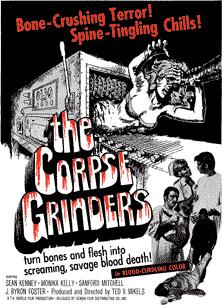
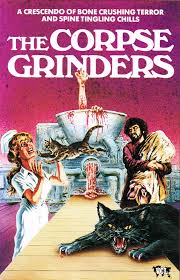
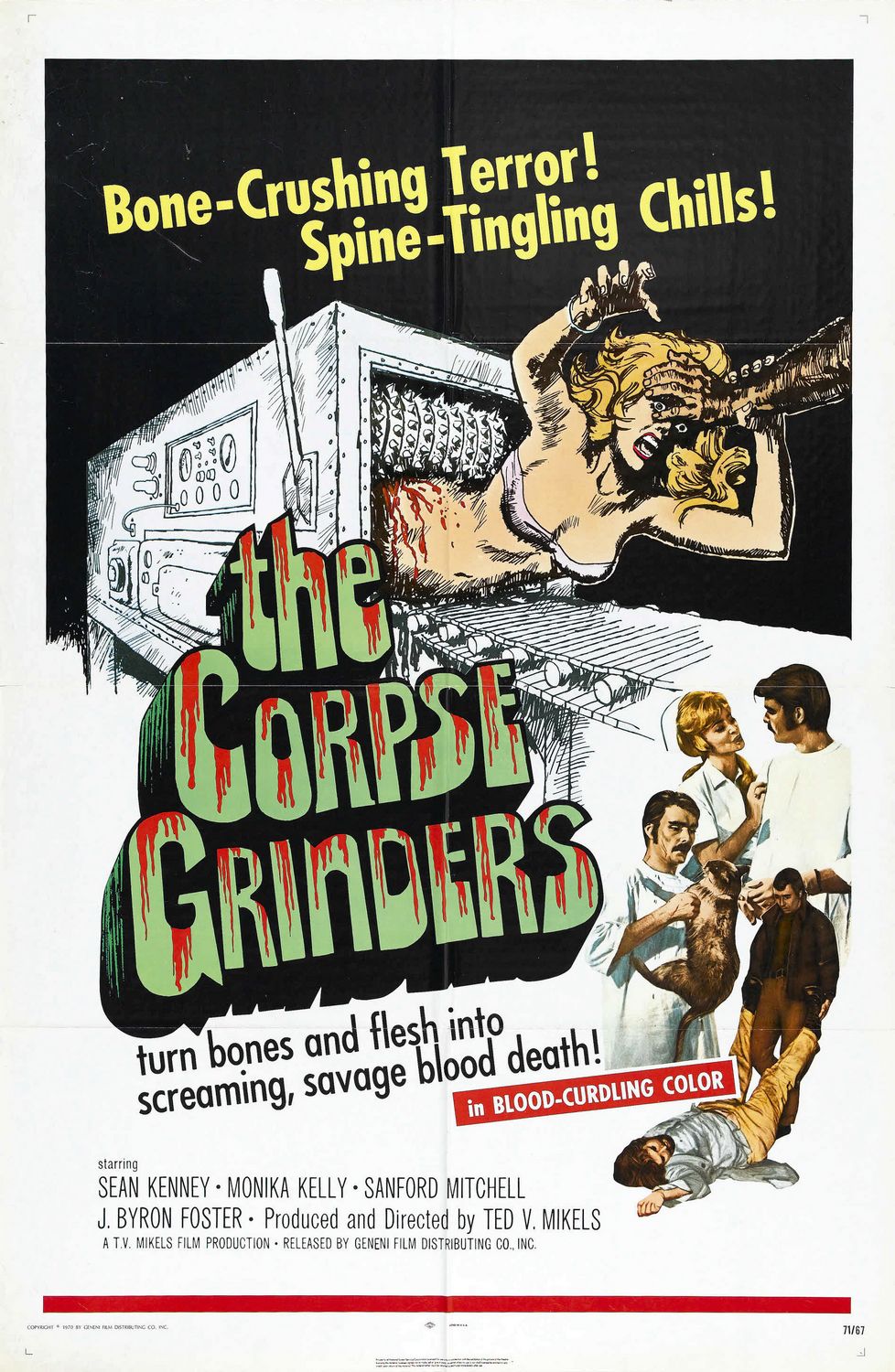
Today’s movie is a little story that answers the age-old mystery of what cat food is made of: “The Corpse Grinders.”
“The Corpse Grinders” was directed, produced, edited, scored, and co-written by Ted V. Mikels, a b-movie legend who also created “Girl In Gold Boots,” “The Astro-Zombies,” “The Black Klansman,” and “The Doll Squad.” The other credited writers were Arch Hall Sr., best known for “Eegah,” and Joseph Cranston (“The Crawling Hand”).
The effects for “The Corpse Grinders” were provided by Sherri Vernon (“Blood Orgy of the She-Devils”) and Gary Heacock (“The Astro-Zombies”).
The executive producer on the film was Peter James, who was also behind “Head in the Clouds,” “The Merchant of Venice” starring Al Pacino, and a 2005 adaptation of “Beowulf & Grendel.”
The cast of “The Corpse Grinders” is made up mostly of inexperienced exploitation actors, like Sean Kenney (“Star Trek,” “The Toy Box”), Sanford Mitchell (“The Scavengers”), Warren Ball (“The Harem Bunch”), Ann Noble (“Sins of Rachel”), Vincent Barbi (“Dolemite,” “The Astro-Zombies,” “The Blob”), and Drucilla Hoy (“Sinner’s Blood”).
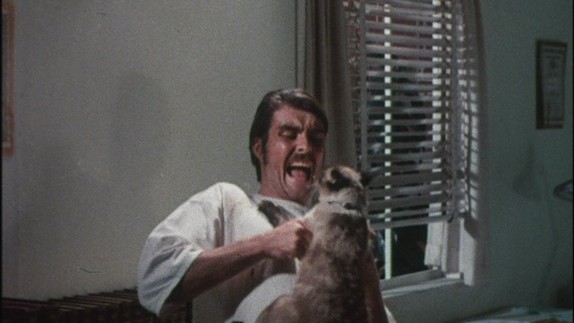
The story of “The Corpse Grinders” centers on a cat food company that is grinding up human corpses to make their product. The result is, of course, that domestic cats begin going wild and attacking their owners.
“The Corpse Grinders” spawned two sequels many years after the fact: “The Corpse Grinders 2” in 2000, and “The Corpse Grinders 3” in 2012.
In 2013, the Las Vegas Review Journal did a spotlight feature on Ted V. Mikels that covers many of his eccentric life experiences, as well as how the digital revolution affected his film making. Apparently, he at one point lived in a castle with a veritable harem, has a distinctive mustache, and is generally a bit of a creepy oddball. However, he also provided some interesting insights into his film-making process, particularly why he almost always worked with amateurs, and how that rounded him as a director:
“I found that the people I could use, the only ones I could afford, were people who didn’t have the type of experience that I required. So I had to put some tutoring into them to get what I wanted.”
The cat food company featured in “The Corpse Grinders” is called Lotus Cat Food Company. As luck would have it, there is now an actual pet food company that uses the name Lotus: Lotus Pet Foods. Much like the recent popularity of “Soylent,” based on the infamous product from “Soylent Green,” perhaps using the name “Lotus” has given the company a slight boost.
A 2008 documentary was made about the long career of Ted V. Mikels, called, appropriately, “The Wild World of Ted V. Mikels.” The movie was made by documentary maker Kevin Sean Michaels, who also created a feature about the infamous horror host and “Plan 9 From Outer Space” star Vampira.
The infamous corpse grinding machine, according to Ted V. Mikels, was constructed out of plywood and a series of bicycle parts, contradicting the myth that it was made precariously of cardboard.
Justifiably, the reception to “The Corpse Grinders” wasn’t exactly glowing. It currently has an IMDb rating of 3.4, along with Rotten Tomatoes scores of 17% (critic) and 28% (audience). That said, the outlandish plot has cemented the film as a cult classic of the good-bad quasi-genre.
The budget for “The Corpse Grinders” was reportedly less than $50,000, which is astoundingly low even for low-budget flicks.
“The Corpse Grinders” obviously suffers from being as cheap as it is: the actors aren’t good, the effects are iffy, and, most notable of all, the sound quality is just awful. However, considering all of this, the film really isn’t all that bad. The biggest issue is probably how slow it is, as the plot plods around a bit too long.
If there is anything to say positive about “The Corpse Grinders,” it is that it is imaginative. The film came out the same year as “Willard,” which popularized the use of otherwise innocuous creatures as the subjects of monster movies, which led to films like “Night of the Lepus” and “Frogs.” However, “The Corpse Grinders” does a better job of explaining why the cats are attacking, something that most of the others gloss over. “The Corpse Grinders” also makes some interesting use of colored lighting during certain scenes, which creates a bizarre ambiance for the corpse grinding room.
Ted V. Mikels is, of course, an exploitation director. As you would expect from the genre, there’s a lot of inexplicable lack of clothing throughout the film, but it could certainly have been more flagrant. From what I have seen of Ted V. Mikels, “The Corpse Grinders” is actually pretty low-key among his films.
Overall, “The Corpse Grinders” is an imaginative little cheap flick with an interesting concept, but it suffers immensely from having an extremely low budget and being paced awfully. The experience of sitting through it is unfortunately pretty boring, and the highlights are rare and fleeting. That said, a supercut of them is probably worth checking out.
Today’s feature is the bizarre cult classic “C.H.U.D.,” which stands for Cannibalistic Humanoid Underground Dweller.
“C.H.U.D.” apparently had four different writers over the course of a number of rewrites: actors Christopher Curry and Daniel Stern were ultimately uncredited (“We wrote 50 percent of this fucking movie” – Daniel Stern), while Shepard Abbott and Parnell Hall, who did the rewrites, wound up with their names on the film. Interestingly, none of the four writers have any other film writing credits to their names.
The director on “C.H.U.D.” was Douglas Cheek, who has primarily worked as an editor on documentaries such as “Wal-Mart: The High Cost of Low Price” and “Outfoxed: Rupert Murdoch’s War on Journalism.”
The cinematography on “C.H.U.D.” was provided by Peter Stein, who also shot “Ernest Goes to Jail,” “Graveyard Shift,” “Pet Sematary,” and “Mr. Nanny.”
The editor for “C.H.U.D.” was Claire Simpson, who cut such acclaimed films as “Wall Street,” “Platoon,” and “The Fan” over her career.
The makeup effects team for “C.H.U.D.” included David E. Smith (“Pulp Fiction,” “Day of the Dead,” “League of Extraordinary Gentlemen”), Kevin Haney (“Cocoon,” “Death Becomes Her,” “Guardians of the Galaxy”), Ed French (“The Stuff,”“Vampire’s Kiss,” “Paul Blart: Mall Cop”), George Engel (“In the Mouth of Madness”), Doug Drexler (“Drive Angry,” “Battlestar Galactica”), Joe Cuervo (“Bad Lieutenant,” “Amityville II,” “Oz,” “Sesame Street”), John Caglione Jr. (“State of Play,” “The Smurfs”), and Mike Maddi (“The Stuff,” “The Blob,” “Saturday Night Live”).
The special effects for “C.H.U.D.” were done by the duo of Steven Kirshoff (“The Stepford Wives,”“Hackers,” “Crocodile Dundee II,” “The Departed”) and Matt Vogel (“Maniac Cop 2,” “King of New York”).
The musical score for “C.H.U.D.” was written by David A. Hughes, who also did music for the films “Fat Slags,” “Proteus,” and “Lock, Stock, and Two Smoking Barrels.”
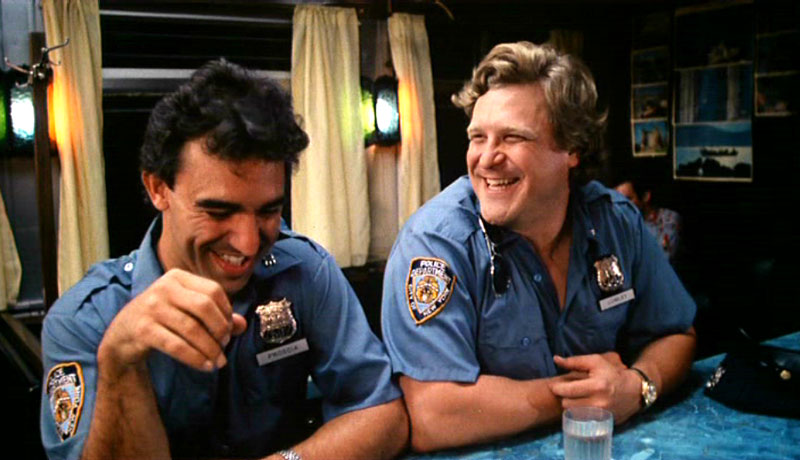
The cast for “C.H.U.D.” included John Heard (“Home Alone,” “Cat People”), Daniel Stern (“Home Alone,” “Leviathan”), Christopher Curry (“Starship Troopers,” “Red Dragon”), Kim Greist (“Brazil,” “Manhunter”), Michael O’Hare (“Babylon 5,” “The Ambulance”), Eddie Jones (“Q,” “A League of Their Own,” “Sneakers”), Sam McMurray (“Baby Geniuses,” “Raising Arizona”), Graham Beckel (“Pearl Harbor,” “True Believer”), Frankie Faison (“The Wire,” “Mother Night”), Bill Raymond (“The Wire,” “Michael Clayton”), and one of the first film appearances of John Goodman (“The Big Lebowski,” “Barton Fink,” “King Ralph,” “Matinee,” “Red State”).
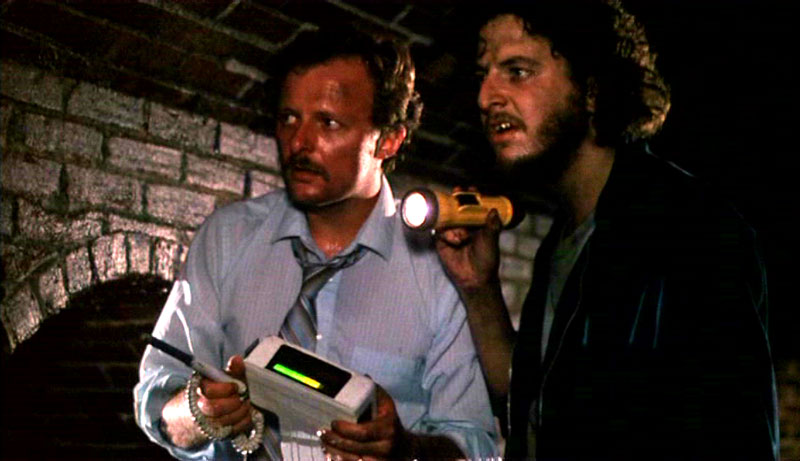
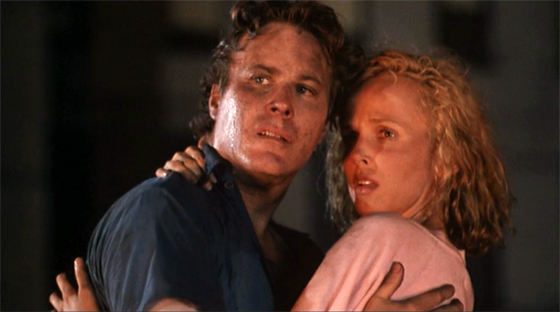
The plot of “C.H.U.D.” follows three intertwined characters who are each investigating a series of mysterious disappearances among the homeless of New York City. Slowly, they each begin to uncover a dark secret beneath the streets of Manhattan: a population of monsters being covered up by the government.
The famed Criterion Collection did an April Fool’s Day joke back in 2011 that “C.H.U.D.” would be added to their distinguished list of films. Of course, the staff of the notable film news website CHUD.com, which was inspired by the movie, were excited about the possibility. Shockingly, the inclusion of “Armageddon” in the Criterion Collection isn’t a joke.
“C.H.U.D.” ultimately spawned one sequel, the notorious horror-comedy “C.H.U.D. II: Bud the Chud”
The term “CHUD” was apparently dreamed up by one of the writers while he was drunk, and wound up being the inspiration for the entire film. However, the acronym has two meanings in the film: “Contamination Hazard Urban Disposal” and, more famously, “Cannibalistic Humanoid Underground Dwellers.”
The reception to “C.H.U.D.” was generally poor, though it has certainly lived on as a cult classic. It currently has a 5.5 score on IMDb, along with Rotten Tomatoes ratings of 17% (critics) and 32% (audience).
The budget for “C.H.U.D.” was roughly 1.25 million, and it wound up grossing about 4.6 million in its domestic theatrical release, making it a financial success for a low budget picture.
The DVD commentary for “CHUD” is one of the most simultaneously contentious and and easy-going tracks I have ever listened to. John Heard, Christopher Curry, Daniel Stern, and Douglas Cheek laugh uproariously throughout, while also complaining about not getting paid for their work, how awful the re-writes and effects were, and how much they dislike the ultimate theatrical cut of the movie, and how drunk they were during any given scene. For fans of the film, it is totally worth checking out.
“C.H.U.D.” unsurprisingly features a load of hammy performances, particularly from Daniel Stern and John Heard. That said, none of them are so over-the-top as to be particularly memorable, especially for b-movie performances.
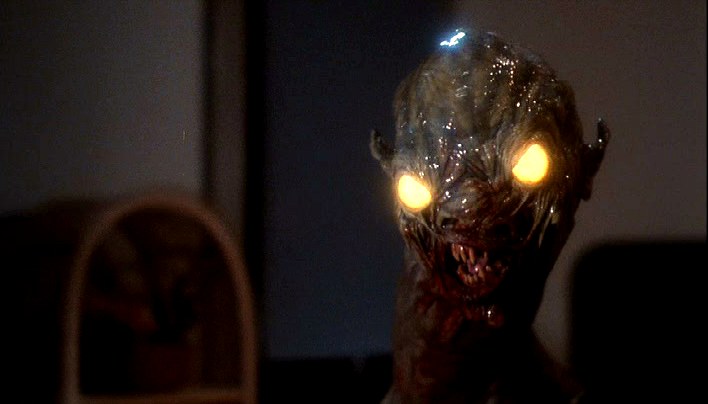
Personally, I really like the design of the CHUDs. The glowing eyes in particular are really key, making them stand out among other movie monsters. Considering how low the budget was, they had to do something to make them stand out, and the eyes worked for that. Apparently, the CHUD suits accounted for a tenth of the budget of the flick in total. Without those distinctive eyes, it wouldn’t have counted for much.
The explanation/origin behind the CHUDs is interesting, and plays into the popular disdain for authority and anxieties over the government’s role in pollution. There is also a clear message about the invisibility of the homeless to people in power, which is pretty deep for a film about sewer monsters.
One of the biggest criticisms I have seen of “CHUD” is how slow the pacing is, which is something I find totally valid. The film is very atmospheric, and there isn’t a whole lot of payoff until the very end. I think it could have been edited in such a way as to make it a bit tighter, but as it stands, it is pretty dull.
Outside of the eponymous CHUDs, the most memorable aspect of the film is the near-iconic grimy portrayal of 1980s New York City, which rivals other b-movies like “Maniac Cop” and “Q.” It openly conflicts with the idealized portrayals of the city in major pictures, and provides a look at the underbelly of the city during an era when it was at its worst.
I consider another film I have covered, Clive Barker’s “The Midnight Meat Train,” to be a sort of spiritual successor to “CHUD.” I think it manages to take a lot of the same plot points and characters, update them, and then nail the desired dark tone a bit better. If people out there are big fans of “CHUD,” then I consider “The Midnight Meat Train” a must-watch.
“CHUD” may be one of the great b-movie classics of the 1980s, but it is still a pretty slow flick for casual audiences to sit through. Despite some nice highlights, I consider this to be a bit of a deep cut for bad movie fans, in spite of how much cultural recognition it has. I would personally pick up “Maniac Cop” or “Maniac Cop 2” over “CHUD” any day, but I still love the charm of the ambiance and the monsters here.
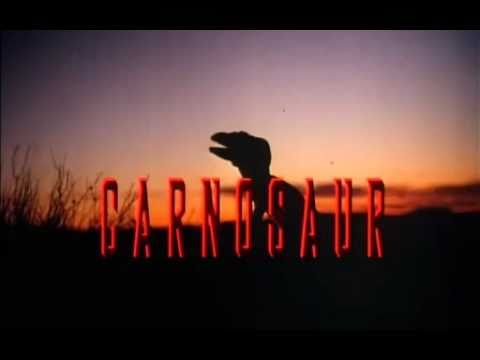
Next up is a little flick called “Carnosaur,” which was Roger Corman’s per-emptive answer to the blockbuster sensation of “Jurassic Park.”
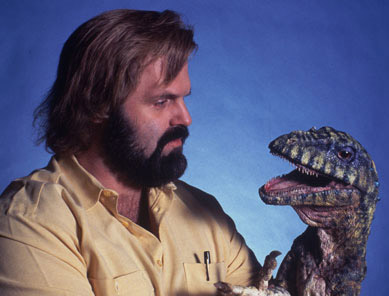
“Carnosaur” was directed and written by Adam Simon (“Brain Dead,” “Salem”), with additional footage done by Darren Moloney, who later directed something called “Andromina: The Pleasure Planet.” The story was based on a novel, also called “Carnosaur,” by the Australian fantasy and science fiction writer John Brosnan. Brosnan was known for using a variety of pen names for his novels, such as Harry Adam Knight, which was used for the publication of “Carnosaur.”
The “Carnosaur” musical score was composed by Nigel Holton, who also did music for flicks like “The Haunted Sea” and “Bloodfist II.” The cinematography for “Carnosaur” was done by a man named Keith Holland, who shot a number of other low budget pictures like “Bloody Murder” and “Neon City.” The two credited editors for “Carnosaur” were Richard Gentner (“Leprechaun 2,” “Against the Law”) and Lorne Morris (“Carnosaur 2,” “Killer Instinct”).
The makeup effects work on “Carnosaur” was done by the two-person team of David Barrett (“Tank Girl,” “Batman & Robin,” “Mighty Morphin Power Rangers: The Movie”) and Fleur Morell (“Terminator: Genisys,” “Dawn of the Planet of the Apes”). Likewise, the visual effects for “Carnosaur” were provided by the duo of Alan Lasky (“Last Action Hero”) and Mark Plunkett (“Robot Jox”).
The special effects on “Carnosaur” were provided by Magical Media Industries Inc., which worked on such films as “The Gingerdead Man,” “Demonic Toys,” and “Bride of Re-Animator.” This specific team was led by John Carl Buechler, a longtime Roger Corman collaborator who worked on such movies as “Troll,” “Trancers,” “Ghoulies,” “From Beyond,”“Dolls,” “The Garbage Pail Kids Movie,” and “Arena.” The rest of the team included Tuck John Porter (“Space Truckers,” “Red Planet,”“Baby Geniuses”), Bill Zahn (“Battlefield Earth,” “The Faculty”), Jeffrey S. Farley (“The Evil Bong,” “Alligator II”), Thomas R. Dickens (“Theodore Rex,” “Anaconda,” “Hollow Man”), Joe Colwell (“Waterworld,” “Super Mario Bros.”), Ted Haines (“The Master of Disguise,” “The League of Extraordinary Gentlemen”), and James Rohland (“Dollman”).
The executive producer for “Canosaur” was none other than Roger Corman, arguably the king of all b-movie producers, who had previously been behind “Humanoids from the Deep,”“Piranha,” “The Little Shop of Horrors,” “Attack of the Giant Leeches,” and countless other memorable flicks. The other credited producer was Mike Elliott, who has worked on more recent films such as “War” and “The Devil’s Rejects.”
The cast of “Carnosaur” is made up of a number of familiar faces, most notably character actor Clint Howard (“Blubberella,”“House of the Dead,”“Santa With Muscles”), Diane Ladd (“Chinatown,” “Kingdom Hospital”), Ned Bellamy (“Treme,” “The Ice Harvest”), Frank Novak (“Independence Day”), Harrison Page (“JAG”), Raphael Sbarge (“The Guardian”), and Jennifer Runyon (“Charles in Charge”).
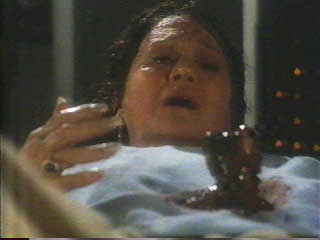
The story of “Carnosaur” centers on a mad genetic scientist, who has managed to reproduce dinosaurs by modifying chickens. If that wasn’t frightening enough, she is also hatching a plan to replace all of humanity with her new breed of dinos, and the only people standing in her way are a hippie and a janitor.
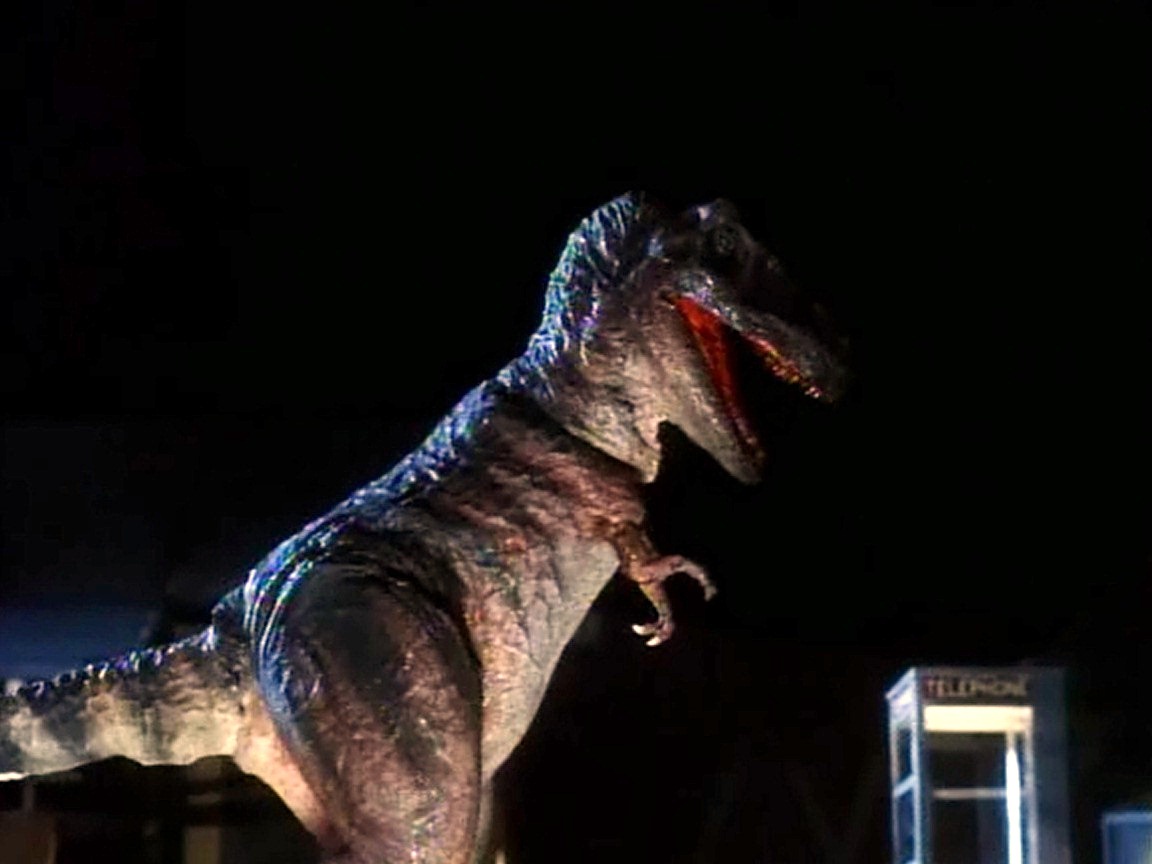
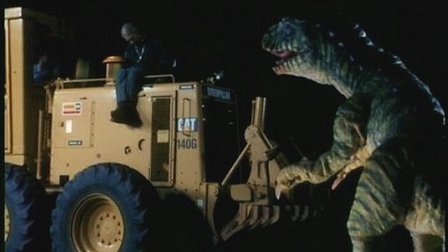
“Carnosaur” features two different dinosaur species: the famous Tyrannosaurus Rex, and the more obscure Deinonychus, which bears significant similarities to the Velociraptors popularized by “Jurassic Park.” The production actually employed an amateur paleontologist to act as a supervisor for the creature creation, which is mildly astounding given the low quality of the picture.
Diane Ladd, who plays the key antagonist in “Carnosaur,” is interestingly the mother of Laura Dern, one of the primary players in the big-budget inspiration for the flick, “Jurassic Park.” This might have been an intentional casting choice due to the relation, but who knows?
Gener Siskel & Roger Ebert were famously split on their opinions of “Carnosaur” on “At The Movies,” with Siskel giving it a “marginal thumbs up” due to the silliness of the plot and Diane Ladd’s performance. Roger Ebert, on the other hand, gave it an unconditional thumbs down. The disagreement was even joked about in the television show, “The Critic.”
“Carnosaur” ultimately spawned two sequels: “Carnosaur 2” in 1995 and “Carnosaur 3: Primal Species” in 1996. Jim Wynorski (“Chopping Mall”) reused clips from “Carnosaur” for a couple of his films: 1994’s “Dinosaur Island” and 2001’s “Raptor.”
In true Roger Corman style, “Carnosaur” was reportedly shot in just 18 days, for a budget of well under $1 million. It grossed roughly $1.7 million in its theatrical run, making it a profitable little picture. That said, it certainly wasn’t well loved by critics or audiences: it currently holds a 3.4 rating on IMDb, along with Rotten Tomatoes scores of 11% (critics) and 24% (audiences). It is certainly fondly remembered by good-bad movie fans for the cheesy effects work, however.
Speaking of which, the dinosaur puppets in “Carnosaur” look really bad. In a number of sequences, it is painfully obvious that the creature is actually a hand puppet, which doesn’t exactly inspire terror. It also borders on being kind of cute at times, and never manages to pull off ‘menace’ very well. Even the large T Rex spends most of it’s time in a laser room that would fit in more suitably in a documentary on EDM, which I assume was done because it obscures the details of the puppet. There is also some lazy, POV, green-tinted ‘dino-vision’ used on and off throughout the movie, which certainly didn’t help anything.
“Carnosaur” definitely has no qualms about being a knockoff at its core, and doesn’t even limit itself to the confines of “Jurassic Park.” As with “Humanoids of the Deep,” there are a couple of unsettling monster births a la “Alien,” and there is even a “Night of the Living Dead” inspired downer ending.
The production clearly didn’t have Diane Ladd for very long (reportedly 5 days), and the way they shot her made it clear. Her character, who is portrayed as a bit of a hermit, almost exclusively interacts with other characters through security cameras. Despite the obvious awkwardness caused by this, and the fact that the film’s evil plot is more than a bit ridiculous, Diane Ladd plays her mad scientist role pretty straight. Her performance is certainly not as phoned in as I expected. However, I personally thought it was Ned Bellamy who really stole the show as an eccentric corporate figure behind the scenes, though Ladd is certainly hammy.
One of the things that surprisingly stood out the most for me is how absolutely awful the musical score for “Carnosaur” is. It sounds like something a middle school student put together on a cheap keyboard, and it borders on being grating throughout the film.
Overall, “Carnosaur” is worth watching for the hilarious puppet effects, but not much else. The plot is outrageous to be sure, but isn’t particularly memorable. The same can be said of the acting, which is really just on par for b-pictures. It is probably one of the more memorable Corman flicks from the 90s, and might be worth giving a shot with a group for the highlights.
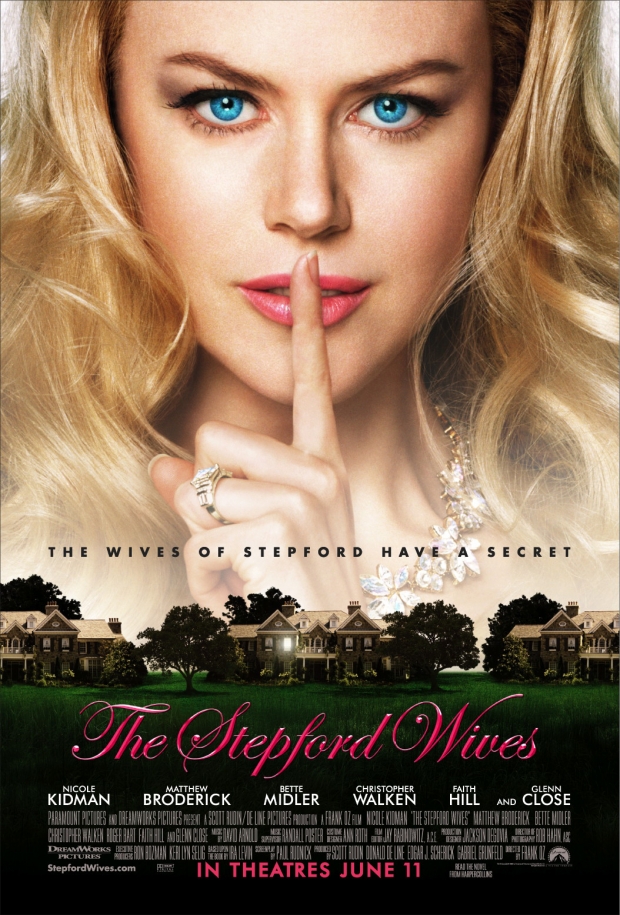
Today’s film is a truly unnecessary and awful remake: Frank Oz’s “The Stepford Wives,” from 2004.
The screenplay for “The Stepford Wives” was written by Paul Rudnick, who also penned “Jeffrey” and “Addams Family Values.” The story is very loosely based on a novel by Ira Levin, who also wrote “Rosemary’s Baby” and “A Kiss Before Dying.” The novel was originally adapted for the screen in 1975 by Bryan Forbes, and that flick is a well-regarded classic science fiction thriller.
The director for “The Stepford Wives” was Frank Oz, who has directed such films as “The Dark Crystal” and “Little Shop of Horrors.” However, he is best known as a celebrated voice actor, and is behind such iconic characters as Yoda, Miss Piggy, Fozzie Bear, and The Cookie Monster.
The cinematographer on “The Stepford Wives” was Rob Hahn, who previously shot for Frank Oz on “In & Out” and “The Score.” Most of his career has been spent as a camera operator on films like “Midnight Run,” “Batman Returns,” and “The Golden Child.”
The score for “The Stepford Wives” was done by David Arnold, who also did the music for such films as “Hot Fuzz,” “Casino Royale,” and “Stargate.”
The editor for “The Stepford Wives” was Jay Rabinowitz, an accomplished worker who has cut movies such as “Rosewater,” “The Fountain,” “Requiem For A Dream,” “Dead Man,” and “Mother Night.”
The producers for “The Stepford Wives” included Ronald M. Bozman (“Philadelphia,” “The Silence of The Lambs,” “The Ref”), Donald De Line (“Yogi Bear,” “Burlesque”), Leslie J. Converse, who was previously Frank Oz’s assistant, Scott Rudin (“Ex Machina,” “The Social Network”), and Edgar Sherick, one of the producers from the original movie who sadly died before the remake was released.
The cast for “The Stepford Wives” is headlined by Nicole Kidman (“Eyes Wide Shut,” “Australia”), Bette Midler (“Hocus Pocus”), Matthew Broderick (“Godzilla,” “Addicted to Love”), Christopher Walken (“The Dead Zone,” “True Romance”), Glenn Close (“Fatal Attraction,” “Damages”), Roger Bart (“The Midnight Meat Train,” “The Producers”), and Jon Lovitz (“Saturday Night Live,” “Happiness”).
The story of “The Stepford Wives” centers around a high powered television executive who is suddenly fired from her company. Her family decides to move with her to the small, suburban, Connecticut town of Stepford, where she can recover from the stress of losing her job. However, there is a dark secret to the town of Stepford and the surreal families that inhabit it.
Oddly, this remake of “The Stepford Wives” isn’t really even in the same genre of the original film/novel, which emphasize the elements of science-fiction, thriller, and mystery. This film, in contrast, is a black comedy with loose elements of science-fiction interspersed, with little to no thrilling aspects.
The Stepford Wives was too big and it was unsatisfying to do. Not that it was unsatisfying to do, but it was unsatisfying as a result, because as much as I loved parts of it, and I’m really proud of so much of it, the entire movie wasn’t what I wanted it to be. It’s my own fault, I didn’t follow my instincts
….
on Stepford Wives, for the first time and through nobody’s fault but my own, all the actors were great, but I was too beholden to the budget —I felt too responsible if the budget was getting higher. And I don’t like to work with that high a budget, and I tried to play it safe in decision-making, as opposed to following my gut, subversive instincts. And it was a mistake, my mistake totally.
…
[The direction/tone] wasn’t clear. That’s ’cause the director didn’t have a clear thought. Totally my fault.
The reception to “The Stepford Wives” was certainly not positive. The film currently has a rating of 5.2 on IMDb, with Rotten Tomatoes scores of 26% (critics) and 29% (audience).
Nancy Griffin of The New York Times wrote an article about the issues surrounding the production of “The Stepford Wives” just days before the theatrical release. Apparently there were numerous test screenings, last minute edits, re-shoots, and immense tensions between various cast and crew members, which made for a hostile set and generally disjointed production.
“The Stepford Wives” was made on a budget of $90 million, and ultimately grossed a total of roughly $102 million in it’s theatrical run. That made the movie profitable, but due to not meeting expectations and being hated by critics, it is publicly remembered as a failure.
One of the biggest problems with “The Stepford Wives” is that all of the characters are utterly despicable, to the point that they aren’t even believable. There is also no real comeuppance for the majority of them. For instance, the villainous husbands are ultimately punished by being forced to do the household shopping at the grocery store. Personally, I try to believe that most functioning, healthy adults can handle going to a grocery store. Speaking of which, why are all of these husbands portrayed as oafs? When it comes down to it, they are evil. They essentially sacrifice the lives of their spouses so they can be lazy, but I’ll delve more into their sinister behavior later. Even Nicole Kidman’s lead character is introduced as being a hateful, exploitative piece of human garbage, and she never really does anything to redeem herself. In fact, one line of dialogue (from her husband) describes her in the following way:
“Your whole attitude makes people try to kill you.”
After she learns to cook and dress in colors, the audience is just supposed to forgive her for being such an ass previously, which makes for quite the borked moral compass on the whole.
Speaking of which, the characters make for the biggest difference between this 2004 remake and the original film. Matthew Broderick’s character is much deeper, sinister, and subtle figure in the original movie, which is replaced by an awkward but well-meaning buffoon in the remake. Likewise, the protagonist in the original film is a relateable, artistic feminist in a community clinging to outdated, conservative values. In the remake, Kidman is a strawman version of a business world feminist, and lacks any of the soul or depth that made the original character interesting. The cinematography, lighting, and tension are also big departures from the original film, and the only real improvements in the remake are (arguably) the musical score and production design. For instance, the famous grocery store scene looks much better in the remake, but doesn’t have nearly the same gravity as it does in the original, and further doesn’t fit in with the comedic style of the remake at all.
To the credit of “The Stepford Wives,” it does have brief flashes of humor. Jon Lovitz always has a way of lighting up in minor roles, and Bette Midler’s seething deliveries in the film are unparalleled. That said, Broderick and Kidman both wind up being pretty wooden, which is a big problem given the importance of their roles. Glenn Close does a good job of making her role hammy and larger-than-life, but the rest of the wives are perhaps a little too good at being robots. Christopher Walken is also unfortunately a bit disappointing, especially given what we all know he is capable of doing.
“The Stepford Wives” is a waste of a pretty good cast and an excellent story, which is twisted into something that is simultaneously a vapid sex comedy and a cynical quasi-dissection of relationships. The film is misanthropic and bitter with a thin veneer of comedy, and it never really seems to lighten up. The whole tone is biting enough that the movie seems to despise it’s own existence, particularly as it lazily tries to stab at societal gender roles while simultaneously reinforcing them. It is a confused, self-loathing piece of work.
One of the biggest questions I have about “The Stepford Wives” remake is this: how exactly do the wives work? Are they replaced with robots, as they were in the original movie and novel? That doesn’t appear to be the case, because they are fixed/cured in the end. Are they victims of some kind of mind control? That is how the plot haphazardly tries to explain it, but that doesn’t cover the electrical shocks and glitches seen earlier in the film. Are they cyborgs, equipped with artificial enhancements? They don’t appear to affected at all after they are freed, even the ones that previously functioned as ATMs. However, that is the only explanation that really makes sense, and it directly contradicts what is said in the exposition. The story tries to claim that the wives are solely the result of implanted microchips, but that fails to explain the remote controls, the aforementioned sparks, the mechanical motion bugs, or the inexplicable inflatable boobs. I’m curious if there were major changes to the screenplay that might explain some of these vestigial details, or if this treatment just never made any sense from the start.
The biggest change for this remake was the axing of the original, downer ending. I’m guessing going full “Pod People” made the husbands too nefarious for the comedic-focused remake. But, as far as I am concerned, they were already re-written as unapologetic rapists for the re-imagining of the story. When it comes down to it, you can’t give consent when you have a mind control chip in your head, and being married isn’t an on-demand sex entitlement agreement. So, how exactly are these mind-controlling rapists more likable and appropriate for a comedy than the murderous, conspiratorial husbands from the original? Personally, I don’t think they are, and the fact that they are portrayed as just being oafs as opposed to villains makes the internal morality of the film even more twisted.
Another one of my problems with the writing of “The Stepford Wives” is the way that the comedy is structured. It is all set up and delivered in such a way that you can almost hear a laugh track after every lazily placed joke. It makes all of the conversations feel more inorganic than the actual robots in the story, and doesn’t do anything to make the characters feel like anything other than sloppy cut-outs.
As far as the effects in “The Stepford Wives” go, the worst thing I saw was the robot dog, which apart from being excessively goofy, looks absolutely awful. Would it have been so difficult to make a physical robot dog, like K-9 from “Doctor Who”? Because, as you should expect, the computer generated mutt has aged incredibly poorly. Or, better yet, maybe a robot dog wasn’t a necessary addition for the film?
I’m been wracking by brain trying to figure out why Frank Oz decided to do “The Stepford Wives.” My best guess is that he believed that it had the potential to catch the same lightning of “Little Shop of Horrors,” which was also a remake of a classic film in a new genre. It is still remembered as his career highlight as a director, and I suspect that it sat in the back of his mind throughout the production. However, “The Stepford Wives” doesn’t play to his specialties in the way that “Little Shop of Horrors” did: namely, the puppet effects. Also, “Little Shop of Horrors” was already tightly written for the stage, which “The Stepford Wives” certainly was not. If “Stepford” had been rewritten before going into production, some of the major problems might have been ironed out. Unfortunately, as it is, the movie is a castle built on sand.
“The Stepford Wives” is twisted in all the wrong ways. It fails to be an insightful satire, an interesting sci-fi, or a funny comedy. It is a complete failure in all of its intentions, and the amount of star-power behind it just made it fall all the harder. The fact that it is branded as a remake is an insult to the source material, and I’m honestly a little confused what it was not just called something else and played as a parody.
Despite a few funny lines, “The Stepford Wives” isn’t really worth the time to sit through. It isn’t enjoyable, though it isn’t brutally unwatchable either. However, there is so much wrong with the writing, characters, logic, and internal morality that the film approaches being a spectacle of wrongness, and an exemplar of just how awful a Hollywood product can be. All of that said, the original “The Stepford Wives” is a fine movie, and I’ll give the remake credit for bringing a new audience to it.
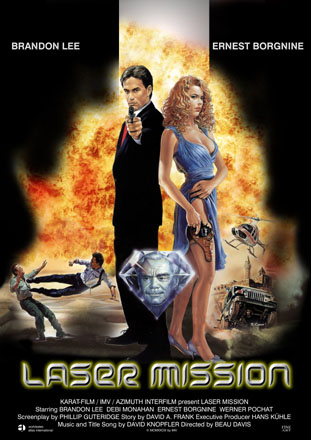
Today’s flick is Brandon Lee’s “Laser Mission,” an odd little low-budget action movie with more ambition than sense.
The director for “Laser Mission” was BJ Davis, who is an accomplished stunt worker with experience on movies like “Fatal Games,” “The Hand,” “Darkman,” and “Army of Darkness.” He also directed a handful of other smaller pictures, such as “White Ghost” and “Forget About It.” The two writers of “Laser Mission” were Phillip Gutteridge and David Frank, neither of whom have any other screen credits.
The producer and cinematographer for “Laser Mission” were the father and son duo of Hans Kuhle, Sr. and Hans Kuhle, Jr. The latter of the two had previously worked on films like “City Wolf” and the BJ Davis movie “White Ghost.”
The music for “Laser Mission” was interestingly provided by David Knopfler, who is best known for being part of the band “Dire Straits.”
The effects team for “Laser Mission” included Debbie Christiane (“River of Death,” “Gor”), Debbie Nicoll (“Gor II,” “Lethal Ninja”), and Jannie Wienland (“The Order,” “Cyborg Cop,” “Sweepers”).
The three credited editors for “Laser Mission” were Bob Yrtuc, E. Selavie, and Robert L. Simpson, who received an Academy Award nomination for 1940’s “The Grapes of Wrath.” “Laser Mission” was his last credited picture, and was released an astonishing (and suspicious) 12 years posthumously.
The cast for “Laser Mission” includes a number of vaguely familiar faces, specifically Brandon Lee (“The Crow”), Ernest Borgnine (“Small Soldiers,” “The Dirty Dozen,” “McHale’s Navy”), Graham Clarke (“Space Mutiny,” “The Evil Below”), and Debi A. Monahan (“Night Court,” “Shattered”).
The story of “Laser Mission” centers on a freelance operative is sent into an African nation by the CIA to rescue a kidnapped expert laser scientist. He is running against the clock, as communists are hoping to force the kidnapped expert to build a devastating laser weapon.
Reportedly, David Hasselhoff was at one point considered for the lead role that ultimately went to Brandon Lee. I’m honestly not sure if that would have been an upgrade or a downgrade, but Lee is certainly one of the stronger aspects of the film.
Robert L. Simpson’s editor credit absolutely baffles me. As far as I can tell, he was long dead before any shooting ever even happened. It could just be an IMDb error, or a weird tribute by the filmmakers. I’m sure someone out there knows the story, but I wasn’t able to dig it up.
The reception for “Laser Mission” has been generally negative, as it has accrued a Rotten Tomatoes audience score of 25% and an IMDb rating of 3.4. I couldn’t dig up any financial details, but there is no way that this was a particularly expensive production. I assume the went straight to video, but who knows? It might have had a limited theatrical run somewhere. In any case, it has a bit of a following now as a good-bad classic, and is considered by some to be the platonic ideal of a low-budget schlock action movie.
As far as issues with “Laser Mission” go, it is hard to rank them in terms of severity. The first thing I noticed is that the film quality is just awful, which isn’t surprising for this sort of small production. Still, it just looks awful, in a way that you just know how terrible the movie is going to be out of the gate.
Brandon Lee’s acting is probably one of the few mildly positive aspects of the film, but the rest of the acting is atrocious. There is no romantic chemistry at all between Lee and his partner, Borgnine’s accent is all over the place, characters rotate nationalities, and the comic relief bits are just unbearable. The writing is obviously at least partially at fault here, as the unnecessary and clunky attempts at humor certainly don’t help anything. The title of the movie is even awkwardly wedged into a bit of dialogue, which is just spectacular.
The unnecessary comic relief cop duo, who don’t really serve a purpose for the overall story, make for some of the most unbearable moments in the film. All of their bits boil down to “Women can’t do _____!” / “Yes I can!”, with the occasional interspersed physical comedy routines. It feels like they wandered in from an entirely different movie, and all of the plot progress has to grind to a halt to make room for them.
During the first few sequences of the film, Brandon Lee’s character literally wears Clark Kent glasses as a disguise, which was worth a legitimate laugh. However, it was one of the few that the film pulled from me.
The cinematography on “Laser Mission” is nothing short of awful, to the point that it is hard to tell what is happening in any given shot. Shots are constantly too far away from the action, off-center, and linger far too long, which is just weird to look at.
As far as positive things go, there are certainly some good stunts throughout “Laser Mission,” which isn’t a surprise given the director’s professional background.
“Laser Mission” has a few good moments here and there, including a ridiculous conclusion and a laughable diamond heist, but overall it is pretty slow and uneventful. The clunky acting and dialogue are front and center if that is your thing, but I generally consider this a deep cut only fit for hard core bad movie fans. I just don’t see it working for a mixed audience of casual movie watchers.
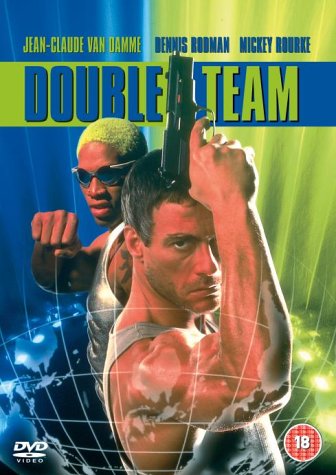
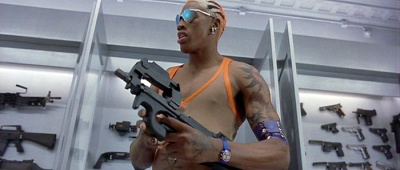
Today’s feature is yet another off-the-wall buddy cop team-up: Dennis Rodman and Jean-Claude Van Damme in “Double Team.”
One of the writers for “Double Team” was Don Jakoby (“Evolution,” “Vampires,” “Philadelphia Experiment II”), who also served as a producer on the film. The other credited screenplay contributor was Paul Mones, an actor who appears in the James Spader movie “Tuff Turf,” and who also wrote some smaller flicks like “Fathers & Sons,” starring Jeff Goldblum.
The director for “Double Team” was Hark Tsui, an acclaimed Chinese action movie director who was making his American debut. He has also been behind films like “Knock Off,” “Seven Swords,” and the “Once Upon A Time In China” series.
The cinematographer for “Double Team” was Peter Pau, who also shot “Shoot ‘Em Up,” “Dracula 2000,” and “Bride of Chucky.”
The editor on “Double Team” was Bill Pankow, who has cut an assortment of acclaimed films, including “Snake Eyes” and “The Untouchables.”
The distinct musical score for “Double Team” was done by Gary Chang, who also scored “A Shock To The System,” “The Substitute,” and the infamous 1996 version of “The Island of Dr. Moreau” starring Val Kilmer and Marlon Brando.
One of the producers for “Double Team” was Richard G. Murphy, who was previously Van Damme’s assistant on “Universal Soldier,” and has produced other Van Damme movies like “Timecop,” “Knock Off,” and “Replicant.” The other producers included Moshe Diamant (“It’s Alive,”“Timecop,” “Dark Angel,” “Simon Sez,” “Pray For Death”), Hark Tsui’s wife, Nansun Shi, David Rodgers (“Total Recall,” “Vampires”), and Rick Nathanson (“Poison Ivy,” “China O’Brien,” “Red Cliff”).
The makeup effects on “Double Team” were done by the duo of Katalin Elek (“The Monster Squad,” “SpaceCamp”) and Zoltan Elek (“Street Fighter,” “Timecop,”“Leviathan”). The special effects team for the film included Daniel Acon (“Cliffhanger,” “The Life Aquatic With Steve Zissou”), Phillipe Hubin (“Lucy,” “Taken 2,” “The Happening”), and Bruno Van Zeebroeck (“Jaws 3-D,”“Class of 1999,” “The Thing”).
The “Double Team” visual effects team featured such people as Peter Siciliano (“Carnosaur,” “Class of 1999 II”), Mark Intravartolo (“Guardians of the Galaxy,” “Tropic Thunder,” “Sucker Punch”), Ziad Seirafi (“Tales From The Crypt,” “Green Lantern”), Brent Gilmartin (“Monkeybone,” “Bruce Almighty”), Leif Einarsson (“Torque,” “Hollow Man”), Brian Conlon (“Wild Wild West,” “300”), Joe Bauer (“Game of Thrones,” “Blade Trinity”), and Rick Cortes (“League of Extraordinary Gentlemen,” “Dexter,” “Here Comes Dr. Tran”).
The cast for “Double Team” is of course highlighted by Jean Claude Van Damme (“Timecop,” “Cyborg,” “JCVD”) and Dennis Rodman (“Simon Sez”), with Mickey Rourke (“Angel Heart,” “The Wrestler,” “Iron Man 2”) filling in as their antagonist.
The story of “Double Team” focuses primarily on Van Damme, who is a special agent on the verge of retirement with a young child on the way. On a mission involving Rodman, he manages to make a dramatic mistake which lands him into an unofficial prison camp for ex-operatives. The story quickly turns into a tale of escape and revenge, culminating in a number of significant explosions.
also disguises
Mickey Rourke, in preparation for his villainous role opposite Van Dame, apparently took significant martial arts training to get into shape. The result is a surprisingly ripped Rourke, who would years later mimic the physique for his acclaimed role in “The Wrestler.”
“Double Team” apparently had sequel plans, though they never materialized for one reason or another. My guess is that Rodmen’s acting aspirations didn’t quite pan out, making a sequel difficult.
“Double Team” was apparently the first film to use a Coca Cola vending machine as direct product placement, which unbelievably plays a significant role in the film’s plot.
The reception to “Double Team” wasn’t exactly fantastic, and it has earned a 4.6 rating on IMDb, along with Rotten Tomatoes scores of 11% (critics) and 24% (audience).
The budget for “Double Team” was reportedly around $30 million, of which only about $11.5 million was made back in the film’s U.S. theatrical release.
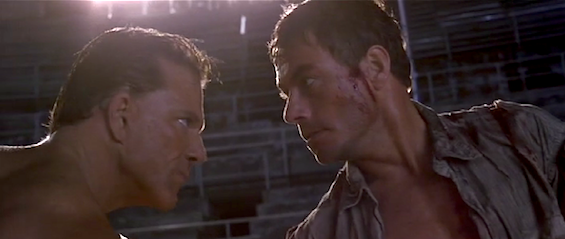
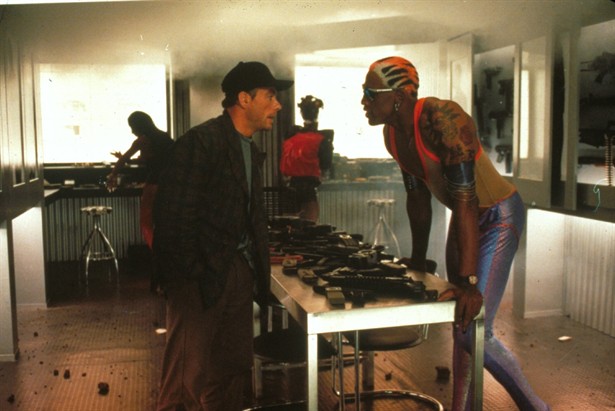
One of the most memorable and bizarre aspects of “Double Team” is the use of odd sets and locations. For instance, Dennis Rodman’s introduction takes place in a neon SCUBA nightclub, the finale takes place in a coliseum, and a major firefight is set in the middle of a carnival, complete with clowns getting downed as casualties in the crossfire.
Speaking of which, boy does this movie destroy that carnival. Clearly the production had a lot of fun with the location, and got everything they could out of it. Also, outside of the clown murder, a child and countless bystanders also die in the same scene.
The product placement in “Double Team” is a little over the top, particularly for Coca Cola. Not only does a coke machine wind up playing a key role in saving the central characters from an explosion, but a coke can also features prominently in Van Damme’s escape from his pseudo-prison. It is one thing for products to appear in a film, but it is another for the name brand to actually serve a direct function in the plot.
As you might expect, “Double Team” features lots of explosions and fireballs. Unfortunately, most of them look just fucking terrible, which is kind of astounding. The finale sequence has some of the worst executed explosions I have ever seen, and they look terrible enough that they essentially ruin the sequence.
When it comes to the plot of “Double Team,” I actually thought that the bizarre hitman/special agent retirement home was a far more interesting and original concept than the central revenge storyline. Personally, I would rather see a movie about that, making a sort of hybrid of “John Wick” and “Fortress.”
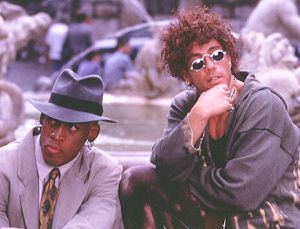
Unsurprisingly, Dennis Rodman’s outfits are way out there, and add a lot of color to the film. Rodman as an actor isn’t really suited for comic relief though, and he is frankly better as the straight man in “Simon Sez” than he is here. Of course, the writing didn’t help anything, particularly with the near-constant basketball references forced into the dialogue.
Interestingly, “Double Team” features an order of cyber monks, much like the other Rodman film “Simon Sez.” However, they don’t appear to be connected in any way, making for an unexpected coincidence.
Mickey Rourke is actually pretty fantastic in “Double Team,” and is easily too good for the movie. He looks intimidating and sinister, and delivers a performance worthy of a much better script. His death is also one of the most memorable ones from any action film, as he kills himself with a land mine while being mauled by a giant tiger.
The sheer volume of collateral damage and casualties in “Double Team” is unusually high, even for an action flick. It seems like every major sequence has to have at least one innocent gunned down, which makes it stand out from most other oddball, buddy action movies.
The best fight sequence of the movie is undoubtedly the foot knife fight, which features some solid choreography and camera work. Unfortunately, it is also one of the shorter sequences in the film, which was a little disappointing, especially given how long the others seem to drag on for.
The finale of “Double Team” rose an interesting question for me: did Rourke buy the same tiger from the carnival where his wife and son died? Was the specific tiger part of his revenge plan? I don’t see how it would make sense to have an entirely different tiger introduced in act three, but trying to think through Rourke’s logic is boggling. Maybe his grief made him commit a lot of bizarre impulse purchases from the carnival?
Overall, “Double Team” has some solid highlights, but is a little too slow and sloppily edited to be a lot of fun. The beginning and end are good enough, but the middle drags a bit more than it needed to. It isn’t a painful watch though, and the finale is enough in my book to warrant a recommendation.
Reviews/Trivia of B-Movies, Bad Movies, and Cult Movies.
![Misan[trope]y](https://misantropey.com/wp-content/uploads/2014/10/misantropeyhead1.png)
 To do my part, I’m going to be resurrecting my (God)Awful Movies segment with a bang: by covering the entire infamous video series of “BibleMan” over the course of the week. Also, I’m pledging to honor any coverage requests for people who donate to the Secular Student Alliance (through my fundraising page) over the course of the week. If you want me to cover your favorite movie, a movie you made, a training video you found on YouTube, a cat video, a movie you think I will hate/love, a horror film about killer rabbits, whatever: I’ll honor whatever you point me to. That doesn’t mean I’ll like it, but I will certainly watch and write about it. Caveat emptor, as they say.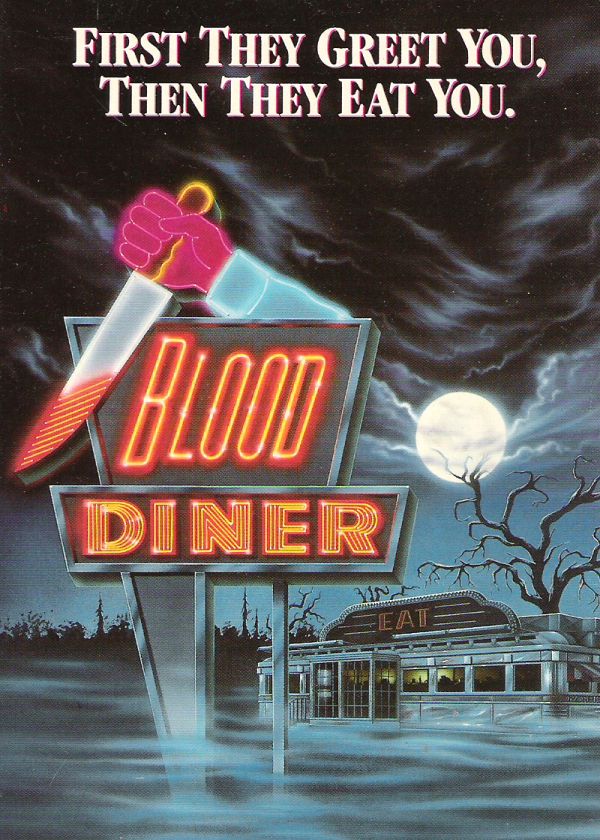
















 Misan[trope]y